

for ALLWATER

THE
ONLY
THING
THAT
MATTERS
TO
US
&
OUR
CLIENTS
IS
ROI
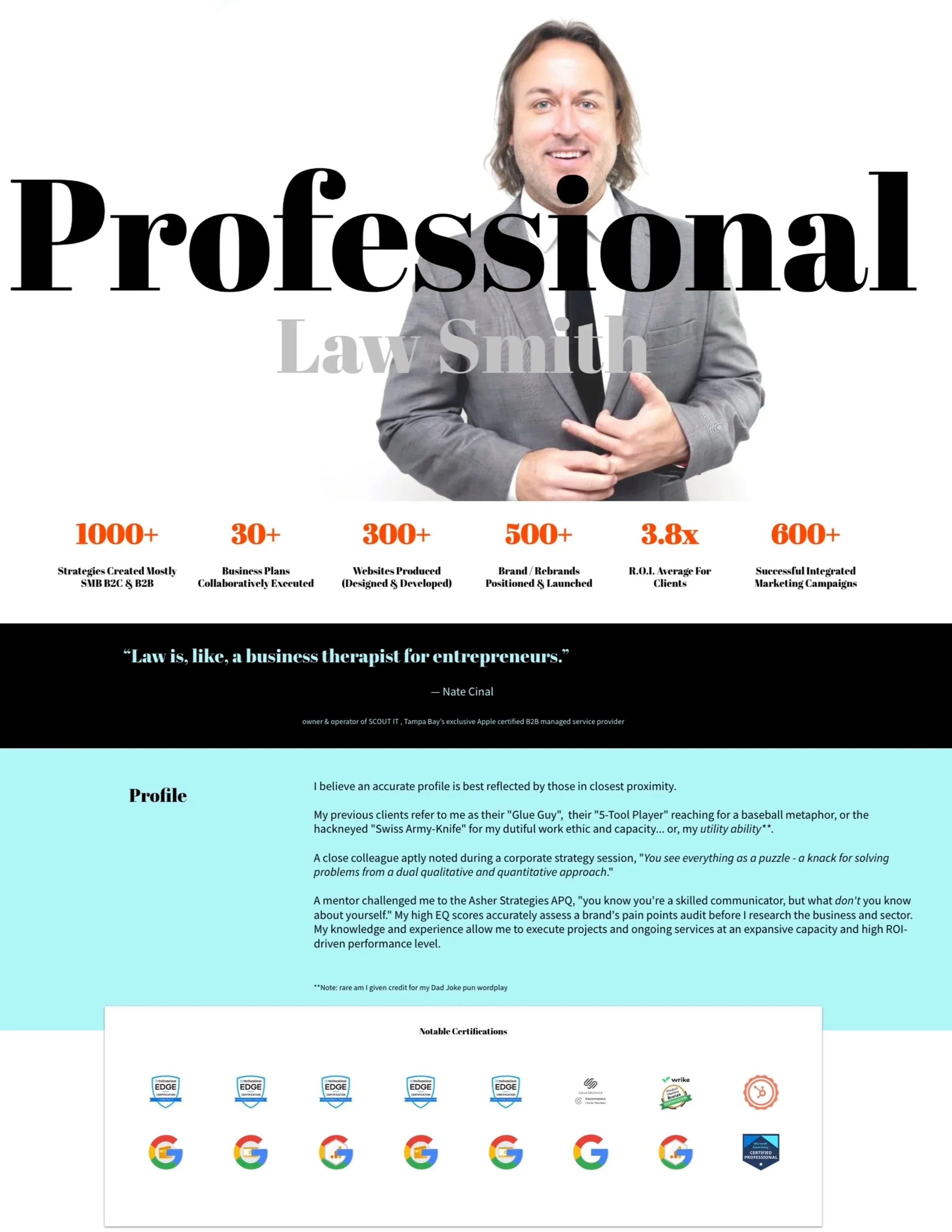
1,000+
Small-to-Medium Businesses Strategically Advised
600+
Successful Integrated
Marketing Campaigns
7.8X
ROI
Average Client
Return On Investment
300+
Websites Produced
(Developed & Designed)
1,000,000+
High Performing
Emails Deployed
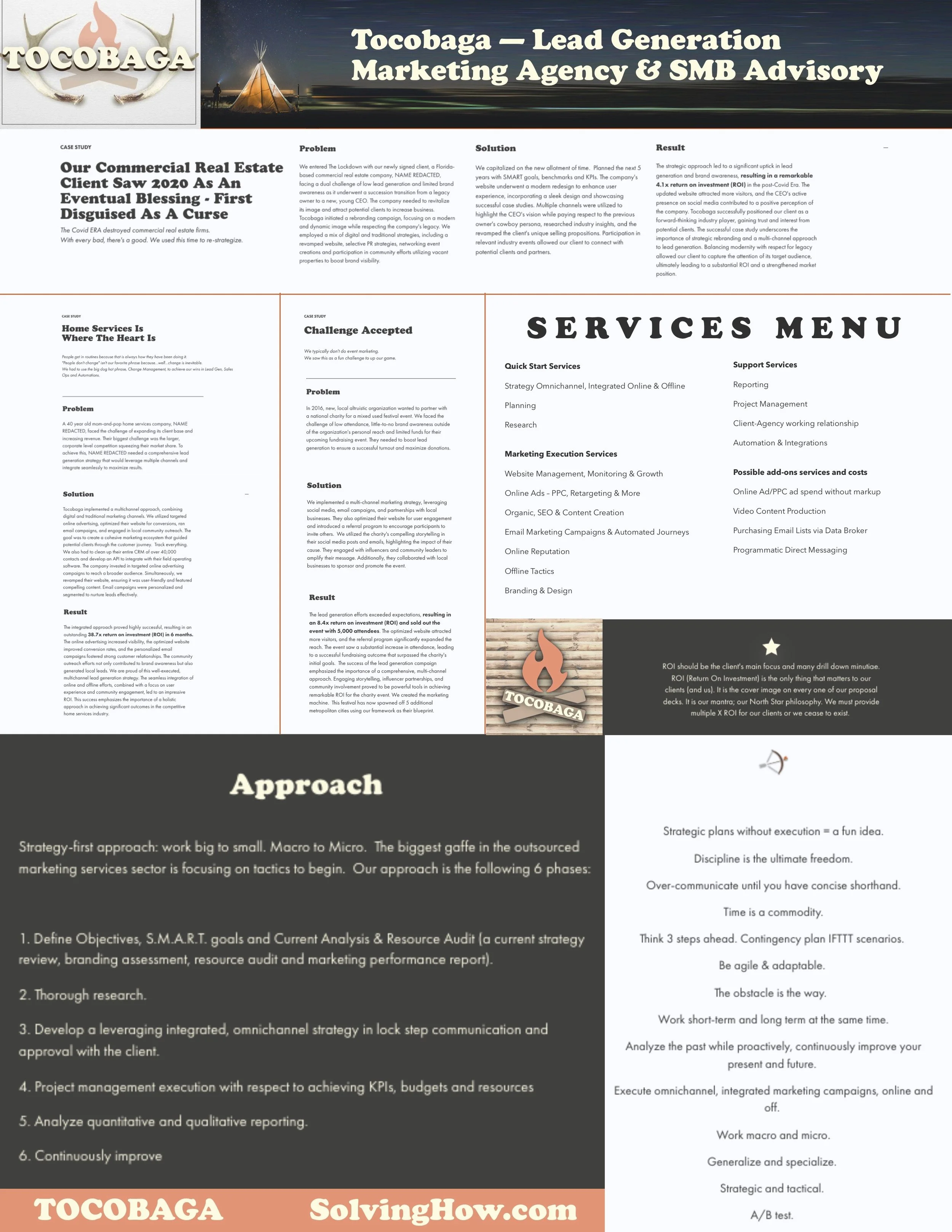
CASE STUDY
Our Commercial Real Estate Client Saw 2020 As An Eventual Blessing - First Disguised As A Curse
The Covid ERA destroyed commercial real estate firms.
With every bad, there's a good. We used this time to re-strategize.
-
We entered The Lockdown with our newly signed client, a Florida-based commercial real estate company, NAME REDACTED, facing a dual challenge of low lead generation and limited brand awareness as it underwent a succession transition from a legacy owner to a new, young CEO. The company needed to revitalize its image and attract potential clients to increase business. Tocobaga initiated a rebranding campaign, focusing on a modern and dynamic image while respecting the company's legacy. We employed a mix of digital and traditional strategies, including a revamped website, selective PR strategies, networking event creations and participation in community efforts utilizing vacant properties to boost brand visibility.
-
We capitalized on the new allotment of time. Planned the next 5 years with SMART goals, benchmarks and KPIs. The company's website underwent a modern redesign to enhance user experience, incorporating a sleek design and showcasing successful case studies. Multiple channels were utilized to highlight the CEO's vision while paying respect to the previous owner's cowboy persona, researched industry insights, and the revamped the client's unique selling propositions. Participation in relevant industry events allowed our client to connect with potential clients and partners.
-
The strategic approach led to a significant uptick in lead generation and brand awareness, resulting in a remarkable 4.1x return on investment (ROI) in the post-Covid Era. The updated website attracted more visitors, and the CEO's active presence on social media contributed to a positive perception of the company. Tocobaga successfully positioned our client as a forward-thinking industry player, gaining trust and interest from potential clients. The successful case study underscores the importance of strategic rebranding and a multi-channel approach to lead generation. Balancing modernity with respect for legacy allowed our client to capture the attention of its target audience, ultimately leading to a substantial ROI and a strengthened market position.
CASE STUDY
Home Services Is Where The Heart Is
People get in routines because that is always how they have been doing it.
"People don't change" isn't our favorite phrase because...well...change is inevitable.
We had to use the big dog hot phrase, Change Management, to achieve our wins in Lead Gen, Sales Ops and Automations.
-
A 40 year old mom-and-pop home services company, NAME REDACTED, faced the challenge of expanding its client base and increasing revenue. Their biggest challenge was the larger, corporate level competition squeezing their market share. To achieve this, NAME REDACTED needed a comprehensive lead generation strategy that would leverage multiple channels and integrate seamlessly to maximize results.
-
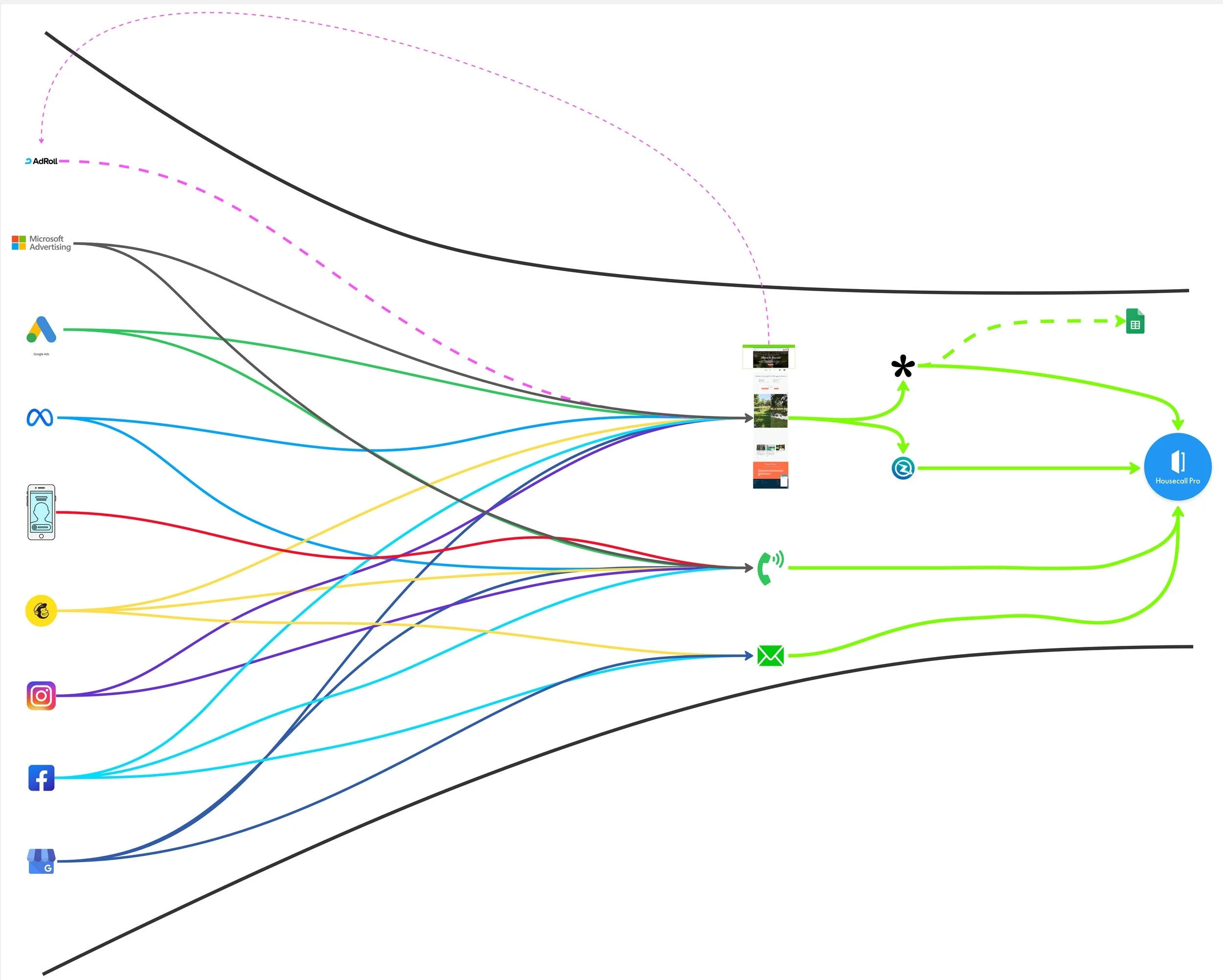
Tocobaga implemented a multichannel approach, combining digital and traditional marketing channels. We utilized targeted online advertising, optimized their website for conversions, ran email campaigns, and engaged in local community outreach. The goal was to create a cohesive marketing ecosystem that guided potential clients through the customer journey. Track everything. We also had to clean up their entire CRM of over 40,000 contacts and develop an API to integrate with their field operating software. The company invested in targeted online advertising campaigns to reach a broader audience. Simultaneously, we revamped their website, ensuring it was user-friendly and featured compelling content. Email campaigns were personalized and segmented to nurture leads effectively.
-
The integrated approach proved highly successful, resulting in an outstanding 38.7x return on investment (ROI) in 6 months. The online advertising increased visibility, the optimized website improved conversion rates, and the personalized email campaigns fostered strong customer relationships. The community outreach efforts not only contributed to brand awareness but also generated local leads. We are proud of this well-executed, multichannel lead generation strategy. The seamless integration of online and offline efforts, combined with a focus on user experience and community engagement, led to an impressive ROI. This success emphasizes the importance of a holistic approach in achieving significant outcomes in the competitive home services industry.
CASE STUDY
Challenge Accepted
We typically don't do event marketing.
We saw this as a fun challenge to up our game.
-
In 2016, new, local altruistic organization wanted to partner with a national charity for a mixed used festival event. We faced the challenge of low attendance, little-to-no brand awareness outside of the organization's personal reach and limited funds for their upcoming fundraising event. They needed to boost lead generation to ensure a successful turnout and maximize donations.
-
We implemented a multi-channel marketing strategy, leveraging social media, email campaigns, and partnerships with local businesses. They also optimized their website for user engagement and introduced a referral program to encourage participants to invite others. We utilized the charity's compelling storytelling in their social media posts and emails, highlighting the impact of their cause. They engaged with influencers and community leaders to amplify their message. Additionally, they collaborated with local businesses to sponsor and promote the event.
-
The lead generation efforts exceeded expectations, resulting in an 8.4x return on investment (ROI) and sold out the event with 5,000 attendees. The optimized website attracted more visitors, and the referral program significantly expanded the reach. The event saw a substantial increase in attendance, leading to a successful fundraising outcome that surpassed the charity's initial goals. The success of the lead generation campaign emphasized the importance of a comprehensive, multi-channel approach. Engaging storytelling, influencer partnerships, and community involvement proved to be powerful tools in achieving remarkable ROI for the charity event. We created the marketing machine. This festival has now spawned off 5 additional metropolitan cities using our framework as their blueprint.
-

Steven Fantetti
Serial Entrepreneur, M&A Attorney
10x Client
Click Here To Email -
Nate Cinal
Owner & Operator of Tampa Bay’s Only Apple B2B Certified Managed Services Provider, SCOUT IT
Preferred Referral Partner
-

Dean Akers
Prepared by: Tocobaga Marketing Agency & Business Advisory
“Leave the campsite better than you found it, and the world will be a better place because of it”
Segment-Level Analysis
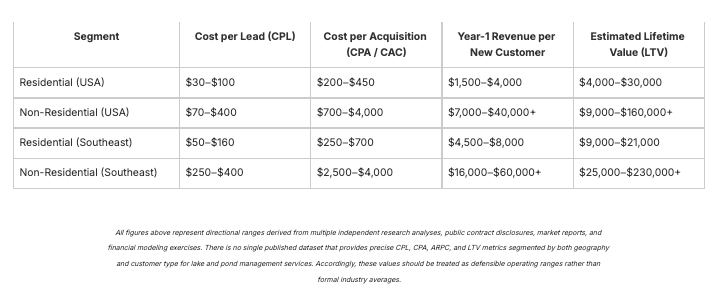
Residential (USA)
Residential accounts consist primarily of private homeowners managing ornamental ponds, small acreage lakes, and aesthetic water features.
Cost per Lead estimates cluster between $30 and $100 per lead, depending on digital channel mix, metro competition, and service positioning. Lower-cost leads are typically referral- or SEO-driven; higher costs are associated with competitive paid search in affluent suburban markets.
Cost per Acquisition generally falls between $200 and $450, assuming lead-to-customer conversion rates between 10% and 25%. Sales cycles are short relative to commercial segments, but price sensitivity is higher.
Year-1 revenue per new customer typically ranges from $1,500 to $4,000. Small ornamental ponds generate lower annual service contracts, while comprehensive monthly service programs and larger private lakes can approach $5,000 annually.
Lifetime Value varies significantly based on retention patterns. With average annual churn near 20% and gross margins between 30% and 50%, modeled LTV ranges from approximately $4,000 to as high as $30,000 in scenarios involving long-tenured clients and consistent upselling.
Non-Residential (USA)
Non-Residential accounts include golf courses, municipal parks, stormwater systems, corporate campuses, business parks, industrial developments, and master-planned communities.
Cost per Lead ranges from $70 to $400, reflecting more targeted B2B outreach, bid-based acquisition processes, and relationship-driven sales environments.
Cost per Acquisition ranges from $700 to $4,000. While acquisition costs are materially higher than residential, the payback period is often measured in months rather than years due to significantly larger contract values.
Year-1 revenue per customer ranges from $7,000 for single retention ponds to $40,000+ for multi-pond communities and municipal systems. Complex civic infrastructure projects can materially exceed these ranges.
Lifetime Value is structurally higher due to non-discretionary service requirements and multi-year renewals. Conservative modeling yields LTV between $9,000 and $160,000+, with upper-tier municipal and institutional relationships exceeding that range over decade-long horizons.
Residential (Southeast)
Southeast residential pond management reflects unique climatic and regulatory conditions. Warm temperatures, high rainfall, and nutrient-rich runoff create year-round maintenance demand.
Cost per Lead ranges from $50 to $160 depending on market density and advertising competition in metro areas such as Orlando, Tampa, and Miami.
Cost per Acquisition ranges from $250 to $700. Southeast conversion rates can be lower than national averages due to competitive provider density, though higher ARPU often offsets acquisition cost variance.
Year-1 revenue per new customer typically ranges from $4,500 to $8,000 for recurring service clients. Subscription-tier pricing structures often materially exceed national residential averages due to higher visit frequency and biological load management.
Lifetime Value ranges from $9,000 to $21,000 in conservative retention models and can exceed this in upscale communities with stable homeowner tenure.
Non-Residential (Southeast)
Southeast represents a uniquely attractive non-residential market due to dense HOA networks, master-planned communities, tourism-driven resort infrastructure, and stringent stormwater regulations.
Cost per Lead for qualified HOA or institutional prospects typically ranges from $250 to $400, reflecting highly targeted marketing and RFP-driven pipelines.
Cost per Acquisition ranges from $2,500 to $4,000. Despite elevated sales complexity, payback periods are short given contract values.
Year-1 revenue per customer commonly ranges from $16,000 to $60,000+, depending on number of ponds, fountain systems, nutrient compliance requirements, and add-on capital projects.
Lifetime Value conservatively ranges from $25,000 to $230,000+ under multi-year retention assumptions. Large-scale municipal systems and master-planned communities can exceed these levels substantially.
Competitive Landscape of Non-Residential Aquatic Management in Florida and Georgia
Page 1 – Competitive Landscape Snapshot
Market structure at a glance
The non-residential pond, lake, and stormwater management market in Florida and Georgia is highly fragmented, with an estimated few dozen active providers in Florida and another dozen or so notable firms when Georgia is included. No audited revenue-based market-share data is publicly available, but office footprints and service descriptions indicate a small group of multi-state platforms (such as SOLitude, Aquagenix/TIGRIS, Dragonfly, Lake Doctors, and Georgia Stormwater Services) sitting above a long tail of local and regional specialists. Globally, the lake and pond management services market is growing at a mid-single-digit compound annual rate, and Florida and Georgia represent disproportionately dense demand nodes due to extensive stormwater infrastructure, rapid development, and climate-related stress on water bodies.
High-level positioning (narrative summary instead of table)
AllWater, including its Georgia Stormwater Services brand, operates as an established regional platform with more than 50 years of experience and multi-office coverage across Florida and Georgia. It provides an integrated portfolio spanning pond and lake management, stormwater compliance and repair, dredging, shoreline and erosion control, aeration and fountains, fisheries, and consulting, and serves as the reference operator for this analysis.
SOLitude Lake Management is a national leader with a large employee base and dozens of offices nationwide, including dense coverage across Florida and Georgia. It offers full-service lake and pond programs, invasive species control, dredging and hydro-raking, shoreline restoration, advanced aeration technologies such as nanobubbles, fisheries services, and GPS/bathymetric mapping. Given its scale and footprint, SOLitude is likely among the largest share holders in the non-residential segment.
TIGRIS Aquatic Services, which includes the Aquagenix brand, operates as a private-equity-backed macro-regional roll-up with strong coverage throughout Florida and the Atlanta metro area. Its core offerings mirror AllWater’s, with emphasis on lake and pond management, invasive vegetation and algae control, stormwater pond maintenance, JetVac and Vactor truck sediment removal, CCTV inspections, aeration, and fisheries. Within the Southeast, TIGRIS/Aquagenix is a primary direct rival wherever its footprint overlaps AllWater.
The Lake Doctors is a long-tenured large regional chain headquartered in Florida, with statewide Florida coverage and operations in Georgia. It focuses on algae and weed control, fountains and aeration, erosion repair, fish stocking, muck removal, and recurring maintenance programs, and holds strong share in HOA and municipal decorative and maintenance contracts.
Dragonfly Pond Works is a mid-market specialist with multi-state operations, including key Florida metros and the Atlanta area. It is highly differentiated in stormwater maintenance and compliance, low-impact hydraulic dredging, erosion and slope repair, inlet and outlet reconstruction, and related pond and lake maintenance and fountain work. Dragonfly competes directly with AllWater and Georgia Stormwater Services on complex stormwater and capital projects.
Georgia Stormwater Services, operating under the AllWater umbrella, is a Georgia-centric stormwater platform serving metro Atlanta and North Georgia. It provides comprehensive pond and lake management, routine dredging and sediment control, stormwater repairs and rehabilitation, shoreline stabilization, fountains and aeration, fish stocking and pest control, and permitting and compliance support. Within Georgia, it is one of the most prominent stormwater-focused brands.
Aquatic Environmental Services (AES) is a science-driven specialist based in Georgia with projects across the broader Southeast. It is a niche leader in advanced fisheries management, water quality diagnostics, oxygen saturation technologies, stream assessments, and consulting. AES is frequently selected over generalist competitors for high-end fisheries and industrial compliance work.
Lake and Pond Remediation, along with other Florida-centric firms such as Crosscreek Environmental, Mettauer Environmental, Premier Lakes, and Florida Lake Management, operate as regional specialists with concentrated footprints in particular Florida corridors. They provide aquatic weed control, stormwater pond programs, shoreline restoration, fountains and aeration, and in some cases specialized dredging and wetland mitigation. These firms tend to hold meaningful local or micro-regional share and compete with AllWater on vegetation-led and restoration-heavy scopes.
High-level implications for AllWater (executive view)
Market concentration at the top, fragmentation below: A small set of Tier 1 players (SOLitude, TIGRIS/Aquagenix, The Lake Doctors) exert outsized influence in major metros and multi-property accounts, while dozens of Tier 2 and Tier 3 firms compete in local and niche segments.
Intense overlap in service menus: Most significant competitors now offer full or near-full portfolios covering vegetation control, dredging, stormwater compliance, shoreline stabilization, aeration and fountains, fisheries, and consulting. Differentiation is driven by technology, regulatory fluency, equipment, and responsiveness rather than basic capability.
Strategic role for AllWater: With a 50-year Southeast heritage, integrated stormwater and aquatic expertise, and a Florida–Georgia footprint, AllWater is structurally positioned as a credible alternative to both national platforms and local specialists. To defend and grow share, it must continue to invest in advanced diagnostics, transparent compliance reporting, and environmentally forward solutions such as living shorelines and low-impact dredging in high-growth corridors like Tampa, Orlando, and Atlanta.
Page 2+ – Research Methodology and Analytical Approach
1. Scope and definitions
The analysis focuses on non-residential pond, lake, and stormwater waterbody services in Florida and Georgia. Target customer segments include homeowner associations, municipalities, commercial and industrial properties, developers, golf courses, and institutional waterbodies. In-scope service lines are:
Pond and lake management (including water chemistry, nutrient management, algae and weed control)
Dredging and sediment remediation
Stormwater compliance and infrastructure rehabilitation
Aquatic weed and algae control
Shoreline stabilization and erosion control
Aeration and fountain systems
Fisheries management and biological assessments
Consulting, mapping, permitting, and environmental compliance
Residential-only landscapers, agricultural irrigation providers, and purely recreational guides or fishing services were excluded unless they also marketed structured aquatic management programs to non-residential clients.
2. Framing questions
The research was structured around four core questions:
Who are the material competitors to AllWater in Florida and Georgia, and how can they be segmented by scale and specialization?
What is the degree of service-line overlap between these competitors and AllWater, particularly in stormwater compliance, dredging, and fisheries or advanced biology?
How is geographic coverage distributed between Florida and Georgia, and where does it most directly overlap with AllWater’s footprint?
In the absence of formal revenue disclosures, what can reasonably be inferred about relative market position and share?
3. Data sources and evidence base
The analysis synthesizes content from multiple internal research documents and the public information they are based on.
First, AllWater-focused competitive research artifacts were used as foundational inputs. These included a Florida and Georgia competitor matrix, a narrative competitive landscape memorandum, and a synthesized report aggregating public-source review and mapping competitors by geography and service mix.
Second, a comprehensive market and competitive landscape report on non-residential aquatic management in Florida and Georgia provided deeper context on macroeconomic trends, regulatory frameworks, private-equity-driven consolidation, and tiered competitor profiles, including case studies and service-line deep dives.
Third, the underlying reports draw extensively on primary external sources such as company websites, licensing and certification pages, industry directories, university extension guides, and government water management resources. These sources were used to validate service offerings, locations, years in business, certifications, and target client segments.
No proprietary financial data, non-public client revenue, or contract information was available or used. As a result, all discussion of “market share” is qualitative and indicative rather than quantitative.
4. Competitor identification and screening logic
Competitor identification followed a multi-step, rules-based process.
Initial candidate lists were constructed from existing internal research that enumerated:
Florida-only competitors such as Florida Aquatic Management, Aquatic Weed Control, Crosscreek Environmental, Mettauer Environmental, and Sunwest Waterway.
Multi-state Florida–Georgia competitors including AllWater and Georgia Stormwater Services, Dragonfly Pond Works, Lake Doctors, SOLitude, Aquagenix, Aquatic Environmental Services, and AQUALIS.
Georgia-centric players such as Georgia Stormwater Services, Aquatic Restoration, Eco Stormwater, TBX Landworks, TLC Perfect Pond, Georgia Plantation Solutions, and Estate Management Services.
Companies were retained if they met three inclusion criteria:
They explicitly marketed pond and lake management or stormwater pond services.
They operated in at least one of Florida or Georgia.
They served non-residential segments (HOAs, municipalities, commercial or industrial sites, golf courses, or institutional clients) as a core audience.
Companies were excluded or deprioritized if:
They were primarily general landscapers or groundskeepers with only incidental pond work.
They focused mainly on retail product sales, such as fountain-only distributors without management programs.
Their core geographic focus lay outside Florida and Georgia, with only incidental or unspecified work in the region.
Applying these rules produced a competitive universe of roughly a few dozen Florida entities and an additional set of Georgia or cross-border operators, with the most strategically relevant subset highlighted in the narrative snapshot.
5. Tiering framework (Tier 1 / Tier 2 / Tier 3)
To make the landscape intelligible, competitors were grouped into three tiers based on scale, geographic reach, and specialization.
Tier 1 – Macro-regional and national behemoths:
These operators have statewide or multi-state coverage across both Florida and Georgia, significant employee counts, and evident capital backing. Examples include SOLitude Lake Management, TIGRIS Aquatic Services (including Aquagenix), and The Lake Doctors. They maintain dense networks in Florida and Georgia, offer broad service portfolios, and target large municipal and multi-property accounts.Tier 2 – Mid-market and specialized powerhouses:
These firms have strong regional density or highly specialized capabilities, but lack the national footprint of Tier 1 players. Dragonfly Pond Works, Crosscreek Environmental, Aquatic Environmental Services, Gator Dredging, Georgia Stormwater Services, Lake and Pond Remediation, and AllWater itself fall into this band. They often outcompete Tier 1 players on complex, niche projects requiring heavy equipment, specialized biology, or deep regulatory fluency.Tier 3 – Local and niche operators:
This tier consists of localized contractors such as Florida Lake Pond Care, TLC Perfect Pond, Georgia Plantation Solutions, Eco Stormwater, and TBX Landworks. They typically have restricted geographic reach and narrower service menus, competing on price, responsiveness, and local relationships.
AllWater and its Georgia Stormwater Services brand sit at the upper end of Tier 2, functioning as a regional platform with multi-state reach, integrated stormwater and aquatic capabilities, and head-to-head overlap with Tier 1 competitors in many opportunities.
6. Service-line mapping and coverage analysis
A structured service taxonomy was developed to assess service-line overlap across competitors. The taxonomy included eight core verticals:
Pond and lake management (water quality and chemistry)
Stormwater compliance and infrastructure rehabilitation
Dredging and sediment remediation
Aquatic weed and algae control
Shoreline stabilization and erosion control
Fountains, aeration, and oxygenation technologies
Fisheries management and biological assessments
Consulting, bathymetric mapping, and environmental compliance
For each competitor, public materials were reviewed to determine whether they clearly promoted services in each vertical. The resulting coverage map showed that:
Most major Florida–Georgia competitors cover at least four to six of the eight verticals.
A subset of one-call, full-service providers—SOLitude, Aquagenix/TIGRIS, The Lake Doctors, AllWater and Georgia Stormwater Services—cover nearly the entire taxonomy and position themselves as single-source partners.
Differentiation tends to arise from specialized equipment (such as walking excavators or proprietary dredges), advanced diagnostics and technology (such as GPS bathymetry, nanobubbles, oxygen saturation technology, drones), and environmentally forward approaches (such as biochar, biological augmentation, and living shorelines).
7. Geographic footprint mapping
Geographic analysis focused on where competitors’ footprints overlap with AllWater’s.
A node-based approach was used, mapping each company’s offices or clearly defined service areas to metro-level nodes such as Tampa Bay, Orlando, Miami, Jacksonville, Atlanta, and Savannah. These nodes were then compared against AllWater’s hubs in Lake City, Lakeland, Miami, Tampa, and Brunswick/Atlanta.
Key observations:
Florida is the highest-density theatre, with extensive retention pond infrastructure driving recurring demand in HOA, golf, and commercial segments. SOLitude, Aquagenix/TIGRIS, Dragonfly, The Lake Doctors, Crosscreek, Mettauer Environmental, Premier Lakes, Lake and Pond Remediation, and others collectively provide nearly statewide coverage that overlaps heavily with AllWater’s Florida operations.
Georgia’s market is bifurcated. Metro Atlanta and North Georgia are dominated by stormwater compliance and urban retention systems, whereas South Georgia and rural areas emphasize fisheries, dredging, and stream or reservoir assessments. AllWater and Georgia Stormwater Services, Dragonfly, Georgia Stormwater Services, Eco Stormwater, Aquatic Restoration, Aquatic Environmental Services, TLC Perfect Pond, and plantation-focused providers all operate in these theatres, with particularly intense competition in and around Atlanta.
The combined view confirms that AllWater operates in one of the most saturated aquatic management regions in the country.
8. Market structure and indicative share estimation
Because detailed revenue and contract data are not publicly available, traditional market-share calculations by competitor are not feasible. Instead, a qualitative approach was used.
Data limitations include:
Lack of revenue breakdowns by state or service line for privately held competitors.
Public directories and consultant lists that enumerate providers but offer no volume metrics.
Significant private ownership and consolidation activity, which obscures underlying size and share.
To compensate, relative position was inferred using qualitative proxies such as:
Number and distribution of offices and indicated staff size.
Breadth of the service portfolio across the eight verticals.
Presence of large, named municipal, federal, or marquee private case studies.
Degree of national versus local marketing visibility and brand recognition.
Using these proxies, it is reasonable to view SOLitude, TIGRIS/Aquagenix, and The Lake Doctors as the most likely high-share competitors in the Florida–Georgia non-residential market. AllWater and Georgia Stormwater Services, together with Dragonfly, represent the next band of regionally significant share holders, followed by a long tail of local specialists that collectively account for a substantial share of project volume.
All share-related statements in this report should be read as directional rather than numerical.
9. Regulatory and macro-context integration
Competitive positioning was interpreted in light of broader market growth and tightening regulatory requirements.
On the macro side, global growth in lake and pond management and the specific characteristics of Florida and Georgia—high water tables, dense constructed stormwater systems, and climate-driven stressors such as harmful algal blooms and accelerated sedimentation—support expectations of sustained demand. These factors make both states structurally attractive for non-residential aquatic management providers.
On the regulatory side, Florida’s permit-driven framework under the Department of Environmental Protection and regional water management districts, together with National Pollutant Discharge Elimination System (NPDES) and Municipal Separate Storm Sewer System (MS4) standards, creates high technical and compliance bars for commercial aquatic operators. Georgia’s riparian water-rights doctrine, oversight by the Environmental Protection Division, and strict aquatic nuisance species controls further increase the need for sophisticated environmental and regulatory expertise.
Firms that explicitly position around stormwater compliance, MS4 and NPDES expertise, and environmental consulting—such as AllWater and Georgia Stormwater Services, Dragonfly, Georgia Stormwater Services, AQUALIS, SOLitude, and TIGRIS—are therefore better placed to command higher-value, compliance-critical contracts than purely aesthetic weed-control vendors.
10. Limitations and recommended next steps
This analysis has several inherent limitations:
It cannot provide precise percentage market-share estimates because core financial and volume data are not public.
Service-line and geographic coverage assessments are based on how companies describe themselves in public materials, which may not fully capture their operational reality.
The competitive landscape is fluid, with ongoing private equity roll-ups and acquisitions that can quickly change ownership, branding, and scale.
Recommended next steps for AllWater include:
Conducting targeted interviews with municipal, HOA, and large commercial clients in key metros to validate perceived leaders by service line and understand selection criteria.
Systematically tracking and analyzing recent request-for-proposal (RFP) win–loss results to quantify which competitors appear most frequently and in what contexts.
Refreshing this competitive landscape periodically to capture new acquisitions, expansions, and technology deployments, ensuring that tiering, footprint mapping, and qualitative share assessments remain current.
Website (and branding) audit
Primary Call to Action Is Not Clearly Defined – The primary conversion action is not prominently positioned in the navigation or hero section, creating ambiguity regarding the intended user action.
• Define a single primary conversion goal (e.g., Call Now or Schedule Free Assessment) and place it prominently in the top-right navigation and hero section with consistent styling.
Brand Name Inconsistency – The capitalization and typography of "All Water" are inconsistent across the hero section, navigation, and body copy, weakening brand cohesion.
• Establish a formal brand standard for capitalization, typography, and logo usage and implement it consistently across all site instances.
Weak Call-to-Action Visibility – The "Schedule Free Assessment" button blends into surrounding design elements and lacks visual hierarchy.
• Apply contrast styling, increased padding, and consistent accent color treatment to all primary CTAs to improve prominence and click-through likelihood.
Lack of Outcome-Oriented Messaging – The homepage does not immediately communicate measurable end results, such as cost savings, compliance efficiency, or property value improvement.
• Introduce quantified outcome statements above the fold, supported by metrics or performance data that demonstrate tangible results.
Absence of Case Studies and Testimonials – There are no visible case studies, testimonials, or proof elements validating service effectiveness.
• Develop structured case studies with measurable results and incorporate testimonial excerpts with attribution and logos where permitted.
Premature Presentation of Pricing Plans – Service plans are presented before fully communicating value propositions and differentiators.
• Reorder page structure to present benefits, outcomes, and credibility indicators before introducing pricing or service tiers.
Logo Ticker Dilutes Credibility – The rotating logo ticker reduces impact and may create visual distraction rather than authority reinforcement.
• Replace the animated ticker with a static, curated selection of high-value client logos and contextualize them with a brief credibility statement.
No Clear Brand Slogan – The site lacks a concise positioning statement that encapsulates the company’s core value proposition.
• Develop and test a concise, outcome-driven slogan that reinforces brand differentiation and strategic positioning.
Subtitle Positioning Is Unclear – The phrase "Aquatic Resource Management" does not clearly communicate scope or differentiation to target audiences.
• Refine or expand the subtitle to clarify services, industries served, and operational benefits in direct language.
Crowded Text Below the Fold – Text density below the hero section reduces readability and increases cognitive load.
• Increase white space, improve line height, and restructure content into scannable sections with subheadings and bullet formatting.
Inconsistent Service Imagery – Service images vary in tone, scale, and quality, reducing visual cohesion.
• Establish a defined visual identity guide for photography style and consider using standardized iconography on overview sections.
No Human Presence on Key Pages – The homepage and service pages lack imagery featuring personnel, reducing relatability and trust signals.
• Incorporate professional team imagery and operational photos that demonstrate active service delivery.
Digital Compliance Gaps – Privacy policy content is incomplete and legal documentation is not clearly accessible.
• Complete privacy policy placeholders, implement ADA accessibility review, and ensure terms of service and cookie policies are clearly linked.
Target Audience Positioning Is Not Prominent – The industries and client segments served are listed but not emphasized strategically.
• Create a dedicated "Who We Serve" section with segmented messaging tailored to each core audience type.
Call-to-Action Buttons Lack Visual Hierarchy – Buttons lack shadow, depth, or consistent accent color, reducing affordance and click visibility.
• Standardize button styling with shadow depth, consistent accent color usage, and adequate spacing to increase visual recognition.
Broken Academy Link – The Academy page generates an error and redirects improperly, indicating a technical configuration issue.
• Audit internal links, resolve URL configuration errors, and validate all navigation pathways across devices.
Service Pages Are Descriptive but Not Demonstrative – Service pages rely on explanatory text without sufficient visual proof or applied examples.
• Integrate before-and-after imagery, diagrams, process visuals, and performance data to demonstrate execution quality.
Lack of Regional Location Pages – Geographic coverage is not supported by dedicated regional landing pages for search visibility and conversion relevance.
• Develop structured regional landing pages by service category, optimized for local search and aligned with operational territories.
Limited Association or Industry Credibility Indicators – The site does not display affiliations, certifications, or professional memberships.
• Join relevant industry associations and display certification badges to strengthen perceived authority.
Insufficient Conversion Tracking Strategy – Phone tracking and campaign attribution appear underutilized, limiting performance visibility.
• Implement structured call tracking, UTM governance, and analytics configuration to attribute conversions accurately across landing pages.
-
1. Strengths & Weaknesses of the Current Brand Messaging
Strengths
Authority Built on Longevity and Breadth of Services
The home page headline announces that AllWater has been delivering “expert aquatic system management across the Southeast for 50+ years.” This long operating history, dating back to 1974, establishes credibility and signals deep institutional knowledge.Science-Backed Expertise
The home page states that its certified biologists and aquatic specialists deliver science-backed solutions tailored to specific challenges. The About page reinforces that AllWater blends environmental science with regulatory expertise to protect clients’ water resources.Clear Articulation of Pain Points and Solutions
The site highlights common problems such as algae blooms, sediment accumulation, and stormwater compliance, and explains how AllWater addresses each issue through aeration, bathymetric surveys, and regulatory expertise. This educates prospective clients and positions AllWater as a problem-solving partner.Regulatory Competence
Florida’s updated stormwater rules are referenced directly on the home page, and AllWater positions itself as a guide who can walk clients through permitting, testing, and next steps. This differentiates the company as a compliance partner rather than simply a maintenance contractor.Defined Target Market Segments
The About page clearly lists the audiences served: municipalities and government agencies, commercial and industrial clients, residential communities and HOAs, civil engineers and developers, and private landowners and estates. This clarity helps potential customers self-identify quickly.Comprehensive Capabilities
AllWater outlines capabilities beyond standard lake management, including wetland delineation, mitigation plans, hydraulic and mechanical dredging, aerial and airboat application, and aquatic toxicology analysis. This signals a full-service provider capable of handling complex aquatic and environmental needs.Environmental Stewardship Narrative
The About page states that the company is “more than just an aquatic services provider” and positions itself as a steward of the waters and ecosystems in its care. This mission-driven tone resonates with organizations that prioritize environmental responsibility.
Weaknesses
Limited Emphasis on Outcomes and ROI
The copy focuses heavily on features and services but rarely quantifies results such as reduced fines, improved property values, or measurable water-quality improvements. Many modern buyers, especially budget-conscious HOAs and municipalities, expect data-driven outcomes.Lack of Social Proof
While the site mentions “Featured Clients,” it does not prominently showcase testimonials, case studies, or recognizable client logos. Competitors often use visible proof points to build credibility.Corporate Tone May Feel Impersonal
The language is professional and authoritative, but it may feel distant to smaller HOAs or private landowners who value relational service. The human element is present, but it appears deeper within the site rather than up front.Limited Focus on Innovation
Longevity is emphasized, but there is little discussion of modern technology such as remote monitoring, automation, data analytics, or predictive maintenance. Many competitors highlight technological differentiation.Underdeveloped ESG Positioning
While stewardship is referenced, there is no clear articulation of sustainability commitments, ecosystem restoration metrics, or alignment with clients’ ESG goals. This could limit appeal to institutional and corporate buyers.Minimal Regional Storytelling
Although the company operates across multiple states, the site lacks region-specific case examples. In Florida, where algae blooms and storm events are common, localized success stories would strengthen credibility.
2. Positioning vs. Leading Florida Competitors
SOLitude Lake Management
SOLitude emphasizes transforming lakes and ponds into healthy, attractive ecosystems. The brand highlights sustainability, community education, fish stocking programs, and remote monitoring technology. Compared to AllWater, SOLitude projects a softer, more lifestyle-oriented brand appealing strongly to HOAs and residential communities. AllWater leans more heavily into regulatory and infrastructure expertise.The Lake Doctors / Lake and Wetland Management
These companies promote complete lake and pond management with a friendly, service-driven approach. They frequently showcase testimonials and visual before-and-after results. AllWater offers broader technical capabilities and a longer legacy, but competitors often win on relatability and visible proof.Aquagenix & Vertex Water Features
Aquagenix focuses on aquatic vegetation and invasive species control. Vertex emphasizes engineered aeration systems and performance-driven equipment solutions. AllWater competes technically but could more clearly articulate differentiation in terms of performance metrics and innovation.Stormwater-Focused Providers
Companies specializing strictly in stormwater inspection and compliance position themselves as technical compliance experts. AllWater competes directly in this space and has the advantage of combining stormwater expertise with aquatic biology and environmental restoration. However, this integrated strength could be communicated more clearly.Summary
AllWater’s positioning emphasizes longevity, scale, and regulatory expertise. Competitors in Florida differentiate through sustainability, personalization, visible results, and technology-forward messaging. AllWater’s tone is more corporate and infrastructure-oriented, which appeals strongly to municipalities and industrial clients but may be less compelling to HOA decision-makers.3. Gaps & Opportunities
Quantifiable Proof Points
The absence of case studies and measurable results creates an opportunity. Before-and-after data, compliance success rates, and water-quality improvements would strengthen persuasion.Technology Narrative
Florida buyers increasingly value remote monitoring, data dashboards, and predictive maintenance. If AllWater uses advanced surveying, aerial applications, or monitoring tools, these should be prominently featured.Stronger Sustainability Story
The stewardship message could be expanded into clear sustainability commitments, such as native vegetation use, biodiversity protection, and chemical reduction strategies.Persona-Specific Messaging
Municipalities worry about regulatory fines and flood mitigation. HOAs care about property values and aesthetics. Industrial facilities prioritize liability and operational continuity. Segment-specific messaging would increase relevance and conversions.Local Authority Content
Publishing Florida-specific educational content on stormwater rule updates, hurricane impacts, and algae season management would strengthen thought leadership.Improved Visual Engagement
The site is text-heavy. Visual storytelling, infographics, and interactive tools could increase engagement and clarity.
4. Reframing the Messaging for Higher Conversion
Outcome-Driven Headlines
Replace capability-focused headlines with results-oriented language such as:
“Reduce Stormwater Fines and Restore Lake Health in 90 Days”
“Trusted by Florida Communities for 50+ Years of Compliance and Clarity”Segmented Landing Pages
Create dedicated pages for municipalities, HOAs, industrial facilities, and developers. Tailor messaging to each group’s primary risks and goals.Case Studies and Metrics
Highlight measurable improvements, such as percentage reduction in algae coverage, improved dissolved oxygen levels, or documented regulatory compliance success.Showcase Technology and Field Expertise
Feature bathymetric surveys, dredging equipment, aerial applications, and real-world field imagery to reinforce operational capability.Expand the Stewardship Commitment
Turn the stewardship language into a visible promise that aligns with environmental resilience and long-term ecosystem health.Simplify and Strengthen Calls to Action
Maintain the “Schedule Your Free Assessment” offer but make it more prominent and pair it with educational resources.Lead Nurturing Strategy
Offer downloadable guides and Florida-specific compliance checklists in exchange for contact information, followed by structured follow-up.
5. Florida-Focused Acquisition Strategy
Targeted Digital Advertising
Use geo-targeted campaigns focused on Florida-specific search terms such as “Florida stormwater compliance,” “HOA pond management Florida,” and “lake dredging Tampa.”Strategic Partnerships
Build relationships with civil engineers, property managers, and HOA associations. Offer continuing education sessions on Florida stormwater regulations.Thought Leadership Content
Publish white papers and blog posts analyzing Florida Department of Environmental Protection regulations, algae bloom mitigation strategies, and hurricane recovery best practices.Referral Programs
Incentivize referrals from existing clients, especially neighboring HOAs and municipal districts.Community Engagement
Host educational workshops and water-quality events in key Florida markets to build goodwill and visibility.Spanish-Language Outreach
Offer Spanish-language versions of key pages to expand reach within Florida’s diverse communities.CRM and Lead Tracking
Segment Florida leads by buyer type and maintain consistent follow-up with tailored proposals and educational materials.
Strategy
All Water B2B Marketing Strategy for the Southeast Region (March – August 2026)
Overview & Goals
All Water is a high‑value provider of water and stormwater solutions, focusing on municipalities, industrial facilities, developers and commercial property owners. The company’s existing footprint spans the Southeast with offices in Alabama, Florida, Georgia and South Carolina, positioning it to serve clients across the region. The goal of this marketing plan is to build brand awareness, generate qualified leads and secure contracts with high‑ticket accounts over the next six months. This plan assumes a marketing budget of roughly 9 % of revenue (approx. $600 k over six months), which may be adjusted based on revenue and business goals.
Overall B2B Marketing Strategy
Emphasise brand leadership and trust. For B2B services, credibility and compliance are critical. Invest in professional branding, a clear value proposition and authoritative content demonstrating compliance expertise, safety and cost savings.
Allocate budget strategically. A typical B2B marketing mix allocates ~35 % to digital advertising (LinkedIn Ads, Google & Bing Search, programmatic display and retargeting), ~15 % to content and SEO, ~15 % to events/tradeshows, ~15 % to technology (CRM, marketing automation, AI tools), and ~20 % to personnel, partnerships and miscellaneous.
Leverage digital channels. Use LinkedIn Ads to target job titles such as Public Works Directors, Facilities Managers and Engineers. Run Google and Bing search campaigns around stormwater compliance, Best Management Practices (BMPs) and industrial water management. Use AdRoll or similar platforms for retargeting visitors and unconverted leads. Invest in SEO to ensure the website ranks for regional keywords (e.g., “stormwater services Georgia,” “industrial water treatment South Carolina”).
Use account‑based marketing (ABM). Identify a list of high‑value targets in each ICP and tailor outreach using account‑specific landing pages and content. Employ personalized email sequences, LinkedIn InMails and direct outreach by sales.
Invest in content & thought leadership. Produce white papers, case studies and blog posts on compliance, cost savings, and sustainability. Host webinars and video interviews with subject‑matter experts.
Attend and host trade shows & events. Participate in relevant industry conferences (e.g., Southeast Stormwater Association events, municipal/public works expos, manufacturing shows). Consider hosting educational seminars or roundtable breakfasts for decision‑makers. Use these events to capture leads and deliver take‑home folders containing case studies, brochures and testimonials.
Enable the sales team. Provide sales with tools like a printed “take‑home folder” containing spec sheets, case studies, client testimonials and a corporate overview. Use a CRM to track all leads, segment by ICP and integrate marketing automation to nurture prospects.
Measure what matters. Track metrics such as marketing qualified leads (MQLs), cost per lead, pipeline value, conversion rates from MQL to SQL (Sales Qualified Lead), contract value, and ROI. Use dashboards to align marketing and sales teams.
ICP‑Specific Sub‑Strategies
ICP 1 – Municipalities & Public Agencies
Segment profile: City and county public works departments, stormwater managers, and environmental compliance officers responsible for meeting state and federal regulations (e.g., MS4 permits). The decision‑making process often involves RFQs, budgets and councils.
Strategy:
Messaging: Emphasize compliance, risk reduction and cost‑effective upgrades. Highlight case studies where municipalities improved stormwater infrastructure and avoided fines.
Channels: LinkedIn Ads targeting job titles like Public Works Director and Environmental Manager; Google/Bing search ads with keywords such as “MS4 compliance,” “municipal stormwater services;” content marketing (white papers on compliance); webinars with regulatory experts; participation in state and regional public works and stormwater conferences; account‑based email outreach; PR placements in municipal trade publications.
Budget (March–August 2026):
Digital ads (LinkedIn, Google/Bing): $60 k
Webinars & white paper production: $10 k
Trade shows & events: $20 k
ABM tools & CRM: $10 k
Tactics by month:
March: Identify top 50 municipal agencies in the four states; build account lists and personas. Develop a compliance‑focused landing page and start LinkedIn and Google search campaigns. Plan to sponsor the upcoming state Public Works Expo.
April: Publish a white paper on navigating new EPA/State stormwater regulations; host a webinar featuring an industry expert. Begin targeted ABM outreach with personalized emails and LinkedIn InMails. Purchase a booth for an April/May public works conference and design the take‑home folder materials.
May: Attend the public works conference; collect leads via booth visits and seminar presentations. Follow up with attendees via email and schedule site assessments. Launch AdRoll retargeting for municipal prospects who visited the website.
June: Create a case study from a recent municipal client to use in outreach. Run LinkedIn sponsored content promoting the case study. Prepare to speak at the Georgia Stormwater Association meeting in July.
July: Sponsor and present at the Georgia Stormwater Association meeting. Host a breakfast roundtable in Atlanta for municipal leaders, providing take‑home folders and discussing upcoming RFPs.
August: Review performance, adjust ad targeting, and start planning budgets and events for the next fiscal year.
ICP 2 – Industrial & Manufacturing Facilities
Segment profile: Industrial plants, warehouses and manufacturing facilities that must manage industrial wastewater, runoff, and process water. Typically have Environmental Health & Safety (EHS) managers and operations directors.
Strategy:
Messaging: Highlight reduced downtime, compliance with industrial wastewater permits, and cost savings from modern treatment systems. Emphasize return on investment and reliability.
Channels: Google/Bing ads targeting terms like “industrial wastewater treatment,” “NPDES industrial permit assistance;” LinkedIn ads targeting EHS managers; programmatic display advertising on industry websites; LinkedIn retargeting; participation in manufacturing and industrial trade shows; targeted email campaigns; SEO focusing on industrial water management queries; case studies and ROI calculators.
Budget (March–August 2026):
Digital ads (search, LinkedIn, programmatic): $80 k
SEO & content: $15 k
Trade shows & events: $25 k
Sales enablement & ABM: $10 k
Tactics by month:
March: Audit existing industrial client list; identify top industrial targets across the region. Launch Google/Bing campaigns for industrial wastewater keywords. Update website with an industrial solutions page.
April: Publish a case study demonstrating cost savings for an industrial client. Launch LinkedIn ads targeting EHS managers. Register for the June Southeast Manufacturing Expo; secure speaking opportunity. Develop ROI calculators for wastewater treatment solutions.
May: Conduct an industry webinar on “Reducing industrial water treatment costs.” Begin outreach to trade show attendees via targeted email.
June: Attend the manufacturing expo; collect leads; provide take‑home folders with spec sheets and ROI calculations. Follow up with leads through nurture emails and sales calls.
July: Launch an account‑based email sequence for industrial prospects with personalized case studies. Run display ads on industry news sites.
August: Conduct a LinkedIn thought leadership campaign featuring operations directors from key clients. Plan Q3 industrial outreach strategy.
ICP 3 – Construction & Development Firms
Segment profile: Civil and site contractors, engineering firms, and real estate developers who must manage stormwater and erosion control on construction sites. Often operate under tight project timelines and budgets.
Strategy:
Messaging: Emphasize regulatory compliance, cost‑effective Best Management Practices (BMPs), and project schedule adherence. Highlight design–build and turnkey services that reduce contractor headaches.
Channels: Search ads (“stormwater BMP services,” “construction site runoff solutions”); LinkedIn ads targeting engineers and project managers; industry association publications; sponsorship of construction trade shows; webinars on erosion control; partnerships with engineering firms; targeted email campaigns.
Budget (March–August 2026):
Digital ads: $50 k
Content & webinars: $10 k
Trade shows & sponsorships: $20 k
Partnership development & ABM: $5 k
Tactics by month:
March: Identify top engineering and construction firms in the target states; build an account list. Launch search campaigns around “construction stormwater compliance.”
April: Create a downloadable BMP checklist and use it as a lead magnet. Start outreach to engineering firms for partnership opportunities. Register for the Southeast Builders Conference.
May: Host a webinar on best practices for erosion and sediment control. Send targeted invites to the account list.
June: Attend the builders conference; deliver a technical presentation and distribute take‑home folders.
July: Publish a case study on a successful construction project and promote it via LinkedIn ads. Launch retargeting campaigns for construction visitors.
August: Evaluate campaign performance and refine targeting; plan an onsite training seminar for Q3.
ICP 4 – Commercial Property Owners & Facility Managers
Segment profile: Owners and operators of retail centers, campuses, hospitals and large office buildings that must maintain stormwater infrastructure and ensure water quality. Facilities managers and property managers control budgets and vendor selection.
Strategy:
Messaging: Highlight maintenance cost savings, risk mitigation, and improved property value through professional water management. Promote annual maintenance packages and long‑term service contracts.
Channels: LinkedIn and Bing search ads; display ads on real estate and facilities management sites; industry association sponsorships (e.g., IFMA, BOMA); targeted email newsletters; case studies; local business journals; ABM outreach.
Budget (March–August 2026):
Digital ads: $45 k
Content & email marketing: $12 k
Events & sponsorships: $15 k
ABM & sales enablement: $8 k
Tactics by month:
March: Build a list of commercial property owners and facility managers in the region. Launch LinkedIn and Bing ads around “stormwater maintenance services,” “retail center drainage solutions.”
April: Publish a blog post on how property managers can extend infrastructure lifespan through preventive maintenance. Start an email newsletter featuring maintenance tips and relevant regulatory updates.
May: Sponsor a luncheon at a local BOMA (Building Owners & Managers Association) meeting. Provide a short presentation and distribute take‑home folders with maintenance plan samples.
June: Launch AdRoll retargeting campaigns for visitors from commercial property pages. Conduct an account‑based email campaign to major property management firms.
July: Host a webinar on cost‑efficient facility water management. Follow up with attendees via email and schedule consultations.
August: Develop an annual contract offer for facility managers; push via email and LinkedIn ads. Evaluate campaign results and adjust targeting.
Additional Sales Enablement
Take‑home folder: Prepare a professional folder for sales meetings containing the following: (1) an overview brochure describing All Water’s services, regional locations, and differentiators; (2) compliance & regulatory guidance sheets; (3) relevant case studies per ICP; (4) technical spec sheets or ROI calculators; (5) testimonials from satisfied clients; (6) contact details and next steps. Ensure the folder is branded and includes both print and digital versions accessible via a QR code.
CRM & automation: Maintain all prospect and client interactions in a CRM system. Use marketing automation to deliver personalized follow‑ups and nurture campaigns based on lead behaviour and ICP classification. Ensure sales has visibility into marketing activities and vice versa.
Training & alignment: Hold monthly alignment meetings between marketing and sales to review pipeline metrics, share feedback from the field, and adjust messaging or targeting as needed.
Tasks & Timeline (30/60/90/180 Days)
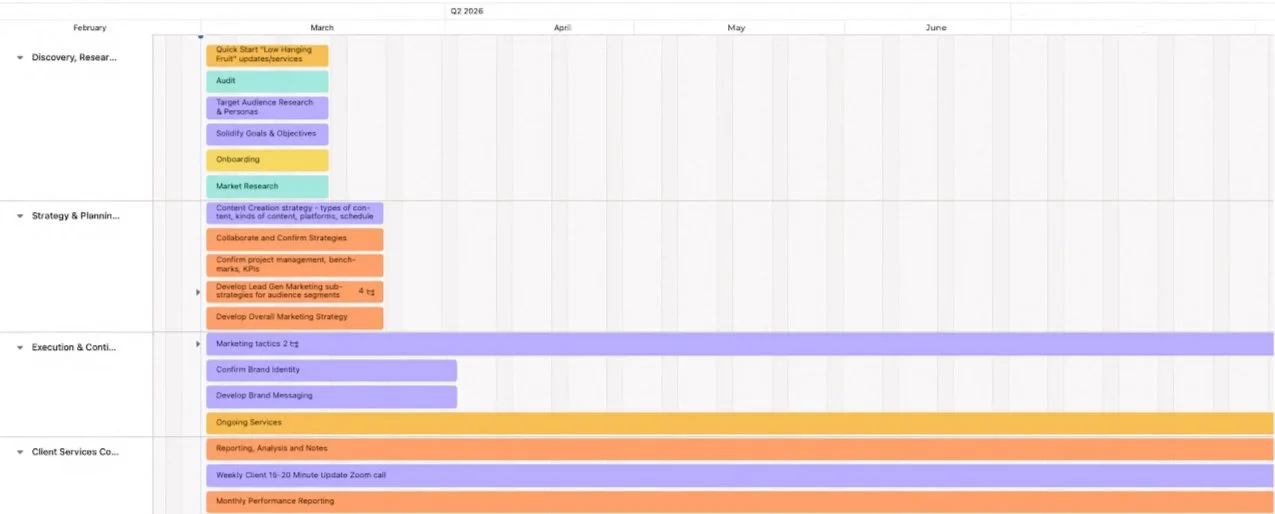
The following tasks summarise key actions for the next six months. Detailed tasks with dates and dependencies are provided separately in the Asana CSV file.
First 30 days (March 2026):
Define budget allocations and finalize marketing team roles.
Build account lists for each ICP in Alabama, Florida, Georgia and South Carolina.
Set up CRM, marketing automation and analytics dashboards.
Develop key messaging and landing pages tailored to each ICP.
Launch initial search and LinkedIn campaigns for each ICP.
Register for relevant trade shows and conferences; plan event strategy.
Next 30 days (April 2026):
Produce white papers, case studies and lead magnets (checklists, guides).
Host webinars for municipal and industrial audiences.
Launch account‑based outreach via personalized emails and InMails.
Publish blog posts and start email newsletters.
Create printed take‑home folders and event materials.
Following 30 days (May 2026):
Attend trade shows and conferences; collect leads.
Follow up with event leads via email and sales calls.
Launch retargeting campaigns (AdRoll) across all ICPs.
Continue content marketing and SEO efforts.
Host webinars or roundtable events for construction and property management audiences.
60–180 days (June – August 2026):
Expand digital advertising to programmatic display and audio channels.
Continue ABM outreach and nurture sequences.
Attend or host additional trade shows/roundtables (manufacturing expo, stormwater association meetings, BOMA events).
Release new case studies and success stories.
Evaluate campaign performance, adjust budgets and targeting.
Plan and begin Q3 campaigns; refine technology stack and marketing processes for continued success.
6 Month Simple Gantt Chart
ABOUT
TOCOBAGA
a
B2B, B2C SMB Strategic Advisory
&
Omni-channel, Integrated Marketing Agency
Fractional CMO FAQs
-
A Fractional CMO (Chief Marketing Officer) is a part-time or shared resource hired by a company to provide strategic marketing leadership. This arrangement allows businesses to access high-level marketing expertise without the cost of a full-time executive.
-
A Fractional CMO typically handles various aspects of marketing strategy, planning, and execution. Their responsibilities may include market analysis, brand development, campaign management, and team leadership. They work on a part-time basis, providing strategic guidance to help businesses achieve their marketing goals.
-
1. Cost-Effective: Fractional CMOs offer high-level expertise without the full cost of a permanent executive, making it a cost-effective solution for businesses.
2. Flexibility: Companies can scale their marketing leadership up or down based on their needs, without the commitment of a full-time hire.
3. Diverse Experience: Fractional CMOs often bring diverse industry experience, providing fresh perspectives and insights to the marketing strategy.
4. Strategic Guidance: These professionals offer strategic guidance, helping businesses align marketing efforts with overall business objectives.
5. Access to Networks: Fractional CMOs may bring valuable industry connections and networks, enhancing opportunities for partnerships and collaborations.
6. Objective Perspective: Being external to the organization, Fractional CMOs can provide unbiased and objective viewpoints on marketing strategies.
7. Quick Onboarding: As seasoned professionals, Fractional CMOs can quickly adapt to the business environment, accelerating the onboarding process.
8. Task-Specific Expertise: Companies can engage Fractional CMOs for specific projects or challenges, tapping into their expertise for targeted improvements.
9. Risk Mitigation: Businesses can mitigate the risk associated with hiring a full-time CMO by testing the waters with a fractional arrangement.
10. Efficiency: With a focus on strategic planning, Fractional CMOs can optimize marketing processes for efficiency and effectiveness.
Why would a SMB hire a Fractional CMO?
Small and Medium-sized Businesses (SMBs) might choose to hire a Fractional CMO for several reasons:
1. Cost Efficiency: SMBs often have budget constraints, and a Fractional CMO allows them to access high-level marketing expertise without the cost of a full-time executive.
2. Flexibility: The variable nature of marketing needs in SMBs can be addressed with a part-time resource, adjusting the level of expertise based on the business's current requirements.
3. Strategic Insight: Fractional CMOs bring strategic thinking and experience, helping SMBs develop effective marketing strategies aligned with their business goals.
4. Resource Optimization: SMBs may not need a full-time CMO, making a fractional arrangement a practical way to optimize resources and focus on key priorities.
5. Quick Impact: Fractional CMOs can swiftly assess the marketing landscape, identify opportunities, and implement strategies to generate quick and impactful results.
6. Access to Networks: SMBs can leverage the networks and industry connections of Fractional CMOs, opening doors to potential partnerships and collaborations.
7. Task-Specific Projects: SMBs can engage a Fractional CMO for specific projects or campaigns, tailoring the arrangement to address immediate marketing needs.
8. Objective Perspective: An external CMO can provide an unbiased and objective viewpoint, offering insights that might be challenging to achieve with an in-house team.
9. Risk Mitigation: Hiring a full-time executive involves risks, but a fractional arrangement allows SMBs to test the waters and evaluate the impact of senior marketing leadership.
10. Learning Opportunity: SMBs can benefit from the knowledge transfer that occurs when working with an experienced Fractional CMO, helping build internal marketing capabilities over time.
-
short answer: engagement, commitment, and scope of responsibility
more detailed answer:
1. Time Commitment:
- Fractional CMO: Works on a part-time or project-specific basis, dedicating a limited number of hours per week or month to the organization.
- Full-time CMO: Is a permanent, full-time employee committed to the organization on a daily basis.
2. Cost Structure:
- Fractional CMO: Typically charges on an hourly or project basis, providing a more cost-effective solution for businesses with budget constraints.
- Full-time CMO: Involves a fixed annual salary, potentially with additional benefits, which may be a higher financial commitment for the organization.
3. Scope of Responsibilities:
- Fractional CMO: Focuses on specific strategic initiatives, projects, or areas of expertise as agreed upon with the organization.
- Full-time CMO: Assumes a broader range of responsibilities, overseeing the entire marketing department and contributing to overall business strategy.
4. Flexibility:
- Fractional CMO: Offers greater flexibility, allowing organizations to scale up or down based on their evolving marketing needs.
- Full-time CMO: Represents a more fixed and consistent presence within the organization, which may be less adaptable to changes in workload.
5. Depth of Involvement:
- Fractional CMO: Often works at a more hands-on level, directly involved in strategy development and execution.
- Full-time CMO: Balances strategic leadership with managerial responsibilities, overseeing day-to-day operations and team management.
6. Long-Term Commitment:
- Fractional CMO: May be engaged for specific projects, a defined period, or on an ongoing but part-time basis, providing a more flexible arrangement.
- Full-time CMO: Implies a longer-term commitment to the organization, with a focus on sustained leadership and relationship building.
-
short-answer: adaptability, agility, resources, communication, wisdom (experience x knowledge)
long answer:
1. Diverse Perspectives: A Fractional CMO with varied industry experience can offer diverse perspectives and insights, bringing a fresh and innovative approach to marketing strategies.
2. Cross-Industry Best Practices: They can bring best practices from different industries, adapting successful strategies and tactics to the specific needs of the organization.
3. Benchmarking Opportunities: With exposure to various industries, a Fractional CMO can provide valuable benchmarking data, helping the organization understand how its marketing performance compares to similar businesses in different sectors.
4. Adaptability: The ability to adapt strategies from one industry to another can be a key advantage. The Fractional CMO can leverage successful techniques across different markets, promoting adaptability and agility.
5. Network Access: Their extensive network across industries can open doors to potential partnerships, collaborations, and industry-specific opportunities that may not be readily apparent within a single-sector focus.
6. Innovation and Creativity: Exposure to diverse industries fosters innovation and creativity. A Fractional CMO can bring a rich mix of ideas, drawing on experiences beyond the confines of a single sector.
7. Risk Mitigation: They can provide insights into potential risks and challenges by drawing on experiences from various sectors, helping the organization proactively address issues before they become significant problems.
8. Market Trends Awareness: A Fractional CMO engaged with multiple clients in different industries stays attuned to a wide range of market trends. This knowledge can be invaluable in staying ahead of industry changes and emerging opportunities.
9. Customization for Unique Markets: Leveraging experience in various industries, the Fractional CMO can tailor marketing strategies to suit the unique characteristics and challenges of the organization's specific market.
10. Continuous Learning: A Fractional CMO involved in diverse industries is likely to be a continuous learner, staying updated on the latest trends, technologies, and strategies across various sectors, which can benefit the organization.
-
1. Fractional CMO:
- A Fractional CMO typically refers to a part-time or shared Chief Marketing Officer who provides strategic marketing leadership to organizations on a flexible basis.
- They might work with multiple clients simultaneously, dedicating a certain number of hours per week or month to each client.
2. Interim Fractional CMO:
- An "Interim Fractional CMO" could imply a temporary or transitional role where the Fractional CMO is specifically engaged to fill a gap or address a short-term need.
- The "Interim" aspect suggests a focus on providing leadership during a transitional period, such as when a company is between full-time CMOs or undergoing significant changes in its marketing strategy.
SERVICES
-
OVERALL STRATEGY
CAMPAIGN STRATEGIES
TACITICAL STRATEGIES
-
SMART Goals, Benchmarks + KPI Planning
-
- Audiences
- Targets
- Find out 4 Holy Metrics:
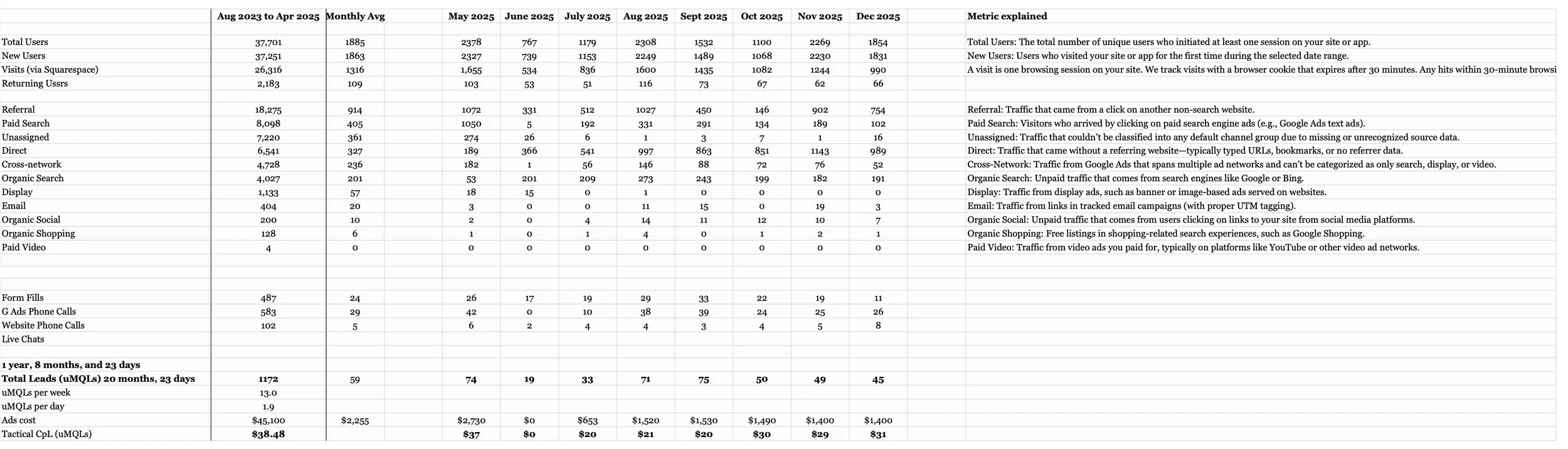
- Cost Per Lead
- Cost Per Acquisition
- Average Revenue of a customer within 1st year
- Lifetime Value
Quick Start Services
Marketing Execution Services
-
Monitoring & Maitenance
Analytics Tracking
SEO (technical)
Live Chat optimization
Build out
* Landing pages by service
* Landing pages by service and city/region
Content
FAQs
Blog posts
-
- PPC
- Google Search Ads
- Bing Search Ads
- Local Services Ads
- AdRoll - cross platform retargeting/remarketing
- Later - platform-industry specific ads w/ Angi, Yelp, etc.
- Social Ads
- AdRoll retargeting ads on FB and IG
- Pinterest might be a great avenue
- Programmatic
- We can get precise targeting
-
- Technical SEO
- At least 1 blog post per month
-
- Automation emails for servicing
- Marketing email campaigns
- New lead automated journeys
-
- Review Capturing
- Review Monitoring
- Directory Listings optimization
-
Traditional Advertising - radio, tv, newspaper, magazine, etc.
Community - sponsorships, focused local corporate responsibility
-
BRANDING:
Brand Development
Brand Identities
Brand Messaging
DESIGN: Any design deliverables needed
Graphic Design, Website Design, UI (User Interface), UX (User Experience), Print Design, Online Ad Design, Video Editing, Image Editing, Custom Illustrations, Newspaper Ads and Design, Magazine Ads and Design, Brick & Mortar Exterior Signage, etc.
Support Services
-
create a Google Data Studio or similar to aggregate analytics into
1) Snapshot
2) by campaign/tactic
-
Setup every task and project in your PM app, Asana?
-
- Starting line: I would want to come in office to War Room around y'all's schedules and work from the office a few days in the beginning. There's always smaller things to absorb just being around that is lost in digital communication
- Slack (or whatever your team uses) for direct communication. We prioritize client communication above email, calls and texts. We keep all conversations in Slack/Teams to have transparency and a searchable knowledge base.
- Update meetings: Weekly until we find a rhythm and go biweekly. I keep them 30 minutes and apply the EOS system to keep it efficient.
-
- Will need to learn your automation processes to streamline any redundant tasks
Possible add-ons services and costs
Online Ad/PPC ad spend without markup
Video Content Production
Purchasing Email Lists via Data Broker
Programmatic Direct Messaging
Approach
Strategy-first approach: work big to small. Macro to Micro. The biggest gaffe in the outsourced marketing services sector is focusing on tactics to begin. Our approach is the following 6 phases:
1. Define Objectives, S.M.A.R.T. goals and Current Analysis & Resource Audit (a current strategy review, branding assessment, resource audit and marketing performance report).
2. Thorough research.
3. Develop a leveraging integrated, omnichannel strategy in lock step communication and approval with the client.
4. Project management execution with respect to achieving KPIs, budgets and resources
5. Analyze quantitative and qualitative reporting.
6. Continuously improve

Strategic plans without execution = a fun idea.
Discipline is the ultimate freedom.
Over-communicate until you have concise shorthand.
Time is a commodity.
Think 3 steps ahead. Contingency plan IFTTT scenarios.
Be agile & adaptable.
The obstacle is the way.
Work short-term and long term at the same time.
Analyze the past while proactively, continuously improve your present and future.
Execute omnichannel, integrated marketing campaigns, online and off.
Work macro and micro.
Generalize and specialize.
Strategic and tactical.
A/B test.
ROI should be the client's main focus and many drill down minutiae. ROI (Return On Investment) is the only thing that matters to our clients (and us). It is the cover image on every one of our proposal decks. It is our mantra; our North Star philosophy. We must provide multiple X ROI for our clients or we cease to exist.