

Clean Air Pros proposal

THE
ONLY
THING
THAT
MATTERS
TO
US
&
OUR
CLIENTS
IS
ROI
Supplemental Video Notes
1,000+
Small-to-Medium Businesses Strategically Advised
600+
Successful Integrated
Marketing Campaigns
7.8X
ROI
Average Client
Return On Investment
300+
Websites Produced
(Developed & Designed)
1,000,000+
High Performing
Emails Deployed
CASE STUDY
Our Commercial Real Estate Client Saw 2020 As An Eventual Blessing - First Disguised As A Curse
The Covid ERA destroyed commercial real estate firms.
With every bad, there's a good. We used this time to re-strategize.
-
We entered The Lockdown with our newly signed client, a Florida-based commercial real estate company, NAME REDACTED, facing a dual challenge of low lead generation and limited brand awareness as it underwent a succession transition from a legacy owner to a new, young CEO. The company needed to revitalize its image and attract potential clients to increase business. Tocobaga initiated a rebranding campaign, focusing on a modern and dynamic image while respecting the company's legacy. We employed a mix of digital and traditional strategies, including a revamped website, selective PR strategies, networking event creations and participation in community efforts utilizing vacant properties to boost brand visibility.
-
We capitalized on the new allotment of time. Planned the next 5 years with SMART goals, benchmarks and KPIs. The company's website underwent a modern redesign to enhance user experience, incorporating a sleek design and showcasing successful case studies. Multiple channels were utilized to highlight the CEO's vision while paying respect to the previous owner's cowboy persona, researched industry insights, and the revamped the client's unique selling propositions. Participation in relevant industry events allowed our client to connect with potential clients and partners.
-
The strategic approach led to a significant uptick in lead generation and brand awareness, resulting in a remarkable 4.1x return on investment (ROI) in the post-Covid Era. The updated website attracted more visitors, and the CEO's active presence on social media contributed to a positive perception of the company. Tocobaga successfully positioned our client as a forward-thinking industry player, gaining trust and interest from potential clients. The successful case study underscores the importance of strategic rebranding and a multi-channel approach to lead generation. Balancing modernity with respect for legacy allowed our client to capture the attention of its target audience, ultimately leading to a substantial ROI and a strengthened market position.
CASE STUDY
Home Services Is Where The Heart Is
People get in routines because that is always how they have been doing it.
"People don't change" isn't our favorite phrase because...well...change is inevitable.
We had to use the big dog hot phrase, Change Management, to achieve our wins in Lead Gen, Sales Ops and Automations.
-
A 40 year old mom-and-pop home services company, NAME REDACTED, faced the challenge of expanding its client base and increasing revenue. Their biggest challenge was the larger, corporate level competition squeezing their market share. To achieve this, NAME REDACTED needed a comprehensive lead generation strategy that would leverage multiple channels and integrate seamlessly to maximize results.
-
Tocobaga implemented a multichannel approach, combining digital and traditional marketing channels. We utilized targeted online advertising, optimized their website for conversions, ran email campaigns, and engaged in local community outreach. The goal was to create a cohesive marketing ecosystem that guided potential clients through the customer journey. Track everything. We also had to clean up their entire CRM of over 40,000 contacts and develop an API to integrate with their field operating software. The company invested in targeted online advertising campaigns to reach a broader audience. Simultaneously, we revamped their website, ensuring it was user-friendly and featured compelling content. Email campaigns were personalized and segmented to nurture leads effectively.
-
The integrated approach proved highly successful, resulting in an outstanding 38.7x return on investment (ROI) in 6 months. The online advertising increased visibility, the optimized website improved conversion rates, and the personalized email campaigns fostered strong customer relationships. The community outreach efforts not only contributed to brand awareness but also generated local leads. We are proud of this well-executed, multichannel lead generation strategy. The seamless integration of online and offline efforts, combined with a focus on user experience and community engagement, led to an impressive ROI. This success emphasizes the importance of a holistic approach in achieving significant outcomes in the competitive home services industry.
CASE STUDY
Challenge Accepted
We typically don't do event marketing.
We saw this as a fun challenge to up our game.
-
In 2016, new, local altruistic organization wanted to partner with a national charity for a mixed used festival event. We faced the challenge of low attendance, little-to-no brand awareness outside of the organization's personal reach and limited funds for their upcoming fundraising event. They needed to boost lead generation to ensure a successful turnout and maximize donations.
-
We implemented a multi-channel marketing strategy, leveraging social media, email campaigns, and partnerships with local businesses. They also optimized their website for user engagement and introduced a referral program to encourage participants to invite others. We utilized the charity's compelling storytelling in their social media posts and emails, highlighting the impact of their cause. They engaged with influencers and community leaders to amplify their message. Additionally, they collaborated with local businesses to sponsor and promote the event.
-
The lead generation efforts exceeded expectations, resulting in an 8.4x return on investment (ROI) and sold out the event with 5,000 attendees. The optimized website attracted more visitors, and the referral program significantly expanded the reach. The event saw a substantial increase in attendance, leading to a successful fundraising outcome that surpassed the charity's initial goals. The success of the lead generation campaign emphasized the importance of a comprehensive, multi-channel approach. Engaging storytelling, influencer partnerships, and community involvement proved to be powerful tools in achieving remarkable ROI for the charity event. We created the marketing machine. This festival has now spawned off 5 additional metropolitan cities using our framework as their blueprint.
-

Steven Fantetti
Serial Entrepreneur, M&A Attorney
10x Client
Click Here To Email -
Nate Cinal
Owner & Operator of Tampa Bay’s Only Apple B2B Certified Managed Services Provider, SCOUT IT
Preferred Referral Partner
-

Dean Akers
“Leave the campsite better than you found it, and the world will be a better place because of it”
-
Clean Air Pros operates from a position of genuine competitive advantage: a family-owned service model rooted in honesty, no upselling, and customer-first values. The business has built a strong 4.9-star review reputation across six counties with a loyal customer base. However, the constraint to growth is not service quality—it is predictable, scalable lead flow and modern marketing systems that convert inbound demand into booked jobs at a sustainable cost per acquisition.
This proposal takes a dual-track approach that mirrors how top-performing service businesses scale: simultaneously execute foundational strategy work and quick-win tactics from day one. This is not sequential; it is parallel. While we invest the first month in research, brand messaging, audience mapping, and website audit, we also deploy immediate lead generation and conversion fixes that begin capturing value immediately.
The Tocobaga Methodology: Strategy first, tactics second, but both running in tandem from the kickoff moment. -
Total Addressable Market (TAM), Serviceable Available Market (SAM) and Serviceable Obtainable Market (SOM) for Clean Air Pros core services (air‑duct cleaning, dryer‑vent cleaning and HVAC services). Clean Air Pros offers residential and commercial air‑duct, dryer‑vent, chimney/fireplace, insulation and HVAC services across central‑west Florida (Hillsborough, Manatee, Orange, Pasco, Pinellas and Polk counties); this analysis therefore focuses on households in those counties.
Assumptions and key data points
Households in service area: ~2.33 million households across the six counties.
Air‑duct cleaning frequency & cost: National Air Duct Cleaners Association recommends duct cleaning every 3–5 years; Angi reports Tampa-area air‑duct cleaning costs average US$450 per job.
Dryer‑vent cleaning frequency & cost: Dryer vents should be cleaned annually; typical cost ~US$144 per job.
HVAC services market: The U.S. HVAC services market is about US$28.2 billion in 2025, with the South region (including Florida) accounting for 38 % and the residential segment ~52 %. The six‑county service area contains ~27 % of Florida’s population; this share was applied to estimate the regional residential HVAC market.
Estimated market sizes (USD)
ServiceTAM (Total Addressable Market)SAM (Serviceable Available Market)SOM (Serviceable Obtainable Market)Methodology (keywords only)Air‑duct cleaning~$261.7M~$157.0M~$3.14MTAM: (2.33 M households ÷ avg. 4‑yr cleaning interval) × $450 cost; SAM: assume 60 % owner-occupied or willing households; SOM: assume 2 % share of SAM.Dryer‑vent cleaning~$335.0M~$201.0M~$4.02MTAM: 2.33 M households × $144 annual service; SAM: apply 60 % service‑ready households; SOM: assume 2 % of SAM.Residential HVAC services~$2.89B~$1.51B~$15.0MTAM: U.S. HVAC services market ($28.2 B) × South share (38 %) × six‑county population share (~27 %); SAM: apply residential segment share (52 %); SOM: assume 1 % of SAM.
Discussion
TAM represents the theoretical annual revenue if Clean Air Pros served every household/business in its service area. Air‑duct cleaning TAM (~$261.7 M) uses NADCA’s cleaning frequency and Tampa pricing; dryer‑vent cleaning TAM (~$335 M) uses the recommendation for annual cleaning and typical cost; HVAC TAM (~$2.89 B) reflects the counties’ share of the U.S. residential HVAC services market.
SAM narrows the TAM to households realistically reachable (e.g., owner‑occupied or service‑ready; ~60 % for ducts and vents) and to the residential share of HVAC.
SOM is the share Clean Air Pros could reasonably capture given competition and capacity; conservative assumptions (2 % for ducts and vents, 1 % for HVAC) produce obtainable revenues of roughly $3–4 M for air‑quality services and $15 M for HVAC services.
These figures should be treated as high‑level estimates; actual market share will depend on pricing, marketing effectiveness, competition and expansion into commercial segments.
-
Integrated Growth Strategy & Marketing Systems Proposal
What We Learned from the Discovery CallThe conversation with you and your colleague revealed a clear, values-aligned business philosophy and some strategic clarity on where to focus energy:
Primary goal: More qualified residential leads and a website that converts those leads to booked jobs at a predictable cost.
Channel priority: Intent-based channels (search, maps, directories) matter far more than social media "scroll" discovery for HVAC and air quality services.
Budget reality: PPC in HVAC is notoriously expensive ($80–$100 per lead). LSA and Bing often deliver better economics. We'll focus on precision targeting and low-waste channels first.
Website state: Past SEO efforts relied on content stuffing; technical SEO and consistent, helpful content are missing. The site needs modern on-page optimization, schema markup, and a content strategy tied to real customer questions.
Brand voice: Clean Air Pros is family-owned, values-driven, and explicitly does not upsell. Your competitive edge is integrity—not price, not flashiness, but trustworthiness. This is your message system anchor.
Growth ambition: You want a 3–5-year trajectory where you spend less time in the field and the business runs on systems and lead flow, not word-of-mouth alone.
Operational reality: You're still in the field as a technician while growing the business. We have to be respectful of your time and build systems that scale without requiring constant input from you.
Objectives and Success Metrics
We measure success against four "holy marketing metrics" that tie directly to your bottom line:
Metric
Definition
Baseline Target
Cost Per Lead (CPL)
Total marketing spend ÷ inbound leads from paid channels
<$250 across all channels
Cost Per Booked Job (CPBJ)
Total marketing spend ÷ leads that convert to scheduled service
<$550
Average Revenue Per Customer (ARPC)
Total revenue from new customers ÷ number of new customers
Target: track and compare to existing customer value
Customer Lifetime Value (CLV)
Repeat revenue + referral value over customer lifetime
Target: 3–5 year model
Primary Objectives
Increase qualified inbound lead volume from high-intent channels (Google Search, Google Business Profile, local directories, LSA, Bing) to 8–12 new leads per week within 90 days.
Improve lead-to-booked conversion rate via clearer messaging, better landing pages, and responsive follow-up workflows (target: 35–45% close rate on inbound leads).
Stabilize and grow local SEO visibility for priority service keywords (air duct cleaning, HVAC repair, dryer vent cleaning in service area) by fixing technical SEO and publishing consistent, helpful content.
Protect and expand the existing customer base through review generation, referral systems, and light-touch retention (email + SMS campaigns that feel human, not spammy).
Build a sustainable brand messaging system and content library that can scale across all marketing channels without requiring constant creative direction from you.
The Dual-Track Working Model: Strategy & Tactics in Parallel
This is the core insight you articulated on the call, and it differentiates this engagement.
Most marketing agencies do strategy first, then tactics. You have business to run right now. Instead, we execute two workstreams simultaneously:
Workstream 1: Long-Term Strategy (Month 1, continues ongoing)
Audience research and customer heat-mapping
Brand messaging system and voice guidelines
Service-area and competitive analysis
SEO keyword strategy and content roadmap
Website architecture and conversion optimization plan
Referral and retention program design
Workstream 2: Immediate Tactics (Month 1, deployed continuously)
Access setup and tracking pixel installation (Google Analytics, call tracking, Facebook/Google conversion pixels)
Google Business Profile optimization (categories, services, photos, review links)
Directory cleanup (NAP consistency across all listings)
Quick website fixes (above-the-fold messaging, CTA clarity, mobile speed)
Review request campaign (email to past satisfied customers)
LSA and paid search keyword testing and campaign setup
Email sequence setup for lead follow-up and review requests
Why both at once? You need quick wins to see momentum and build confidence in the partnership. Simultaneously, the long-term work ensures those wins compound into a sustainable system.
Phase-Based Implementation Plan
Phase 1: Discovery, Access, and Foundation (Month 1)
Duration: Month 1
Touchpoints: 2 weekly Zoom calls + asynchronous work
Deliverables: Audit report, audience map, messaging framework, tracking setupStrategy Work (Workstream 1)
Onboarding & Business Alignment
Initial kickoff call (30–45 min) to confirm goals, service area focus, and decision-making process.
Request: customer data export (ZIP codes, neighborhoods, service types, and a simple quality score: good, great, best). No customer names or addresses needed.
Establish shared action tracker and weekly meeting schedule.
Website & Technical SEO Audit
Analyze site structure, page speed, mobile usability, indexing status, schema markup, and on-page SEO fundamentals.
Identify quick fixes vs. bigger rebuilds.
Document all technical debt and prioritize fixes.
Local Presence Audit
Audit Google Business Profile (photos, categories, services, review count/rating, Q&A quality, posting cadence).
Check directory consistency across Google Maps, Apple Maps, Yelp, Angie's List, BBB, and industry-specific directories.
Analyze competitor presence and messaging in the local space.
Audience & Service-Area Definition
Build a heat map of current customer ZIP codes and neighborhoods.
Define 3–5 audience clusters (examples: homeowners with older HVAC systems; families concerned about air quality and allergies; new movers to Tampa Bay; property managers with small residential portfolios).
Document target household income, age, and pain points for each cluster.
Define geographic service area (currently: Hillsborough, Manatee, Orange, Pasco, Pinellas, Polk counties—we'll confirm priority zones).
Brand Messaging System (Draft)
Core promise: Honest, transparent service. No upselling. Family-owned values applied to every interaction. Healthy homes, healthy families.
Proof points: 4.9-star reviews, customer stories, certifications (NADCA), emergency service, guarantees.
Tone and language guardrails: Never attack competitors; instead, contrast the experience customers want (transparency, honesty, fair pricing) with what they're tired of (upselling, hidden fees, pressure).
Service-specific messaging for each major service line (air duct cleaning, HVAC repair, dryer vent cleaning, etc.).
Immediate Tactics (Workstream 2)
Access & Tracking Setup
Secure login access to website CMS, domain registrar, hosting, Google Business Profile, Google Analytics, Google Search Console, and any existing ad accounts.
Install Google Analytics 4 (GA4) if not present.
Install call tracking (CallRail, CallJoy, or similar) to attribute inbound calls to marketing source.
Set up conversion pixels (Facebook, Google) to track form submissions and calls.
Ensure all platforms are connected and data is flowing.
Google Business Profile Optimization
Confirm all business details: name, phone, address, website, hours.
Add/verify service areas (all six counties).
Ensure category and service tags are complete and accurate.
Upload 10–15 high-quality photos (technicians at work, before/after, office, vehicles, certifications).
Create a review request link and integrate into follow-up workflows.
Set up a template for responding to reviews (positive and constructive).
Directory & NAP Cleanup
Verify and update listings across: Google Maps, Apple Maps, Yelp, Angie's List, BBB, Home Advisor, Thumbtack, and any HVAC-specific directories.
Ensure consistent name, address, phone, and website across all platforms.
Add or optimize business descriptions and service lists.
Website Quick Fixes
Improve above-the-fold messaging to clearly state: service offerings, service area, and main call-to-action.
Add trust elements: reviews, certifications, response-time guarantee ("Typically respond within 1 hour").
Ensure all CTAs (call buttons, contact forms) are visible and mobile-friendly.
Check page speed and fix any major slowdowns.
Verify mobile usability across all key pages.
Review Acceleration Campaign (Email + SMS)
Identify 20–30 past customers who are likely to give a five-star review (based on job type and service dates).
Send a short, personalized email: "We'd be grateful if you could share your experience with us on Google and Yelp."
Follow up with a text message (if phone numbers are available) with a direct link to review pages.
This is a one-time campaign in early Month 1, with follow-up messaging in subsequent months.
Lead Response SOP (Standard Operating Procedure)
Document and confirm the current lead response process: who responds, how fast, what happens next?
Ensure every inbound lead (call, form, Google Business Profile message) gets acknowledged within 1 hour during business hours.
Create email/SMS templates for appointment confirmation and follow-up.
Phase 2: Demand Capture & Content Launch (Months 2–3)
Duration: Months 2–3
Touchpoints: 1 weekly Zoom call + asynchronous updates
Deliverables: New website pages, paid search campaigns live, first content pieces published, reporting dashboard liveStrategy Work (Workstream 1)
Website Rebuild & Conversion Optimization
Redesign key pages: homepage, service pages (air duct cleaning, HVAC repair, dryer vent cleaning, etc.), contact page.
Each service page includes:
Clear problem statement and pain point.
How Clean Air Pros solves it (step-by-step process).
Before/after visuals (if available).
Customer reviews and testimonials specific to that service.
Trust elements (certifications, guarantees, response time).
Single, clear CTA (call or form).
Add a dedicated landing page for LSA campaigns (separate conversion funnel).
Implement lead-capture forms with smart fields (service type, location, urgency).
Add chat or messaging widget for real-time lead engagement.
SEO Keyword Strategy & Content Roadmap
Identify 20–30 priority keywords (short-tail and long-tail) across service lines and service area.
Examples: "air duct cleaning Tampa," "HVAC repair Clearwater," "dryer vent cleaning near me," "indoor air quality," "chimney cleaning St. Petersburg."
Build a 6-month content calendar starting with:
Weekly short-form content (500–700 words): answers to common customer questions (FAQs).
Monthly long-form content (1,500–2,500 words): in-depth guides on topics like "Why HVAC Maintenance Matters" or "Signs Your Air Ducts Need Cleaning."
Seasonal content: winter heating prep, summer AC efficiency, holiday maintenance tips.
Outline all posts and establish a publication workflow.
Paid Search Strategy
LSA (Google Local Services Ads): If eligible, launch LSA for primary service areas. LSA has lower lead costs and better quality in many HVAC markets.
Google Search (PPC): Test long-tail keywords with lower competition (e.g., "emergency air duct cleaning Tampa," "HVAC tune-up Largo"). Start with allocated budget to test and learn.
Bing Search: Often overlooked, often cheaper. Allocate 20–30% of search budget to Bing.
Negative keywords: Build a negative keyword list to avoid wasting spend on irrelevant searches.
Geographic targeting: Tight geo-targeting to service area ZIP codes. Exclude areas you don't serve.
Ad copy: Highlight the brand promise (honest, no upselling, family-owned, fast response, 24/7 availability).
Retargeting Strategy
Build a retargeting pixel audience: anyone who visits the website but doesn't convert (call or form).
Create retargeting display ads on Google Display Network and Facebook.
Ad messaging: "Get Your Air Ducts Cleaned by Certified Professionals—Schedule Your Free Assessment."
Keep spend low and frequency controlled (3–5 impressions per user per day max) to avoid ad fatigue.
Referral & Retention Program Design
Build a light-touch email sequence for existing customers:
Month 1 (post-service): "Thanks for choosing us. Here's how to get the most out of your service."
Month 3: "Seasonal tip: why now is a good time to think about [next service]."
Month 6: "Check-in: how are you feeling about your air quality and HVAC?"
Month 12: "Annual reminder—schedule your maintenance."
Design a referral ask that feels human: "If you know someone who'd benefit from what we do, we'd love to help them. Here's a referral link with a $50 credit for both of you."
Handwritten birthday and thank-you card program: 10 minutes per day of manual outreach to top customers.
Immediate Tactics (Workstream 2)
Paid Search Campaigns Go Live
Launch LSA campaigns (if eligible) and Google/Bing Search campaigns by end of Month 2.
Set up automated bidding, conversion tracking, and daily budget management.
Publish a weekly performance dashboard (leads, cost per lead, conversions, ROI).
Content Publishing Begins
First FAQ-driven blog post published by mid-Month 2.
Subsequent posts published weekly on schedule.
All posts optimized for SEO (keywords, headers, internal links, schema).
Google Business Profile Posts & Photos
Publish 1–2 posts per week on GBP (service reminders, seasonal tips, recent projects).
Add 5–10 new photos to photo gallery each month (before/after, team, equipment, certifications).
Email Sequences Automated
Lead follow-up sequence: automatically triggered when someone fills out a form or calls.
Review request sequence: triggered after service completion.
Retention sequence: automated monthly/quarterly touchpoints to existing customers.
SMS supplement: key messages (appointment reminders, review requests) sent via SMS for higher engagement.
Phase 3: Scale, Optimize, and Systemize (Months 4–6+)
Duration: Months 4–6 and beyond
Touchpoints: Biweekly Zoom calls, weekly written updates
Deliverables: Content library live, referral program active, optimized campaigns, long-term roadmapOngoing Strategy Work (Workstream 1)
Content Library Growth
Continue weekly FAQ posts and monthly in-depth guides.
Build out service-specific landing pages based on search demand and audience interest.
Develop customer story case studies (1–2 per quarter).
Create downloadable resources (checklists, guides) for lead magnets.
Brand & Creative Assets
Build a library of before/after photos and process videos.
Develop customer testimonial videos (short-form, authentic).
Create social media templates (for potential future use when and if you expand to social channels).
Document brand guidelines for consistency across all touchpoints.
Audience Segmentation Refinement
Use early campaign data to refine audience clusters.
Identify which audience segments convert best and have highest CLV.
Shift spend and messaging toward high-value segments.
Competitive Monitoring
Quarterly competitive analysis on messaging, pricing, reviews, and ad strategies.
Adjust positioning if competitive landscape shifts.
Ongoing Tactics (Workstream 2)
Campaign Optimization
Shift spend to top-performing keywords, ads, and audience segments.
Pause underperforming campaigns.
Test new keywords and creative based on data.
Quarterly budget reallocation based on ROI.
Lead Quality & Close-Rate Improvement
Track which lead sources convert best to booked jobs.
Optimize landing pages based on form abandonment and bounce data.
A/B test ad copy and CTAs to improve click-through rates.
Implement a lead-scoring system to prioritize hot leads.
Review & Rating Management
Monitor review velocity across Google, Yelp, Facebook, BBB.
Respond to all reviews (positive and constructive) within 24 hours.
Look for patterns in feedback and address systemic issues.
Referral Program Activation
Launch formal referral program with clear incentives.
Promote referral program in email signatures, invoices, and follow-up calls.
Track and celebrate referral wins.
Reporting & Performance Review
Weekly dashboard: leads by source, cost per lead, booked jobs, conversion rate, spend.
Monthly narrative report: wins, challenges, insights, recommendations for next month.
Quarterly strategic review: deep-dive into data, audience performance, competitive position, 6-month outlook.
Working Cadence & Communication Structure
Efficiency is built into this model because we respect your time.
Synchronous (Live Meetings)
Month 1: Two weekly Zoom calls (60 min each)
Call 1 (Mon/Tue): Deep work session—review data, make decisions on messaging, strategy, and tactics.
Call 2 (Thu/Fri): Weekly check-in—review what shipped, unblock issues, answer questions.
Months 2–3: One weekly Zoom call (45 min)
Strategic check-in and tactical adjustments.
Month 4+: Biweekly Zoom calls (45 min) + optional ad-hoc calls as needed.
Asynchronous
Shared action tracker (Google Docs or Notion): real-time visibility into what's in progress, what's blocked, what shipped this week.
Weekly written updates (Slack or email): Friday afternoon summary of completed work, next week's priorities, any decisions needed from you.
Video notes on proposal: Instead of a text-heavy document, key concepts explained in 3–5 minute video clips. You can watch at your own pace (e.g., after kids are asleep).
Slack or email channel: For quick questions and async communication between calls.
Decision-Making
Fast approval loops: You have 24–48 hours to review and approve most messaging, landing page drafts, and campaign concepts.
Default to ship: If it's low-risk and matches the brand strategy, we move forward and show you the result rather than ask permission first.
Channel Strategy Summary
Channel
Use Case
Timeline
Notes
Google Local Services Ads (LSA)
High-intent, local, residential service demand
Month 2–3
Lowest-friction if eligible; Google handles lead quality
Google Search (PPC)
Long-tail keywords, intent-based
Month 2–3
Start with low-spend test; scale what works
Bing Search
Often overlooked; cheaper
Month 2–3
20–30% of search budget; test and learn
Google Business Profile (Organic)
Map pack visibility, local pack rankings
Ongoing
Highest ROI over time; publishing + reviews + Q&A
Local SEO (Organic Search)
Long-term brand visibility; sustainable traffic
Ongoing
Compound effect; takes 12–18 months to mature
Retargeting (Display/Facebook)
Re-engage site visitors who didn't convert
Month 2–3
Low-cost reminder ads; high conversion potential
Email & SMS
Review requests, referrals, retention
Ongoing
Touches existing customers at near-zero cost
Paid Social (Future)
Awareness and brand building
Not recommended Year 1
Hold for Year 2 if brand awareness becomes priority
Immediate Quick Wins (Month 1)
These ship immediately once the contract is signed and access is granted:
✓ Analytics & call tracking live — by end of first business day
✓ Google Business Profile optimized — by end of first 3 days
✓ Directory cleanup initiated — ongoing through Month 1
✓ Review request campaign launched — early Month 1
✓ Lead response SOP documented and tested — Month 1
✓ Website performance baseline — by end of first week
✓ Paid search test campaigns outlined — Month 1Assumptions, Dependencies, and Constraints
What We Need from You
Access to: website CMS, domain, hosting, Google Business Profile, Google Analytics/Search Console, and any existing ad accounts (Google Ads, Facebook Ads Manager).
Customer data (anonymized): ZIP codes, neighborhoods, service types, dates, and a quality score (good/great/best) to build the audience map.
Responsiveness on key decisions: messaging approval, service-area focus, and campaign direction (we'll keep decisions batched and simple).
Time commitment: 2–3 hours per month during Month 1, 1–2 hours per month thereafter.
What We Control
Strategy development, research, and competitive analysis.
Website audits, copywriting, and optimization.
Campaign setup, monitoring, and optimization.
Content creation, publishing, and SEO.
Reporting and performance analysis.
What Depends on External Factors
Google algorithm changes and organic rankings (long-term SEO takes 6–12 months to show material impact).
PPC competition and cost per click (HVAC is competitive; we'll find the best-value channels).
Review velocity (depends on customer satisfaction and engagement—we'll optimize the ask, but can't force reviews).
Lead quality and close rate (depends on sales process, pricing, and service delivery—marketing owns lead volume and quality, not the close itself).
Commitment Structure
Flexible cancellation clause: 60 days' written notice required for disengagement. We take on risk because you take on risk. If something external happens to your business (equipment failure, economic downturn, family emergency), you're not locked in. But we've built enough momentum into the first 60 days to prove value. By the end of Month 2, you'll see:
Tracking and analytics live and flowing.
First 6–8 content pieces published.
Paid search campaigns running with early conversion data.
Website improvements live.
Review requests sent and some new reviews likely posted.
A clear picture of what's working and what needs adjustment.
What's Included:
Fractional CMO strategic guidance.
Website audit, optimization, and ongoing improvements.
Content creation (weekly blog posts, monthly in-depth guides).
Paid search setup and daily management (LSA, Google, Bing).
Local SEO strategy and execution.
Email and SMS sequence setup and management.
Google Business Profile management (posts, photos, reviews, Q&A).
Weekly reporting and performance dashboard.
Monthly strategy meeting and quarterly deep-dive reviews.
All creative and copywriting.
Success Timeline & Milestones
Timeline
Milestone
Days 1–3
Access granted, onboarding complete, tracking live
Month 1
Website audit, initial strategy work, GBP optimized, review requests launched, LSA/search outlined, first blog post draft
Month 2
First paid campaigns live, website quick fixes deployed, content publishing begins, 4+ blog posts published
Month 3
Website redesign live, 8+ blog posts published, paid campaigns delivering data, early conversions tracked, 8–12 new leads per month from marketing
Month 4
12+ pieces of content live, lead volume ramping, data showing which channels and messages convert best
Month 6
Clear picture of CLV by source, audience, and messaging; sustainable lead flow at predictable cost; content library functioning as ongoing lead magnet; positioned for Year 2 scaling
Next Steps
Review and feedback on this proposal (48–72 hours).
Approval and signing of engagement agreement.
Access provisioning — you'll share login credentials for website, GBP, analytics, and ad accounts.
Kickoff call scheduled for within 48 hours of signing.
Month 1 deliverables shipped: website audit, initial strategy work, tracking setup, first action tracker.
Why This Approach Works for Clean Air Pros
You're not just hiring a marketing agency. You're hiring someone who understands that:
Service quality matters, but people have to know you exist. Your reviews and customer loyalty prove you deliver. Marketing's job is to put your best customers in front of people who have the same problem.
Strategy without execution is philosophy. Execution without strategy is noise. This plan does both at the same time.
Your time is your most valuable asset. We've built this to require minimal disruption to your field work while still moving fast.
Long-term thinking beats quick fixes. You want to be less in the field in 3–5 years. We're building systems that scale without you having to do the marketing yourself.
Integrity in marketing is possible. We hate snake-oil agencies too. You're not going to see vanity metrics or fluff. Every tactic ties back to measurable, booked jobs and revenue.
This is the rebound boyfriend agency working for the honest HVAC company. Let's build something real.
Ready to get started?
Contact: Law Smith | Tocobaga
Next Step: Schedule the kickoff call and grant access.
Prepared by: Tocobaga Marketing Agency & Business Advisory
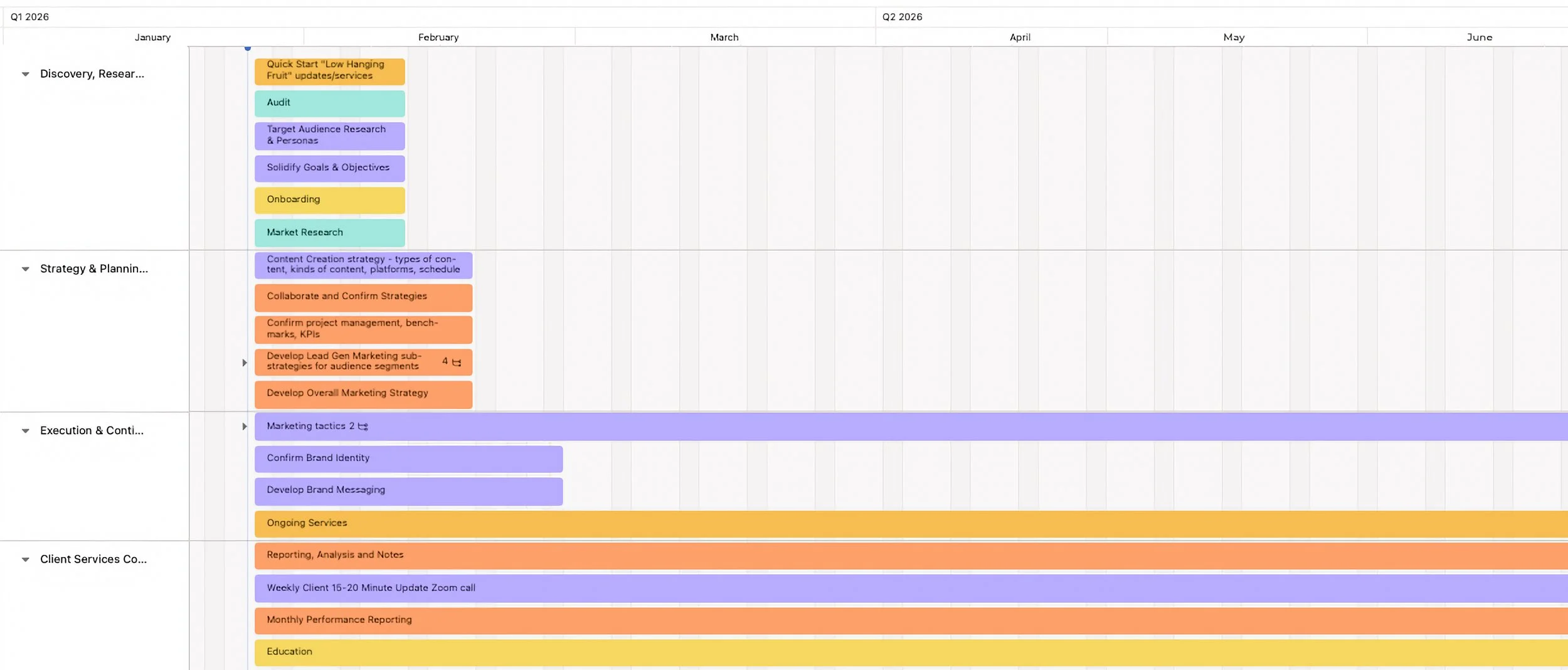
6 Month Simple Gantt Chart
Proposal Summary
Comparisons & Your Price
No one wants to feel like a dumbo overpaying an outside firm.
We get it. We abhor 99% of advisors and agencies. Our industry has a lot of snake oil.
If you’re going to try to compare bid costs, you must examine the exact same
QCD+F: Quality, Cost, Deliverability + Flexibility
Average Agency Rate
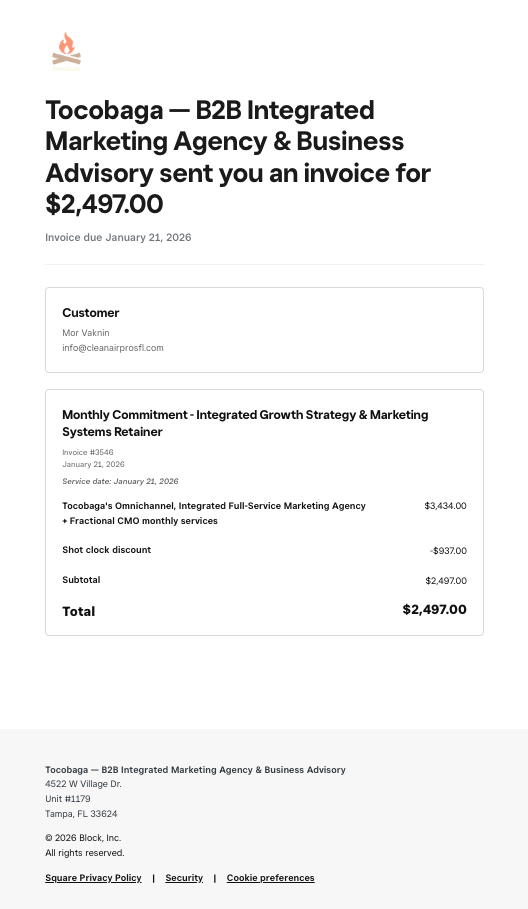
$7,127
Tocobaga’s Normal Rate
$3,434+
Your Tocobaga Rate
$2,497
DISCOUNT
SHOT
CLOCK
Quick-Start Next Steps
Administrative & Clerical Tasks
Invoice is deposited - either total for the month or deposit.
Tocobaga begins working
Tocobaga receives access to Tech Stack and any relevant brand collateral
Quick-Start onboarding will not be sequential - aka might be a little out of order than our normal process
Tocobaga will send over Company Services Agreement
Tocobaga will start a Slack workspace for internal communication. If you use another internal communication app, we can integrate Slack with other apps e.g. Slack two-way sync with Teams.
Tocobaga will coordinate a recurring, update meeting cadence - usually once a week initially and then every 2 weeks once we build a rhythm. If clients cannot attend because of schedule conflicts, we will record an update video and send via Slack.
If we’re ready to go right now,
the button to the invoice is below
or click on the invoice image to the right.
Once the invoice is paid, we begin.
Let’s Go ➳
ABOUT
TOCOBAGA
a
B2B, B2C SMB Strategic Advisory
&
Omni-channel, Integrated Marketing Agency
Fractional CMO FAQs
-
A Fractional CMO (Chief Marketing Officer) is a part-time or shared resource hired by a company to provide strategic marketing leadership. This arrangement allows businesses to access high-level marketing expertise without the cost of a full-time executive.
-
A Fractional CMO typically handles various aspects of marketing strategy, planning, and execution. Their responsibilities may include market analysis, brand development, campaign management, and team leadership. They work on a part-time basis, providing strategic guidance to help businesses achieve their marketing goals.
-
1. Cost-Effective: Fractional CMOs offer high-level expertise without the full cost of a permanent executive, making it a cost-effective solution for businesses.
2. Flexibility: Companies can scale their marketing leadership up or down based on their needs, without the commitment of a full-time hire.
3. Diverse Experience: Fractional CMOs often bring diverse industry experience, providing fresh perspectives and insights to the marketing strategy.
4. Strategic Guidance: These professionals offer strategic guidance, helping businesses align marketing efforts with overall business objectives.
5. Access to Networks: Fractional CMOs may bring valuable industry connections and networks, enhancing opportunities for partnerships and collaborations.
6. Objective Perspective: Being external to the organization, Fractional CMOs can provide unbiased and objective viewpoints on marketing strategies.
7. Quick Onboarding: As seasoned professionals, Fractional CMOs can quickly adapt to the business environment, accelerating the onboarding process.
8. Task-Specific Expertise: Companies can engage Fractional CMOs for specific projects or challenges, tapping into their expertise for targeted improvements.
9. Risk Mitigation: Businesses can mitigate the risk associated with hiring a full-time CMO by testing the waters with a fractional arrangement.
10. Efficiency: With a focus on strategic planning, Fractional CMOs can optimize marketing processes for efficiency and effectiveness.
Why would a SMB hire a Fractional CMO?
Small and Medium-sized Businesses (SMBs) might choose to hire a Fractional CMO for several reasons:
1. Cost Efficiency: SMBs often have budget constraints, and a Fractional CMO allows them to access high-level marketing expertise without the cost of a full-time executive.
2. Flexibility: The variable nature of marketing needs in SMBs can be addressed with a part-time resource, adjusting the level of expertise based on the business's current requirements.
3. Strategic Insight: Fractional CMOs bring strategic thinking and experience, helping SMBs develop effective marketing strategies aligned with their business goals.
4. Resource Optimization: SMBs may not need a full-time CMO, making a fractional arrangement a practical way to optimize resources and focus on key priorities.
5. Quick Impact: Fractional CMOs can swiftly assess the marketing landscape, identify opportunities, and implement strategies to generate quick and impactful results.
6. Access to Networks: SMBs can leverage the networks and industry connections of Fractional CMOs, opening doors to potential partnerships and collaborations.
7. Task-Specific Projects: SMBs can engage a Fractional CMO for specific projects or campaigns, tailoring the arrangement to address immediate marketing needs.
8. Objective Perspective: An external CMO can provide an unbiased and objective viewpoint, offering insights that might be challenging to achieve with an in-house team.
9. Risk Mitigation: Hiring a full-time executive involves risks, but a fractional arrangement allows SMBs to test the waters and evaluate the impact of senior marketing leadership.
10. Learning Opportunity: SMBs can benefit from the knowledge transfer that occurs when working with an experienced Fractional CMO, helping build internal marketing capabilities over time.
-
short answer: engagement, commitment, and scope of responsibility
more detailed answer:
1. Time Commitment:
- Fractional CMO: Works on a part-time or project-specific basis, dedicating a limited number of hours per week or month to the organization.
- Full-time CMO: Is a permanent, full-time employee committed to the organization on a daily basis.
2. Cost Structure:
- Fractional CMO: Typically charges on an hourly or project basis, providing a more cost-effective solution for businesses with budget constraints.
- Full-time CMO: Involves a fixed annual salary, potentially with additional benefits, which may be a higher financial commitment for the organization.
3. Scope of Responsibilities:
- Fractional CMO: Focuses on specific strategic initiatives, projects, or areas of expertise as agreed upon with the organization.
- Full-time CMO: Assumes a broader range of responsibilities, overseeing the entire marketing department and contributing to overall business strategy.
4. Flexibility:
- Fractional CMO: Offers greater flexibility, allowing organizations to scale up or down based on their evolving marketing needs.
- Full-time CMO: Represents a more fixed and consistent presence within the organization, which may be less adaptable to changes in workload.
5. Depth of Involvement:
- Fractional CMO: Often works at a more hands-on level, directly involved in strategy development and execution.
- Full-time CMO: Balances strategic leadership with managerial responsibilities, overseeing day-to-day operations and team management.
6. Long-Term Commitment:
- Fractional CMO: May be engaged for specific projects, a defined period, or on an ongoing but part-time basis, providing a more flexible arrangement.
- Full-time CMO: Implies a longer-term commitment to the organization, with a focus on sustained leadership and relationship building.
-
short-answer: adaptability, agility, resources, communication, wisdom (experience x knowledge)
long answer:
1. Diverse Perspectives: A Fractional CMO with varied industry experience can offer diverse perspectives and insights, bringing a fresh and innovative approach to marketing strategies.
2. Cross-Industry Best Practices: They can bring best practices from different industries, adapting successful strategies and tactics to the specific needs of the organization.
3. Benchmarking Opportunities: With exposure to various industries, a Fractional CMO can provide valuable benchmarking data, helping the organization understand how its marketing performance compares to similar businesses in different sectors.
4. Adaptability: The ability to adapt strategies from one industry to another can be a key advantage. The Fractional CMO can leverage successful techniques across different markets, promoting adaptability and agility.
5. Network Access: Their extensive network across industries can open doors to potential partnerships, collaborations, and industry-specific opportunities that may not be readily apparent within a single-sector focus.
6. Innovation and Creativity: Exposure to diverse industries fosters innovation and creativity. A Fractional CMO can bring a rich mix of ideas, drawing on experiences beyond the confines of a single sector.
7. Risk Mitigation: They can provide insights into potential risks and challenges by drawing on experiences from various sectors, helping the organization proactively address issues before they become significant problems.
8. Market Trends Awareness: A Fractional CMO engaged with multiple clients in different industries stays attuned to a wide range of market trends. This knowledge can be invaluable in staying ahead of industry changes and emerging opportunities.
9. Customization for Unique Markets: Leveraging experience in various industries, the Fractional CMO can tailor marketing strategies to suit the unique characteristics and challenges of the organization's specific market.
10. Continuous Learning: A Fractional CMO involved in diverse industries is likely to be a continuous learner, staying updated on the latest trends, technologies, and strategies across various sectors, which can benefit the organization.
-
1. Fractional CMO:
- A Fractional CMO typically refers to a part-time or shared Chief Marketing Officer who provides strategic marketing leadership to organizations on a flexible basis.
- They might work with multiple clients simultaneously, dedicating a certain number of hours per week or month to each client.
2. Interim Fractional CMO:
- An "Interim Fractional CMO" could imply a temporary or transitional role where the Fractional CMO is specifically engaged to fill a gap or address a short-term need.
- The "Interim" aspect suggests a focus on providing leadership during a transitional period, such as when a company is between full-time CMOs or undergoing significant changes in its marketing strategy.
SERVICES
-
OVERALL STRATEGY
CAMPAIGN STRATEGIES
TACITICAL STRATEGIES
-
SMART Goals, Benchmarks + KPI Planning
-
- Audiences
- Targets
- Find out 4 Holy Metrics:
- Cost Per Lead
- Cost Per Acquisition
- Average Revenue of a customer within 1st year
- Lifetime Value
Quick Start Services
Marketing Execution Services
-
Monitoring & Maitenance
Analytics Tracking
SEO (technical)
Live Chat optimization
Build out
* Landing pages by service
* Landing pages by service and city/region
Content
FAQs
Blog posts
-
- PPC
- Google Search Ads
- Bing Search Ads
- Local Services Ads
- AdRoll - cross platform retargeting/remarketing
- Later - platform-industry specific ads w/ Angi, Yelp, etc.
- Social Ads
- AdRoll retargeting ads on FB and IG
- Pinterest might be a great avenue
- Programmatic
- We can get precise targeting
-
- Technical SEO
- At least 1 blog post per month
-
- Automation emails for servicing
- Marketing email campaigns
- New lead automated journeys
-
- Review Capturing
- Review Monitoring
- Directory Listings optimization
-
Traditional Advertising - radio, tv, newspaper, magazine, etc.
Community - sponsorships, focused local corporate responsibility
-
BRANDING:
Brand Development
Brand Identities
Brand Messaging
DESIGN: Any design deliverables needed
Graphic Design, Website Design, UI (User Interface), UX (User Experience), Print Design, Online Ad Design, Video Editing, Image Editing, Custom Illustrations, Newspaper Ads and Design, Magazine Ads and Design, Brick & Mortar Exterior Signage, etc.
Support Services
-
create a Google Data Studio or similar to aggregate analytics into
1) Snapshot
2) by campaign/tactic
-
Setup every task and project in your PM app, Asana?
-
- Starting line: I would want to come in office to War Room around y'all's schedules and work from the office a few days in the beginning. There's always smaller things to absorb just being around that is lost in digital communication
- Slack (or whatever your team uses) for direct communication. We prioritize client communication above email, calls and texts. We keep all conversations in Slack/Teams to have transparency and a searchable knowledge base.
- Update meetings: Weekly until we find a rhythm and go biweekly. I keep them 30 minutes and apply the EOS system to keep it efficient.
-
- Will need to learn your automation processes to streamline any redundant tasks
Possible add-ons services and costs
Online Ad/PPC ad spend without markup
Video Content Production
Purchasing Email Lists via Data Broker
Programmatic Direct Messaging
Approach
Strategy-first approach: work big to small. Macro to Micro. The biggest gaffe in the outsourced marketing services sector is focusing on tactics to begin. Our approach is the following 6 phases:
1. Define Objectives, S.M.A.R.T. goals and Current Analysis & Resource Audit (a current strategy review, branding assessment, resource audit and marketing performance report).
2. Thorough research.
3. Develop a leveraging integrated, omnichannel strategy in lock step communication and approval with the client.
4. Project management execution with respect to achieving KPIs, budgets and resources
5. Analyze quantitative and qualitative reporting.
6. Continuously improve

Strategic plans without execution = a fun idea.
Discipline is the ultimate freedom.
Over-communicate until you have concise shorthand.
Time is a commodity.
Think 3 steps ahead. Contingency plan IFTTT scenarios.
Be agile & adaptable.
The obstacle is the way.
Work short-term and long term at the same time.
Analyze the past while proactively, continuously improve your present and future.
Execute omnichannel, integrated marketing campaigns, online and off.
Work macro and micro.
Generalize and specialize.
Strategic and tactical.
A/B test.
ROI should be the client's main focus and many drill down minutiae. ROI (Return On Investment) is the only thing that matters to our clients (and us). It is the cover image on every one of our proposal decks. It is our mantra; our North Star philosophy. We must provide multiple X ROI for our clients or we cease to exist.