

Grandoff (Brand Name TBD) proposal

THE
ONLY
THING
THAT
MATTERS
TO
US
&
OUR
CLIENTS
IS
ROI
Supplemental Video Notes
1,000+
Small-to-Medium Businesses Strategically Advised
600+
Successful Integrated
Marketing Campaigns
7.8X
ROI
Average Client
Return On Investment
300+
Websites Produced
(Developed & Designed)
1,000,000+
High Performing
Emails Deployed
CASE STUDY
Our Commercial Real Estate Client Saw 2020 As An Eventual Blessing - First Disguised As A Curse
The Covid ERA destroyed commercial real estate firms.
With every bad, there's a good. We used this time to re-strategize.
-
We entered The Lockdown with our newly signed client, a Florida-based commercial real estate company, NAME REDACTED, facing a dual challenge of low lead generation and limited brand awareness as it underwent a succession transition from a legacy owner to a new, young CEO. The company needed to revitalize its image and attract potential clients to increase business. Tocobaga initiated a rebranding campaign, focusing on a modern and dynamic image while respecting the company's legacy. We employed a mix of digital and traditional strategies, including a revamped website, selective PR strategies, networking event creations and participation in community efforts utilizing vacant properties to boost brand visibility.
-
We capitalized on the new allotment of time. Planned the next 5 years with SMART goals, benchmarks and KPIs. The company's website underwent a modern redesign to enhance user experience, incorporating a sleek design and showcasing successful case studies. Multiple channels were utilized to highlight the CEO's vision while paying respect to the previous owner's cowboy persona, researched industry insights, and the revamped the client's unique selling propositions. Participation in relevant industry events allowed our client to connect with potential clients and partners.
-
The strategic approach led to a significant uptick in lead generation and brand awareness, resulting in a remarkable 4.1x return on investment (ROI) in the post-Covid Era. The updated website attracted more visitors, and the CEO's active presence on social media contributed to a positive perception of the company. Tocobaga successfully positioned our client as a forward-thinking industry player, gaining trust and interest from potential clients. The successful case study underscores the importance of strategic rebranding and a multi-channel approach to lead generation. Balancing modernity with respect for legacy allowed our client to capture the attention of its target audience, ultimately leading to a substantial ROI and a strengthened market position.
CASE STUDY
Home Services Is Where The Heart Is
People get in routines because that is always how they have been doing it.
"People don't change" isn't our favorite phrase because...well...change is inevitable.
We had to use the big dog hot phrase, Change Management, to achieve our wins in Lead Gen, Sales Ops and Automations.
-
A 40 year old mom-and-pop home services company, NAME REDACTED, faced the challenge of expanding its client base and increasing revenue. Their biggest challenge was the larger, corporate level competition squeezing their market share. To achieve this, NAME REDACTED needed a comprehensive lead generation strategy that would leverage multiple channels and integrate seamlessly to maximize results.
-
Tocobaga implemented a multichannel approach, combining digital and traditional marketing channels. We utilized targeted online advertising, optimized their website for conversions, ran email campaigns, and engaged in local community outreach. The goal was to create a cohesive marketing ecosystem that guided potential clients through the customer journey. Track everything. We also had to clean up their entire CRM of over 40,000 contacts and develop an API to integrate with their field operating software. The company invested in targeted online advertising campaigns to reach a broader audience. Simultaneously, we revamped their website, ensuring it was user-friendly and featured compelling content. Email campaigns were personalized and segmented to nurture leads effectively.
-
The integrated approach proved highly successful, resulting in an outstanding 38.7x return on investment (ROI) in 6 months. The online advertising increased visibility, the optimized website improved conversion rates, and the personalized email campaigns fostered strong customer relationships. The community outreach efforts not only contributed to brand awareness but also generated local leads. We are proud of this well-executed, multichannel lead generation strategy. The seamless integration of online and offline efforts, combined with a focus on user experience and community engagement, led to an impressive ROI. This success emphasizes the importance of a holistic approach in achieving significant outcomes in the competitive home services industry.
CASE STUDY
Challenge Accepted
We typically don't do event marketing.
We saw this as a fun challenge to up our game.
-
In 2016, new, local altruistic organization wanted to partner with a national charity for a mixed used festival event. We faced the challenge of low attendance, little-to-no brand awareness outside of the organization's personal reach and limited funds for their upcoming fundraising event. They needed to boost lead generation to ensure a successful turnout and maximize donations.
-
We implemented a multi-channel marketing strategy, leveraging social media, email campaigns, and partnerships with local businesses. They also optimized their website for user engagement and introduced a referral program to encourage participants to invite others. We utilized the charity's compelling storytelling in their social media posts and emails, highlighting the impact of their cause. They engaged with influencers and community leaders to amplify their message. Additionally, they collaborated with local businesses to sponsor and promote the event.
-
The lead generation efforts exceeded expectations, resulting in an 8.4x return on investment (ROI) and sold out the event with 5,000 attendees. The optimized website attracted more visitors, and the referral program significantly expanded the reach. The event saw a substantial increase in attendance, leading to a successful fundraising outcome that surpassed the charity's initial goals. The success of the lead generation campaign emphasized the importance of a comprehensive, multi-channel approach. Engaging storytelling, influencer partnerships, and community involvement proved to be powerful tools in achieving remarkable ROI for the charity event. We created the marketing machine. This festival has now spawned off 5 additional metropolitan cities using our framework as their blueprint.
“Leave the campsite better than you found it, and the world will be a better place because of it”
Homework
Confirm the primary focus. Pick what Grandoff is selling first.
Send website and brand references. Send examples of sites, logos, and colors he likes.
Provide credibility assets. Send testimonials, reviews, photos, awards, and affiliations.
Grandoff (Brand Name TBD) x Tocobaga Full Service Agency Proposal
-
Grandoff [Brand Name TBD] is moving from a relationship-first, generalist commercial real estate presence into a more focused, specialized market position.
The objective of this 30-day sprint is not to build a broad marketing machine yet. The objective is to establish the foundation: a clear brand, a direct message, and a functional website that gives Grandoff a credible digital presence for industrial real estate, land, warehouse, and related commercial opportunities.
This sprint is designed to help Grandoff quickly clarify what it sells, who it serves, how it should be positioned, and how that positioning should appear online.
Once the foundation is live, future phases can focus on ongoing SEO, Google Ads, content, outbound prospecting support, automation, and lead generation. This proposal is limited to the initial 30-day branding and website sprint.
-
Build and launch a focused brand and website foundation for Grandoff [Brand Name TBD] within a 30-day sprint.
The final product should help Grandoff:
Look credible before the first conversation
Communicate a clear specialty
Support seller, investor, and property-owner conversations
Create a simple destination for prospects, referrals, and outbound follow-up
Establish a foundation for future lead generation
Avoid looking like another generic commercial real estate broker
-
This project includes three core workstreams:
Branding
Website
Client Communications / Handoff
The sprint runs for 30 days. Some workstreams overlap because the brand, message, and website need to develop together.
Timeline Structure
Phase 1: Branding
Brand Naming
Timeline: Day 0-15
Tocobaga will develop and refine brand name options based on the selected business focus.
Naming direction will prioritize:
Directness
Easy spelling
Easy pronunciation
Word-of-mouth clarity
Domain availability
Memorability
Fit with land, industrial, warehouse, or commercial real estate positioning
The goal is a name that feels practical, clear, and usable, not overly clever or decorative.
Brand Identity
Timeline: Day 0-30
Tocobaga will develop the visual identity for Grandoff [Brand Name TBD].
This includes:
Logo direction
Color palette
Typography direction
Basic visual system
Website visual style
Image style guidance
Simple brand usage direction
The brand identity should feel clean, direct, industrial, and professional. It should support the type of buyer, seller, investor, and property-owner relationships Grandoff wants to build.
Brand Messaging
Timeline: Day 0-30
Tocobaga will develop the core message for the brand and website.
This includes:
Positioning statement
Primary value proposition
Homepage message
Service/category language
Prospect-facing copy direction
FAQ language
Calls to action
Tone and voice guidance
The message should make it clear:
What Grandoff does
Who Grandoff helps
What types of properties matter most
Why a prospect should engage
What the next step should be
Phase 2: Website
Website
Timeline: Day 0-23
Tocobaga will design and build the initial website foundation.
The website will be built as a focused, launch-ready digital headquarters, not a bloated content library.
Core website work may include:
Homepage
About / credibility section
Service or category pages
Property focus sections
Contact / inquiry path
FAQ section
Basic SEO structure
Mobile-responsive design
Compliance and required footer language
Basic analytics setup, if applicable
Forms or lead capture setup, if applicable
The site should work as a credibility asset first and a lead generation asset second. It should be ready to support referrals, direct outreach, Google searches, and future advertising.
Phase 3: Post-Launch Website
Post-Launch Website
Timeline: Day 23-30
After the initial site is built, Tocobaga will complete final QA, indexing preparation, launch checks, and handoff.
This includes:
Mobile review
Desktop review
Link testing
Form testing
Copy cleanup
Metadata review
Basic SEO review
Indexing preparation
Final launch notes
Client handoff
Recommendations for next phase
This period is designed to get the site out of build mode and into live operating mode.
Client Communications
Weekly Calls
Timeline: Throughout 30-day sprint
Tocobaga will use short weekly check-ins or recorded updates to keep the project moving.
The communication model is designed for speed. If schedules are difficult, Tocobaga can provide video notes, written updates, or specific feedback requests instead of forcing unnecessary meetings.
The goal is to avoid delays and keep decisions moving.
-
Tocobaga Responsibilities
Tocobaga will lead the strategy, creative direction, messaging, website structure, website build, and launch preparation.
Tocobaga will provide:
Brand strategy
Naming recommendations
Visual identity direction
Core brand messaging
Website architecture
Website design
Website development
Launch preparation
Post-launch website review
Handoff notes
Next-phase recommendations
What This Sprint Is Not
This 30-day sprint does not include a full ongoing marketing program.
The following may be addressed after launch as a separate ongoing phase:
Google Ads management
SEO content publishing
Monthly blog or article strategy
CRM automation
Email marketing
Retargeting
LinkedIn campaigns
Direct mail
Long-term reporting
Ongoing optimization
Geographic landing page expansion
Investor database development
Seller prospecting systems
Those items are valuable, but they should come after the foundation is built.
-
After the 30-day sprint, Tocobaga recommends evaluating:
SEO content strategy
Google Ads feasibility
Local market pages
Seller lead magnets
Investor resource pages
CRM and follow-up workflow
Prospecting scripts and email templates
Monthly reporting and optimization
The sprint sets the foundation. The next phase builds the machine.
Success Criteria
The 30-day sprint is successful if Grandoff has:
A selected brand name
A clear brand direction
A visual identity
A clear message
A live or launch-ready website
A defined specialty
A basic lead capture path
A cleaner way to send prospects, referrals, and contacts to one credible destination
A practical foundation for future marketing
Grandoff [Brand Name TBD] does not need an overbuilt marketing system on day one.
It needs a clear position, a credible brand, and a website that makes the business easier to understand, easier to trust, and easier to contact.
This 30-day sprint is designed to get that foundation built quickly, cleanly, and with enough strategic clarity to support future growth.
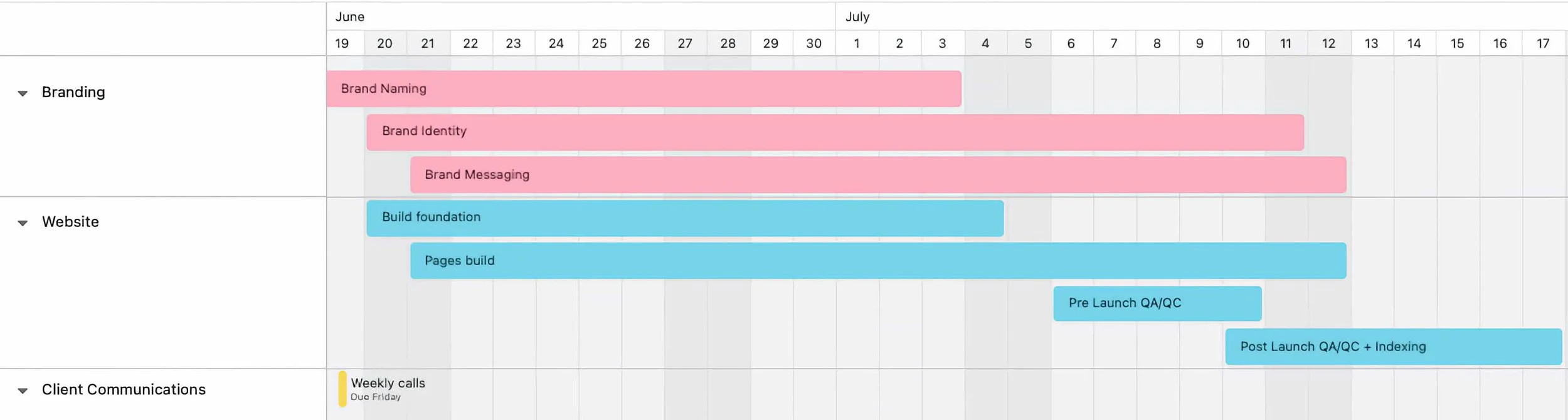
30 Day Sprint Simple Gantt Chart
Proposal Summary
Comparisons & Your Price
No one wants to feel like a dumbo overpaying an outside firm.
We get it. We abhor 99% of advisors and agencies. Our industry has a lot of snake oil.
If you’re going to try to compare bid costs, you must examine the exact same
QCD+F: Quality, Cost, Deliverability + Flexibility
Average Agency Rate
$18,563
Tocobaga’s Normal Rate
$3,434
Your Wareagle Discounted Tocobaga Rate
$769
-
Based on the market analysis and the specific 30-day timeline here is a summary of the pricing data:
Consolidated 30-Day Sprint Rate: The most accurate market rate for an agile agency executing this exact 30-day scope is between $15,000 and $25,000. Agencies utilizing a strict sprint methodology—which includes the fixed weekly decision calls to prevent scope creep—often price these comprehensive web and branding packages starting around a flat $15,000. Given the specialized commercial real estate focus required to emulate an authority brand like Warehouse Hotline, presenting a target price of $18,500 to $24,500 is highly defensible.
Specialized Commercial Real Estate Rate: If you were to hire a traditional marketing firm that strictly specializes in commercial real estate (developers, investment firms, and brokerages), the cost for a full brand identity combined with a custom website typically ranges from $30,000 to $65,000.
Decoupled Standalone Costs: To further prove the value of the 30-day package, if you purchased the timeline's deliverables separately from traditional agencies, the costs would be substantially higher:
Brand Naming: $15,000 to $30,000 for an entry-level boutique naming agency.
Brand Identity & Messaging: $5,000 to $20,000+ for foundational visual systems and strategic positioning.
Authority Website (8-12 Pages): $8,000 to $15,000 for a custom, professionally indexed service-business build.
Ultimately, compressing these high-value deliverables into a single, aggressively managed 30-day timeline allows productized agencies to offer the suite at a massive discount compared to traditional retainers.
-
Strategic Cost Analysis: Market Valuations for a 30-Day Commercial Real Estate Branding and Website Sprint
Executive Summary and Market Context
The commercial real estate landscape is undergoing a profound digital transformation, systematically pivoting away from traditional, relationship-reliant generalist brokerages toward hyper-specialized, digitally native authority brands. The objective of establishing a digital headquarters capable of functioning as a primary credibility asset requires a highly focused deployment of capital, strategic positioning, and creative resources. The proposed engagement under review—a highly structured 30-day sprint designed to deliver brand naming, visual identity, core messaging, and an indexable, authority-building website—represents a modern productized agency service intended to rapidly accelerate market entry.
This analysis evaluates the exact market costs associated with executing this specific scope within the commercial and industrial real estate vertical. By synthesizing pricing data from top-tier branding firms, specialized web development agencies, and dedicated commercial real estate marketing partners, the analysis establishes a defensible, empirical pricing baseline. This baseline serves as the necessary financial proof to justify the costs of executing an accelerated go-to-market strategy. The proposed 30-day timeline involves concurrent workstreams, strict client communication protocols characterized by weekly twenty-minute synchronous decision calls, and the rapid deployment of a scalable digital foundation.
Crucially, this digital foundation is not intended to be a generic placeholder. The explicit directive is to mimic the successful market positioning of specialized firms within the industrial and warehouse sectors, utilizing a specific archetype as the foundational model. Replicating the digital authority of established industrial specialists requires an agency partner capable of understanding complex commercial real estate lexicons, such as Triple Net (NNN) lease structures, industrial outdoor storage zoning, and capitalization rate compression, and translating that knowledge into a high-conversion digital asset. The subsequent sections of this report will deconstruct the target archetype, analyze the proposed execution timeline, and calculate the decoupled and consolidated market value of every deliverable within the sprint.
Deconstructing the Target Archetype: The Industrial Specialist Paradigm
To accurately price the proposed 30-day sprint, it is necessary to first conduct a deep examination of the market positioning it seeks to emulate. The target vertical focuses on industrial real estate, industrial land, warehouse properties, and related commercial opportunities. The strategic principle driving this initiative is that a specialist brand creates substantially more trust, brand recall, and search engine relevance than a generalist commercial real estate brand. When an investor or logistics firm requires a highly specific property type, they actively seek out brokers whose entire digital ecosystem reflects an unwavering dedication to that single asset class.
The primary archetype identified for this highly focused digital presence is the model utilized by Warehouse Hotline. Operating as a heavily branded, warehouse-focused commercial real estate firm based in Denver, Colorado, this entity provides a blueprint for modern industrial real estate marketing. The firm differentiates itself not solely through its multi-generational expertise in the Denver market, but through an aggressive, multi-channel digital marketing presence that prioritizes high-intent search engine optimization, specialized multimedia content, and a clear focus on industrial and warehouse properties.
The brand positioning of this archetype is aggressively direct. It communicates immediate expertise to property owners, institutional investors, and logistics tenants without diluting its message with residential or generic retail listings. The digital strategy extends far beyond a static brochure website. The archetype leverages advanced marketing techniques, including educational content distributed across platforms like TikTok and YouTube, and a dedicated podcast titled "Commercial Real Estate Secrets" which discusses complex topics such as real estate syndication, capital raising, and Securities and Exchange Commission (SEC) regulations. This level of content saturation establishes the firm as an indisputable authority in the space.
When a new entity seeks to replicate this specialized authority, the digital assets cannot resemble a traditional, bloated commercial real estate website filled with generic, uncurated Multiple Listing Service (MLS) feeds. Instead, the asset must be a focused digital headquarters. The pages must be carefully architected to capture high-intent organic traffic. This requires the creation of specific content silos that address the exact queries potential clients are typing into search engines. For example, the archetype website features dedicated indexable pages dissecting topics such as "Flex vs Traditional Industrial Space," "Triple Net vs Gross Warehouse Leases," and macro-level "Denver Warehouse Pricing" trends. Furthermore, the architecture includes targeted tenant representation strategies, discussing supply chain shifts, multi-site consolidation, and warehouse leasing speeds.
The cost of building a digital asset capable of competing with this archetype is directly tied to the strategic restraint required to keep the platform clean, authoritative, and conversion-optimized. The agency executing the sprint must possess the strategic acumen to write copy that appeals to institutional buyers like Blackstone or Prologis, understanding that these entities utilize digital footprints to evaluate the sophistication of local brokers before initiating contact. Specialized commercial real estate agencies recognize the extraordinarily high lifetime value of an industrial property client and price their branding and development services accordingly to reflect the massive return on investment a single successful digital lead can generate. The market rates for achieving this level of niche authority will be explored in the subsequent valuation sections.
Granular Analysis of the 30-Day Operational Timeline
Traditional marketing and branding agency engagements often span three to six months, a duration characterized by hourly billing structures, continuous scope creep, and protracted feedback loops that ultimately dilute the initial strategic vision. The 30-day sprint model is a deliberate operational compression designed to eliminate administrative bloat and force rapid decision-making from all stakeholders. To accurately evaluate the market cost of this service, the specific temporal execution of the proposed scope must be analyzed.
Based on the provided project timeline mapping, the 30-day sprint operates on a highly synchronized schedule of concurrent workstreams. The timeline commences on June 19th and culminates exactly thirty days later on July 17th. This schedule is not merely a theoretical framework; it requires precise project management to ensure that sequential dependencies do not cause critical failures.
The first major phase, Branding, is subdivided into three overlapping disciplines. Brand Naming is initiated on Day 1 (June 19th) and is allocated a strict fifteen-day window, concluding on July 3rd. This necessitates rapid linguistic exploration, domain availability checks, and preliminary trademark screening. Concurrent with the naming process, Brand Identity development begins on June 20th and extends through July 11th. The fact that visual identity work begins only one day after the naming process starts implies a highly agile creative environment where color palettes, typography, and logo systems are developed in abstract before the final name is securely locked. The third branding component, Brand Messaging, initiates on June 22nd and runs through July 13th, ensuring that the copywriting evolves alongside the visual aesthetic.
Parallel to the branding efforts, the Website development workstream is aggressively scheduled. The "Build foundation" phase begins on June 20th, a mere twenty-four hours after the project kickoff, and concludes on July 4th. This indicates that the agency is establishing the core Content Management System (CMS) architecture, technical SEO scaffolding, and server environments before the brand identity is even finalized. The "Pages build" phase, where the actual content and visual identity are populated into the foundation, runs from June 21st to July 12th. This massive overlap between the identity, messaging, and page build phases highlights the necessity of utilizing modern, flexible web development platforms—such as Webflow or headless WordPress architectures—that allow developers to apply global class changes to a site instantaneously as the brand guidelines solidify.
The final segment of the timeline is dedicated to rigorous quality assurance and launch protocols. Pre-Launch QA/QC is scheduled tightly between July 7th and July 10th. Following the finalization of the page builds, the Post-Launch QA/QC and Indexing phase occupies the final week from July 11th through July 17th. This period is critical for ensuring that the newly minted digital headquarters is submitted to search engines properly, with all meta descriptions, schema markup, and mobile responsiveness verified to guarantee the "index properly" requirement of the project scope.
A critical operational requirement that underpins this entire 30-day timeline is the client communication protocol. The timeline explicitly denotes "Weekly calls Due Friday" occurring on June 19th, June 26th, July 3rd, July 10th, and July 17th. These twenty-minute synchronous decision calls are the linchpin of the sprint methodology. By forcing all stakeholder feedback and approvals into a rigid end-of-week checkpoint, the agency prevents the asynchronous communication bottlenecks that typically derail digital projects. Market data indicates that agencies offering fixed-price sprints rely heavily on these strict sync meetings to maintain their internal profit margins and guarantee the delivery timelines to the client. The cost of the sprint, therefore, includes the premium for this highly managed, risk-mitigated project management structure.
Market Valuation of Foundational Brand Architecture
When pricing marketing services, agencies generally utilize one of three models: hourly billing, value-based retainers, or productized fixed-fee sprints. The proposed 30-day timeline firmly places this project into the productized sprint category. However, to provide comprehensive proof of valuation, it is necessary to dissect the sprint into its component deliverables and analyze what traditional agencies charge for these services on a standalone basis. This granular breakdown demonstrates the immense cumulative value consolidated within the thirty-day operation.
The Financial Premium on Brand Naming
The inclusion of Brand Naming within the first fifteen days of the sprint is a massive value driver that significantly elevates the overall cost of the package. Naming is widely considered one of the most arduous, legally complex, and strategically vital creative processes in the marketing industry. The depletion of available primary dot-com domains and the extreme density of existing commercial trademarks mean that generating a name that is simultaneously direct, memorable, and legally defensible requires specialized expertise.
According to Tanj, a highly regarded specialized naming agency, a professional brand naming engagement typically incurs costs ranging from $15,000 to $150,000 for a full engagement. The pricing is heavily dependent on the agency's experience, the number of names being developed, and the depth of trademark screening required. Even at the entry-level boutique tier, which is designed for early-stage startups needing a single name rapidly with lighter legal exposure, the cost ranges between $15,000 and $30,000. A mid-market naming engagement, which includes thorough positioning strategy, multiple linguistic development rounds, and preliminary trademark screening to weed out obvious conflicts, commands $35,000 to $75,000.
Other industry data corroborates these exorbitant figures. Clutch, a primary directory for B2B service providers, indicates that standalone brand name development packages at reputable firms can cost a flat $25,000, while combined naming and identity development easily reaches $75,000. The agency River + Wolf, which specializes in trademark discipline and corporate branding, consistently prices its naming services within these premium brackets. Catchword, another top-tier naming firm, emphasizes that naming cannot happen in a vacuum; it requires customized research, cultural checks, and domain strategy, all of which justify the high barrier to entry.
For the proposed real estate sprint, the agency is tasked with developing name options that prioritize directness, word-of-mouth clarity, domain availability, and alignment with the industrial, land, and warehouse positioning. The directive explicitly eschews overly clever or decorative names in favor of practical usability. Providing this highly specialized service as a mere fraction of a 30-day sprint effectively absorbs tens of thousands of dollars of traditional agency value into a single, accelerated package. If a client attempts to procure this service independently, the baseline market expectation for a legally screened, strategically viable commercial real estate brand name is no less than $10,000 to $15,000.
The Economics of Visual Identity and Strategic Messaging
Beyond the nomenclature, the visual identity and the strategic messaging form the psychological and authoritative core of the new brand. Professional visual identity development encompasses the creation of logo systems, expansive color palettes, typography hierarchies, visual styling guidelines, brand patterns, iconography, and social asset frameworks. This is not a simple logo acquisition; it is the construction of a comprehensive design ecosystem that dictates how the brand will be perceived by institutional investors and property owners.
Market data sourced from Dribbble and independent agency pricing guides indicates that professional brand identity design ranges significantly, typically falling between $2,500 and $30,000 depending on the depth of the guidelines and the prestige of the agency. Boutique agencies and small studios typically charge between $5,000 and $20,000 for a full discovery process resulting in a custom visual system. This specific tier is the most appropriate comparable for the proposed real estate brand, as it avoids the generic, strategically hollow templates of sub-$1,000 freelancers on platforms like Fiverr, but does not necessitate the $100,000 to $200,000+ enterprise-level transformation required by global, publicly traded corporations.
Strategic brand messaging is an equally critical cost center, especially when a firm is pivoting from a generalist commercial model to a hyper-specialized industrial model. The messaging must flawlessly articulate the firm's unique knowledge, differentiating it from residential brokers who occasionally dabble in commercial spaces. The messaging deliverable includes the formulation of a core positioning statement, a primary value proposition, target audience pain points, service category language, and prospect-facing copywriting direction. The copy must explicitly define what the firm does, who it helps, what types of warehouse or land properties matter most, and why an investor should engage immediately.
Developing this level of specialized copy commands its own distinct premium. Market rates for professional brand voice and messaging typically range from $2,500 to $20,000 for standard B2B applications, with extensive messaging frameworks reaching up to $50,000 at larger enterprise agencies. The cost is driven by the research required to understand the nuances of the specific vertical. When combined, the visual identity and messaging components carry a median decoupled market value of $10,000 to $25,000 when executed by a competent, mid-tier boutique branding agency.
Branding Service DeliverableMinimum Market RateMedian Market RateEnterprise/Specialized RateStrategic Brand Naming$5,000$15,000$35,000 - $150,000+Visual Identity Design$2,500$10,000$30,000+Brand Voice & Messaging$2,500$8,500$20,000 - $50,000+Sum of Decoupled Branding$10,000$33,500$85,000+
The table above illustrates the inherent financial leverage of the 30-day sprint model prior to even factoring in the website development. Procuring naming, identity, and messaging from disparate agencies results in a median cost exceeding $30,000. Compressing these deliverables into a synchronized 30-day operation requires intense labor but allows productized agencies to offer the suite at a consolidated, highly competitive rate.
Valuation of Web Architecture and Search Engine Indexability
The final major deliverable of the proposed sprint is the website itself, alongside the requirement that it contains enough pages to establish market authority and is structured to index properly with search engines. The scope explicitly calls for an authority-building digital headquarters, completely avoiding the trap of building a bloated content library or a complex, unmanageable property listing portal.
Defining "Enough Pages to be an Authority"
In the context of specialized commercial real estate, search engine algorithms and institutional buyers evaluate authority based on the depth and specificity of the content provided. A single-page landing site is insufficient to rank for high-value organic search terms or to convince a logistics firm that the brokerage possesses deep market knowledge. To achieve the mandate of having "enough pages," the site architecture must utilize a siloed approach.
Drawing from the Warehouse Hotline archetype, an authoritative industrial real estate site requires a minimum foundational structure comprising:
A high-conversion Homepage that immediately states the specialized value proposition.
An About/Credibility section detailing the principal broker's expertise, transaction history, and institutional knowledge.
A dedicated page for Industrial Real Estate sales and acquisitions.
A dedicated page for Warehouse Leasing Strategy, addressing concepts like Triple Net vs. Gross leases.
A dedicated page for Industrial Outdoor Storage (IOS) or Industrial Land.
A Tenant Representation page detailing supply chain shifts and multi-site consolidation strategies.
A comprehensive FAQ section addressing local market pricing, cap rates, and zoning objections.
A Contact and Inquiry path optimized for high-net-worth lead capture.
This architectural requirement dictates a custom build of approximately eight to twelve highly specialized pages. The pages must feature a foundational SEO structure, including optimized metadata, schema markup for local businesses, and seamless mobile responsiveness to ensure the site indexes properly during the Post-Launch QA/QC phase in mid-July.
Market Pricing for High-Performance Web Development
Website development pricing is highly variable, dictated by page count, custom functionality requirements, the underlying technology stack, and the agency's geographical location. Data across the marketing industry indicates that most mid-level agency projects involving custom design and basic development range between $10,000 and $30,000.
Examining the sprint-specific agency market reveals precise comparables. Creative Corner Studio offers a 30-day "Growth-Ready Website" sprint for a fixed price of $15,000. This package mirrors the proposed real estate scope with remarkable accuracy. The $15,000 fixed fee covers a visual identity refresh, custom visuals, a homepage, five additional authority pages, a complete design system, full CMS setup tailored for self-management, technical SEO/GEO optimization, weekly synchronous meetings, and full Quality Assurance. The use of modern platforms like Webflow allows these agencies to bypass the sluggish timelines of traditional custom coding while delivering enterprise-grade aesthetics and performance.
Other regional competitors exhibit similar pricing structures for this level of depth. Tampa-based agency Rawcut Creative prices a small business service site—defined as eight to twelve pages, mobile optimization, on-page SEO foundations, and a manageable CMS—between $8,000 and $15,000. If the client requires stronger SEO architecture, copywriting support, and up to twenty-five pages, the price scales to between $15,000 and $30,000. Another competitor, Thirteen05 Creative, states that all custom, performance-driven websites start at $6,850, encompassing strategic planning, conversion-focused layouts, and strong foundational SEO structures, but this is a starting baseline that rapidly escalates with additional authority pages. Bold Thinkers Group offers a "Growth Engine" package featuring up to ten custom pages and conversion-optimized design, which aligns perfectly with the requirement for enough pages to establish specialized authority.
Furthermore, the specific demands of the real estate vertical drive website development costs upward. According to industry analyses by Luxury Presence, a fully custom real estate website in the current market starts at a minimum of $5,000 and frequently exceeds $25,000, depending heavily on the complexity of third-party property integrations and lead capture architecture. While the initial 30-day sprint explicitly avoids building a bloated machine or a complex MLS-integrated portal, the foundation must be robustly engineered to support future Google Ads campaigns, outbound prospecting efforts, and CRM automations. If the site fails to load quickly or lacks conversion architecture, subsequent advertising spend will be entirely wasted. Therefore, the baseline market cost for designing and building this 8-to-12 page indexable digital headquarters sits comfortably between $10,000 and $20,000 in the current professional agency market.
Web Development ScopeMinimum Market RateMedian Market RatePremium/Complex RateBasic Template Site (1-3 Pages)$1,500$3,500$5,000Custom Authority Site (8-12 Pages)$8,000$15,000$25,000Enterprise Real Estate Portal$25,000$40,000$100,000+
The Operational Economics: Traditional Retainers versus Productized Sprints
To fully provide proof of pricing to the client, it is necessary to explain why agencies charge what they do, and how the specific constraints of the 30-day timeline alter the fundamental economics of the engagement. The divergence in pricing across the market—from a $3,300 minimum viable product build to a $65,000 specialized agency package —highlights the commoditization of technical execution versus the premium placed on strategic positioning and operational efficiency.
The Cost of Hourly Billing and Scope Creep
In traditional agency environments, client communication and unending revision loops are massive sources of margin erosion. An agency billing hourly will typically charge between $100 and $200 per hour for senior design and strategy work. Clutch data indicates that the average cost of hiring a branding agency in the United States is $100 to $149 per hour across services like brand messaging, brand strategy, and corporate branding.
When a project lacks rigid boundaries, multi-hour strategy workshops, meandering stakeholder committee meetings, and unbounded revision rounds consume hundreds of billable hours. A traditional website and branding project spread over three to four months can easily consume 150 to 300 hours of agency time. At an average blended rate of $150 per hour, the raw labor cost to the client scales rapidly from $22,500 to $45,000. To protect themselves against indecisive clients, traditional agencies often pad their fixed-bid proposals by 20% to 30% simply to account for anticipated delays.
The Financial Efficiency of the 20-Minute Weekly Sync
The 30-day sprint methodology explicitly circumvents this administrative bloat. The communication architecture required by the prompt—"weekly 20 minute calls for decisions"—drastically influences the pricing model. By restricting synchronous communication to a brief, highly focused weekly checkpoint (scheduled on Fridays according to the timeline), the agency reclaims dozens of hours typically lost to project management overhead.
The onus is shifted onto the client to complete prerequisites rapidly. To keep the sprint on schedule, the client must decide whether to pursue a personal brand or a standalone category brand, answer key positioning questions regarding ideal buyers and sellers, and supply necessary assets like headshots and professional bios prior to the weekly syncs.
Because the agency's operational risk is mitigated by this strict framework, the agency does not need to build excessive contingency buffers into the price. This operational efficiency is precisely what allows an agency like Creative Corner to offer a comprehensive 30-day sprint for a flat $15,000, or for an agency like Nextstack to offer a 30-day Launch Pack for $5,000 AUD. The fixed timeline and disciplined communication protocol transform a bespoke, unpredictable creative service into a high-margin, scalable product. When presenting a price to the client, this structural efficiency must be highlighted as the primary reason the sprint is cost-effective relative to a traditional, open-ended agency retainer.
The Premium of Commercial Real Estate Specialization
While operational efficiency drives costs down, the specific target vertical drives costs up. Pricing a marketing sprint is not done in a vacuum; the commercial and industrial real estate market applies a significant multiplier to the baseline cost. The financial magnitude of a single transaction in this sector—whether leasing a 50,000-square-foot distribution center or brokering the sale of industrial land—is enormous. Consequently, the marketing assets required to secure these transactions must exude absolute authority, institutional trust, and flawless industry literacy.
Generalist web design agencies often lack the nuanced understanding required to position an industrial real estate broker. They may default to residential real estate templates, utilizing imagery of single-family homes, generic cityscapes, or lifestyle photography, which actively undermines the credibility of an industrial specialist seeking to attract supply chain executives.
Agencies that possess deep sector expertise in commercial real estate command a substantial premium for their domain knowledge. For instance, Splash Creative, an agency explicitly specializing in real estate developers, investment firms, and brokerages, prices a comprehensive brand identity between $15,000 and $40,000. When a custom commercial real estate website is added to the brand package, their minimum engagement scales to between $30,000 and $65,000.
Similarly, Torque Network, which engineers websites and brands specifically for maximum customer engagement in real estate, quotes full brand strategy and design systems at $5,000 to $10,000, with custom property or portfolio websites adding an additional $10,000 to $25,000 to the engagement. B2B marketing agency retainers that handle complex brand strategy and positioning typically range from $3,000 to $25,000 per month, with comprehensive project-based engagements such as brand refreshes and website builds ranging from $15,000 to $100,000 depending on the specific deliverables.
The decision to emulate a brand like Warehouse Hotline necessitates this level of specialized sophistication. A generalist agency cannot easily replicate the tone, terminology, and structural hierarchy required to establish authority on complex industrial topics without extensive, billable education from the client. Therefore, if the client seeks an agency that already understands the industrial real estate lexicon, the cost of the 30-day sprint will trend toward the higher end of the spectrum. The client is paying to bypass the agency's learning curve.
Strategic Synthesis and Final Valuation Models
The directive of this analysis is to establish definitive proof of market pricing for a 30-day Sprint encompassing Brand Naming, Brand Identity, Brand Messaging, and an authority-building, properly indexed website, complete with a structured 20-minute weekly communication protocol.
The empirical data demonstrates unequivocally that delivering this expansive scope within a highly compressed thirty-day window requires a sophisticated, productized operational framework. The inclusion of brand naming—a service that routinely commands $15,000 to $30,000 on its own at reputable boutique firms —alongside custom website development, which averages $15,000 for mid-market service businesses , establishes a high foundational valuation. If a client were to procure naming, identity, messaging, and web development from disparate agencies on standard hourly or retainer models, the median cost would easily approach or exceed $45,000 to $50,000.
By compressing these deliverables into a synchronized 30-day operation with strict feedback loops, productized agencies can offer the entire suite at a consolidated rate. Based on an exhaustive synthesis of the available market data, the pricing for this exact 30-day scope can be categorized into three distinct tiers, providing the empirical proof required to present and justify a competitive price to the client.
Agency Execution TierEstimated Price RangeStrategy DepthDelivery ModelIndustry ExpertiseTier 1: Budget / Freelance Assembly$3,500 - $8,000Minimal (Client-led)Template ModificationGeneralist B2C/B2BTier 2: Agile Productized Sprint Agency$12,500 - $25,000High (Collaborative)Custom CMS (Webflow/WP)Advanced B2B GeneralistTier 3: Specialized Commercial RE Firm$30,000 - $65,000+Profound (Agency-led)Enterprise CustomNiche Industrial/CRE
Detailed Tier Breakdown
Tier 1: The Budget Model ($3,500 – $8,000) At this tier, the execution is highly commoditized. The client will likely work with independent freelancers or offshore development teams assembling pre-built WordPress or Squarespace templates. Strategic positioning is virtually non-existent; the agency will rely entirely on the client to dictate the brand name, write the commercial real estate copy, and provide all creative direction. The lack of strategic positioning almost guarantees the brand will fail to achieve the specialized authority required to emulate the Warehouse Hotline archetype. This tier represents a high risk of capital waste for an industrial real estate firm.
Tier 2: The Agile Sprint Agency ($12,500 – $25,000) This tier represents the optimal balance of speed, quality, and cost. It comprises highly competent, agile domestic agencies that utilize fixed-price sprint methodologies. They employ modern, rapid-deployment tech stacks and possess dedicated strategists to handle identity and messaging. They enforce the strict timelines and twenty-minute synchronous communication protocols requested to protect their margins while delivering agency-quality assets in thirty days. The price point reflects a fair exchange of value for senior-level execution without the administrative bloat of traditional open-ended retainers.
Tier 3: The Specialized Commercial Real Estate Marketing Firm ($30,000 – $65,000+) At the premium tier, the client is purchasing profound industry expertise alongside execution. These agencies already understand the nuances of industrial property marketing, institutional buyer personas, and complex lease structures. They can immediately architect a brand that speaks the exact language of logistics executives and property owners. While this tier virtually guarantees high-fidelity market alignment, the deep strategic research often causes timelines to stretch beyond the desired 30-day sprint window, and the capital outlay is significant.
Final Valuation Conclusion
If the objective is to execute this 30-day sprint utilizing a competent, agile agency capable of deploying modern architectures while providing senior-level strategic messaging and identity design, the verifiable, data-backed market rate sits squarely between $15,000 and $25,000.
Agencies that successfully productize comprehensive 30-day sprints, such as Creative Corner Studio at $15,000 for a comparable web and branding package , represent the absolute floor for high-quality, comprehensive delivery of this scope. However, given the stringent requirements to generate a viable brand name, position the brand as a specialized authority in the highly lucrative industrial real estate sector, and build enough indexed pages to mimic established market leaders, a pricing premium toward the higher end of that bracket is entirely justified.
Therefore, presenting a final target price of $18,500 to $24,500 for this exact 30-day scope is highly defensible. It falls comfortably within the median range of professional digital agencies, represents a massive operational discount compared to specialized real estate agencies that charge upwards of $65,000, and provides the rapid speed-to-market necessary to transition the business into a highly profitable, digital-first industrial specialist. This figure serves as the definitive proof required to confidently quote the project value to relevant stakeholders.
DISCOUNT
SHOT
CLOCK
Quick-Start Next Steps
Administrative & Clerical Tasks
Invoice is deposited - either total for the month or deposit.
Tocobaga begins working
Tocobaga receives access to Tech Stack and any relevant brand collateral
Quick-Start onboarding will not be sequential - aka might be a little out of order than our normal process
Tocobaga will send over Company Services Agreement
Tocobaga will start a Slack workspace for internal communication. If you use another internal communication app, we can integrate Slack with other apps e.g. Slack two-way sync with Teams.
Tocobaga will coordinate a recurring, update meeting cadence - usually once a week initially and then every 2 weeks once we build a rhythm. If clients cannot attend because of schedule conflicts, we will record an update video and send via Slack.
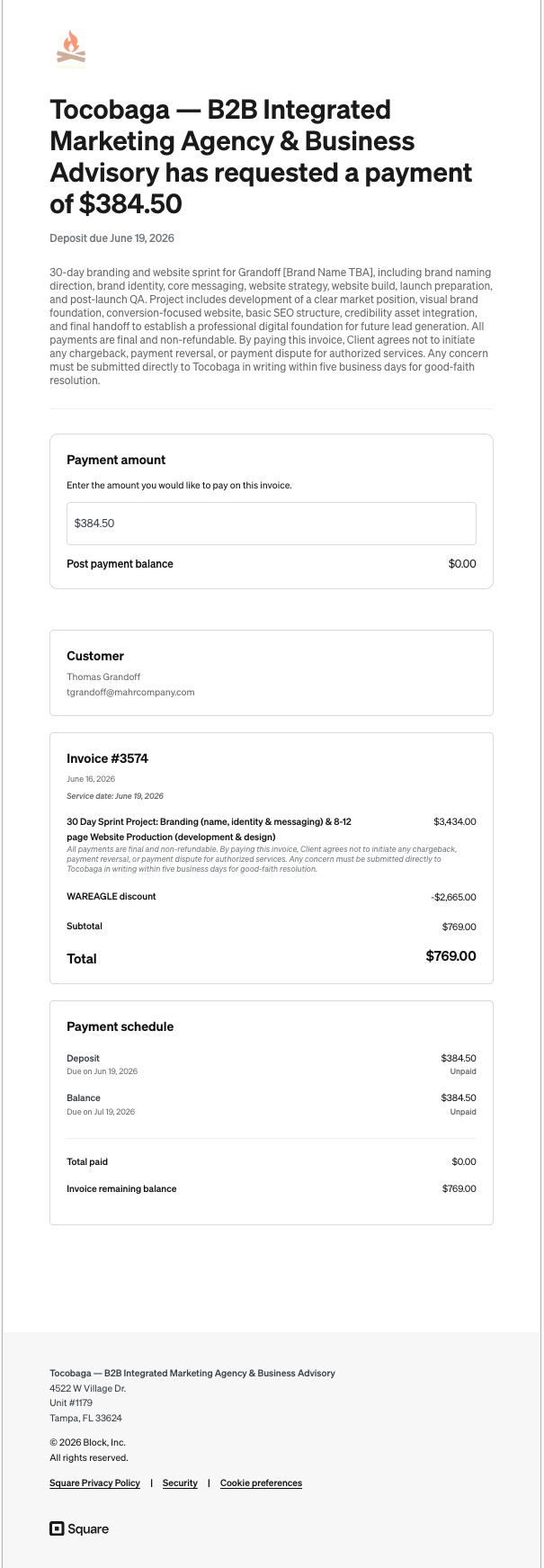
If we’re ready to go right now, the button to the invoice is below or click on the invoice image to the right. Once the invoice is paid, we begin.
Let’s Go ➳
ABOUT
TOCOBAGA
a
B2B, B2C SMB Strategic Advisory
&
Omni-channel, Integrated Marketing Agency
Fractional CMO FAQs
-
A Fractional CMO (Chief Marketing Officer) is a part-time or shared resource hired by a company to provide strategic marketing leadership. This arrangement allows businesses to access high-level marketing expertise without the cost of a full-time executive.
-
A Fractional CMO typically handles various aspects of marketing strategy, planning, and execution. Their responsibilities may include market analysis, brand development, campaign management, and team leadership. They work on a part-time basis, providing strategic guidance to help businesses achieve their marketing goals.
-
1. Cost-Effective: Fractional CMOs offer high-level expertise without the full cost of a permanent executive, making it a cost-effective solution for businesses.
2. Flexibility: Companies can scale their marketing leadership up or down based on their needs, without the commitment of a full-time hire.
3. Diverse Experience: Fractional CMOs often bring diverse industry experience, providing fresh perspectives and insights to the marketing strategy.
4. Strategic Guidance: These professionals offer strategic guidance, helping businesses align marketing efforts with overall business objectives.
5. Access to Networks: Fractional CMOs may bring valuable industry connections and networks, enhancing opportunities for partnerships and collaborations.
6. Objective Perspective: Being external to the organization, Fractional CMOs can provide unbiased and objective viewpoints on marketing strategies.
7. Quick Onboarding: As seasoned professionals, Fractional CMOs can quickly adapt to the business environment, accelerating the onboarding process.
8. Task-Specific Expertise: Companies can engage Fractional CMOs for specific projects or challenges, tapping into their expertise for targeted improvements.
9. Risk Mitigation: Businesses can mitigate the risk associated with hiring a full-time CMO by testing the waters with a fractional arrangement.
10. Efficiency: With a focus on strategic planning, Fractional CMOs can optimize marketing processes for efficiency and effectiveness.
Why would a SMB hire a Fractional CMO?
Small and Medium-sized Businesses (SMBs) might choose to hire a Fractional CMO for several reasons:
1. Cost Efficiency: SMBs often have budget constraints, and a Fractional CMO allows them to access high-level marketing expertise without the cost of a full-time executive.
2. Flexibility: The variable nature of marketing needs in SMBs can be addressed with a part-time resource, adjusting the level of expertise based on the business's current requirements.
3. Strategic Insight: Fractional CMOs bring strategic thinking and experience, helping SMBs develop effective marketing strategies aligned with their business goals.
4. Resource Optimization: SMBs may not need a full-time CMO, making a fractional arrangement a practical way to optimize resources and focus on key priorities.
5. Quick Impact: Fractional CMOs can swiftly assess the marketing landscape, identify opportunities, and implement strategies to generate quick and impactful results.
6. Access to Networks: SMBs can leverage the networks and industry connections of Fractional CMOs, opening doors to potential partnerships and collaborations.
7. Task-Specific Projects: SMBs can engage a Fractional CMO for specific projects or campaigns, tailoring the arrangement to address immediate marketing needs.
8. Objective Perspective: An external CMO can provide an unbiased and objective viewpoint, offering insights that might be challenging to achieve with an in-house team.
9. Risk Mitigation: Hiring a full-time executive involves risks, but a fractional arrangement allows SMBs to test the waters and evaluate the impact of senior marketing leadership.
10. Learning Opportunity: SMBs can benefit from the knowledge transfer that occurs when working with an experienced Fractional CMO, helping build internal marketing capabilities over time.
-
short answer: engagement, commitment, and scope of responsibility
more detailed answer:
1. Time Commitment:
- Fractional CMO: Works on a part-time or project-specific basis, dedicating a limited number of hours per week or month to the organization.
- Full-time CMO: Is a permanent, full-time employee committed to the organization on a daily basis.
2. Cost Structure:
- Fractional CMO: Typically charges on an hourly or project basis, providing a more cost-effective solution for businesses with budget constraints.
- Full-time CMO: Involves a fixed annual salary, potentially with additional benefits, which may be a higher financial commitment for the organization.
3. Scope of Responsibilities:
- Fractional CMO: Focuses on specific strategic initiatives, projects, or areas of expertise as agreed upon with the organization.
- Full-time CMO: Assumes a broader range of responsibilities, overseeing the entire marketing department and contributing to overall business strategy.
4. Flexibility:
- Fractional CMO: Offers greater flexibility, allowing organizations to scale up or down based on their evolving marketing needs.
- Full-time CMO: Represents a more fixed and consistent presence within the organization, which may be less adaptable to changes in workload.
5. Depth of Involvement:
- Fractional CMO: Often works at a more hands-on level, directly involved in strategy development and execution.
- Full-time CMO: Balances strategic leadership with managerial responsibilities, overseeing day-to-day operations and team management.
6. Long-Term Commitment:
- Fractional CMO: May be engaged for specific projects, a defined period, or on an ongoing but part-time basis, providing a more flexible arrangement.
- Full-time CMO: Implies a longer-term commitment to the organization, with a focus on sustained leadership and relationship building.
-
short-answer: adaptability, agility, resources, communication, wisdom (experience x knowledge)
long answer:
1. Diverse Perspectives: A Fractional CMO with varied industry experience can offer diverse perspectives and insights, bringing a fresh and innovative approach to marketing strategies.
2. Cross-Industry Best Practices: They can bring best practices from different industries, adapting successful strategies and tactics to the specific needs of the organization.
3. Benchmarking Opportunities: With exposure to various industries, a Fractional CMO can provide valuable benchmarking data, helping the organization understand how its marketing performance compares to similar businesses in different sectors.
4. Adaptability: The ability to adapt strategies from one industry to another can be a key advantage. The Fractional CMO can leverage successful techniques across different markets, promoting adaptability and agility.
5. Network Access: Their extensive network across industries can open doors to potential partnerships, collaborations, and industry-specific opportunities that may not be readily apparent within a single-sector focus.
6. Innovation and Creativity: Exposure to diverse industries fosters innovation and creativity. A Fractional CMO can bring a rich mix of ideas, drawing on experiences beyond the confines of a single sector.
7. Risk Mitigation: They can provide insights into potential risks and challenges by drawing on experiences from various sectors, helping the organization proactively address issues before they become significant problems.
8. Market Trends Awareness: A Fractional CMO engaged with multiple clients in different industries stays attuned to a wide range of market trends. This knowledge can be invaluable in staying ahead of industry changes and emerging opportunities.
9. Customization for Unique Markets: Leveraging experience in various industries, the Fractional CMO can tailor marketing strategies to suit the unique characteristics and challenges of the organization's specific market.
10. Continuous Learning: A Fractional CMO involved in diverse industries is likely to be a continuous learner, staying updated on the latest trends, technologies, and strategies across various sectors, which can benefit the organization.
-
1. Fractional CMO:
- A Fractional CMO typically refers to a part-time or shared Chief Marketing Officer who provides strategic marketing leadership to organizations on a flexible basis.
- They might work with multiple clients simultaneously, dedicating a certain number of hours per week or month to each client.
2. Interim Fractional CMO:
- An "Interim Fractional CMO" could imply a temporary or transitional role where the Fractional CMO is specifically engaged to fill a gap or address a short-term need.
- The "Interim" aspect suggests a focus on providing leadership during a transitional period, such as when a company is between full-time CMOs or undergoing significant changes in its marketing strategy.
SERVICES
-
OVERALL STRATEGY
CAMPAIGN STRATEGIES
TACITICAL STRATEGIES
-
SMART Goals, Benchmarks + KPI Planning
-
- Audiences
- Targets
- Find out 4 Holy Metrics:
- Cost Per Lead
- Cost Per Acquisition
- Average Revenue of a customer within 1st year
- Lifetime Value
Quick Start Services
Marketing Execution Services
-
Monitoring & Maitenance
Analytics Tracking
SEO (technical)
Live Chat optimization
Build out
* Landing pages by service
* Landing pages by service and city/region
Content
FAQs
Blog posts
-
- PPC
- Google Search Ads
- Bing Search Ads
- Local Services Ads
- AdRoll - cross platform retargeting/remarketing
- Later - platform-industry specific ads w/ Angi, Yelp, etc.
- Social Ads
- AdRoll retargeting ads on FB and IG
- Pinterest might be a great avenue
- Programmatic
- We can get precise targeting
-
- Technical SEO
- At least 1 blog post per month
-
- Automation emails for servicing
- Marketing email campaigns
- New lead automated journeys
-
- Review Capturing
- Review Monitoring
- Directory Listings optimization
-
Traditional Advertising - radio, tv, newspaper, magazine, etc.
Community - sponsorships, focused local corporate responsibility
-
BRANDING:
Brand Development
Brand Identities
Brand Messaging
DESIGN: Any design deliverables needed
Graphic Design, Website Design, UI (User Interface), UX (User Experience), Print Design, Online Ad Design, Video Editing, Image Editing, Custom Illustrations, Newspaper Ads and Design, Magazine Ads and Design, Brick & Mortar Exterior Signage, etc.
Support Services
-
create a Google Data Studio or similar to aggregate analytics into
1) Snapshot
2) by campaign/tactic
-
Setup every task and project in your PM app, Asana?
-
- Starting line: I would want to come in office to War Room around y'all's schedules and work from the office a few days in the beginning. There's always smaller things to absorb just being around that is lost in digital communication
- Slack (or whatever your team uses) for direct communication. We prioritize client communication above email, calls and texts. We keep all conversations in Slack/Teams to have transparency and a searchable knowledge base.
- Update meetings: Weekly until we find a rhythm and go biweekly. I keep them 30 minutes and apply the EOS system to keep it efficient.
-
- Will need to learn your automation processes to streamline any redundant tasks
Possible add-ons services and costs
Online Ad/PPC ad spend without markup
Video Content Production
Purchasing Email Lists via Data Broker
Programmatic Direct Messaging
Approach
Strategy-first approach: work big to small. Macro to Micro. The biggest gaffe in the outsourced marketing services sector is focusing on tactics to begin. Our approach is the following 6 phases:
1. Define Objectives, S.M.A.R.T. goals and Current Analysis & Resource Audit (a current strategy review, branding assessment, resource audit and marketing performance report).
2. Thorough research.
3. Develop a leveraging integrated, omnichannel strategy in lock step communication and approval with the client.
4. Project management execution with respect to achieving KPIs, budgets and resources
5. Analyze quantitative and qualitative reporting.
6. Continuously improve

Strategic plans without execution = a fun idea.
Discipline is the ultimate freedom.
Over-communicate until you have concise shorthand.
Time is a commodity.
Think 3 steps ahead. Contingency plan IFTTT scenarios.
Be agile & adaptable.
The obstacle is the way.
Work short-term and long term at the same time.
Analyze the past while proactively, continuously improve your present and future.
Execute omnichannel, integrated marketing campaigns, online and off.
Work macro and micro.
Generalize and specialize.
Strategic and tactical.
A/B test.
ROI should be the client's main focus and many drill down minutiae. ROI (Return On Investment) is the only thing that matters to our clients (and us). It is the cover image on every one of our proposal decks. It is our mantra; our North Star philosophy. We must provide multiple X ROI for our clients or we cease to exist.