

Red Tree proposal

THE
ONLY
THING
THAT
MATTERS
TO
US
&
OUR
CLIENTS
IS
ROI
Supplemental Video Notes
1,000+
Small-to-Medium Businesses Strategically Advised
600+
Successful Integrated
Marketing Campaigns
7.8X
ROI
Average Client
Return On Investment
300+
Websites Produced
(Developed & Designed)
1,000,000+
High Performing
Emails Deployed
CASE STUDY
Our Commercial Real Estate Client Saw 2020 As An Eventual Blessing - First Disguised As A Curse
The Covid ERA destroyed commercial real estate firms.
With every bad, there's a good. We used this time to re-strategize.
-
We entered The Lockdown with our newly signed client, a Florida-based commercial real estate company, NAME REDACTED, facing a dual challenge of low lead generation and limited brand awareness as it underwent a succession transition from a legacy owner to a new, young CEO. The company needed to revitalize its image and attract potential clients to increase business. Tocobaga initiated a rebranding campaign, focusing on a modern and dynamic image while respecting the company's legacy. We employed a mix of digital and traditional strategies, including a revamped website, selective PR strategies, networking event creations and participation in community efforts utilizing vacant properties to boost brand visibility.
-
We capitalized on the new allotment of time. Planned the next 5 years with SMART goals, benchmarks and KPIs. The company's website underwent a modern redesign to enhance user experience, incorporating a sleek design and showcasing successful case studies. Multiple channels were utilized to highlight the CEO's vision while paying respect to the previous owner's cowboy persona, researched industry insights, and the revamped the client's unique selling propositions. Participation in relevant industry events allowed our client to connect with potential clients and partners.
-
The strategic approach led to a significant uptick in lead generation and brand awareness, resulting in a remarkable 4.1x return on investment (ROI) in the post-Covid Era. The updated website attracted more visitors, and the CEO's active presence on social media contributed to a positive perception of the company. Tocobaga successfully positioned our client as a forward-thinking industry player, gaining trust and interest from potential clients. The successful case study underscores the importance of strategic rebranding and a multi-channel approach to lead generation. Balancing modernity with respect for legacy allowed our client to capture the attention of its target audience, ultimately leading to a substantial ROI and a strengthened market position.
CASE STUDY
Home Services Is Where The Heart Is
People get in routines because that is always how they have been doing it.
"People don't change" isn't our favorite phrase because...well...change is inevitable.
We had to use the big dog hot phrase, Change Management, to achieve our wins in Lead Gen, Sales Ops and Automations.
-
A 40 year old mom-and-pop home services company, NAME REDACTED, faced the challenge of expanding its client base and increasing revenue. Their biggest challenge was the larger, corporate level competition squeezing their market share. To achieve this, NAME REDACTED needed a comprehensive lead generation strategy that would leverage multiple channels and integrate seamlessly to maximize results.
-
Tocobaga implemented a multichannel approach, combining digital and traditional marketing channels. We utilized targeted online advertising, optimized their website for conversions, ran email campaigns, and engaged in local community outreach. The goal was to create a cohesive marketing ecosystem that guided potential clients through the customer journey. Track everything. We also had to clean up their entire CRM of over 40,000 contacts and develop an API to integrate with their field operating software. The company invested in targeted online advertising campaigns to reach a broader audience. Simultaneously, we revamped their website, ensuring it was user-friendly and featured compelling content. Email campaigns were personalized and segmented to nurture leads effectively.
-
The integrated approach proved highly successful, resulting in an outstanding 38.7x return on investment (ROI) in 6 months. The online advertising increased visibility, the optimized website improved conversion rates, and the personalized email campaigns fostered strong customer relationships. The community outreach efforts not only contributed to brand awareness but also generated local leads. We are proud of this well-executed, multichannel lead generation strategy. The seamless integration of online and offline efforts, combined with a focus on user experience and community engagement, led to an impressive ROI. This success emphasizes the importance of a holistic approach in achieving significant outcomes in the competitive home services industry.
CASE STUDY
Challenge Accepted
We typically don't do event marketing.
We saw this as a fun challenge to up our game.
-
In 2016, new, local altruistic organization wanted to partner with a national charity for a mixed used festival event. We faced the challenge of low attendance, little-to-no brand awareness outside of the organization's personal reach and limited funds for their upcoming fundraising event. They needed to boost lead generation to ensure a successful turnout and maximize donations.
-
We implemented a multi-channel marketing strategy, leveraging social media, email campaigns, and partnerships with local businesses. They also optimized their website for user engagement and introduced a referral program to encourage participants to invite others. We utilized the charity's compelling storytelling in their social media posts and emails, highlighting the impact of their cause. They engaged with influencers and community leaders to amplify their message. Additionally, they collaborated with local businesses to sponsor and promote the event.
-
The lead generation efforts exceeded expectations, resulting in an 8.4x return on investment (ROI) and sold out the event with 5,000 attendees. The optimized website attracted more visitors, and the referral program significantly expanded the reach. The event saw a substantial increase in attendance, leading to a successful fundraising outcome that surpassed the charity's initial goals. The success of the lead generation campaign emphasized the importance of a comprehensive, multi-channel approach. Engaging storytelling, influencer partnerships, and community involvement proved to be powerful tools in achieving remarkable ROI for the charity event. We created the marketing machine. This festival has now spawned off 5 additional metropolitan cities using our framework as their blueprint.
Executive Summary
“Leave the campsite better than you found it, and the world will be a better place because of it”
-
Economic and Market Analysis of Residential Tree Services in Tampa Bay: A Financial Architecture for Red Tree Service
Market Context and Operator Profile
The residential tree care industry represents a highly specialized, capital-intensive sector within the broader home services and environmental management market. With the United States tree care industry generating approximately $24.8 billion annually and projecting a 4.2% compound annual growth rate through 2030, local markets are experiencing significant upward pressure on demand.1 This sustained demand is primarily driven by macro-environmental factors, including massive urban canopy expansion initiatives, aging residential housing stock, and an increasing frequency of severe weather events driven by climate shifts.1 In Florida, and specifically within the Tampa Bay metropolitan and Pasco County areas, these macro-economic factors are compounded by localized ecological dynamics. The region features a prevalence of massive heritage live oaks, rapid subtropical growth cycles, complex mangrove coastal regulations, and strict municipal regulatory frameworks governing tree mitigation and removal.2
Within this highly localized and heavily regulated operational environment, Red Tree Service operates as a dedicated residential and commercial tree care provider based in the Tampa Bay area, with operational footprints noted in Dade City, Florida.5 Positioning itself as an expert local provider that strictly adheres to the standards set by the International Society of Arboriculture (ISA), Red Tree Service focuses on a core triad of arboricultural services: precision tree trimming, hazardous tree removal, and complete stump grinding.6 The firm is structurally aligned to capture high-intent demand from residential property owners who require sophisticated hazard mitigation, aesthetic landscaping maintenance, and emergency response services.6
To sustainably scale operations in the hyper-competitive Tampa Bay market, tree service operators must transcend basic arboricultural expertise and master a highly specific set of unit economics. Success in this sector is dictated entirely by the mathematical and operational relationships between the Cost Per Lead (CPL), the true Cost Per Acquisition (CPA) or Customer Acquisition Cost (CAC), the Average Revenue per Customer (Average Ticket Size), and the Customer Lifetime Value (LTV).7 This exhaustive report provides a forensic analysis of these four economic pillars, localized to the Florida and Tampa Bay markets, outlining the strategic financial architecture required for an entity like Red Tree Service to achieve long-term profitability and enterprise scale.
Customer Acquisition Economics and Marketing Efficiency
The digital acquisition of home service customers has become increasingly commoditized, yet it remains highly nuanced in execution. Tree service companies routinely fail to scale or achieve profitability because ownership misunderstands the fundamental economic difference between acquiring a raw lead and acquiring a profitable, closed customer.7 The financial outlay required to generate an inquiry is vastly different from the total cost required to secure a signed contract, and optimizing the acquisition funnel requires a granular, empirical understanding of channel-specific metrics.8
The Misleading Nature of Cost Per Lead (CPL)
Cost Per Lead (CPL) is defined as the gross marketing and advertising expenditure divided by the total number of new leads acquired over a specific measurement period.8 In the national tree care industry, CPL ranges dramatically from as low as $15 to well over $150, largely depending on the source channel, the geographic market density, and the exclusivity of the lead.7 However, analyzing CPL in isolation is a fundamental analytical error that obscures true operational profitability; the cost of a lead is mathematically meaningless without measuring its corresponding close rate.7
The broader environmental services and landscaping sector experiences a blended average CPL of approximately $278 across all paid and organic channels, while specific blended digital strategies (such as Google Ads combined with organic Search Engine Optimization) often yield a blended cost of roughly $57.39.10 However, tree service leads are typically segmented into distinct performance tiers based on user intent and lead exclusivity, which dictate both their upfront cost and their ultimate conversion value.7
Table: Tree Service Lead Cost and Conversion Matrix
Lead Source Type
Upfront Cost Per Lead (CPL)
Lead Exclusivity Dynamics
Average Close Rate
True Cost Per Closed Job (CPA)
Shared Platforms (Angi, Thumbtack, HomeAdvisor)
$15 – $45
Shared concurrently with 3-5 local competitors
12% – 22%
$68 – $375
Google Local Services Ads (LSAs)
$20 – $60 (Spikes to $80-$100 in major metros)
Exclusive to the purchasing business
45% – 60%
$33 – $133
Google Pay-Per-Click (PPC)
$35 – $85
Exclusive to the purchasing business
50% – 70%
$50 – $170
Agency-Managed Exclusive Leads
$50 – $120
Exclusive to the purchasing business
60% – 85%
$59 – $200
Facebook / Instagram Ads
$8 – $35
Exclusive to the purchasing business
5% – 15%
$53 – $700
Data derived from national tree service marketing benchmarks and digital performance aggregators.7
The data explicitly indicates that while shared lead platforms present an artificially low CPL ($15 to $45), the hyper-competitive nature of these leads depresses the close rate to a mere 12% to 22%.7 The resulting race to the bottom in pricing erodes profit margins. Consequently, an operator might purchase 100 shared leads at $30 each (a total marketing investment of $3,000), close only 15 jobs based on the 15% industry average, and generate $33,000 in gross revenue assuming an average job value of $2,200.7 After factoring in standard 40% operating costs, the net profit rests at roughly $7,920, representing a 264% Return on Investment (ROI).7
Conversely, purchasing exclusive leads generated through professional marketing agencies or high-intent search requires a higher upfront investment but yields superior unit economics. Purchasing 100 exclusive leads at $75 each requires a $7,500 investment.7 Because the leads are exclusive, the business is not subjected to aggressive price shopping, which allows the average job value to rise to $2,400.7 An average close rate of 70% yields 70 closed jobs and $168,000 in gross revenue.7 After the same 40% operating costs are applied, the net profit equals $40,320, generating a 537% ROI.7 The analysis proves that the superficially "cheap" shared lead ultimately results in a significantly lower return on investment and a much higher administrative burden.
Cost Per Acquisition (CPA) and Funnel Economics
While CPL measures the cost to generate top-of-funnel interest, Cost Per Acquisition (CPA)—frequently referred to interchangeably as Customer Acquisition Cost (CAC)—measures the total marketing spend required to acquire a single paying customer.8 CPA is the definitive metric for evaluating conversion effectiveness, sales pipeline health, and overarching campaign profitability.8
To calculate CPA, the total marketing spend over a defined period is divided by the exact number of closed customers generated from that spend.8 For example, a tree care company that spends $4,500 on a Google Ads campaign and acquires 45 leads operates at a CPL of $100.10 If the company only closes 18% of those leads into paying customers (8 closed jobs), it will incur a CPA of $562.50.10 In a healthy, sustainable tree service economic model, the CPA should never exceed 20% to 30% of the Average Job Value, and ideally, it should represent less than 10% of the Customer Lifetime Value.10 A robust benchmark target is a CPA of approximately $400 for a residential client that yields an LTV of $3,600, thereby producing a highly sustainable 1:9 acquisition-to-revenue ratio.9
The conversion rate from a raw lead to an acquired customer is highly elastic and depends entirely on internal operational workflows. Empirical research demonstrates that leads contacted within five minutes of submission convert at seven times the rate of leads contacted after just one hour.1 The operational failure to answer inbound calls live during business hours, provide rapid on-site estimates, or implement automated text and email follow-up sequences severely degrades conversion rates, thereby artificially inflating the CPA.1
Closing only 40% to 50% of inbound leads results in massive revenue leakage. Advanced operators solve this bottleneck by implementing a strict five-stage sales process. The first stage requires an immediate response via automated SMS or live dispatch.1 The second stage involves deploying a professional estimator who utilizes tablet software to present "good, better, and best" service options, significantly boosting the average sale value.1 The third stage is a systematic follow-up sequence: sending the estimate on Day 0, executing a follow-up phone call on Day 2, sending a text message on Day 5, emailing neighborhood social proof and reviews on Day 10, and executing a final call on Day 14.1 The fourth stage requires training estimators to navigate common consumer objections regarding price and competitor quotes, while the fifth stage focuses on creating non-pushy urgency based on scheduling limitations or hazard liability.1 Boosting a close rate from 50% to 60% on 60 monthly leads yields six additional customers per month, which can easily equate to nearly $100,000 in recovered annual revenue without increasing the marketing budget.1
A case study involving a Tampa Bay tree service operator, Lee Claxton (an ISA Certified Arborist), illustrates the immense power of optimizing the digital conversion funnel.14 By overhauling the company's outdated website to properly handle high-intent traffic and restructuring self-managed Google Ads to segment the budget toward the most profitable services, the business achieved transformative results in just 90 days.14 The optimization increased the visitor-to-lead conversion rate by an astonishing 905%, decreased the CPL by 78.9%, and improved the overall efficiency of the advertising spend by nearly 120%.14 A similar case study for Eco Tree Experts in West Palm Beach demonstrated a 3x revenue increase by abandoning third-party shared lead platforms in favor of a cohesive strategy combining a highly converting website, SEO, Google Maps, and Local Service Ads.15
Channel-Specific Acquisition Strategies in Florida
In a highly saturated and competitive market like Tampa Bay, allocating the marketing budget across the correct digital channels is critical to managing CPA and ensuring steady crew utilization.16 The most robust acquisition strategy for a residential tree service relies on a multi-channel approach heavily weighted toward high-intent search queries.1
Google Local Services Ads (LSAs) represent the absolute highest priority channel for local operators.1 LSAs appear at the very top of search engine results, feature a highly coveted "Google Guaranteed" trust badge, and operate strictly on a pay-per-lead basis rather than pay-per-click, eliminating wasted spend on browsing competitors.1 Because they capture homeowners actively searching for immediate, urgent solutions—such as "emergency tree removal Tampa"—LSA close rates are exceptionally high, ranging from 45% to 75%.1 While typical LSA leads cost $20 to $60, high competition in major metropolitan areas like Tampa can temporarily drive prices up to $80 or $100 per lead.7 Success on this platform requires a minimum 3.0-star rating, active insurance verification, and a high volume of positive reviews, as companies with over 50 reviews generate three times the call volume of those with fewer than 10.1
Google Pay-Per-Click (PPC) advertising is utilized to scale operations beyond the immediate geographical limitations of LSAs and to target highly specific, high-ticket services like crane-assisted removals, commercial contracts, or large-scale lot clearing.1 PPC leads typically cost between $35 and $85, with true acquisition costs settling between $50 and $170 per closed job.1 Effective PPC management requires rigorous negative keyword strategies to filter out unprofitable searches such as "free tree removal" or "DIY tree trimming".1
Organic search (SEO) and content marketing require a heavy upfront time and financial investment—often $3,000 to $8,000 deployed over four to nine months—but ultimately yield a compounding digital asset.7 Once a local tree service ranks organically in the top three positions for localized keywords (e.g., "stump grinding Dade City" or "arborist Tampa"), the marginal cost per lead drops to near zero.5 This heavily dilutes the blended CPA across the entire company and generates extensive long-term ROI that can exceed 800% to 1,500% over a 12-month period.7 Industry benchmarks dictate that an optimized budget allocation for a startup tree service should dedicate 70% of spend to Google LSAs.1 Growing businesses should allocate 40% to combined Google LSAs and PPC, while established enterprises should push 35% into paid search and transition the majority of their budget into long-term SEO maintenance, content development, and organic asset expansion.1
Revenue Dynamics and Average Ticket Value
The gross revenue generated by a single customer engagement—defined as the Average Ticket Size or Average Job Value—is the primary engine of a tree service's profitability. Unlike subscription-based home services, such as weekly lawn maintenance or monthly pest control, tree removal is an inherently high-ticket, low-frequency transaction. Understanding how to aggressively structure pricing based on operational complexity, ecological factors, species types, and municipal regulatory compliance is paramount for survival.
Baseline Pricing Models and Core Services
Standard tree service pricing is rarely calculated or presented to consumers as a flat hourly rate; instead, projects are priced based on a comprehensive visual assessment of project complexity, tree height, trunk diameter, structural integrity, and site accessibility.2 The foundational operational cost for a tree service crew—including direct labor, equipment depreciation, fuel, and overhead—ranges from $35 to $70 per hour per worker.17 To achieve profitability, businesses must calculate their true hourly cost of operations and apply a 3x to 4x multiplier to establish the customer-facing billing rate.1 If an operation costs $85 per hour to run, the baseline charge to the client must range between $255 and $340 per hour.1
Across the United States, the national average cost to remove a single tree is approximately $750 to $850.18 However, the average job value for a dedicated residential removal specialist typically lands between $1,800 and $4,500, as most residential clients require multiple trees addressed simultaneously alongside premium clean-up services.1 In the Tampa Bay and Southwest Florida markets, base costs are elevated due to specific environmental challenges, coastal access constraints, and a much higher density of massive, hardwood canopy species.18
Tree height and Diameter at Breast Height (DBH)—measured roughly 4.5 feet above the ground—are the two most heavily weighted variables in removal pricing.2 Data synthesized from Tampa and regional Florida operations outlines the following baseline removal pricing tiers based strictly on dimensional scale:
Table: Tampa Bay Average Tree Removal Cost by Height and Species Profile
Tree Size Category
Height Range
Typical Florida Species Profile
Tampa Price Range (Per Tree)
Small / Ornamental
Under 30 feet
Crape Myrtle, Young Pines, Small Palms
$200 – $800
Medium Shade Tree
30 – 60 feet
Red Maple, Sweetgum, Medium Palms
$800 – $2,500
Large Canopy Tree
60 – 80 feet
Mature Live Oak, Longleaf Pine, Ash
$2,500 – $5,000
Very Large / Heritage
Over 80 feet
Old-Growth Oaks, Bald Cypress
$5,000 – $15,000+
Data derived from regional pricing analyses for the Tampa Bay and Southwest Florida markets.2
Beyond the foundational removal cost, Average Ticket Sizes are expanded through the systematic cross-selling of necessary add-on services.2 Stump grinding is almost universally billed as an independent line item, adding $75 to $300 to the invoice depending on the diameter of the stump.2 Full root-ball extraction, required when homeowners plan to pour concrete or install pools over the site, costs between $200 and $1,000+.2 Debris hauling, wood chipping, and log splitting add an additional $50 to $350 per project, particularly if the client does not wish to keep the wood for personal use.19
Operators utilizing a tiered "Premium Removal Package" model—which includes the complete removal of the tree, deep stump grinding to 8 inches below grade, topsoil backfill, and immaculate site cleanup—can command $200 to $300 per foot of tree height, dramatically elevating the gross revenue of a single customer acquisition compared to basic cut-and-drop services.1
Florida-Specific Cost Drivers and Operational Friction
Operating in the Tampa Bay area introduces distinct ecological and operational cost drivers that inflate the Average Job Value while simultaneously demanding significantly higher technical expertise from field crews. The specific methodology of removal heavily dictates the final invoice.2 While simple felling—cutting a tree at the base and letting it fall into an open yard—is highly cost-effective and typically completed in one to three hours, Tampa’s dense, older suburban environments frequently prohibit this approach.2
When trees overhang residential roofs, delicate pool cages, screen enclosures, or utility lines, arborists must utilize highly technical rigging with specialized climbers or bucket trucks.2 This methodology demands slow, methodical dismantling of the tree, pushing the price into the $800 to $3,500 range per tree.2 For severely dead, heavily leaning, or massive heritage trees over 80 feet tall, crane-assisted removal becomes mandatory for safety.2 A crane deployment inherently raises the minimum job cost to $2,000, with complex, multi-day crane removals involving complex rigging systems easily exceeding $10,000 to $15,000 per tree.2
The specific species of the tree also acts as a primary pricing variable. Hardwood species native to Florida, such as the iconic Live Oak, pack massive weight and dense wood volume into a wide, sprawling structural frame.2 Removing a 50-foot, 20-inch DBH laurel oak in a standard Tampa subdivision requires extensive time on the chainsaw, generates multiple heavy chip truck loads, incurs higher commercial disposal site fees, and frequently prices out around $1,200 to $1,800.2 Conversely, Palm trees present unique challenges; despite lacking wide canopies, mature palms are extremely water-dense and heavy, making them expensive to rig and haul, with removals ranging from $650 to $1,800 depending on access.18
Table: Tree Removal Cost by Technical Method in Tampa
Removal Methodology
Typical Time on Site
Tampa Price Range (Per Tree)
Ideal Application Profile
Simple Felling
1 – 3 hours
$200 – $800
Open yards, no targets, small to medium trees
Technical Rigging (Climber/Bucket)
3 – 8 hours
$800 – $3,500
Medium to large trees near homes, fences, pools, and driveways
Crane-Assisted Removal
1 – 3 days
$2,000 – $10,000+
Very large, severely leaning, decayed, or inaccessible trees
Data synthesized from regional methodologies and equipment deployments.2
The alternative to professional service—the Do-It-Yourself (DIY) approach—carries hidden costs that professional operators must leverage in their sales processes.24 DIY tree work for a small to medium tree often incurs $250 to $900 in equipment rentals, fuel, dump fees, and basic safety gear, demanding a full weekend of labor.24 More importantly, the homeowner assumes catastrophic liability for ladder falls, chainsaw kickbacks, and structural property damage.24 Professional operators in Tampa absorb this risk through heavy insurance premiums, justifying the $350 to $1,200 flat quote for the equivalent job.24
Emergency and Storm-Driven Revenue Multipliers
Florida’s geographic vulnerability to severe weather events, specifically hurricanes, tropical storms, and localized microbursts, introduces extreme volatility and massive revenue upside potential to tree service economic models.1 Climate-driven storm damage creates immediate, hyper-localized demand surges for emergency hazard mitigation.1
Emergency tree removal is priced entirely differently from scheduled maintenance.17 When a tree fails and strikes a structure, blocks a driveway, or leans perilously against a power line, rapid mobilization, after-hours labor, and heightened physical risk allow operators to command premium pricing—typically a 2x to 3x multiplier on standard regional rates.17 While a standard scheduled removal for a 40-foot tree might cost $650, an emergency response to safely extract a fallen tree of the same size from a residential roof easily ranges from $800 to $3,600, with extreme, tangled hazards exceeding $5,000.19
Following major hurricane impacts, such as Hurricanes Helene and Milton, which battered North and Southwest Florida, a fully equipped and staffed tree service crew can execute 20 to 40 emergency jobs in a compressed two-week period.1 This velocity generates $80,000 to $150,000 in short-term revenue.1 However, this revenue capture is frequently complicated by property insurance dynamics. While homeowner's insurance will cover the structural repair of a damaged roof, most policies explicitly cap tree debris removal allowances at $500 to $1,000 per tree.22 As post-storm demand drives actual removal prices to $1,500 or more, homeowners are caught off guard and forced to cover the delta out-of-pocket.22 Consequently, tree service operators that offer consumer financing options secure a massive competitive advantage in converting emergency leads into booked jobs.22
Operational Scale, Margins, and Industry Constraints
The impressive top-line revenue generated by a tree service is heavily offset by the immense operational overhead required to execute the work safely and legally. Tree care is officially classified as the sixth most dangerous occupation in the United States, mandating extraordinary commercial insurance premiums, rigorous safety protocols, and constant, expensive equipment maintenance.1
Profitability Benchmarks and Margin Analysis
While a single $4,000 tree removal invoice appears highly lucrative, the capital-intensive nature of the work aggressively compresses net margins. A well-run tree service operates with a standard gross margin of 40% to 60%, leaving enough capital to cover direct field labor (climbers, groundsmen), consumable materials, and the rapid depreciation of heavy machinery (F-350 trucks, minimum 6-inch capacity wood chippers, stump grinders, and aerial lifts).1
Gross margins fluctuate significantly by the specific service type rendered. Routine trimming and pruning achieve highly stable, predictable margins of 15% to 25% due to efficient workflows, minimal equipment wear, and negligible municipal disposal costs.25 Conversely, large tree removal services, despite generating massive top-line revenue per project, often yield tighter net margins of 10% to 20% due to steep equipment financing costs, heavy diesel fuel consumption, elevated workers' compensation risks, and significant municipal dumping fees.25 After accounting for back-office overhead—including administrative staff, marketing budgets, commercial rent, and umbrella liability policies—established tree service companies ultimately yield a blended net profit margin between 10% and 20%.17 Therefore, an owner-operator can generally expect to take home roughly 10% to 20% of the company’s total gross sales as personal compensation.25
The Growth Ceilings of Tree Care Operations
Scaling a tree service is notoriously difficult; industry data reveals that approximately 60% of new tree service businesses fail within their first 36 months.1 This failure is rarely due to a lack of consumer demand. Instead, failure stems from cash flow mismanagement, chronic underpricing of complex jobs, and operational chaos resulting from poor systems.1 As a business attempts to scale, it encounters distinct revenue ceilings that represent fundamental, required shifts in operational infrastructure 25:
The $200,000 to $300,000 Ceiling (The Solo Operator Phase): At this initial stage, the business is constrained entirely by the physical limits of the owner, who acts simultaneously as the primary climber, the lead estimator, the equipment mechanic, and the customer service representative.25 The business generates enough cash to survive, but net income for the owner typically stagnates between $20,000 to $40,000 annually.25 Growth cannot occur until the owner steps out of the bucket truck.
The $500,000 to $600,000 Ceiling (Labor and Capacity Tension): Scaling to half a million dollars requires fielding one to two consistent crews and executing 8 to 12 jobs per week.1 At this stage, payroll expands rapidly. A lead crew requires a certified climber ($28–$35/hr), an equipment operator ($20–$24/hr), and two groundsmen ($16–$20/hr), establishing an annual production capacity of $350,000 to $400,000 for that single unit.1 The primary bottleneck here is labor retention. Turnover is a massive industry challenge, approaching 50% annually for field workers, with first-year employee turnover hitting nearly 70% due to the intense physical demands and safety risks of the labor.29 Owner compensation here scales to $50,000–$100,000, but the tension between managing labor and pricing jobs correctly is extreme.25
The $900,000 to $1,000,000+ Ceiling (Enterprise Systems and Insurance Exposure): Breaking the seven-figure mark requires a complete transition from a reactive owner-operator model to a proactive asset-management model.1 This requires three to four independent, autonomous crews, stringent financial reporting, and the ability to process roughly 1,100 to 1,400 inbound leads annually.1 At this scale, insurance claims exposure becomes a severe threat to profitability; a single property damage claim or worker injury can derail a quarter's profits.28 The business must diversify into lucrative municipal/utility contracts and specialized Plant Health Care to maintain margins.25 An owner at this enterprise level can expect a salary ranging from $100,000 to $200,000 or more.25
B2B and Utility Revenue Streams
While residential tree services form the foundation for companies like Red Tree Service, scaling beyond $1 million often requires penetrating the Business-to-Business (B2B) and utility sectors. Commercial contracts with Homeowner Associations (HOAs), property management firms, and corporate campuses provide average annual contract values ranging from $24,000 to $120,000, stabilizing cash flow during slow residential seasons.1
Furthermore, the utility sector represents a massive addressable market. Across the United States, utility companies spend between $6 billion and $8 billion annually on vegetation management budgets to keep power lines clear of encroaching tree canopies.30 The average annual spend by a single utility on vegetation management is $27 million, with some investor-owned utilities reporting upwards of $320 million to $1 billion in annual spend.30 Securing even a fraction of municipal or utility line-clearing subcontracts provides a tree service with guaranteed, recession-proof revenue, albeit at slightly lower profit margins due to the highly competitive bidding process.25
When assessing the equity value of a tree service for Mergers & Acquisitions (M&A) or an eventual exit, the valuation multiplier is tied directly to these growth phases and revenue diversification. A smaller company ($250k–$500k) heavily reliant on the owner will sell for a modest 1.8x to 2.8x its Seller's Discretionary Earnings (SDE).28 However, a highly systematized company exceeding $1 million in revenue—equipped with autonomous crew leads, standardized estimating software, commercial contracts, and recurring revenue streams—can command a premium valuation of 3.5x to 5.0x its Earnings Before Interest, Taxes, Depreciation, and Amortization (EBITDA).28
Customer Lifetime Value (LTV) and Retention Economics
In classical business models, the Customer Acquisition Cost (CAC) is amortized over the total revenue a customer generates throughout their entire relationship with the business, a metric known as Customer Lifetime Value (CLV or LTV).8 A robust LTV is what makes high top-of-funnel acquisition costs financially sustainable.13 However, the residential tree service industry faces a unique, inherent structural challenge: tree removal is intrinsically finite. Once a tree is cut down and ground to the stump, that specific biological asset can never generate revenue again.
Transactional vs. Recurring Revenue Models
Many local tree care companies operate purely on a transactional basis, relying entirely on one-off removals. This model forces the business into a continuous, high-stress cycle of lead generation, as they must constantly replace their entire customer base month over month to maintain revenue.13
To build true enterprise value and maximize LTV, sophisticated arborists pivot from transactional relationships to recurring asset management.31 This is achieved by offering comprehensive property evaluations rather than just executing the requested removal. For example, if a client hires a company for a $1,200 emergency tree removal, the arborist should comprehensively inspect the remaining canopy on the property, formally proposing regular pruning schedules, deep root fertilization, and pre-hurricane canopy thinning.12 By transforming a one-time emergency buyer into a repeat maintenance client, the baseline LTV expands exponentially. If a customer spends an average of $1,200 per job and contracts the company three times over ten years, the baseline LTV becomes $3,600.9 Assuming a 50% gross profit margin, this single customer yields $1,800 in lifetime gross profit, thoroughly validating the initial $100 to $400 spent to acquire them.9
The Plant Health Care (PHC) Pivot
The most lucrative strategy for maximizing LTV in the modern tree care sector is the integration of Plant Health Care (PHC) programs.25 PHC represents a fundamental shift in the service paradigm from reactive mechanical removal to proactive biological maintenance and preservation. Standard mechanical tree work—running chainsaws and chippers—yields roughly $75 to $150 per hour in gross revenue.1 In stark contrast, PHC services—such as deep soil injection, systemic pest management, fungal treatments, and disease mitigation—command $250 to $400 per hour.32 This premium pricing is justified by the specialized agronomic knowledge required and is highly profitable due to the significantly lower overhead (PHC rarely requires heavy equipment, fuel-heavy trucks, or massive field crews).32 Despite this, over 82% of tree care companies ignore this sector, leaving a $100,000+ annual revenue opportunity untapped.32
More importantly, PHC fundamentally alters customer retention metrics. The industry average customer retention rate for traditional mechanical tree services is an abysmal 15%, reflecting the purely transactional nature of the work.32 Conversely, clients enrolled in PHC programs renew their seasonal maintenance contracts at a staggering rate of 92% annually.32 By bundling tree health assessments, seasonal fertilization, and disease prevention into a multi-year subscription model, tree care companies secure highly predictable, recurring revenue streams that virtually eliminate the need for constant, expensive top-of-funnel lead acquisition for those specific cohorts.13
LTV to CAC Ratios and Technological Integration
The mathematical relationship between what it costs to acquire a customer (CAC/CPA) and the value that customer brings over time (LTV) is the definitive indicator of a business's unit economics.10 The LTV to CAC ratio is calculated by dividing the expected Customer Lifetime Value (or Lifetime Gross Profit) by the Customer Acquisition Cost.9
Table: LTV to CAC Ratio Health Indicators and Strategy
Ratio Benchmark
Economic Health Status
Interpretation for Tree Services
Less than 2:1
Problematic
The business is spending too much on acquisition, failing to cross-sell, or suffering from low pricing. High risk of cash flow depletion.
3:1
Acceptable / Baseline
Sustainable baseline. Every $1 spent on marketing yields $3 in lifetime value.
4.5:1
Strong
Target benchmark. Indicates highly efficient marketing and strong retention (e.g., spending $400 to acquire a $3,600 LTV client at 50% margin).9
10:1 or higher
Excellent but Under-leveraged
Indicates exceptional retention, but suggests the business is under-spending on marketing and unnecessarily restricting its own market share growth.10
For a residential tree service to achieve a "Strong" or "Excellent" rating, the business must simultaneously suppress acquisition costs through organic SEO and aggressively inflate LTV through loyalty programs, automated follow-ups, and PHC subscriptions.10 Attempting to manage this at scale using manual spreadsheets is impossible. Therefore, the integration of industry-specific Customer Relationship Management (CRM) software—such as Arborgold or Stumpp—is mandatory for operators looking to break the seven-figure ceiling.31
These platforms centralize customer profiles with complete service histories, allowing operators to track property data, automatically trigger follow-up emails for annual palm pruning or pre-hurricane assessments, and execute targeted remarketing campaigns.33 By leveraging CRM technology, a company maximizes the LTV of its existing database without incurring any additional primary acquisition costs, driving margins upward and stabilizing cash flow.31
Regulatory Friction and Florida Compliance
A critical component of a tree service's economic model in Florida is its ability to navigate—and monetize—the dense regulatory environment. Municipalities across the Tampa Bay area enforce strict ordinances to protect the urban canopy, creating administrative friction that acts as both a cost driver and a barrier to entry that protects established, professional operators from unlicensed competitors.
In Hillsborough County, the City of Tampa, and neighboring Pasco County, the removal of trees is heavily regulated based on the species and the Diameter at Breast Height (DBH).2 The removal of protected trees—such as certain oaks, pines, and elms over five inches DBH—requires formal permits.21 Standard permit application fees range from $50 to $125, but the true financial burden lies in municipal mitigation.2 Hillsborough County requires protected tree mitigation fees of $40 to $100 per DBH inch, alongside heritage tree replacement ratios requiring two to four new trees planted for every one removed.2
In Pasco County, the Board of County Commissioners recently passed a stronger tree ordinance specifically targeting the protection of "Heritage" trees, defined as Live Oaks 34 inches or larger in diameter, or Southern Magnolias 24 inches or larger.4 Under these new standards, developers and homeowners must pay a fee of $75 per inch DBH for standard tree removal (up from $50), and a highly punitive $150 per inch DBH for Heritage trees.4 These fees are deposited into the Tree Mitigation Fund (TMF) to support county canopy projects.4 Furthermore, Pasco County does not issue generic "Lot Clearing Permits"; every tree removal must be meticulously documented with site plans and surveys.36
The coastal environment of Tampa Bay introduces further regulatory peril. The trimming or removal of coastal mangroves is governed strictly by the Florida Department of Environmental Protection (DEP).3 Illegal trimming of mangroves results in severe penalties, with fines routinely starting around $100 per mangrove branch and rapidly climbing into the thousands of dollars per tree for older specimens.3 For larger stretches of shoreline damage, total fines reaching $10,000 or more are common, accompanied by mandatory restoration orders requiring replanting at ratios higher than 1:1.3
Because the consumer ultimately bears the cost of this compliance, a Tampa tree service utilizing ISA Certified Arborists—like Red Tree Service—will incorporate administrative permit processing, arborist letters ($100-$300), and municipal mitigation fees directly into the final invoice.6 While this substantially raises the Average Ticket Size, it completely insulates the homeowner from legal and financial liability, serving as a powerful unique selling proposition against cheaper, unlicensed competitors.20
Strategic Synthesis
The residential tree care market in Tampa Bay and the broader Florida region presents a highly lucrative opportunity tempered by extreme operational risk, high capital requirements, and intense regulatory complexity. For a local operator such as Red Tree Service, scaling effectively requires moving far beyond the basic mechanics of chainsaws and wood chippers, demanding a mastery of the underlying unit economics of the digital acquisition and retention landscape.
The empirical data demonstrates that obsessively tracking Cost Per Lead is an analytical trap unless it is rigorously paired with sales conversion rates to establish a true Cost Per Acquisition. By prioritizing high-intent digital channels like Google Local Services Ads, deploying systematic SEO strategies, and optimizing the speed of the 5-stage sales follow-up process, operators can drastically lower their CPA while securing exclusive, high-converting leads.
Simultaneously, successfully navigating the dense regulatory environment of Florida—including Hillsborough and Pasco County's aggressive DBH mitigation codes and DEP mangrove protections—requires positioning the brand as a premium, ISA-compliant entity. This premium positioning justifies the inherently high Average Ticket Sizes required to offset the massive capital costs of technical rigging, crane deployment, and heavy hardwood debris disposal.
Finally, long-term enterprise valuation and sustainability in the tree care sector are entirely contingent upon solving the transactional nature of the business. By cross-selling stump grinding, executing multi-year canopy management plans, integrating CRM software, and pivoting toward high-margin, high-retention Plant Health Care (PHC) services, an operator can exponentially elevate the Customer Lifetime Value. This strategic evolution ensures that every dollar spent on customer acquisition yields compounding, predictable returns, allowing the business to break through standard revenue ceilings and achieve dominant scale in the Tampa Bay market.
Works cited
How to Start a Tree Service Business in 2026 (Complete Guide), accessed May 26, 2026, https://www.homeservicedirect.net/starting-a-tree-service-business-guide/
Tree Removal Cost Tampa FL: 2026 Pricing Guide, accessed May 26, 2026, https://www.panoramatreeservice.com/tree-removal-costs/
Mangrove Trimming Rules Florida: Tampa Bay Guide 2026 - Panorama Tree Care, accessed May 26, 2026, https://www.panoramatreeservice.com/major-mangrove-trimming-rules-you-must-know/
Pasco Commissioners Unanimously Approve Stronger Tree Ordinance Rules - Neighborhood News, accessed May 26, 2026, https://neighborhoodnewsonline.net/pasco-commissioners-unanimously-approve-stronger-tree-ordinance-rules/
Dade City, FL Affordable Tree Service Near Me - Tree Removal, Tree Trimming 33525, accessed May 26, 2026, https://www.wuzzatree.com/usa/tree-service/fl/dade-city
Red Tree Service Tampa – Expert Tree Care | RED TREE SERVICE, accessed May 26, 2026, https://redtreeservice.us/
Lead Cost & ROI Analysis for Tree Contractors (2026) | Home Service Direct, accessed May 26, 2026, https://www.homeservicedirect.net/how-much-are-tree-service-leads-worth/
Cost Per Acquisition vs. Cost Per Lead: Key Differences Explained - Blazeo, accessed May 26, 2026, https://www.blazeo.com/blog/cost-per-acquisition-vs-cost-per-lead/
Tree Care Financial Metrics: Three Formulas for Clarity - Tree Care ..., accessed May 26, 2026, https://tcimag.tcia.org/business-strategy/financial-strategies-for-tree-care-businesses/tree-care-financial-metrics/
Cost Per Lead: Definition, Calculation & Benchmarks [2026] - La Growth Machine, accessed May 26, 2026, https://lagrowthmachine.com/cost-per-lead/
Average Cost Per Lead by Industry – 2026 - First Page Sage, accessed May 26, 2026, https://firstpagesage.com/reports/average-cost-per-lead-by-industry/
Tree Service Leads. Exclusive Leads. Pay Per Call - ResultCalls, accessed May 26, 2026, https://resultcalls.com/solutions/tree-service-leads
Tree Service Marketing: Maximizing Lead-to-Job Conversion Rates - Dolead, accessed May 26, 2026, https://www.dolead.com/growth-hub/tree-service-marketing-maximizing-lead-to-job-conversion
Rossyross7 29 march (new), accessed May 26, 2026, https://irp-cdn.multiscreensite.com/8240f9d2/files/uploaded/Working%20Class%20Marketing%20Case%20Study.pdf
Tree Service Marketing Case Study - From $1M to $3M in Revenue in 3 Years, accessed May 26, 2026, https://treeservicedigital.com/case-study/tree-service-marketing-case-study-from-1m-to-3m-in-revenue/
#1 Tampa Tree Service Marketing Agency - Tree Company Leads, accessed May 26, 2026, https://treecompanyleads.com/suburb/tampa-florida/
Tree Worker Pay Guide: Smart Salary Strategies for Your Growing Business - ArborNote, accessed May 26, 2026, https://www.arbornote.com/tree-landscaping-worker-pay-guide/
2026 Tree Removal Cost Guide | Green Topps Blog, accessed May 26, 2026, https://www.greentopps.com/05/2026-tree-removal-cost-guide/
Tree Removal Costs for Fallen Trees | Pricing Guide - Native Tree of Central Florida, accessed May 26, 2026, https://nativetreecf.com/tree-removal-costs-fallen-trees-guide/
Tree Removal Cost Florida | 2025 Pricing Guide & Free Estimates - Andrews Tree Care, accessed May 26, 2026, https://andrewstreecare.net/how-much-does-tree-removal-cost-in-florida/
How Much Does Tree Removal Cost in Tampa, FL? [2026 Data] - Angi, accessed May 26, 2026, https://www.angi.com/articles/how-much-does-tree-removal-cost/fl/tampa
Tree Removal Cost in Lake City, FL | Pricing Guide + Permits, accessed May 26, 2026, https://gatewaytreeservices.com/blog/tree-removal-cost-in-lake-city-fl/
Tree Service Case Studies | Real Projects in Marion County FL, accessed May 26, 2026, https://airbornetree.com/case-studies/
DIY vs Professional Tree Service Tampa: Cost Guide 2026, accessed May 26, 2026, https://www.panoramatreeservice.com/diy-vs-professional-tree-services/
How Much Do Tree Service Companies Make? - ArboStar, accessed May 26, 2026, https://arbostar.com/education-hub/how-much-do-tree-service-companies-make
7 Tree Trimming KPIs: Hit 80% Margin & $150 CAC; - Financial Models Lab, accessed May 26, 2026, https://financialmodelslab.com/blogs/kpi-metrics/tree-trimming-service
How Much do Tree Service Companies Make - Arborgold Software, accessed May 26, 2026, https://arborgold.com/blog/build-your-business/how-much-do-tree-service-companies-make/
How Much Is a Tree Service Business Worth? - Wexford Insurance, accessed May 26, 2026, https://www.wexfordins.com/post/how-much-is-a-tree-service-business-worth
Worker Retention & Turnover - Wright Tree Service, accessed May 26, 2026, https://www.wrighttree.com/2020/03/worker-retention-turnover/
Driving resiliency with satellite intelligence, accessed May 26, 2026, https://5638511.fs1.hubspotusercontent-na1.net/hubfs/5638511/Playbooks%20and%20Whitepapers/UtilityDive_Exec_Whitepaper.pdf
How to Grow Your Tree Care Business from Within - Arborgold Software, accessed May 26, 2026, https://arborgold.com/blog/tree-care-arborist/how-to-grow-your-tree-care-business-from-within/
Plant Health Care (PHC) : The Untapped $100k Revenue for Tree Service Business in 2025, accessed May 26, 2026, https://www.arbornote.com/win-100k-plant-health-care-phc-tree-service-business-2025/
Stumpp: Professional Tree Care CRM Software, accessed May 26, 2026, https://stumpp.co.uk/
Tree Removal Laws & Permits in Pasco County FL - (Summary), accessed May 26, 2026, https://www.gotreequotes.com/tree-removals/laws-permits/pasco-county-fl/
Pasco County Building Permit Guide - PermitFlow, accessed May 26, 2026, https://www.permitflow.com/blog/pasco-county-permits
Permit Submittal Requirements - Residential Tree Removal - Revize, accessed May 26, 2026, https://cms1files.revize.com/pasco/Documents/Services/Building%20Construction/Permits%20And%20Forms/Residential%20Permits/Residential%20Tree%20Removal_WCAG.pdf
Tampa Tree Removal Process: Step-by-Step Guide 2026 - Panorama Tree Care, accessed May 26, 2026, https://www.panoramatreeservice.com/understanding-the-tree-removal-process/
-
RED TREE SERVICES GROWTH WORKFLOW
Tocobaga Proposal Workflow
A practical operating plan for turning early traction into a measurable growth system: clearer positioning, better local search visibility, sharper quoting, faster follow-up, and lead generation that does not feel like throwing money into a wood chipper and hoping it comes out as revenue.
PURPOSE AND CONTEXT
Red Tree Service is an early-stage tree care business serving residential and commercial clients in the Tampa Bay area. In recent conversations with Tocobaga, Red Tree shared that jobs are currently coming through referrals, limited search engine optimization work, door-to-door outreach, and early local search visibility.
That is a good start. It is not yet a system.
Equipment is mostly rented. Pricing is based on field experience. The business is still getting its arms around key numbers like cost per lead, close rate, average job value, and customer lifetime value. That is normal at this stage. The important part is getting those numbers tracked before the business starts scaling spend.
Red Tree’s long-term profitability will depend on controlling customer acquisition costs, improving average ticket size, increasing customer lifetime value, and building enough operating discipline that growth does not create chaos. Chainsaws are loud enough. The business model does not need to be.
Tocobaga’s role is to help Red Tree move from early hustle to a measurable growth engine. That means strategy first, then research, brand, website and field presence, audience-specific campaigns, tactical execution, reporting, feedback, and automation where it actually helps.
FOUNDATIONAL METRICS
Before scaling marketing, the proposal should align around a small set of numbers. Not vanity metrics. Not “we got traffic.” Real business numbers that show whether marketing is creating profitable work.
Cost per lead, or CPL
Total marketing spend divided by number of leads, including calls, form submissions, and qualified inquiries.
A low lead cost does not matter if the leads do not close. Red Tree should track CPL by source, including referrals, SEO, paid ads, door knocking, yard signs, and lead platforms.
Customer acquisition cost, or CPA
Total marketing spend divided by the number of paying customers acquired.
This is the more important number. It shows the true cost of winning a job, not just the cost of making the phone ring.
Average job value
Average revenue per project across tree trimming, tree removal, stump grinding, and larger technical jobs.
This helps Red Tree understand which jobs are worth pursuing, which jobs need better pricing, and which services should be prioritized.
Customer lifetime value, or LTV
Total revenue expected from a customer over the full relationship with the business.
Most tree work starts as a one-time job, but Red Tree can increase value through stump grinding, pruning, storm prep, future service reminders, referrals, and plant health care opportunities.
Red Tree should compile rough current estimates for these numbers before the strategy meeting. They do not need to be perfect. They need to be honest enough to start making better decisions.
TOCOBAGA’S APPROACH
Tocobaga’s approach is intentionally sequential. We do not start with random tactics because random tactics create random results. We start by building the system.
Strategy
Establish goals, build the plan, set up project management, and define key performance indicators.
Research
Evaluate brand positioning, target audiences, service-area opportunity, competitor behavior, and practical market size.
Brand
Clarify positioning, identity, messaging, tone, and proof points so Red Tree sounds consistent everywhere a customer finds it.
Website and IRL presence
Audit the website, Google Business Profile, local listings, social profiles, field materials, yard signs, estimate experience, and other real-world trust signals.
Sub-strategies by audience
Build separate plans for homeowners, referral sources, neighborhood clusters, high-urgency prospects, property managers, and future commercial opportunities.
Content creation and campaign building
Develop service pages, local search content, frequently asked questions, ad messaging, follow-up language, and simple campaign assets that support the plan.
Tactical execution
Launch the prioritized work in the right order instead of chasing one-off marketing ideas.
Reporting and feedback loop
Review results, tighten the system, improve close rates, refine quoting, and keep the work tied to qualified leads and profitable jobs.
Continuous improvement and automation
Add customer relationship management, call tracking, email follow-up, text follow-up, integrations, and repeatable workflows as the business is ready for them.
THE CORE BUSINESS ISSUE
Red Tree does not need random marketing activity.
Red Tree needs an operating system for growth.
That system should answer five basic questions:
Where are leads coming from?
What do those leads cost?
Which leads become paying jobs?
Which jobs are actually profitable?
Which customers can become repeat, referral, or higher-value opportunities?
Without those answers, marketing spend becomes guesswork.
With those answers, Red Tree can make cleaner decisions about advertising, SEO, website improvements, door-to-door outreach, yard signs, pricing, and follow-up.
Red Tree is project-based today, which means the business needs a steady pipeline of new jobs while building repeat and referral opportunities over time.
The earlier this system is built, the easier it is to scale without creating a mess that has to be untangled later.
THE METRICS WE RECOMMEND TRACKING FIRST
Cost per lead
Track the cost of each lead by source, including Google, referrals, SEO, door-to-door outreach, yard signs, and any paid lead platform.
Customer acquisition cost
Track the true cost to win a paying customer, not just the cost to make the phone ring.
Average job value
Track the average revenue per job across trimming, removal, stump grinding, and larger technical work.
Customer lifetime value
Track how much a customer may be worth over time through repeat work, referrals, storm preparation, pruning, stump grinding, and future plant health services.
Close rate
Track how many leads become booked jobs and why the rest do not close.
Gross margin
Track how much profit remains after labor, rentals, fuel, disposal, insurance exposure, subcontractors, and owner time.
STRATEGY: GOALS, PLAN, PROJECT MANAGEMENT, AND KPIS
Define the first 60-day business goals before choosing tactics.
Set practical growth targets around qualified leads, booked estimates, closed jobs, average job value, and gross margin.
Build a simple project management board so Red Tree can see what is being worked on, what is next, and what decisions are needed.
Prioritize the sequence of work:
Fix the foundation.
Track the numbers.
Improve response and quoting.
Launch high-intent lead channels.
Build local authority through content and SEO.
Expand into retention, recurring value, and larger commercial opportunities.
Keep weekly meetings focused on what matters: what happened, what changed, what the numbers say, and what needs to happen next.
RESEARCH: MARKET, AUDIENCE, AND OPPORTUNITY
Review the Tampa Bay tree service market through the lens of demand, competition, storm season, residential need, commercial opportunity, and local regulations.
Evaluate Red Tree’s current service focus against likely high-intent customer needs:
Tree trimming
Tree removal
Stump grinding
Hazardous tree removal
Storm preparation
Emergency response
Future plant health services
Research target audiences by likely value and urgency:
Homeowners with visible tree risk
Homeowners preparing for storm season
Customers with stumps, access issues, or property improvement plans
Referral sources
Neighborhood clusters where Red Tree is already working
Property managers and HOA boards for future growth
Identify where Red Tree can compete now and where it should build authority over time.
Use market and competitor research to avoid competing only on price. That race has one finish line, and it is usually a dented truck and a thin bank account.
BRAND: POSITIONING, IDENTITY, AND MESSAGING
Position Red Tree as a practical, responsive, safety-conscious local tree service that understands the job, the property, and the homeowner’s risk.
Build the brand around trust, clarity, responsiveness, and professional execution.
Create a basic brand guide covering:
Positioning
Tone of voice
Service language
Colors and typography
Estimate language
Social captions
Review requests
Website messaging
Make Red Tree’s message simple enough for a homeowner to understand in ten seconds.
Make the proof strong enough that a customer feels comfortable calling.
Keep the voice human, not corporate mulch. Clear beats clever when someone has a tree leaning toward their roof.
WEBSITE AND IRL PRESENCE: AUDIT AND PREPARE
Audit Red Tree’s website, Google Business Profile, local directory listings, social profiles, current SEO work, and basic tracking setup.
Improve the website so it clearly explains what Red Tree does, where it works, and how to request an estimate.
Give each core service its own clean service page:
Tree removal
Tree trimming
Stump grinding
Add stronger calls to action for calls, quote requests, and estimate scheduling.
Build location-focused content for Tampa Bay and nearby service areas Red Tree wants to own.
Make sure Red Tree’s business name, phone number, address, service area, and service categories are consistent across major directories.
Review field-level touchpoints, including yard signs, estimate presentation, customer follow-up, truck visibility, and neighborhood referrals.
Add temporary yard signs with quick response codes during active jobs so neighbors can quickly request an estimate while Red Tree is already visible in the neighborhood.
SUB-STRATEGIES BY AUDIENCE
Homeowners
Focus on safety, property protection, storm preparation, fast response, and clean job completion.
Referral customers
Make it easy for happy customers to recommend Red Tree with review links, referral language, and simple follow-up.
Neighborhood clusters
Use active job sites as local proof with yard signs, door knocking, and nearby service offers.
High-urgency prospects
Prioritize emergency tree removal, hazardous limbs, storm damage, and trees threatening homes, fences, pools, or utilities.
Price-sensitive prospects
Use clear estimate options so customers can understand scope without Red Tree racing to the cheapest number.
Future property management and HOA opportunities
Build credibility first through residential proof, reviews, local search authority, and documented job processes.
CONTENT CREATION AND CAMPAIGN BUILDING
Build educational content that answers the questions homeowners ask before hiring a tree service.
Use frequently asked question content to improve search visibility and help AI tools understand Red Tree’s expertise.
Develop service-page content around the highest-value and highest-intent searches.
Create seasonal content around storm preparation, tree risk, pruning timing, permit questions, stump grinding, and emergency removal.
Build ad messaging around clear customer intent:
“I need this tree removed.”
“This limb is over my roof.”
“I need the stump gone.”
“Storm season is coming.”
“I want someone local who will answer.”
Create follow-up language for estimates, no-responses, lost jobs, reviews, and past customers.
TACTICAL EXECUTION
Start with high-intent demand before broad awareness.
Use Google Local Services Ads if Red Tree qualifies, because those leads come from people already looking for a local service provider.
Use Google pay-per-click advertising selectively for profitable searches such as emergency tree removal, stump grinding, hazardous tree removal, and larger technical jobs.
Use Meta carefully for awareness and retargeting, not as the primary lead engine in the beginning.
Keep door-to-door outreach, but track it like a real channel:
Hours spent
Homes contacted
Conversations started
Estimates booked
Jobs closed
Avoid cheap shared lead sources unless the numbers prove they are profitable after close rate and job margin are included.
Launch the work in phases so Red Tree does not overspend before tracking, quoting, follow-up, and website basics are ready.
SALES FOLLOW-UP AND QUOTING SYSTEM
Respond to every new lead as quickly as possible.
Create a basic follow-up cadence:
Day 0: estimate sent
Day 2: follow-up call
Day 5: text reminder
Day 10: proof-point or review message
Day 14: final follow-up
Present “good, better, best” estimate options when appropriate so customers can choose based on scope, urgency, and budget.
Build a quoting system that protects Red Tree from underpricing complex jobs.
Include all direct costs in every quote:
Equipment rentals
Crew labor
Fuel
Dump fees
Insurance exposure
Permit or compliance needs
Time on site
Risk from nearby homes, pools, fences, utilities, or limited access
Review completed jobs against the original estimate so Red Tree can see whether the quote was accurate.
Refine the quoting model after each job so pricing becomes more consistent over time.
Track lost jobs by reason:
Price
Timing
Competitor
No response
Wrong-fit lead
Unqualified inquiry
REPORTING, FEEDBACK LOOP, AND CONTINUOUS IMPROVEMENT
Build a simple performance dashboard around cost per lead, customer acquisition cost, close rate, average job value, customer lifetime value, and gross margin.
Review lead quality, not just lead quantity.
Compare estimate volume against closed jobs so Red Tree can see whether the issue is marketing, sales, pricing, timing, or fit.
Use job closeout reviews to compare expected margin against actual margin.
Improve campaigns based on real feedback from the field, not vanity metrics.
Keep the loop simple:
Generate the lead.
Respond quickly.
Quote clearly.
Follow up.
Close or learn why it did not close.
Review job profitability.
Improve the system.
AUTOMATION AND INTEGRATION OPPORTUNITIES
Add customer relationship management once Red Tree is ready to centralize leads, estimates, customers, follow-up, and job history.
Add call tracking so the business can understand which channels produce qualified calls.
Add email and text follow-up once the customer list is clean and segmented.
Create seasonal reminders around storm preparation, pruning, hazard checks, and property maintenance.
Build a clean past-customer database from the beginning.
Explore plant health care as a future recurring-revenue service line once the core residential engine is stable.
Build operating discipline now so Red Tree can eventually become more valuable as a partner-ready or acquisition-ready business.
CLOSING RECOMMENDATION
Red Tree does not need to do everything at once.
Red Tree needs to do the right things in the right order.
Tocobaga’s role is to help Red Tree move from early traction to a measurable growth system.
The goal is not activity for the sake of activity.
The goal is qualified leads, cleaner sales follow-up, better job economics, and a business that becomes easier to scale.
Build the machine first. Then put more fuel in it.
FOOTNOTES
*CPL: Cost per lead. Total marketing cost divided by the number of leads generated.
†CPA: Cost per acquisition. Total marketing cost divided by the number of paying customers acquired.
‡LTV: Lifetime value. The total revenue a customer is expected to generate over the full relationship with the business.
§KPI: Key performance indicator. A measurable number used to evaluate progress against business goals.
¶SEO: Search engine optimization. The process of improving a website, local listings, and content so the business appears more often in search results.
#IRL: In real life. Physical, offline, or customer-facing touchpoints outside the website.
**HOA: Homeowners association. An organization that manages rules, maintenance standards, and common-area decisions for a residential community.
††AI: Artificial intelligence. Software systems that generate answers, recommendations, or summaries based on data and language patterns.
‡‡CRM: Customer relationship management. A system for tracking leads, customers, follow-up, job history, and sales activity.
Plan (more concise, but still thorough)
Red Tree Services Proposal Summary
Executive Summary
Red Tree has early traction, real lead activity, and a focused service base: tree trimming, tree removal, and stump grinding.
Leads are already coming from referrals, local search activity, voice search discovery, and field-level hustle. That is a good start. It is not yet a system.
Tocobaga’s recommendation is to turn that early motion into a measurable growth engine: clear goals, better tracking, sharper positioning, stronger local search presence, cleaner quoting, faster follow-up, and a practical execution plan.
The first priority is to make Red Tree easier to find, easier to trust, easier to contact, and easier to measure.
The second priority is to turn every lead source into a trackable channel so Red Tree can see what is working, what is wasting time, and what should be scaled.
The third priority is to improve pricing discipline so growth does not come at the cost of margin, cash flow, or unnecessary job risk.
The point is not to throw every marketing tactic into a blender and call it a smoothie. The point is to build the right sequence, then run it consistently.
Tocobaga’s Approach
Strategy: establish goals, build the plan, set up project management, and define KPIs†.
Research: evaluate brand positioning, target audiences, service-area opportunity, competitor behavior, and market size through SAM‡, SOM§, and TAM¶ analysis where useful.
Brand: clarify positioning, identity, messaging, tone, and proof points so Red Tree sounds consistent everywhere a customer finds it.
Website and IRL# presence: audit the website, Google Business Profile, local listings, social profiles, field materials, yard signs, customer estimate experience, and any real-world touchpoints that affect trust.
Sub-strategies: build audience-specific plans for homeowners, referral sources, neighborhoods, property managers, commercial prospects, and future recurring service opportunities.
Content creation and campaign building: develop service pages, local search content, FAQs**, ad messaging, follow-up language, and simple campaign assets that support the plan.
Tactical execution: launch the prioritized work in the right order instead of chasing one-off marketing ideas.
Reporting and feedback loop: review results, tighten the system, improve close rates, refine quoting, and keep the work tied to qualified leads and profitable jobs.
Continuous improvement and automation: add CRM††, call tracking, email/SMS‡‡ follow-up, integrations, and repeatable workflows as the business is ready for them.
The Core Business Issue
Red Tree does not need random marketing activity.
Red Tree needs an operating system for growth.
That system should answer five basic questions:
Where are leads coming from?
What do those leads cost?
Which leads become paying jobs?
Which jobs are actually profitable?
Which customers can become repeat, referral, or higher-value opportunities?
Without those answers, marketing spend becomes guesswork.
With those answers, Red Tree can make cleaner decisions about advertising, SEO§§, website improvements, door-to-door outreach, yard signs, pricing, and follow-up.
Red Tree is project-based today, which means the business needs a steady pipeline of new jobs while building repeat and referral opportunities over time.
The earlier this system is built, the easier it is to scale without creating a mess that has to be untangled later.
The Metrics We Recommend Tracking First
CPL¶¶: track the cost of each lead by source, including Google, referrals, SEO, door-to-door outreach, yard signs, and any paid lead platform.
CPA###: track the true cost to win a paying customer, not just the cost to make the phone ring.
Average job value: track the average revenue per job across trimming, removal, stump grinding, and larger technical work.
LTV***: track how much a customer may be worth over time through repeat work, referrals, storm preparation, pruning, stump grinding, and future plant health services.
Close rate: track how many leads become booked jobs and why the rest do not close.
Gross margin: track how much profit remains after labor, rentals, fuel, disposal, insurance exposure, subcontractors, and owner time.
Strategy: Goals, Plan, Project Management, and KPIs
Define the first 60-day business goals before choosing tactics.
Set practical growth targets around qualified leads, booked estimates, closed jobs, average job value, and gross margin.
Build a simple project management board so Red Tree can see what is being worked on, what is next, and what decisions are needed.
Prioritize the sequence of work:
Fix the foundation.
Track the numbers.
Improve response and quoting.
Launch high-intent lead channels.
Build local authority through content and SEO.
Expand into retention, recurring value, and larger commercial opportunities.
Keep weekly meetings focused on what matters: what happened, what changed, what the numbers say, and what needs to happen next.
Research: Market, Audience, and Opportunity
Review the Tampa Bay tree service market through the lens of demand, competition, storm season, residential need, commercial opportunity, and local regulations.
Evaluate Red Tree’s current service focus against likely high-intent customer needs:
Tree trimming
Tree removal
Stump grinding
Hazardous tree removal
Storm preparation
Emergency response
Future plant health services
Research target audiences by likely value and urgency:
Homeowners with visible tree risk
Homeowners preparing for storm season
Customers with stumps, access issues, or property improvement plans
Referral sources
Neighborhood clusters where Red Tree is already working
Property managers and HOA††† boards for future growth
Identify where Red Tree can compete now and where it should build authority over time.
Use market and competitor research to avoid competing only on price. That race has one finish line, and it is usually a dented truck and a thin bank account.
Brand: Positioning, Identity, and Messaging
Position Red Tree as a practical, responsive, safety-conscious local tree service that understands the job, the property, and the homeowner’s risk.
Build the brand around trust, clarity, responsiveness, and professional execution.
Create a basic brand guide covering:
Positioning
Tone of voice
Service language
Colors and typography
Estimate language
Social captions
Review requests
Website messaging
Make Red Tree’s message simple enough for a homeowner to understand in ten seconds.
Make the proof strong enough that a customer feels comfortable calling.
Keep the voice human, not corporate mulch. Clear beats clever when someone has a tree leaning toward their roof.
Website and IRL Presence: Audit and Prepare
Audit Red Tree’s website, Google Business Profile, local directory listings, social profiles, current SEO work, and basic tracking setup.
Improve the website so it clearly explains what Red Tree does, where it works, and how to request an estimate.
Give each core service its own clean service page:
Tree removal
Tree trimming
Stump grinding
Add stronger calls to action for calls, quote requests, and estimate scheduling.
Build location-focused content for Tampa Bay and nearby service areas Red Tree wants to own.
Make sure Red Tree’s business name, phone number, address/service area, and service categories are consistent across major directories.
Review field-level touchpoints, including yard signs, estimate presentation, customer follow-up, truck visibility, and neighborhood referrals.
Add temporary yard signs with QR§§§ codes during active jobs so neighbors can quickly request an estimate while Red Tree is already visible in the neighborhood.
Sub-Strategies by Audience
Homeowners: focus on safety, property protection, storm preparation, fast response, and clean job completion.
Referral customers: make it easy for happy customers to recommend Red Tree with review links, referral language, and simple follow-up.
Neighborhood clusters: use active job sites as local proof with yard signs, door knocking, and nearby service offers.
High-urgency prospects: prioritize emergency tree removal, hazardous limbs, storm damage, and trees threatening homes, fences, pools, or utilities.
Price-sensitive prospects: use clear estimate options so customers can understand scope without Red Tree racing to the cheapest number.
Future property management and HOA opportunities: build credibility first through residential proof, reviews, local search authority, and documented job processes.
Content Creation and Campaign Building
Build educational content that answers the questions homeowners ask before hiring a tree service.
Use FAQ content to improve search visibility and help AI### tools understand Red Tree’s expertise.
Develop service-page content around the highest-value and highest-intent searches.
Create seasonal content around storm preparation, tree risk, pruning timing, permit questions, stump grinding, and emergency removal.
Build ad messaging around clear customer intent:
“I need this tree removed.”
“This limb is over my roof.”
“I need the stump gone.”
“Storm season is coming.”
“I want someone local who will answer.”
Create follow-up language for estimates, no-responses, lost jobs, reviews, and past customers.
Tactical Execution
Start with high-intent demand before broad awareness.
Use Google LSA**** if Red Tree qualifies, because those leads come from people already looking for a local service provider.
Use Google PPC†††† selectively for profitable searches such as emergency tree removal, stump grinding, hazardous tree removal, and larger technical jobs.
Use Meta carefully for awareness and retargeting, not as the primary lead engine in the beginning.
Keep door-to-door outreach, but track it like a real channel: hours spent, homes contacted, conversations started, estimates booked, and jobs closed.
Avoid cheap shared lead sources unless the numbers prove they are profitable after close rate and job margin are included.
Launch the work in phases so Red Tree does not overspend before tracking, quoting, follow-up, and website basics are ready.
Sales Follow-Up and Quoting System
Respond to every new lead as quickly as possible.
Create a basic follow-up cadence:
Day 0: estimate sent
Day 2: follow-up call
Day 5: text reminder
Day 10: proof-point or review message
Day 14: final follow-up
Present “good, better, best” estimate options when appropriate so customers can choose based on scope, urgency, and budget.
Build a quoting system that protects Red Tree from underpricing complex jobs.
Include all direct costs in every quote:
Equipment rentals
Crew labor
Fuel
Dump fees
Insurance exposure
Permit or compliance needs
Time on site
Risk from nearby homes, pools, fences, utilities, or limited access
Review completed jobs against the original estimate so Red Tree can see whether the quote was accurate.
Refine the quoting model after each job so pricing becomes more consistent over time.
Track lost jobs by reason: price, timing, competitor, no response, wrong-fit lead, or unqualified inquiry.
Reporting, Feedback Loop, and Continuous Improvement
Build a simple performance dashboard around CPL, CPA, close rate, average job value, LTV, and gross margin.
Review lead quality, not just lead quantity.
Compare estimate volume against closed jobs so Red Tree can see whether the issue is marketing, sales, pricing, timing, or fit.
Use job closeout reviews to compare expected margin against actual margin.
Improve campaigns based on real feedback from the field, not vanity metrics.
Keep the loop simple:
Generate the lead.
Respond quickly.
Quote clearly.
Follow up.
Close or learn why it did not close.
Review job profitability.
Improve the system.
Automation and Integration Opportunities
Add CRM once Red Tree is ready to centralize leads, estimates, customers, follow-up, and job history.
Add call tracking so the business can understand which channels produce qualified calls.
Add email and SMS follow-up once the customer list is clean and segmented.
Create seasonal reminders around storm preparation, pruning, hazard checks, and property maintenance.
Build a clean past-customer database from the beginning.
Explore PHC‡‡‡‡ as a future recurring-revenue service line once the core residential engine is stable.
Build operating discipline now so Red Tree can eventually become more valuable as a partner-ready or acquisition-ready business.
Closing Insights
Red Tree does not need to do everything at once.
Red Tree needs to do the right things in the right order.
Tocobaga’s role is to help Red Tree move from early traction to a measurable growth system.
The goal is not activity for the sake of activity.
The goal is qualified leads, cleaner sales follow-up, better job economics, and a business that becomes easier to scale.
Build the machine first. Then put more fuel in it.
Footnotes
*SEO: Search engine optimization. The process of improving a website, local listings, and content so the business appears more often in search results.
†KPI: Key performance indicator. A measurable number used to evaluate progress against business goals.
‡SAM: Serviceable available market. The portion of the total market a business can realistically serve based on geography, services, capacity, and customer fit.
§SOM: Serviceable obtainable market. The portion of the serviceable market a business can realistically win in a defined period.
¶TAM: Total addressable market. The total possible market demand for a product or service.
#IRL: In real life. Physical, offline, or customer-facing touchpoints outside the website.
**FAQ: Frequently asked questions. A content format that answers common customer questions directly.
††CRM: Customer relationship management. A system for tracking leads, customers, follow-up, job history, and sales activity.
‡‡SMS: Short Message Service. Standard text messaging used for customer reminders, follow-ups, and alerts.
§§SEO: Search engine optimization. The process of improving a website, local listings, and content so the business appears more often in search results.
¶¶CPL: Cost per lead. Total marketing cost divided by the number of leads generated.
##CPA: Cost per acquisition. Total marketing cost divided by the number of paying customers acquired.
***LTV: Lifetime value. The total revenue a customer is expected to generate over the full relationship with the business.
†††HOA: Homeowners association. An organization that manages rules, maintenance standards, and common-area decisions for a residential community.
‡‡‡QR: Quick Response code. A scannable barcode that sends users to a webpage, form, phone action, or other digital destination.
§§§AI: Artificial intelligence. Software systems that generate answers, recommendations, or summaries based on data and language patterns.
¶¶¶LSA: Local Services Ads. Google’s pay-per-lead advertising product for local service businesses.
###PPC: Pay per click. A paid advertising model where the advertiser pays when someone clicks an ad.
****PHC: Plant health care. A recurring tree and landscape care service model focused on prevention, soil health, pest management, disease treatment, and long-term tree condition.
6 Month Simple Gantt Chart
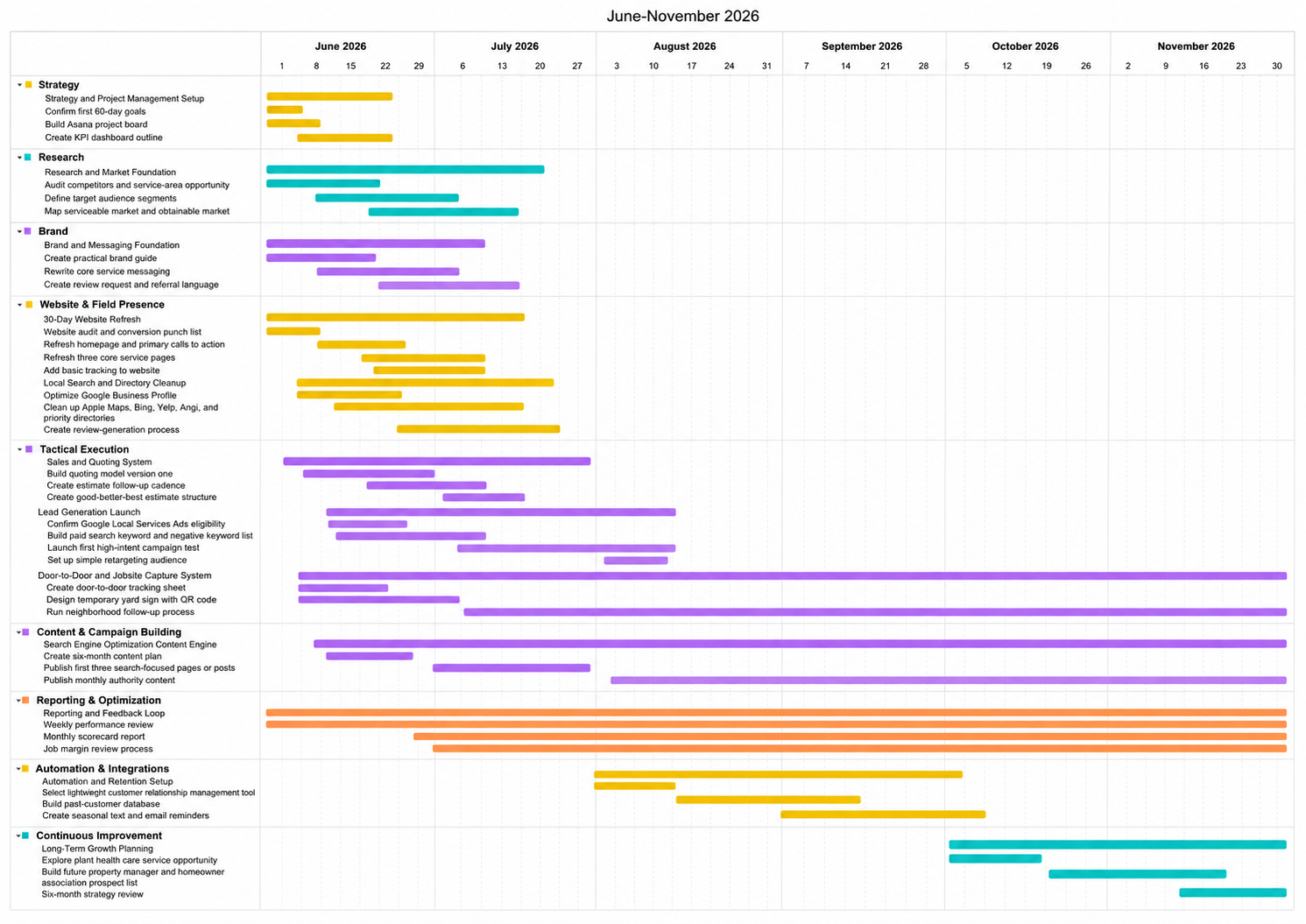
Proposal Summary
Comparisons & Your Price
No one wants to feel like a dumbo overpaying an outside firm.
We get it. We abhor 99% of advisors and agencies. Our industry has a lot of snake oil.
If you’re going to try to compare bid costs, you must examine the exact same
QCD+F: Quality, Cost, Deliverability + Flexibility
Average Agency Rate
$7,039
Tocobaga’s Normal Rate
$4,457
Your Tocobaga Rate
$2,488
DISCOUNT
SHOT
CLOCK
Quick-Start Next Steps
Administrative & Clerical Tasks
Invoice is deposited - either total for the month or deposit.
Tocobaga begins working
Tocobaga receives access to Tech Stack and any relevant brand collateral
Quick-Start onboarding will not be sequential - aka might be a little out of order than our normal process
Tocobaga will send over Company Services Agreement
Tocobaga will start a Slack workspace for internal communication. If you use another internal communication app, we can integrate Slack with other apps e.g. Slack two-way sync with Teams.
Tocobaga will coordinate a recurring, update meeting cadence - usually once a week initially and then every 2 weeks once we build a rhythm. If clients cannot attend because of schedule conflicts, we will record an update video and send via Slack.
If we’re ready to go right now, the button to the invoice is below or click on the invoice image to the right. Once the invoice is paid, we begin.
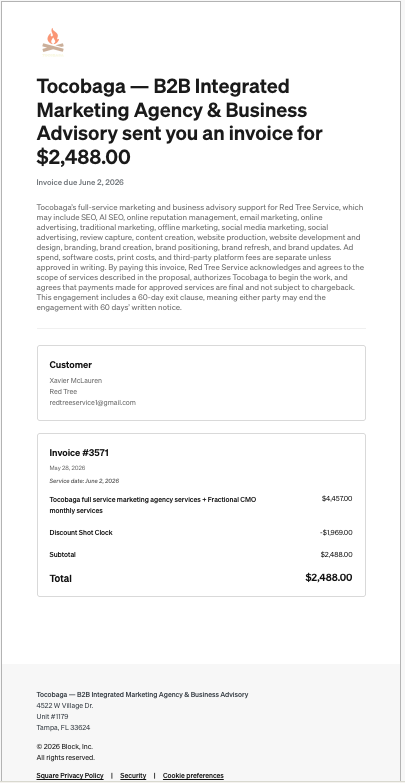
Let’s Go ➳
ABOUT
TOCOBAGA
a
B2B, B2C SMB Strategic Advisory
&
Omni-channel, Integrated Marketing Agency
Fractional CMO FAQs
-
A Fractional CMO (Chief Marketing Officer) is a part-time or shared resource hired by a company to provide strategic marketing leadership. This arrangement allows businesses to access high-level marketing expertise without the cost of a full-time executive.
-
A Fractional CMO typically handles various aspects of marketing strategy, planning, and execution. Their responsibilities may include market analysis, brand development, campaign management, and team leadership. They work on a part-time basis, providing strategic guidance to help businesses achieve their marketing goals.
-
1. Cost-Effective: Fractional CMOs offer high-level expertise without the full cost of a permanent executive, making it a cost-effective solution for businesses.
2. Flexibility: Companies can scale their marketing leadership up or down based on their needs, without the commitment of a full-time hire.
3. Diverse Experience: Fractional CMOs often bring diverse industry experience, providing fresh perspectives and insights to the marketing strategy.
4. Strategic Guidance: These professionals offer strategic guidance, helping businesses align marketing efforts with overall business objectives.
5. Access to Networks: Fractional CMOs may bring valuable industry connections and networks, enhancing opportunities for partnerships and collaborations.
6. Objective Perspective: Being external to the organization, Fractional CMOs can provide unbiased and objective viewpoints on marketing strategies.
7. Quick Onboarding: As seasoned professionals, Fractional CMOs can quickly adapt to the business environment, accelerating the onboarding process.
8. Task-Specific Expertise: Companies can engage Fractional CMOs for specific projects or challenges, tapping into their expertise for targeted improvements.
9. Risk Mitigation: Businesses can mitigate the risk associated with hiring a full-time CMO by testing the waters with a fractional arrangement.
10. Efficiency: With a focus on strategic planning, Fractional CMOs can optimize marketing processes for efficiency and effectiveness.
Why would a SMB hire a Fractional CMO?
Small and Medium-sized Businesses (SMBs) might choose to hire a Fractional CMO for several reasons:
1. Cost Efficiency: SMBs often have budget constraints, and a Fractional CMO allows them to access high-level marketing expertise without the cost of a full-time executive.
2. Flexibility: The variable nature of marketing needs in SMBs can be addressed with a part-time resource, adjusting the level of expertise based on the business's current requirements.
3. Strategic Insight: Fractional CMOs bring strategic thinking and experience, helping SMBs develop effective marketing strategies aligned with their business goals.
4. Resource Optimization: SMBs may not need a full-time CMO, making a fractional arrangement a practical way to optimize resources and focus on key priorities.
5. Quick Impact: Fractional CMOs can swiftly assess the marketing landscape, identify opportunities, and implement strategies to generate quick and impactful results.
6. Access to Networks: SMBs can leverage the networks and industry connections of Fractional CMOs, opening doors to potential partnerships and collaborations.
7. Task-Specific Projects: SMBs can engage a Fractional CMO for specific projects or campaigns, tailoring the arrangement to address immediate marketing needs.
8. Objective Perspective: An external CMO can provide an unbiased and objective viewpoint, offering insights that might be challenging to achieve with an in-house team.
9. Risk Mitigation: Hiring a full-time executive involves risks, but a fractional arrangement allows SMBs to test the waters and evaluate the impact of senior marketing leadership.
10. Learning Opportunity: SMBs can benefit from the knowledge transfer that occurs when working with an experienced Fractional CMO, helping build internal marketing capabilities over time.
-
short answer: engagement, commitment, and scope of responsibility
more detailed answer:
1. Time Commitment:
- Fractional CMO: Works on a part-time or project-specific basis, dedicating a limited number of hours per week or month to the organization.
- Full-time CMO: Is a permanent, full-time employee committed to the organization on a daily basis.
2. Cost Structure:
- Fractional CMO: Typically charges on an hourly or project basis, providing a more cost-effective solution for businesses with budget constraints.
- Full-time CMO: Involves a fixed annual salary, potentially with additional benefits, which may be a higher financial commitment for the organization.
3. Scope of Responsibilities:
- Fractional CMO: Focuses on specific strategic initiatives, projects, or areas of expertise as agreed upon with the organization.
- Full-time CMO: Assumes a broader range of responsibilities, overseeing the entire marketing department and contributing to overall business strategy.
4. Flexibility:
- Fractional CMO: Offers greater flexibility, allowing organizations to scale up or down based on their evolving marketing needs.
- Full-time CMO: Represents a more fixed and consistent presence within the organization, which may be less adaptable to changes in workload.
5. Depth of Involvement:
- Fractional CMO: Often works at a more hands-on level, directly involved in strategy development and execution.
- Full-time CMO: Balances strategic leadership with managerial responsibilities, overseeing day-to-day operations and team management.
6. Long-Term Commitment:
- Fractional CMO: May be engaged for specific projects, a defined period, or on an ongoing but part-time basis, providing a more flexible arrangement.
- Full-time CMO: Implies a longer-term commitment to the organization, with a focus on sustained leadership and relationship building.
-
short-answer: adaptability, agility, resources, communication, wisdom (experience x knowledge)
long answer:
1. Diverse Perspectives: A Fractional CMO with varied industry experience can offer diverse perspectives and insights, bringing a fresh and innovative approach to marketing strategies.
2. Cross-Industry Best Practices: They can bring best practices from different industries, adapting successful strategies and tactics to the specific needs of the organization.
3. Benchmarking Opportunities: With exposure to various industries, a Fractional CMO can provide valuable benchmarking data, helping the organization understand how its marketing performance compares to similar businesses in different sectors.
4. Adaptability: The ability to adapt strategies from one industry to another can be a key advantage. The Fractional CMO can leverage successful techniques across different markets, promoting adaptability and agility.
5. Network Access: Their extensive network across industries can open doors to potential partnerships, collaborations, and industry-specific opportunities that may not be readily apparent within a single-sector focus.
6. Innovation and Creativity: Exposure to diverse industries fosters innovation and creativity. A Fractional CMO can bring a rich mix of ideas, drawing on experiences beyond the confines of a single sector.
7. Risk Mitigation: They can provide insights into potential risks and challenges by drawing on experiences from various sectors, helping the organization proactively address issues before they become significant problems.
8. Market Trends Awareness: A Fractional CMO engaged with multiple clients in different industries stays attuned to a wide range of market trends. This knowledge can be invaluable in staying ahead of industry changes and emerging opportunities.
9. Customization for Unique Markets: Leveraging experience in various industries, the Fractional CMO can tailor marketing strategies to suit the unique characteristics and challenges of the organization's specific market.
10. Continuous Learning: A Fractional CMO involved in diverse industries is likely to be a continuous learner, staying updated on the latest trends, technologies, and strategies across various sectors, which can benefit the organization.
-
1. Fractional CMO:
- A Fractional CMO typically refers to a part-time or shared Chief Marketing Officer who provides strategic marketing leadership to organizations on a flexible basis.
- They might work with multiple clients simultaneously, dedicating a certain number of hours per week or month to each client.
2. Interim Fractional CMO:
- An "Interim Fractional CMO" could imply a temporary or transitional role where the Fractional CMO is specifically engaged to fill a gap or address a short-term need.
- The "Interim" aspect suggests a focus on providing leadership during a transitional period, such as when a company is between full-time CMOs or undergoing significant changes in its marketing strategy.
SERVICES
-
OVERALL STRATEGY
CAMPAIGN STRATEGIES
TACITICAL STRATEGIES
-
SMART Goals, Benchmarks + KPI Planning
-
- Audiences
- Targets
- Find out 4 Holy Metrics:
- Cost Per Lead
- Cost Per Acquisition
- Average Revenue of a customer within 1st year
- Lifetime Value
Quick Start Services
Marketing Execution Services
-
Monitoring & Maitenance
Analytics Tracking
SEO (technical)
Live Chat optimization
Build out
* Landing pages by service
* Landing pages by service and city/region
Content
FAQs
Blog posts
-
- PPC
- Google Search Ads
- Bing Search Ads
- Local Services Ads
- AdRoll - cross platform retargeting/remarketing
- Later - platform-industry specific ads w/ Angi, Yelp, etc.
- Social Ads
- AdRoll retargeting ads on FB and IG
- Pinterest might be a great avenue
- Programmatic
- We can get precise targeting
-
- Technical SEO
- At least 1 blog post per month
-
- Automation emails for servicing
- Marketing email campaigns
- New lead automated journeys
-
- Review Capturing
- Review Monitoring
- Directory Listings optimization
-
Traditional Advertising - radio, tv, newspaper, magazine, etc.
Community - sponsorships, focused local corporate responsibility
-
BRANDING:
Brand Development
Brand Identities
Brand Messaging
DESIGN: Any design deliverables needed
Graphic Design, Website Design, UI (User Interface), UX (User Experience), Print Design, Online Ad Design, Video Editing, Image Editing, Custom Illustrations, Newspaper Ads and Design, Magazine Ads and Design, Brick & Mortar Exterior Signage, etc.
Support Services
-
create a Google Data Studio or similar to aggregate analytics into
1) Snapshot
2) by campaign/tactic
-
Setup every task and project in your PM app, Asana?
-
- Starting line: I would want to come in office to War Room around y'all's schedules and work from the office a few days in the beginning. There's always smaller things to absorb just being around that is lost in digital communication
- Slack (or whatever your team uses) for direct communication. We prioritize client communication above email, calls and texts. We keep all conversations in Slack/Teams to have transparency and a searchable knowledge base.
- Update meetings: Weekly until we find a rhythm and go biweekly. I keep them 30 minutes and apply the EOS system to keep it efficient.
-
- Will need to learn your automation processes to streamline any redundant tasks
Possible add-ons services and costs
Online Ad/PPC ad spend without markup
Video Content Production
Purchasing Email Lists via Data Broker
Programmatic Direct Messaging
Approach
Strategy-first approach: work big to small. Macro to Micro. The biggest gaffe in the outsourced marketing services sector is focusing on tactics to begin. Our approach is the following 6 phases:
1. Define Objectives, S.M.A.R.T. goals and Current Analysis & Resource Audit (a current strategy review, branding assessment, resource audit and marketing performance report).
2. Thorough research.
3. Develop a leveraging integrated, omnichannel strategy in lock step communication and approval with the client.
4. Project management execution with respect to achieving KPIs, budgets and resources
5. Analyze quantitative and qualitative reporting.
6. Continuously improve

Strategic plans without execution = a fun idea.
Discipline is the ultimate freedom.
Over-communicate until you have concise shorthand.
Time is a commodity.
Think 3 steps ahead. Contingency plan IFTTT scenarios.
Be agile & adaptable.
The obstacle is the way.
Work short-term and long term at the same time.
Analyze the past while proactively, continuously improve your present and future.
Execute omnichannel, integrated marketing campaigns, online and off.
Work macro and micro.
Generalize and specialize.
Strategic and tactical.
A/B test.
ROI should be the client's main focus and many drill down minutiae. ROI (Return On Investment) is the only thing that matters to our clients (and us). It is the cover image on every one of our proposal decks. It is our mantra; our North Star philosophy. We must provide multiple X ROI for our clients or we cease to exist.