

RocketStay proposal

THE
ONLY
THING
THAT
MATTERS
TO
US
&
OUR
CLIENTS
IS
ROI
Supplemental Video Notes
SMBs Strategically Advised
Successful Integrated Marketing Campaigns
Average Client Return On Investment
Websites Produced
(Developed & Designed)
High Performing Emails Deployed
CASE STUDY
Our Commercial Real Estate Client Saw 2020 As An Eventual Blessing - First Disguised As A Curse
The Covid ERA destroyed commercial real estate firms.
With every bad, there's a good. We used this time to re-strategize.
-
We entered The Lockdown with our newly signed client, a Florida-based commercial real estate company, NAME REDACTED, facing a dual challenge of low lead generation and limited brand awareness as it underwent a succession transition from a legacy owner to a new, young CEO. The company needed to revitalize its image and attract potential clients to increase business. Tocobaga initiated a rebranding campaign, focusing on a modern and dynamic image while respecting the company's legacy. We employed a mix of digital and traditional strategies, including a revamped website, selective PR strategies, networking event creations and participation in community efforts utilizing vacant properties to boost brand visibility.
-
We capitalized on the new allotment of time. Planned the next 5 years with SMART goals, benchmarks and KPIs. The company's website underwent a modern redesign to enhance user experience, incorporating a sleek design and showcasing successful case studies. Multiple channels were utilized to highlight the CEO's vision while paying respect to the previous owner's cowboy persona, researched industry insights, and the revamped the client's unique selling propositions. Participation in relevant industry events allowed our client to connect with potential clients and partners.
-
The strategic approach led to a significant uptick in lead generation and brand awareness, resulting in a remarkable 4.1x return on investment (ROI) in the post-Covid Era. The updated website attracted more visitors, and the CEO's active presence on social media contributed to a positive perception of the company. Tocobaga successfully positioned our client as a forward-thinking industry player, gaining trust and interest from potential clients. The successful case study underscores the importance of strategic rebranding and a multi-channel approach to lead generation. Balancing modernity with respect for legacy allowed our client to capture the attention of its target audience, ultimately leading to a substantial ROI and a strengthened market position.
CASE STUDY
Home Services Is Where The Heart Is
People get in routines because that is always how they have been doing it.
"People don't change" isn't our favorite phrase because...well...change is inevitable.
We had to use the big dog hot phrase, Change Management, to achieve our wins in Lead Gen, Sales Ops and Automations.
-
A 40 year old mom-and-pop home services company, NAME REDACTED, faced the challenge of expanding its client base and increasing revenue. Their biggest challenge was the larger, corporate level competition squeezing their market share. To achieve this, NAME REDACTED needed a comprehensive lead generation strategy that would leverage multiple channels and integrate seamlessly to maximize results.
-
Tocobaga implemented a multichannel approach, combining digital and traditional marketing channels. We utilized targeted online advertising, optimized their website for conversions, ran email campaigns, and engaged in local community outreach. The goal was to create a cohesive marketing ecosystem that guided potential clients through the customer journey. Track everything. We also had to clean up their entire CRM of over 40,000 contacts and develop an API to integrate with their field operating software. The company invested in targeted online advertising campaigns to reach a broader audience. Simultaneously, we revamped their website, ensuring it was user-friendly and featured compelling content. Email campaigns were personalized and segmented to nurture leads effectively.
-
The integrated approach proved highly successful, resulting in an outstanding 38.7x return on investment (ROI) in 6 months. The online advertising increased visibility, the optimized website improved conversion rates, and the personalized email campaigns fostered strong customer relationships. The community outreach efforts not only contributed to brand awareness but also generated local leads. We are proud of this well-executed, multichannel lead generation strategy. The seamless integration of online and offline efforts, combined with a focus on user experience and community engagement, led to an impressive ROI. This success emphasizes the importance of a holistic approach in achieving significant outcomes in the competitive home services industry.
CASE STUDY
Challenge Accepted
We typically don't do event marketing.
We saw this as a fun challenge to up our game.
-
In 2016, new, local altruistic organization wanted to partner with a national charity for a mixed used festival event. We faced the challenge of low attendance, little-to-no brand awareness outside of the organization's personal reach and limited funds for their upcoming fundraising event. They needed to boost lead generation to ensure a successful turnout and maximize donations.
-
We implemented a multi-channel marketing strategy, leveraging social media, email campaigns, and partnerships with local businesses. They also optimized their website for user engagement and introduced a referral program to encourage participants to invite others. We utilized the charity's compelling storytelling in their social media posts and emails, highlighting the impact of their cause. They engaged with influencers and community leaders to amplify their message. Additionally, they collaborated with local businesses to sponsor and promote the event.
-
The lead generation efforts exceeded expectations, resulting in an 8.4x return on investment (ROI) and sold out the event with 5,000 attendees. The optimized website attracted more visitors, and the referral program significantly expanded the reach. The event saw a substantial increase in attendance, leading to a successful fundraising outcome that surpassed the charity's initial goals. The success of the lead generation campaign emphasized the importance of a comprehensive, multi-channel approach. Engaging storytelling, influencer partnerships, and community involvement proved to be powerful tools in achieving remarkable ROI for the charity event. We created the marketing machine. This festival has now spawned off 5 additional metropolitan cities using our framework as their blueprint.
“Leave the campsite better than you found it, and the world will be a better place because of it”
RocketStay has a real market opening: hotels want access to Airbnb, Vrbo, and short-term-rental demand without hiring a new internal team, learning another software stack, or creating another operational mess. The opportunity is not the problem. The problem is that RocketStay’s growth engine is still too dependent on referrals, manual outbound, and relationship-based selling. Tocobaga’s recommendation is to build a focused B2B lead-generation system around RocketStay’s strongest offer: done-for-you hotel distribution for independent hotels, boutique hotels, franchise ownership groups, and hotel revenue teams that want incremental bookings without adding operational burden or creating unnecessary brand friction.
Objectives
Build RocketStay’s B2B acquisition foundation.
Create high-intent Hotel Connect landing pages.
Capture demand from hotels searching for Airbnb and Vrbo distribution.
Retarget website visitors, CRM contacts, and sales prospects across channels.
Support sales with email, ads, landing pages, and follow-up assets.
Build search authority in Google, AI search, and hospitality vendor discovery.
Separate the B2B Hotel Connect story from B2C short-term-rental reputation noise.
Measure qualified leads, booked calls, CPL, CAC, account value, and channel quality.
RocketStay overview and value-add proposition
RocketStay is not just selling software. RocketStay is selling incremental hotel revenue without operational chaos.
For the hotel operator, the value proposition is simple: you want Airbnb and Vrbo demand, but you do not want to manage the channel yourself. RocketStay becomes the managed layer that handles listing buildout, rate and inventory controls, guest communication, review management, reporting, and 24/7 support.
That distinction matters. RocketStay is not competing only against other software vendors. RocketStay is competing against inertia, in-house staff limitations, channel-manager complexity, and the hotel operator’s fear of creating another operational headache.
The current growth model has worked because the offer is strong, the economics are attractive, and the sales relationships are credible. But referral-based growth and manual outbound eventually hit a ceiling. LinkedIn messaging is more crowded than it used to be. Cold outreach is easier to ignore. The website does not yet carry enough of the sales burden. Search visibility is underbuilt. Retargeting is not yet fully connected to the sales process.
The need is clear: turn RocketStay’s existing credibility into a repeatable funnel that finds, educates, follows, and converts the right hotel decision-makers.
Primary target audiences
RocketStay’s strongest audience is not hotels broadly. The strongest audience is the person or group with enough control to add an alternative distribution channel and enough pain to care about incremental bookings.
The best-fit audience includes independent hotels, boutique hotels, hotel franchisees, local ownership groups, hotel management companies, asset managers, and regional hospitality operators with practical control over revenue strategy.
A key distinction matters: Tocobaga should not waste budget chasing corporate brand teams at Hyatt, Hilton, Marriott, or similar parent brands if those teams cannot authorize local alternative distribution. The better opportunity is with franchisees, ownership groups, and operators who own the local P&L and need to find incremental revenue while staying mindful of brand standards, franchise requirements, and operational risk.
Primary B2B targets:
- Independent hotel owners and operators.
- Boutique hotel revenue managers.
- Hotel general managers with local control.
- Franchise ownership groups.
- Hotel management companies.
- Asset managers responsible for hotel profitability.
- Regional resort and condo-hotel operators.
- Multi-property hospitality groups.
Audiences to avoid wasting budget on:
- Corporate brand teams with no local discretion.
- Broad travel audiences with no B2B buying intent.
- Consumer short-term-rental guests unless the campaign is specifically for Rental Optimization.
- Generic real estate investors unless tied directly to the Rental Optimization offer.
Goals and KPIs
The marketing program should be measured by business outcomes, not vanity metrics.
Primary goals:
- Increase qualified B2B website traffic.
- Generate more qualified Hotel Connect inquiries.
- Improve booked-call conversion from paid, organic, email, offline, and outbound traffic.
- Build retargeting audiences of relevant hospitality decision-makers.
- Improve search visibility for hotel-to-Airbnb and related buyer-intent queries.
- Increase authority in Google, AI search, and hospitality vendor discovery.
- Support the sales team with stronger landing pages, emails, ads, and follow-up assets.
Core KPIs:
- Qualified leads.
- Booked sales calls.
- Cost per lead.
- Cost per qualified lead.
- Cost per acquisition.
- Landing page conversion rate.
- Email open, click, reply, and booked-call rates.
- Retargeting audience size.
- Search impressions for target queries.
- Organic traffic to Hotel Connect pages.
- CRM-sourced lead progression.
- Sales close rate by channel.
- Average new-account value.
- Lifetime value by client segment.
- Pipeline value influenced by marketing.
Cocktail napkin strategy
The strategy is a three-part system: pull, push, and follow.
Pull: Capture active demand from people already searching for solutions. This includes SEO, AI search optimization, paid search, FAQ-rich landing pages, schema, and content around phrases like add my hotel to Airbnb, list hotel rooms on Airbnb, Airbnb distribution for hotels, and hotel channel management for Airbnb.
Push: Get RocketStay in front of the right people before they search. This includes LinkedIn targeting, account-based lists, CRM uploads, Meta awareness and retargeting, conference and event follow-up, email marketing, direct mail, and sales-support campaigns built around hotel revenue managers, ownership groups, and hotel management companies.
Follow: Retarget people after they show interest. This includes AdRoll, Meta retargeting, Google retargeting, CRM-triggered audiences, email nurture, direct mail follow-up, and pixel-based follow-up so the sales conversation is supported by visible, repeated proof.
In plain English: get the right people to the site, make the offer painfully clear, capture their information, keep showing up after they leave, and give the sales team better air cover.
Tocobaga’s role: strategy, channels, and execution
Tocobaga’s role is to build the strategy, structure, assets, tracking, and execution system that makes RocketStay’s sales motion easier to scale.
Tocobaga will not treat RocketStay like a generic lead-gen account. The audience is narrow. The sales cycle is specialized. The offer is technical, operational, and financial at the same time. The campaign needs to speak to hospitality operators with enough detail to be credible and enough simplicity to convert.
- Strategy and research: Define the campaign strategy, clarify the target audience, translate RocketStay’s offer into market-facing language, and build a practical plan around qualified lead generation.
- Website and landing page improvements: Audit the current website, identify fast fixes, improve the user path, and build landing pages that support Hotel Connect, high-intent search, paid traffic, CRM retargeting, and sales follow-up.
- Conversion tracking and analytics: Set up or refine tracking for forms, calls, scheduler clicks, ad traffic, email traffic, retargeting audiences, and CRM progression so RocketStay can see what is producing qualified conversations.
- Brand architecture and reputation separation: Help clarify the difference between RocketStay’s B2B Hotel Connect offer and its B2C short-term-rental management footprint.
- SEO and AI search optimization:
- Technical SEO audit.
- Schema markup.
- FAQ architecture.
- Service-page expansion.
- Internal linking.
- Search-intent mapping.
- Hospitality-specific keyword research.
- AI-search answer formatting.
- Directory and citation cleanup.
- Authority content for revenue managers and hotel operators.
- Competitor comparison content.
- Conversion-focused page titles and meta descriptions.
- Indexing and crawlability cleanup.
- Ad strategy and ad management: Build and manage paid campaigns around high-intent and narrow-audience targeting, including Google Ads, Bing Ads, Meta ads, LinkedIn ads, display retargeting, and social media advertising.
- Retargeting and CRM audience activation: Create a retargeting system that follows website visitors, landing page visitors, warm CRM contacts, and active sales prospects across relevant channels.
- Email marketing and nurture: Build email support around lead nurture, reactivation, post-conference follow-up, cold-to-warm sequences, and sales enablement emails.
- Offline and traditional marketing: Identify practical offline opportunities including hotel conferences, hospitality trade events, regional owner/operator meetings, franchisee gatherings, printed sales collateral, direct mail, and targeted postcard campaigns.
- Direct mail and snail mail campaigns: Use direct mail selectively where it supports a known account list or sales sequence.
- Sales-support content: Create messaging and assets that help RocketStay explain the offer quickly.
- Reporting and optimization: Review performance by channel, audience, landing page, source, and lead quality.
Deliverables
- B2B marketing strategy and acquisition plan.
- RocketStay website and landing page audit.
- ICP and persona refinement.
- Keyword and search-intent map.
- Hotel Connect sitemap recommendations.
- Landing page copy and structure.
- FAQ content for SEO and AI search.
- Schema recommendations and implementation guidance.
- Paid search campaign structure.
- Google Ads setup and management.
- Bing Ads setup and management, if approved.
- Meta ads and social retargeting setup.
- LinkedIn audience testing plan.
- Retargeting setup plan.
- CRM audience activation plan.
- Email marketing and nurture plan.
- Direct mail and offline marketing recommendations.
- Conference and event marketing recommendations.
- Conversion tracking plan.
- Reporting dashboard framework.
- Monthly optimization recommendations.
- Sales-support messaging.
- B2B reputation and brand-architecture recommendations.
- Project management board and implementation timeline.
Six-month roadmap
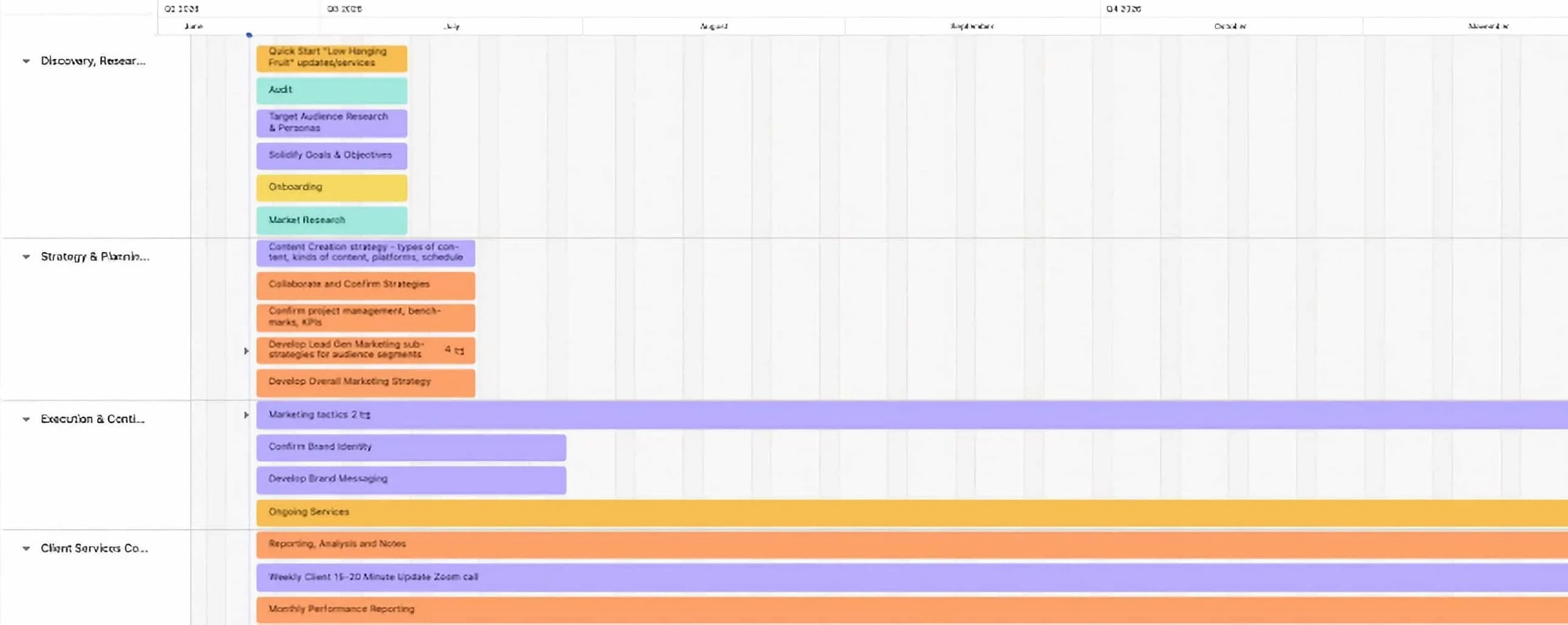
Month 1 and 2: Foundation, setup, launch, and early optimization.
This is the heavy setup period. Tocobaga should audit the website, make immediate website recommendations, define priority audiences, map the funnel, confirm goals, identify priority keywords, review CRM and sales inputs, set up tracking, build or recommend landing pages, create the ad strategy, set up retargeting, launch initial paid campaigns, start SEO work, begin schema and FAQ improvements, prepare email nurture, and identify offline opportunities.
Short-term work begins immediately: website fixes, tracking, landing pages, ad setup, retargeting, CRM audience structure, scheduler path, email support, and early campaign launch.
Long-term work also starts immediately: SEO, AI search authority, content architecture, directory cleanup, reputation separation, and organic visibility. SEO is the long game, but it should start on Day 1.
Month 3 and 4: Authority, audience expansion, and sales enablement.
By this stage, RocketStay should have more active landing pages, better tracking, initial paid campaign data, and retargeting audiences in motion. Tocobaga should expand SEO content, improve AI-search visibility, refine paid media, build stronger email follow-up, support sales sequences, and add more audience segments based on real performance.
This period should also include competitor comparison content, stronger proof points, better landing-page conversion paths, conference or trade-event planning where relevant, and targeted direct mail concepts for high-value accounts.
Month 5 and 6: Optimization, scale decisions, and channel refinement.
The final two months should focus on what the data proves. Tocobaga should evaluate lead quality, booked-call rate, cost per qualified lead, cost per acquisition, CRM progression, sales feedback, and channel performance. Budget should move toward the sources producing real conversations.
The goal at the end of Month 6 is not just more traffic. The goal is a clearer acquisition system: what to keep, what to cut, what to scale, and what RocketStay should build next.
Client homework
RocketStay should provide the following before launch:
- Best current client examples.
- CRM export or target account list.
- Desired lead qualification rules.
- Average account value and lifetime value assumptions.
- Current close rate by source, if available.
- Priority hotel segments.
- Disqualified hotel segments.
- Sales process steps.
- Current sales messaging.
- Access to website, analytics, ad accounts, and CRM.
- Brand decision on Hotel Connect versus Rental Optimization.
- Approval on priority pages and campaign budget.
Commercial structure
Tocobaga recommends a flexible services structure with clear scope, clear reporting, and no long-term trap.
- Monthly services fee.
- Separate approved ad spend.
- Separate approved software costs.
- Separate approved print, mail, conference, or list costs.
- Clear 60-day exit language.
- Clear payment terms.
- Clear non-refundable service payment language.
- Clear ownership of completed assets.
- Clear reporting cadence.
- Clear scope for what is included and what requires approval.
The working model should keep both sides accountable. RocketStay should not be locked into a bloated agency contract, and Tocobaga should have enough clarity to execute without chasing approvals every day.
Research Notes
-
To quantify the growth potential, investment viability, and realistic revenue ceiling of the enterprise, a rigorous analysis of the Total Addressable Market (TAM), Serviceable Available Market (SAM), and Serviceable Obtainable Market (SOM) is required.
Given the strict analytical constraints requiring three independent, notable sources for factual verification, the precise SOM for a privately held entity like RocketStay cannot be stated as definitive fact. The following market sizing relies on macroeconomic data applied through rigorous, logical modeling, yielding estimates with designated confidence percentages based on market variables.
Total Addressable Market (TAM)
The TAM represents the absolute maximum theoretical revenue available if the enterprise captured 100% of its target sector globally. For this specific analysis, the TAM is defined as the total U.S. Hotels and Hospitality Real Estate Market, explicitly focusing on the revenue generated by the lodging sector.
Macroeconomic data indicates that the U.S. Hotels Market size was estimated at approximately $263.21 billion in 2024, with projections reaching $280.63 billion in 2025, growing at a Compound Annual Growth Rate (CAGR) of 7.1%. A broader definition encompassing the entirety of the U.S. Hospitality Real Estate Market places the total asset value and generated revenue closer to a staggering $1.03 Trillion.
However, RocketStay does not capture top-line room revenue; it captures a distribution margin. Assuming an average global distribution cost (the amount hotels pay to OTAs, channel managers, and travel agents to acquire guests) of approximately 15% across the industry, the theoretical maximum TAM for distribution services within the U.S. hotel market ($263 Billion x 15%) is approximately $39.45 Billion.
Confidence in TAM Definition: 95% (Based on aggregated reports from leading market research firms including Grand View Research and Mordor Intelligence).
Serviceable Available Market (SAM)
The SAM refines the TAM by isolating the specific segment of the market that the enterprise's product can practically serve, given its business model and technical capabilities. The enterprise cannot service the entire $39.45 billion distribution market because massive corporate entities (e.g., Marriott International, Hilton Worldwide) utilize proprietary internal distribution networks, deep loyalty programs, and multi-million-dollar enterprise software contracts, largely excluding mid-tier third-party vendors.
Therefore, the SAM consists strictly of the distribution spend of Independent Hotels and Franchise-Operated Branded Hotels that possess the operational autonomy to utilize alternative, third-party distribution platforms.
Independent Hotel Segmentation: Independent properties account for a massive portion of the market, ranging from approximately 40% to 63.38% of the U.S. hospitality landscape, depending on the specific classification metrics utilized. Using a conservative median estimate of 50%, independent hotels represent roughly $131.6 billion of the total hotel market revenue.
The Franchise Factor: The U.S. hotel franchise market is highly active and rapidly expanding, valued at an estimated $42.3 billion in 2025. Many of these individual franchisees operate as small-to-medium businesses and represent ideal target clients.
If the enterprise exclusively targets the distribution spend of independent and select-franchise hotels, the SAM is calculated by applying the standard 15% distribution cost metric to the $131.6 billion independent market.
Calculated SAM: ~$19.74 Billion annually in addressable distribution spend.
Confidence in SAM Calculation: 85% (This calculation is subject to standard macroeconomic variations and the continuously evolving ratio of direct, commission-free bookings versus OTA-driven bookings).
Serviceable Obtainable Market (SOM)
The SOM represents the realistic, tangible market share the enterprise can practically capture in the short to medium term (typically 36 to 48 months), factoring in its current sales velocity, marketing budget, competitive density, and internal operational limitations.
Given that the enterprise currently relies heavily on manual outbound sales, organic industry referrals, and a lean domestic team supported by an offshore operational apparatus, achieving a monolithic market share is highly improbable without a substantial venture capital injection to fuel massive marketing campaigns. The market is highly fragmented, with heavily capitalized pure-play SaaS channel managers (e.g., SiteMinder, Cloudbeds) holding dominant market shares among tech-savvy properties.
Modeling Estimate: Assuming the enterprise operates effectively within its hyper-niche—targeting boutique hotels lacking internal tech resources and specialized STR investors—a realistic SOM over a 36-to-48-month horizon is estimated at a highly conservative 0.05% to 0.1% of the SAM.
Calculated SOM: $9.8 Million to $19.7 Million in realistically capturable annual corporate revenue.
Confidence in SOM Calculation: 70% (This is a forward-looking projection heavily dependent on the successful execution of the proposed digital marketing pivots, the stabilization of inbound lead flow, and the company's ability to maintain its 90% client retention rate against aggressive competitor pricing).
-
The acquisition of business-to-business (B2B) clientele requires a highly targeted, nuanced approach. The enterprise cannot successfully market its services to the entirety of the hospitality sector; the value proposition fundamentally breaks down when applied to mega-chain corporate entities that possess the capital to build internal distribution networks. Consequently, the B2B target audience is deliberately segmented into highly specific professional personas.
Primary Persona: Independent Hotel Revenue Managers
The paramount B2B target consists of Revenue Management Professionals, Directors of Sales, and General Managers at independent hotels, boutique properties, and mid-sized regional resort collections.
Psychographic and Operational Profile: These professionals operate under immense, continuous pressure to maximize Revenue Per Available Room (RevPAR) and overall occupancy rates. They are constantly engaged in a margin battle with traditional OTAs (Expedia, Booking.com) over high commission rates (often 15-25%) and restrictive rate parity clauses. Furthermore, independent hotels—which make up approximately 40% to 63% of the U.S. hotel market depending on classification metrics —lack the vast marketing budgets and proprietary loyalty programs (e.g., Marriott Bonvoy, Hilton Honors) utilized by major chains to drive direct, commission-free bookings.
When occupancy dips during off-peak seasons, shoulder seasons, or mid-week slumps, these managers actively seek alternative distribution channels. Airbnb and VRBO represent massive pools of untapped, high-intent demand. However, the prospect of managing an entirely new channel—one that requires immediate responses to guest inquiries and unique, localized listing optimization—is daunting. The enterprise targets this exact operational pain point, offering a risk-free, commission-only mechanism to access STR demand without adding operational stress or requiring capital expenditure approvals for new software.
Secondary Persona: Franchise Operators and Ownership Groups
While the enterprise explicitly avoids targeting direct corporate employees of mega-brands (e.g., individuals employed directly by corporate Hyatt, Hilton, or Marriott headquarters), it actively targets the independent franchisees and ownership groups that physically operate these branded assets.
Psychographic and Operational Profile: The vast majority of branded hotels in the United States are actually owned and operated by independent franchise groups, family offices, or real estate investment trusts (REITs), not the parent corporation itself. These franchise owners pay heavy royalty fees to the parent brand and are increasingly frustrated by rising operational costs and mandates to honor deeply discounted points bookings.
If a franchisee of a midscale brand has excess, perishable inventory, the local ownership group may seek to discreetly distribute that inventory on alternative platforms like Airbnb to bolster their bottom line, provided it does not overtly violate strict brand franchise agreements. The enterprise targets these local and regional operators who hold the ultimate profit and loss (P&L) responsibility for the physical real estate asset, offering them a covert, highly effective channel to move distressed inventory.
Tertiary Persona: Multi-Family Real Estate Investors
Through its Rental Optimization service module, the enterprise also targets high-net-worth individuals, family offices, and real estate investment groups that own luxury condominiums and multi-family residential buildings.
Psychographic and Operational Profile:
These investors seek maximized passive yield from their real estate portfolios. They possess the physical assets but have absolutely zero desire to engage in the day-to-day minutiae of hospitality management—coordinating cleaning crews, handling midnight lockbox failures, mitigating property damage, or navigating guest disputes. The enterprise markets itself to this cohort as a comprehensive, end-to-end management solution that handles all logistical friction, transforming static, long-term residential real estate into dynamic, high-yielding short-term rental assets.
B2C Target Audiences and Consumer Demographics
While the enterprise's primary revenue engine is B2B client acquisition, its operational credibility relies entirely on its ability to function as a highly effective direct business-to-consumer (B2C) hospitality provider. Properties such as Artrageous on the River, Broadway Suites Downtown, and Cordova Arms require precise, targeted marketing toward end-user guests.
Understanding the B2C target audience is critical; the enterprise's value to its B2B hotel clients is predicated entirely on its ability to actually convert digital listings into physical bookings.
The "Bleisure" and Extended-Stay Professional
A fundamental shift in modern travel demographics is the blending of business and leisure, colloquially termed "bleisure." The normalization of remote work and decentralized corporate structures has catalyzed intense demand for accommodations that offer the spatial amenities of a home combined with the reliability and cleanliness standards of a traditional hotel.
The enterprise's direct portfolio is engineered specifically for this demographic. The properties under its management consistently feature full, modern kitchens, dedicated laptop workspaces, separate living rooms, high-speed Wi-Fi, and critically, in-unit washer/dryers.
Psychographic Profile: This consumer is typically a white-collar professional, digital nomad, or corporate traveler engaged in extended, project-based work. They actively reject traditional, single-room hotel layouts for stays exceeding three days. They prioritize functional, residential amenities over excessive luxury. They require reliable internet for video conferencing during the day, and proximity to urban entertainment districts—such as Las Olas Boulevard in Fort Lauderdale or Brickell City Centre in Miami—for evening leisure. By marketing properties that explicitly serve these dual needs, the enterprise captures premium, extended-stay bookings that traditional hotels struggle to secure.
The Value-Conscious Family Unit and Group Traveler
Short-term rentals inherently offer superior unit economics for groups when compared to the cost of booking multiple traditional, adjoining hotel rooms. The enterprise explicitly markets its multi-bedroom apartments to large families and small groups of friends traveling collectively.
Psychographic Profile: This audience values communal living space and overall cost-efficiency. By offering properties that sleep up to six individuals comfortably across multiple bedrooms and convertible sleeper sofas , the enterprise captures vacationing families seeking to prepare meals in-house to drastically reduce daily travel expenditures. This demographic is heavily influenced by peer reviews, detailed photographic evidence of the space, and the presence of family-friendly amenities such as outdoor pools and proximity to beaches and cultural attractions. They require properties that offer a "home base" experience rather than a transient resting point.
Operational Note on B2C Friction: The enterprise's B2C operations are not without challenges. A review of consumer sentiment indicates instances of operational friction, such as complaints filed with the Better Business Bureau regarding broken entry systems, automated response loops, and language barriers with offshore support staff. These consumer pain points highlight the inherent difficulty of scaling a highly decentralized, offshore-managed property portfolio, and underscore the importance of maintaining rigorous quality control to protect the enterprise's broader brand reputation.
-
Ad spend goes directly to platforms like Google, LinkedIn, Meta, or AdRoll and is billed separately from the agency's management fee. To generate meaningful B2B leads and drive consistent website traffic in the hospitality technology sector, a competitive monthly ad spend typically ranges from $5,000 to $50,000+, depending on aggressive growth goals,.
Here is a breakdown of practical ad spend benchmarks by platform:
Google Ads (PPC): In competitive B2B SaaS and hospitality niches, cost-per-click (CPC) rates can be high. A minimum viable budget of $3,500 per month is generally required just to support competitive bidding and gather statistically meaningful data.
LinkedIn Ads: Because LinkedIn allows for highly precise targeting of B2B decision-makers (like hotel revenue managers), it is the most expensive platform, with CPCs often ranging from $8 to $15. The practical minimum budget to run a successful, data-driven LinkedIn campaign is $4,000 to $5,000 per month, with scaling companies frequently spending $8,000 to $20,000 per month on the platform,.
Retargeting & Paid Social (Meta/AdRoll): For cross-device retargeting and general brand awareness on platforms like Facebook and Instagram, small to mid-sized B2B businesses typically allocate $500 to $1,500+ per month to stay in front of prospects who have already visited their site.
6 Month Simple Gantt Chart
Proposal Summary
Comparisons & Your Price
No one wants to feel like a dumbo overpaying an outside firm.
We get it. We abhor 99% of advisors and agencies. Our industry has a lot of snake oil.
If you’re going to try to compare bid costs, you must examine the exact same
QCD+F: Quality, Cost, Deliverability + Flexibility
Average Agency Rate
$16,563
Tocobaga’s Normal Rate
$5,457
Your Tocobaga Rate
$3,434
-
Tiered Retainer Analysis for Full-Service Capabilities
Based on aggregate 2026 industry pricing data for B2B SaaS marketing, the total monthly management fee (expressly excluding all ad spend) will generally fall into one of three macro-tiers.
Foundational / Boutique $5,000 – $12,000
Best for initiating growth on a strict budget. Includes basic SEO, limited content production (2-4 pieces/mo), single-channel paid media management, and foundational email marketing. Requires heavy internal oversight from the client side. 1
Growth / Mid-Market $15,000 – $35,000
The absolute sweet spot for scaling B2B SaaS. Includes multi-channel paid media (Google + LinkedIn), aggressive content production, active CRO and website expansion, deep CRM integration, and proactive reputation management to separate B2B from B2C. 2
Enterprise / Omnichannel $40,000 – $100,000+
Designed for mature enterprises attacking multiple global markets simultaneously. Features massive scale, dedicated full-time equivalent (FTE) teams embedded within the client, custom engineering, and predictive analytics. 2
Strategic Recommendation: For a company like RocketStay, which is rapidly transitioning from a referral-led model but possesses strong underlying economics (high retention rates, robust margins on software, and high lifetime value), the Growth / Mid-Market tier ($15,000 – $35,000 per month) is the most mathematically defensible and operationally sound starting point. It provides enough velocity and talent depth to generate a meaningful pipeline within a single quarter while concurrently building the long-term SEO, website, and content infrastructure required to sustain multi-year growth.
-
Comprehensive Strategic Analysis of B2B SaaS Marketing Agency Retainers for RocketStay.com
Executive Overview of the B2B SaaS Marketing Landscape
The digital marketing ecosystem for Business-to-Business (B2B) Software as a Service (SaaS) and hospitality technology represents one of the most highly specialized, capital-intensive, and mechanically complex sectors in the contemporary digital economy. Transitioning a business model from a strictly referral-based growth mechanism to a scalable, inbound and outbound digital marketing engine requires a fundamental restructuring of both operational infrastructure and capital allocation. For a platform like RocketStay.com, which provides highly sophisticated revenue management and distribution technology to hotel professionals while simultaneously managing a consumer-facing short-term rental portfolio, the marketing requirements are exceptionally nuanced. The organization is currently confronting a critical inflection point: a historical reliance on referrals and raw outbound sales efforts is beginning to plateau against external market competition, necessitating a pivot toward comprehensive digital demand generation.
Engaging a full-service marketing agency to orchestrate Search Engine Optimization (SEO), website expansion, content creation, organic social media presence, paid media management, reputation control, and lifecycle email marketing involves navigating a labyrinth of pricing models. In the current landscape of 2026, agency compensation has largely shifted away from archaic percentage-of-spend models toward flat-fee monthly retainers, which fundamentally better align agency incentives with long-term client growth rather than arbitrary budget inflation.
This exhaustive research report provides a granular, data-driven analysis of the specific costs associated with outsourcing these critical marketing functions for RocketStay. Crucially, the analysis strictly delineates the management fees—the capital paid directly to the agency for their intellectual property, labor, strategy, and execution—from the media budget (ad spend), which is paid directly to advertising platforms such as Google, LinkedIn, and programmatic networks like AdRoll.
Organizational Context and Strategic Prerequisites for RocketStay
Before dissecting the specific financial parameters of agency retainers, it is necessary to establish the operational baseline that dictates these costs. A company operating in the hospitality technology sector targeting a highly niche audience—specifically, revenue management professionals at independent or franchised hotels, explicitly excluding corporate-level brand employees—faces a narrow, sophisticated, and highly defensive total addressable market (TAM).
The Dual-Brand Dilemma and Brand Architecture
A unique and highly volatile variable impacting the required marketing infrastructure for RocketStay is the dual nature of its business operations. Operating a B2B technology suite alongside a consumer-facing B2C short-term rental management arm under the exact same corporate entity creates significant friction in brand positioning, search engine visibility, and reputation management. Search engines, artificial intelligence aggregators, and review platforms do not naturally distinguish between a hotel executive evaluating complex API integration software and a frustrated vacationer leaving a review for a beachfront condominium. This structural reality necessitates a highly segmented marketing architecture, bespoke landing pages, and rigorous reputation capturing systems to cleanly isolate the B2B enterprise brand from B2C consumer noise. An agency must allocate significant strategic hours to untangling these digital footprints.
The Foundational Infrastructure Deficit
Transitioning into aggressive paid advertising without the requisite digital infrastructure inevitably results in catastrophic capital waste. Currently, RocketStay's digital presence consists of a minimal, nine-page public website lacking complex conversion architecture, dedicated persona-driven landing pages, and deep technical SEO frameworks. Driving high-cost B2B traffic—where clicks can easily exceed ten dollars each—to an unoptimized, generalized site yields unacceptably high bounce rates and entirely suppresses return on ad spend (ROAS). Therefore, the initial phase of any agency engagement must be heavily weighted toward foundational development, technical overhauls, and structural expansion before scaling paid media.
Sales Cycle Integration and Commission Structures
The internal sales structure of the organization also directly dictates the marketing agency's mandate. In an environment where sales representatives operate on a commission-only basis, managing vast books of business across thousands of hotels and earning a fraction of the fractional margin generated by hotel bookings, the marketing imperative is not merely volume, but extreme qualification. Marketing Qualified Leads (MQLs) must be rigorously filtered to ensure sales velocity is not bottlenecked by low-intent prospects or unqualified hotel properties. Consequently, the agency's scope of work must include advanced Customer Relationship Management (CRM) integration, algorithmic lead scoring, and automated nurturing protocols that run parallel to existing outbound tools like Apollo.
Structural Evolution of Agency Pricing Models in 2026
The traditional agency pricing model, heavily reliant on billing by the hour or charging a percentage of advertising spend, has been largely deprecated in the upper echelons of the B2B SaaS sector. In 2026, approximately 78% of performance marketing agencies utilize flat-fee retainers as their primary billing structure. Understanding the mechanics of these disparate models is critical for evaluating proposals and ensuring financial alignment.
The Percentage-of-Spend Model
Historically, agencies charged between 10% and 20% of the total media budget to manage online advertising. While this model scales linearly with the workload required to manage larger budgets, it introduces a severe conflict of interest. The agency is financially incentivized to increase the client's ad spend, even when efficiency dictates scaling back or shifting funds to organic channels. For a B2B SaaS company aiming to lower its Customer Acquisition Cost (CAC) and improve profit margins, this model is fundamentally misaligned and encourages reckless scaling.
The Flat-Fee Retainer Model
The flat-fee retainer provides predictable monthly budgeting and aligns the agency's goals with the client's performance metrics. By decoupling the agency's compensation from the ad platform's revenue, the agency is incentivized to find the most efficient route to generating pipeline, whether through organic SEO, conversion rate optimization (CRO), or highly targeted, low-spend media campaigns. Tiered flat-fee retainers for mid-market SaaS typically range from $5,000 to $35,000+ per month, heavily dependent on the depth of the services provided, the velocity of deliverables, and the seniority of the talent executing the strategy. Point pricing systems are also occasionally utilized within this model, where a flat fee buys a set number of points that can be allocated across different deliverables flexibly.
The Hybrid and Performance Models
Increasingly, specialized B2B SaaS agencies deploy hybrid models to share risk with the client. These feature a lower foundational retainer to cover fixed operational overheads (e.g., $3,000 per month) combined with performance bonuses tied to actual closed-won revenue or the generation of highly qualified meetings (e.g., $150 per qualified lead, or 5-10% of Annual Recurring Revenue). This effectively shares the risk between the enterprise and the agency, though it requires meticulous attribution tracking, flawless closed-loop reporting, and deep CRM access to execute properly without disputes.
Exhaustive Breakdown of Agency Management Fees by Discipline
To construct a comprehensive financial model for RocketStay's anticipated marketing expenditure, it is necessary to isolate and evaluate the discrete services that comprise a full-funnel marketing strategy as requested. The following sections detail the market rates for each service, the underlying mechanics of the deliverables, and the strategic implications for a hospitality technology firm. It must be noted that purchasing these services individually from specialized boutique vendors is structurally possible, but invariably more expensive and strategically fragmented than consolidating them under a single B2B growth agency.
1. Website Improvements, Expansions, and CRO
The digital storefront is the central node of all marketing activities. A basic, nine-page brochure-style website cannot support the rigors of B2B enterprise sales, which demand resource centers, gated content, advanced routing, dedicated landing pages tailored to specific buyer personas, and seamless API integrations.
Mechanics and Scope of Work
Website expansion under an agency retainer is rarely a one-time event; it is an ongoing process of iterative improvement and technical maintenance. The scope typically includes:
Architectural Overhaul: Expanding a minimal site into a 30-to-50-page lead generation engine to support organic search and paid media destinations.
Landing Page Development: Constructing highly specific, high-converting landing pages designed exclusively for traffic originating from Google Ads or LinkedIn campaigns. For example, a page dedicated solely to "Airbnb Integration for Independent Hotels," stripping away navigation bars to force a conversion event.
Technical Optimization: Ensuring the underlying code framework meets modern standards, implementing advanced schema markup, and ensuring site speed meets Google's core web vitals standards, which directly impact search rankings.
Continuous Conversion Rate Optimization (CRO): Utilizing heat mapping, scroll tracking, and A/B testing on calls-to-action, form fields, and user interface elements to perpetually lower the cost per acquisition by turning a higher percentage of visitors into leads.
Financial Projections for Website Management
Website development and maintenance can be billed as massive upfront projects or amortized into a monthly retainer. Standalone costs for web services generally reflect the following tiers:
Website Service TierEstimated Monthly Agency FeeScope CharacteristicsBasic Maintenance$500 – $2,500
Security updates, hosting optimization, minor content edits, basic troubleshooting. Does not include active expansion or CRO.
Growth Expansion & CRO$2,000 – $4,000
Active UI/UX design, continuous addition of landing pages, CRM integration (e.g., HubSpot or Salesforce), advanced module creation.
Project-Based Build (One-Time)$15,000 – $30,000
A one-time capital expenditure to upgrade a brochure site to a mid-market lead generation engine, usually followed by a lower maintenance retainer.
Strategic Implications: Funding aggressive ad campaigns before investing in website expansion is a common strategic error that results in burning capital. If paid media drives high-intent traffic to a generic homepage lacking specific value propositions, the media budget is effectively squandered. The website must be viewed as a living conversion mechanism, not merely a digital brochure.
2. Search Engine Optimization (SEO) and Authority Building
SEO is a long-term capital asset. Unlike paid advertising, which ceases to generate traffic the exact moment the budget is depleted, SEO builds compounding equity over time. For a specialized technology platform like RocketStay, capturing high-intent search queries organically is paramount to reducing blended customer acquisition costs over a multi-year horizon.
Mechanics and Scope of Work
Modern B2B SEO has evolved significantly beyond rudimentary keyword stuffing. Google's algorithm updates, particularly those focused on identifying genuine authority, require a multifaceted approach. An agency's management fee for SEO covers:
Semantic and AI Optimization: Structuring content with comprehensive Frequently Asked Questions (FAQs) and complex schema markup. This is critical for emerging search behaviors, ensuring the brand surfaces as the authoritative answer when revenue managers query Large Language Models (LLMs) like ChatGPT, Claude, Perplexity, and Gemini.
Technical SEO: Ensuring the site is perfectly crawlable, mobile-responsive, devoid of canonical errors, and structured with clean XML sitemaps.
Off-Page Authority (Link Building): Securing high-quality, contextual backlinks from reputable hospitality industry publications, software directories, and technology review aggregators to build domain rating. This is a highly labor-intensive process requiring digital public relations outreach.
Financial Projections for SEO Management
SEO retainers reflect the intensive labor required to reverse-engineer search algorithms and outmaneuver entrenched software competitors.
SEO Service TierMonthly Agency FeeTypical InclusionsFoundational Local/SMB$1,500 – $3,000
On-page optimization, technical audits, basic rank tracking, minor content tweaks.
Mid-Market SaaS$3,500 – $8,000
Comprehensive digital PR and link building, deep technical overhauls, continuous content optimization, semantic restructuring for AI.
Enterprise / Aggressive$8,000 – $15,000+
High-velocity authority building, multi-national keyword targeting, complex programmatic SEO strategies generating hundreds of location or feature pages.
Strategic Implications: The return on investment for SEO is typically realized over a 6-to-12-month horizon. Therefore, the executive team must possess the strategic patience to fund SEO as a foundational pillar while relying on paid channels for immediate lead velocity in the short term. Over a 36-month period, robust SEO can deliver an ROI exceeding 700%, creating a profound, defensible competitive moat.
3. Content Creation and Asset Development
Content is the raw intellectual material that fuels the entire marketing engine. It populates the website for SEO, provides the creative assets for paid advertising, gives substance to social media posts, and serves as the core of email nurturing campaigns. In the B2B tech sector, content must be highly authoritative; generic, surface-level articles generated by junior copywriters will not influence hotel revenue management executives.
Mechanics and Scope of Work
A content marketing retainer encompasses the strategic planning, qualitative research, subject matter expert interviews, writing, design, and multi-channel distribution of various assets.
Thought Leadership Articles: Long-form, data-rich blog posts that address complex industry challenges (e.g., maximizing RevPAR through dynamic pricing algorithms, or the intricacies of connecting independent property management systems to Airbnb).
Lead Magnets: High-value gated assets such as whitepapers, industry benchmark reports, or technical playbooks used to capture email addresses from visitors who are not yet ready to speak to a sales representative.
Sales Enablement Material: Case studies, one-pagers, and pitch decks designed specifically to assist the sales team in closing deals further down the funnel, directly bridging marketing and sales operations.
Financial Projections for Content Marketing
Content can be priced per individual piece or bundled into a comprehensive monthly execution retainer.
Content Production ModelEstimated Agency FeeDetails and ScopePer-Piece (Tactical)$300 – $1,000
Standard 800-1,200 word articles requiring light research and minimal design.
Per-Piece (Premium)$3,000 – $12,000
In-depth whitepapers or industry reports requiring massive data analysis, graphic design, and professional formatting.
Monthly Retainer (Core)$4,000 – $6,000
4-8 pieces per month, basic editorial calendar management, standard SEO keyword integration.
Monthly Retainer (Authority)$8,000 – $15,000
8-16 pieces, full multi-channel strategy, intensive interviews with RocketStay leadership, graphic asset creation.
Strategic Implications: B2B buyers consume an average of numerous pieces of content before making a purchasing decision or feeling comfortable initiating contact. By outsourcing this to an agency, the enterprise guarantees a consistent cadence of publication. However, the agency must have robust processes in place to extract knowledge from internal subject matter experts; otherwise, the content will read as superficial and actively damage brand credibility.
4. Organic Social Media Management
While highly complex B2B purchasing decisions are rarely made directly on social media platforms, an organic social presence serves as a critical trust signal and validation mechanism. An abandoned or highly generic LinkedIn page implies a lack of corporate vitality, which can subconsciously deter enterprise buyers conducting due diligence.
Mechanics and Scope of Work
Organic social media management is distinct from running paid social advertisements. It involves brand building, community engagement, and digital public relations.
Consistent Cadence: Scheduling 3-5 posts per week across relevant platforms (primarily LinkedIn and Twitter/X for B2B technology).
Content Repurposing: Extracting insights, statistics, and quotes from long-form blog posts or whitepapers and condensing them into highly engaging, bite-sized social updates and graphical carousels.
Executive Ghostwriting and Community Management: Monitoring industry comments, participating in relevant discussions, and elevating the personal profiles of the executive team by ghostwriting thought leadership posts for their personal LinkedIn accounts.
Financial Projections for Organic Social Media
Organic social is almost always bundled into broader content or digital retainers, but as a standalone service, it represents a relatively cost-effective branding exercise.
Organic Social ManagementMonthly Agency FeeInclusionsBasic Presence$500 – $1,500
Simple graphics, 2-3 posts per week, basic scheduling tools, passive monitoring.
Active Engagement$2,000 – $5,000
Custom animations/video snippets, active community management, executive ghostwriting on LinkedIn, detailed monthly reporting.
Strategic Implications: For a B2B SaaS company like RocketStay, organic social media functions less as a direct lead generator and more as a digital ecosystem validator. When a commission-based sales representative initiates cold outreach via LinkedIn (utilizing tools like Apollo), the prospect will inevitably review the company's page. A robust, insightful social feed significantly increases the conversion rate of those outbound sales efforts by establishing immediate credibility.
5. Online Ads Management (Paid Search, Paid Social, and Retargeting)
Executing paid media campaigns on platforms like Google Ads, LinkedIn Ads, and retargeting networks requires sophisticated quantitative analysis, relentless A/B testing, and a deep mathematical understanding of algorithmic bidding. The management fee pays for the human expertise, strategic oversight, and proprietary software used to optimize the deployment of the actual media budget.
Mechanics and Scope of Work
The execution of paid media campaigns is not a set-it-and-forget-it endeavor; it involves continuous micro-adjustments to ensure extreme capital efficiency.
Campaign Architecture: Structuring ad groups, keyword themes, negative keyword lists, and audience targeting parameters to ensure the brand only appears for high-intent searches.
Creative and Copy Testing: Deploying numerous variations of ad copy, imagery, and video to determine mathematically which elements yield the highest click-through and conversion rates.
Attribution Modeling: Implementing complex tracking codes and pixels to accurately trace a closed deal back to the specific ad click that initiated the journey, bridging the massive gap between digital marketing metrics and CRM sales data.
Retargeting Orchestration: Setting up cross-platform tracking (e.g., utilizing platforms like AdRoll) to serve display ads to users who previously visited the RocketStay website but failed to convert. This keeps the brand top-of-mind during long B2B evaluation cycles, following the user across news sites, social media, and other digital properties.
Financial Projections for Ads Management
Management fees for paid media strictly exclude the actual ad spend. The agency is compensated purely for its stewardship of the capital and strategic execution.
Ads Management TierMonthly Agency FeeSuitable ScopeEntry Level$1,500 – $3,000
Managing a single channel (e.g., Google Ads) with a limited monthly ad spend, basic reporting.
Mid-Market Scale$4,000 – $8,000
Multi-channel management (Google, LinkedIn, AdRoll retargeting), advanced CRM attribution, active CRO integration.
Enterprise Complexity$10,000 – $25,000+
Highly complex accounts with massive media budgets ($100k+), requiring dedicated daily oversight, programmatic buying, and deep data science support.
Strategic Implications: A highly skilled agency will frequently recommend reducing ad spend on certain campaigns if the data indicates diminishing returns or low lead quality. This dynamic highlights exactly why flat-fee models are vastly superior to percentage-of-spend models; a flat-fee agency is entirely agnostic to the total spend and focuses solely on minimizing the cost per Sales Qualified Lead (SQL).
6. Review Capturing and Reputation Management
For a technology provider, software review platforms (e.g., Capterra, G2, Trustpilot) function as modern-day, highly scalable referral engines. However, a unique vulnerability exists for RocketStay because the corporate brand houses both B2B software and B2C short-term rental management. If an aggrieved vacationer leaves a scathing review regarding a plumbing issue at a condo on the primary corporate Google Business Profile, it can directly sabotage a six-figure software deal with a hotel executive researching the company.
Mechanics and Scope of Work
Reputation management in this uniquely complex environment requires aggressive, proactive operations, blending software automation with delicate human public relations.
Review Capturing Pipelines: Implementing automated post-implementation email and SMS surveys that prompt highly satisfied hotel clients to leave detailed, five-star reviews on critical B2B software directories.
Negative Feedback Interception: Utilizing software to catch negative sentiment via private feedback loops before it is ever published publicly, allowing customer service to intervene.
Brand Separation Strategy: Technically and narratively segregating the B2B technology brand from the consumer-facing rental business across the web to prevent cross-contamination of reviews. This involves managing multiple Google My Business profiles, Yelp pages, and software directories.
Search Engine Reputation Management (SERM): Generating overwhelming positive content and PR placements to systematically push negative search results or irrelevant consumer complaints off the first page of Google.
Financial Projections for Reputation Management
Because reputation management involves both software platform costs and highly sensitive human intervention, the costs reflect the immense risk mitigation it provides.
Reputation Management TierMonthly Agency FeeCharacteristicsBasic Monitoring$500 – $1,500
Automated alerts, basic review responses, white-labeled software access.
Proactive Capturing & SERM$2,500 – $10,000
Aggressive review generation campaigns, narrative control, systematic separation of B2B/B2C entities, active suppression of irrelevant complaints.
Active Crisis Intervention$10,000 – $40,000+
Intensive, multi-region PR control, real-time crisis response, legal/compliance coordination, rapid suppression.
Strategic Implications: In B2B SaaS, a single negative search result on the first page of a branded query can derail enterprise negotiations, potentially costing millions in lifetime value. The mid-market tier ($2,500 - $10,000) is a necessary insurance policy and proactive growth lever to ensure the digital footprint accurately reflects the quality of the technology, thoroughly insulated from the operational friction of the B2C rental division.
7. Email Marketing and Lifecycle Nurturing
The B2B software sales cycle is notoriously protracted, often spanning several months from initial brand awareness to final contract execution. Capturing an email address via a whitepaper download or webinar registration is merely the first step; the prospect must be systematically educated, nurtured, and persuaded until they indicate a readiness to engage with a sales representative.
Mechanics and Scope of Work
Email marketing agencies, or specialized lifecycle departments within full-service firms, design the complex architecture of corporate communication.
Automation Workflows: Building intricate, multi-stage drip campaigns triggered by specific user behaviors (e.g., visiting a pricing page multiple times, or opening three consecutive emails without clicking).
Database Segmentation: Dividing the audience based on precise criteria, ensuring that an independent motel owner receives vastly different messaging and case studies than the regional director of a boutique hotel group.
Copywriting and Design: Crafting compelling subject lines to maximize open rates and optimizing email templates for deliverability across corporate spam filters.
Database Hygiene and Platform Management: Continuously cleaning the CRM to remove unresponsive contacts, managing platform costs (e.g., flat-rate platforms like Flodesk versus scaling costs of HubSpot), and protecting the domain's sender reputation.
Financial Projections for Email Marketing
The cost of email management scales with the size of the database and the complexity of the automated workflows required.
Email Marketing ScopeMonthly Agency FeeDeliverablesNewsletter Focus$500 – $1,500
2-4 standard broadcast campaigns per month, basic reporting, template design, list maintenance.
Lifecycle Nurturing$1,500 – $5,000
Advanced segmentation, creation of deep automation flows (welcome series, nurture tracks, re-engagement campaigns), rigorous A/B testing.
Enterprise Operations$5,000 – $15,000
Predictive sending algorithms, massive global database management, deep revenue attribution modeling, dedicated deliverability consulting.
Strategic Implications: Email marketing consistently boasts the highest return on investment of any digital channel, averaging a return of $36 to $42 for every dollar spent. Unlike social media or search engines, an email list represents an owned audience, entirely immune to the unpredictable algorithmic whims of tech conglomerates. Heavy investment in email automation allows a lean sales team to focus entirely on high-intent prospects, dramatically increasing overall corporate efficiency and reducing wasted outreach hours.
Consolidated Full-Funnel Agency Retainer Projections
Purchasing each of these seven services from disparate, highly specialized boutique agencies leads to operational chaos, misaligned strategies, disjointed branding, and massively bloated aggregate costs. The industry standard for a scaling technology company is to consolidate these functions under a single, full-service B2B growth marketing agency. A unified agency ensures that the SEO team communicates directly with the paid media team, and that the content creators are producing assets that perfectly align with the email marketing workflows.
When these services are bundled, agencies benefit from economies of scale and pass some financial efficiencies onto the client. However, the absolute dollar amount remains significant due to the breadth of the specialized talent deployed (senior strategists, technical SEO experts, copywriters, UI/UX designers, web developers, and quantitative media buyers).
Tiered Retainer Analysis for Full-Service Capabilities
Based on aggregate 2026 industry pricing data for B2B SaaS marketing, the total monthly management fee (expressly excluding all ad spend) will generally fall into one of three macro-tiers.
Agency Partnership TierTotal Monthly RetainerProfile of the EngagementFoundational / Boutique$5,000 – $12,000
Best for initiating growth on a strict budget. Includes basic SEO, limited content production (2-4 pieces/mo), single-channel paid media management, and foundational email marketing. Requires heavy internal oversight from the client side.
Growth / Mid-Market$15,000 – $35,000
The absolute sweet spot for scaling B2B SaaS. Includes multi-channel paid media (Google + LinkedIn), aggressive content production, active CRO and website expansion, deep CRM integration, and proactive reputation management to separate B2B from B2C.
Enterprise / Omnichannel$40,000 – $100,000+
Designed for mature enterprises attacking multiple global markets simultaneously. Features massive scale, dedicated full-time equivalent (FTE) teams embedded within the client, custom engineering, and predictive analytics.
Strategic Recommendation: For a company like RocketStay, which is rapidly transitioning from a referral-led model but possesses strong underlying economics (high retention rates, robust margins on software, and high lifetime value), the Growth / Mid-Market tier ($15,000 – $35,000 per month) is the most mathematically defensible and operationally sound starting point. It provides enough velocity and talent depth to generate a meaningful pipeline within a single quarter while concurrently building the long-term SEO, website, and content infrastructure required to sustain multi-year growth.
Media Allocation: Ad Spend Projections (Outside Management Fees)
The agency management fee outlined above purchases the intellectual property, strategic execution, and labor. However, raw capital must be deployed directly into the advertising networks to distribute the messaging and acquire traffic. In B2B SaaS, ad spend is highly variable but must meet certain algorithmic minimum thresholds to generate statistical significance and allow the machine learning algorithms of the platforms to optimize effectively.
Platform-Specific Benchmarks and Budgeting Dynamics
The B2B audience is undeniably expensive to acquire on a per-click basis because the Lifetime Value (LTV) of an enterprise software contract is immensely lucrative. Consequently, Cost Per Click (CPC) and Cost Per Lead (CPL) metrics are significantly higher than in standard consumer e-commerce advertising.
1. Google Ads (High-Intent Search Capture)
Google Ads captures high-intent prospects actively searching for solutions to immediate problems (e.g., querying "hotel revenue management software," "dynamic pricing tools for hotels," or "Airbnb integration for hospitality").
Market Dynamics: B2B SaaS CPCs range from $5 to $15+, pushing toward $30 in highly competitive, non-brand software categories.
Cost Per Lead (CPL): Averages between $70 and $200 for initial form fills. However, the fully loaded Customer Acquisition Cost (CAC) for a paying B2B SaaS customer via Google averages approximately $1,267 when accounting for sales cycle drop-off and disqualified leads.
Required Monthly Budget: To generate enough data for the algorithm to optimize, an absolute minimum testing spend of $3,000 to $5,000 per month is required. To drive scalable, predictable growth, budgets must rapidly increase to the $10,000 - $30,000+ per month range.
2. LinkedIn Ads (Precision Account-Based Marketing)
LinkedIn is unparalleled for B2B targeting, allowing advertisers to filter audiences by exact job titles (e.g., "Director of Revenue Management"), seniority, company size, and specific hospitality industry codes. However, it is the most expensive digital channel per impression.
Market Dynamics: CPCs typically run $8 to $15, pushing past $25 in peak seasons or when targeting highly sought-after executive titles.
Cost Per Lead (CPL): Generally lands between $150 and $400, though these leads historically close at higher rates and generate larger deal sizes than Google-sourced leads.
Required Monthly Budget: Due to the astronomically high CPC, a minimum testing budget of $5,000 to $8,000 per month is necessary just to penetrate the audience and run valid A/B tests. A standard growth allocation easily reaches $15,000 to $30,000+ per month as campaigns prove successful and Account-Based Marketing (ABM) strategies are fully deployed.
3. Cross-Platform Retargeting (e.g., AdRoll)
Retargeting serves banner, native, and display ads across the broader internet to individuals who have previously visited the RocketStay website but did not convert during their initial session. It is a highly inexpensive way to maintain brand ubiquity and the illusion of massive corporate size during long B2B evaluation cycles.
Market Dynamics: Retargeting clicks are a mere fraction of the cost of initial acquisition clicks, as the audience is already defined and highly restricted.
Required Monthly Budget: Retargeting budgets scale proportionally with website traffic. A starting allocation of $1,000 to $2,500 per month is typically sufficient to blanket previous visitors with persistent, varied messaging across news sites, financial blogs, and social platforms. AdRoll dynamically adjusts CPM based on available inventory, making it highly capital-efficient.
Total Initial Media Budget Recommendation
To mount a credible, multi-channel B2B campaign that moves the needle on enterprise revenue, the organization must prepare a distinct media budget separate from the agency retainer.
Advertising ChannelMinimum Viable Monthly SpendRecommended Growth Monthly SpendPrimary Strategic PurposeGoogle Ads$3,000$10,000 – $25,000
Capturing active, bottom-of-funnel search intent.
LinkedIn Ads$5,000$15,000 – $30,000
Precision targeting of revenue managers; pushing content to a cold audience.
Retargeting (AdRoll)$1,000$2,000 – $5,000
Accelerating the sales cycle via digital omnipresence.
Total Media Budget$9,000 / month$27,000 – $60,000+ / monthCapital paid directly to platforms, explicitly outside agency fees.
Strategic Budget Allocation: A highly effective allocation framework for B2B tech companies spending $10,000 to $20,000 per month is approximately 60% directed to LinkedIn (for precise targeting and content distribution) and 40% to Google Ads (for intent capture). As the budget scales beyond $20,000 per month, LinkedIn often commands an even larger share to support comprehensive, highly personalized Account-Based Marketing (ABM) strategies aimed at specific high-value hotel groups.
Second and Third-Order Strategic Implications
Analyzing the raw financial data of agency retainers and media budgets reveals much deeper, systemic implications for corporate strategy. The interplay between marketing capital, internal sales operations, and long-term valuation requires executive leadership to recognize these secondary and tertiary effects to prevent premature termination of marketing initiatives.
1. The Blended CAC Flywheel and ROI Horizons
In the initial quarters of an agency engagement, the Cost Per Acquisition (CAC) will inevitably appear artificially high. This occurs because the enterprise is paying a full management retainer while the long-term assets (SEO domain authority, website architecture, massive content libraries) have not yet matured, and the paid media campaigns are suffering through costly algorithmic "learning phases."
However, as the SEO strategy takes root and organic traffic begins to generate high-quality inbound leads at a nominal marginal cost, the blended CAC (total marketing spend divided by total new clients acquired) begins to drop precipitously. Furthermore, a robust content library and a proactive review capturing strategy significantly increase the conversion rates of the paid media campaigns, creating a compounding efficiency loop. Therefore, evaluating agency performance must aggressively shift from a short-term ROAS perspective (which only measures immediate ad returns) to a long-term LTV:CAC ratio analysis. A healthy SaaS business targets an LTV to CAC ratio of at least 3:1, with payback periods ideally under 23 months.
2. De-risking Commission-Based Sales Forces
When an internal sales team is compensated entirely through a percentage of the corporate margin on closed deals, their tolerance for poor-quality leads is practically non-existent. If a marketing agency utilizes its retainer to drive high volumes of low-intent "vanity" leads (e.g., entry-level hospitality students downloading a top-of-funnel checklist with absolutely no purchasing authority), the sales team will inevitably ignore the CRM and revert entirely to cold outbound efforts.
This structural dynamic dictates that the agency retainer must heavily prioritize lead qualification processes above raw lead generation. The implementation of Lead Gen Forms on LinkedIn, coupled with automated email nurturing sequences that force prospects to jump through educational hoops, filters out non-buyers before they ever reach a sales representative's calendar. The marketing investment, therefore, acts as a critical protective mechanism against sales force burnout and attrition; providing highly qualified SQLs ensures the commission-based reps remain highly compensated, efficient, and deeply loyal to the enterprise.
3. The Compounding Valuation Impact of Brand Segregation
The intermingling of B2B SaaS software operations and B2C short-term rental management under the RocketStay brand is a significant operational hazard that transcends mere marketing inconvenience. A critical third-order insight is that capital deployed into reputation management—specifically to systematically untangle these brands digitally—yields financial returns far beyond simple public relations.
By aggressively isolating the B2B brand, the enterprise not only increases its conversion rates among skeptical hotel executives but also protects the core valuation of the software division. Should the executive team seek a liquidity event, venture capital injection, or acquisition for the technology arm in the future, a pristine, highly targeted digital footprint entirely untainted by B2C consumer grievances is a critical asset. The agency fee associated with reputation management is, essentially, an investment in long-term enterprise valuation protection.
Final Synthesis and Strategic Recommendation
The financial architecture of outsourcing marketing operations for a specialized, rapidly scaling B2B hospitality technology provider involves a bifurcated, yet highly integrated, capital commitment.
First, the enterprise must allocate between $15,000 and $35,000 per month toward a comprehensive, full-funnel agency management retainer. This flat fee purchases the strategic alignment, technical execution, and continuous optimization across website development, SEO, content creation, media management, organic social engagement, lifecycle email, and complex reputation control. It serves to transition the business from a fragile, referral-dependent model to a predictable, data-driven revenue-generating machine.
Second, a distinct, untouchable media budget must be established, starting at an absolute minimum of $9,000 per month to survive algorithmic testing phases, but rapidly scaling to $25,000 to $60,000+ per month to drive aggressive, market-capturing acquisition across Google Ads, LinkedIn Ads, and retargeting networks.
By structuring the agency partnership strictly as a flat-fee retainer rather than a percentage of ad spend, the enterprise ensures that the agency remains financially motivated to lower acquisition costs, prioritize high-margin organic channels, and deliver the hyper-qualified pipeline necessary to support a commission-driven sales force. Ultimately, this significant capital deployment should not be viewed merely as an operational marketing expense, but as the structural engineering required to build a sustainable, dominant, and highly defensible market position in the hospitality technology sector.
DISCOUNT
SHOT
CLOCK
Quick-Start Next Steps
Administrative & Clerical Tasks
Invoice is deposited - either total for the month or deposit.
Tocobaga begins working
Tocobaga receives access to Tech Stack and any relevant brand collateral
Quick-Start onboarding will not be sequential - aka might be a little out of order than our normal process
Tocobaga will send over Company Services Agreement
Tocobaga will start a Slack workspace for internal communication. If you use another internal communication app, we can integrate Slack with other apps e.g. Slack two-way sync with Teams.
Tocobaga will coordinate a recurring, update meeting cadence - usually once a week initially and then every 2 weeks once we build a rhythm. If clients cannot attend because of schedule conflicts, we will record an update video and send via Slack.
If we’re ready to go right now, the button to the invoice is below or click on the invoice image to the right. Once the invoice is paid, we begin.
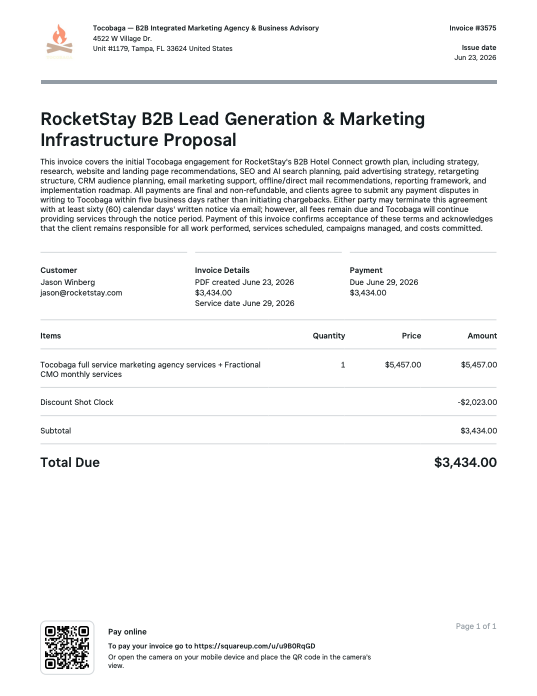
Let’s Go ➳
ABOUT
TOCOBAGA
a
B2B, B2C SMB Strategic Advisory
&
Omni-channel, Integrated Marketing Agency
Fractional CMO FAQs
-
A Fractional CMO (Chief Marketing Officer) is a part-time or shared resource hired by a company to provide strategic marketing leadership. This arrangement allows businesses to access high-level marketing expertise without the cost of a full-time executive.
-
A Fractional CMO typically handles various aspects of marketing strategy, planning, and execution. Their responsibilities may include market analysis, brand development, campaign management, and team leadership. They work on a part-time basis, providing strategic guidance to help businesses achieve their marketing goals.
-
1. Cost-Effective: Fractional CMOs offer high-level expertise without the full cost of a permanent executive, making it a cost-effective solution for businesses.
2. Flexibility: Companies can scale their marketing leadership up or down based on their needs, without the commitment of a full-time hire.
3. Diverse Experience: Fractional CMOs often bring diverse industry experience, providing fresh perspectives and insights to the marketing strategy.
4. Strategic Guidance: These professionals offer strategic guidance, helping businesses align marketing efforts with overall business objectives.
5. Access to Networks: Fractional CMOs may bring valuable industry connections and networks, enhancing opportunities for partnerships and collaborations.
6. Objective Perspective: Being external to the organization, Fractional CMOs can provide unbiased and objective viewpoints on marketing strategies.
7. Quick Onboarding: As seasoned professionals, Fractional CMOs can quickly adapt to the business environment, accelerating the onboarding process.
8. Task-Specific Expertise: Companies can engage Fractional CMOs for specific projects or challenges, tapping into their expertise for targeted improvements.
9. Risk Mitigation: Businesses can mitigate the risk associated with hiring a full-time CMO by testing the waters with a fractional arrangement.
10. Efficiency: With a focus on strategic planning, Fractional CMOs can optimize marketing processes for efficiency and effectiveness.
Why would a SMB hire a Fractional CMO?
Small and Medium-sized Businesses (SMBs) might choose to hire a Fractional CMO for several reasons:
1. Cost Efficiency: SMBs often have budget constraints, and a Fractional CMO allows them to access high-level marketing expertise without the cost of a full-time executive.
2. Flexibility: The variable nature of marketing needs in SMBs can be addressed with a part-time resource, adjusting the level of expertise based on the business's current requirements.
3. Strategic Insight: Fractional CMOs bring strategic thinking and experience, helping SMBs develop effective marketing strategies aligned with their business goals.
4. Resource Optimization: SMBs may not need a full-time CMO, making a fractional arrangement a practical way to optimize resources and focus on key priorities.
5. Quick Impact: Fractional CMOs can swiftly assess the marketing landscape, identify opportunities, and implement strategies to generate quick and impactful results.
6. Access to Networks: SMBs can leverage the networks and industry connections of Fractional CMOs, opening doors to potential partnerships and collaborations.
7. Task-Specific Projects: SMBs can engage a Fractional CMO for specific projects or campaigns, tailoring the arrangement to address immediate marketing needs.
8. Objective Perspective: An external CMO can provide an unbiased and objective viewpoint, offering insights that might be challenging to achieve with an in-house team.
9. Risk Mitigation: Hiring a full-time executive involves risks, but a fractional arrangement allows SMBs to test the waters and evaluate the impact of senior marketing leadership.
10. Learning Opportunity: SMBs can benefit from the knowledge transfer that occurs when working with an experienced Fractional CMO, helping build internal marketing capabilities over time.
-
short answer: engagement, commitment, and scope of responsibility
more detailed answer:
1. Time Commitment:
- Fractional CMO: Works on a part-time or project-specific basis, dedicating a limited number of hours per week or month to the organization.
- Full-time CMO: Is a permanent, full-time employee committed to the organization on a daily basis.
2. Cost Structure:
- Fractional CMO: Typically charges on an hourly or project basis, providing a more cost-effective solution for businesses with budget constraints.
- Full-time CMO: Involves a fixed annual salary, potentially with additional benefits, which may be a higher financial commitment for the organization.
3. Scope of Responsibilities:
- Fractional CMO: Focuses on specific strategic initiatives, projects, or areas of expertise as agreed upon with the organization.
- Full-time CMO: Assumes a broader range of responsibilities, overseeing the entire marketing department and contributing to overall business strategy.
4. Flexibility:
- Fractional CMO: Offers greater flexibility, allowing organizations to scale up or down based on their evolving marketing needs.
- Full-time CMO: Represents a more fixed and consistent presence within the organization, which may be less adaptable to changes in workload.
5. Depth of Involvement:
- Fractional CMO: Often works at a more hands-on level, directly involved in strategy development and execution.
- Full-time CMO: Balances strategic leadership with managerial responsibilities, overseeing day-to-day operations and team management.
6. Long-Term Commitment:
- Fractional CMO: May be engaged for specific projects, a defined period, or on an ongoing but part-time basis, providing a more flexible arrangement.
- Full-time CMO: Implies a longer-term commitment to the organization, with a focus on sustained leadership and relationship building.
-
short-answer: adaptability, agility, resources, communication, wisdom (experience x knowledge)
long answer:
1. Diverse Perspectives: A Fractional CMO with varied industry experience can offer diverse perspectives and insights, bringing a fresh and innovative approach to marketing strategies.
2. Cross-Industry Best Practices: They can bring best practices from different industries, adapting successful strategies and tactics to the specific needs of the organization.
3. Benchmarking Opportunities: With exposure to various industries, a Fractional CMO can provide valuable benchmarking data, helping the organization understand how its marketing performance compares to similar businesses in different sectors.
4. Adaptability: The ability to adapt strategies from one industry to another can be a key advantage. The Fractional CMO can leverage successful techniques across different markets, promoting adaptability and agility.
5. Network Access: Their extensive network across industries can open doors to potential partnerships, collaborations, and industry-specific opportunities that may not be readily apparent within a single-sector focus.
6. Innovation and Creativity: Exposure to diverse industries fosters innovation and creativity. A Fractional CMO can bring a rich mix of ideas, drawing on experiences beyond the confines of a single sector.
7. Risk Mitigation: They can provide insights into potential risks and challenges by drawing on experiences from various sectors, helping the organization proactively address issues before they become significant problems.
8. Market Trends Awareness: A Fractional CMO engaged with multiple clients in different industries stays attuned to a wide range of market trends. This knowledge can be invaluable in staying ahead of industry changes and emerging opportunities.
9. Customization for Unique Markets: Leveraging experience in various industries, the Fractional CMO can tailor marketing strategies to suit the unique characteristics and challenges of the organization's specific market.
10. Continuous Learning: A Fractional CMO involved in diverse industries is likely to be a continuous learner, staying updated on the latest trends, technologies, and strategies across various sectors, which can benefit the organization.
-
1. Fractional CMO:
- A Fractional CMO typically refers to a part-time or shared Chief Marketing Officer who provides strategic marketing leadership to organizations on a flexible basis.
- They might work with multiple clients simultaneously, dedicating a certain number of hours per week or month to each client.
2. Interim Fractional CMO:
- An "Interim Fractional CMO" could imply a temporary or transitional role where the Fractional CMO is specifically engaged to fill a gap or address a short-term need.
- The "Interim" aspect suggests a focus on providing leadership during a transitional period, such as when a company is between full-time CMOs or undergoing significant changes in its marketing strategy.
SERVICES
-
OVERALL STRATEGY
CAMPAIGN STRATEGIES
TACITICAL STRATEGIES
-
SMART Goals, Benchmarks + KPI Planning
-
- Audiences
- Targets
- Find out 4 Holy Metrics:
- Cost Per Lead
- Cost Per Acquisition
- Average Revenue of a customer within 1st year
- Lifetime Value
Quick Start Services
Marketing Execution Services
-
Monitoring & Maitenance
Analytics Tracking
SEO (technical)
Live Chat optimization
Build out
* Landing pages by service
* Landing pages by service and city/region
Content
FAQs
Blog posts
-
- PPC
- Google Search Ads
- Bing Search Ads
- Local Services Ads
- AdRoll - cross platform retargeting/remarketing
- Later - platform-industry specific ads w/ Angi, Yelp, etc.
- Social Ads
- AdRoll retargeting ads on FB and IG
- Pinterest might be a great avenue
- Programmatic
- We can get precise targeting
-
- Technical SEO
- At least 1 blog post per month
-
- Automation emails for servicing
- Marketing email campaigns
- New lead automated journeys
-
- Review Capturing
- Review Monitoring
- Directory Listings optimization
-
Traditional Advertising - radio, tv, newspaper, magazine, etc.
Community - sponsorships, focused local corporate responsibility
-
BRANDING:
Brand Development
Brand Identities
Brand Messaging
DESIGN: Any design deliverables needed
Graphic Design, Website Design, UI (User Interface), UX (User Experience), Print Design, Online Ad Design, Video Editing, Image Editing, Custom Illustrations, Newspaper Ads and Design, Magazine Ads and Design, Brick & Mortar Exterior Signage, etc.
Support Services
-
create a Google Data Studio or similar to aggregate analytics into
1) Snapshot
2) by campaign/tactic
-
Setup every task and project in your PM app, Asana?
-
- Starting line: I would want to come in office to War Room around y'all's schedules and work from the office a few days in the beginning. There's always smaller things to absorb just being around that is lost in digital communication
- Slack (or whatever your team uses) for direct communication. We prioritize client communication above email, calls and texts. We keep all conversations in Slack/Teams to have transparency and a searchable knowledge base.
- Update meetings: Weekly until we find a rhythm and go biweekly. I keep them 30 minutes and apply the EOS system to keep it efficient.
-
- Will need to learn your automation processes to streamline any redundant tasks
Possible add-ons services and costs
Online Ad/PPC ad spend without markup
Video Content Production
Purchasing Email Lists via Data Broker
Programmatic Direct Messaging
Approach
Strategy-first approach: work big to small. Macro to Micro. The biggest gaffe in the outsourced marketing services sector is focusing on tactics to begin. Our approach is the following 6 phases:
1. Define Objectives, S.M.A.R.T. goals and Current Analysis & Resource Audit (a current strategy review, branding assessment, resource audit and marketing performance report).
2. Thorough research.
3. Develop a leveraging integrated, omnichannel strategy in lock step communication and approval with the client.
4. Project management execution with respect to achieving KPIs, budgets and resources
5. Analyze quantitative and qualitative reporting.
6. Continuously improve

Strategic plans without execution = a fun idea.
Discipline is the ultimate freedom.
Over-communicate until you have concise shorthand.
Time is a commodity.
Think 3 steps ahead. Contingency plan IFTTT scenarios.
Be agile & adaptable.
The obstacle is the way.
Work short-term and long term at the same time.
Analyze the past while proactively, continuously improve your present and future.
Execute omnichannel, integrated marketing campaigns, online and off.
Work macro and micro.
Generalize and specialize.
Strategic and tactical.
A/B test.
ROI should be the client's main focus and many drill down minutiae. ROI (Return On Investment) is the only thing that matters to our clients (and us). It is the cover image on every one of our proposal decks. It is our mantra; our North Star philosophy. We must provide multiple X ROI for our clients or we cease to exist.