

ImageNet proposal

THE
ONLY
THING
THAT
MATTERS
TO
US
&
OUR
CLIENTS
IS
ROI
Supplemental Video Notes
SMBs Strategically Advised
Successful Integrated Marketing Campaigns
Average Client Return On Investment
Websites Produced
(Developed & Designed)
High Performing Emails Deployed
CASE STUDY
Our Commercial Real Estate Client Saw 2020 As An Eventual Blessing - First Disguised As A Curse
The Covid ERA destroyed commercial real estate firms.
With every bad, there's a good. We used this time to re-strategize.
-
We entered The Lockdown with our newly signed client, a Florida-based commercial real estate company, NAME REDACTED, facing a dual challenge of low lead generation and limited brand awareness as it underwent a succession transition from a legacy owner to a new, young CEO. The company needed to revitalize its image and attract potential clients to increase business. Tocobaga initiated a rebranding campaign, focusing on a modern and dynamic image while respecting the company's legacy. We employed a mix of digital and traditional strategies, including a revamped website, selective PR strategies, networking event creations and participation in community efforts utilizing vacant properties to boost brand visibility.
-
We capitalized on the new allotment of time. Planned the next 5 years with SMART goals, benchmarks and KPIs. The company's website underwent a modern redesign to enhance user experience, incorporating a sleek design and showcasing successful case studies. Multiple channels were utilized to highlight the CEO's vision while paying respect to the previous owner's cowboy persona, researched industry insights, and the revamped the client's unique selling propositions. Participation in relevant industry events allowed our client to connect with potential clients and partners.
-
The strategic approach led to a significant uptick in lead generation and brand awareness, resulting in a remarkable 4.1x return on investment (ROI) in the post-Covid Era. The updated website attracted more visitors, and the CEO's active presence on social media contributed to a positive perception of the company. Tocobaga successfully positioned our client as a forward-thinking industry player, gaining trust and interest from potential clients. The successful case study underscores the importance of strategic rebranding and a multi-channel approach to lead generation. Balancing modernity with respect for legacy allowed our client to capture the attention of its target audience, ultimately leading to a substantial ROI and a strengthened market position.
CASE STUDY
Home Services Is Where The Heart Is
People get in routines because that is always how they have been doing it.
"People don't change" isn't our favorite phrase because...well...change is inevitable.
We had to use the big dog hot phrase, Change Management, to achieve our wins in Lead Gen, Sales Ops and Automations.
-
A 40 year old mom-and-pop home services company, NAME REDACTED, faced the challenge of expanding its client base and increasing revenue. Their biggest challenge was the larger, corporate level competition squeezing their market share. To achieve this, NAME REDACTED needed a comprehensive lead generation strategy that would leverage multiple channels and integrate seamlessly to maximize results.
-
Tocobaga implemented a multichannel approach, combining digital and traditional marketing channels. We utilized targeted online advertising, optimized their website for conversions, ran email campaigns, and engaged in local community outreach. The goal was to create a cohesive marketing ecosystem that guided potential clients through the customer journey. Track everything. We also had to clean up their entire CRM of over 40,000 contacts and develop an API to integrate with their field operating software. The company invested in targeted online advertising campaigns to reach a broader audience. Simultaneously, we revamped their website, ensuring it was user-friendly and featured compelling content. Email campaigns were personalized and segmented to nurture leads effectively.
-
The integrated approach proved highly successful, resulting in an outstanding 38.7x return on investment (ROI) in 6 months. The online advertising increased visibility, the optimized website improved conversion rates, and the personalized email campaigns fostered strong customer relationships. The community outreach efforts not only contributed to brand awareness but also generated local leads. We are proud of this well-executed, multichannel lead generation strategy. The seamless integration of online and offline efforts, combined with a focus on user experience and community engagement, led to an impressive ROI. This success emphasizes the importance of a holistic approach in achieving significant outcomes in the competitive home services industry.
CASE STUDY
Challenge Accepted
We typically don't do event marketing.
We saw this as a fun challenge to up our game.
-
In 2016, new, local altruistic organization wanted to partner with a national charity for a mixed used festival event. We faced the challenge of low attendance, little-to-no brand awareness outside of the organization's personal reach and limited funds for their upcoming fundraising event. They needed to boost lead generation to ensure a successful turnout and maximize donations.
-
We implemented a multi-channel marketing strategy, leveraging social media, email campaigns, and partnerships with local businesses. They also optimized their website for user engagement and introduced a referral program to encourage participants to invite others. We utilized the charity's compelling storytelling in their social media posts and emails, highlighting the impact of their cause. They engaged with influencers and community leaders to amplify their message. Additionally, they collaborated with local businesses to sponsor and promote the event.
-
The lead generation efforts exceeded expectations, resulting in an 8.4x return on investment (ROI) and sold out the event with 5,000 attendees. The optimized website attracted more visitors, and the referral program significantly expanded the reach. The event saw a substantial increase in attendance, leading to a successful fundraising outcome that surpassed the charity's initial goals. The success of the lead generation campaign emphasized the importance of a comprehensive, multi-channel approach. Engaging storytelling, influencer partnerships, and community involvement proved to be powerful tools in achieving remarkable ROI for the charity event. We created the marketing machine. This festival has now spawned off 5 additional metropolitan cities using our framework as their blueprint.
“Leave the campsite better than you found it, and the world will be a better place because of it”
ImageNet Tampa and Sarasota has a real market opening: a five-county territory of roughly 6.2 million people and 215,000 business establishments, covered by five or six reps against competitors fielding thirty to fifty. The opportunity is not the problem. The problem is that ImageNet's growth engine is still entirely dependent on rep-initiated cold outreach canvassing which caps net new appointments at whatever those reps can physically touch in a week. Tocobaga's recommendation is to build a focused B2B lead generation system around ImageNet's strongest and least commoditized offer: office equipment and servicing large hardware pain points under one locally owned, seventy-year-old roof, sold into businesses with five to one hundred employees that are already inside a lease-expiration.
Objectives
- Build ImageNet Tampa and Sarasota's net new appointment engine.
- Create high-intent landing pages by vertical and by service.
- Capture demand from businesses with expiring copier leases and IT contracts.
- Retarget website visitors, canvassed accounts, and existing prospects across channels.
- Support the rep team with ads, email, landing pages, and follow-up assets.
- Build search authority in Google, Bing, and AI search for office equipment and managed IT.
- Separate the managed IT story from copier-dealer commodity noise.
- Measure qualified leads, booked appointments, CPL, CAC, account value, and channel quality.
ImageNet overview and value-add proposition
Seventy years in business. Canon and HP dealer. Managed IT services. Roughly twenty-one locations nationally — but the Tampa and Sarasota branches run their own P&L under a president who holds ownership in both. Decisions get made in the building, which is the single biggest reason this engagement can move quickly instead of dying in an approval chain.
Three assets are hard for competitors to copy, and none of them are currently being marketed:
- Seventy years of not going anywhere. The category is being rolled up by private equity right now — the largest independent dealer in the country is headquartered in Tampa and was sold twice in five years, most recently to a PE firm in April 2024. When a buyer signs a five-year contract, "will this vendor still exist and still care in year four" is a live fear nobody is answering out loud.
- Local ownership under a national umbrella. National manufacturer relationships and buying power, but an owner in town who can make a call. Buyers hate dialing an 800 number about a jammed machine.
- One vendor, two problems. Equipment and managed IT on one contract. Quocirca's 2025 research found 48% of organizations already use a single provider for managed print and IT, rising to 56% in the midmarket. Most equipment dealers bolt IT on badly; most MSPs will not touch hardware. ImageNet does both.
Positioning line to test: local hands, national backing, seventy years of not going anywhere. Final language gets set against competitor messaging research in the strategy phase.
Primary target audiences
Firmographics. Commercial businesses, roughly five to one hundred employees, with a physical office and document-heavy operations.
Target verticals. Law firms, real estate and property management, HVAC and mechanical contractors, manufacturing, engineering and architecture, churches and faith organizations, nonprofits, private and charter schools, and general professional services.
Out of scope. Retail, restaurants, malls, gas stations, and hospitals — hospitals buy through a parent organization. State and government stay low priority unless ImageNet wants it pursued.
Buying committee. Office manager or administrator as first signal, operations or finance as approver, IT or an outside MSP consulted on the managed services side. That is at least two distinct messages, not one, and creative will reflect it.
Territory, tiered by density and drive time.
- Tier 1 — Hillsborough and Pinellas. About 100,000 establishments combined. Highest density, shortest drive from Waters and Anderson, fastest path to a booked appointment.
- Tier 2 — Sarasota, Manatee, and Pasco. Anchored by the Sarasota branch, plus New Port Richey and Wesley Chapel growth corridors.
- Tier 3 — Polk (Lakeland) and the Fort Myers to Naples stretch. Real opportunity — Lee County alone has nearly 29,000 establishments — but longer drives, so lead quality thresholds are set higher before a rep commits the day.
The trigger that matters most. Demand here is event-driven, not persuasion-driven: lease expiration, office move, service failure, growth, or a security incident. Most copier leases run sixty months and auto-renew for another twelve unless cancelled with sixty to ninety days' notice — which makes the ninety-day pre-expiration window the highest-intent moment in the entire category. Targeting is built around finding that window.
Goals and KPIs
- Establish the baseline. Cost per lead by channel, lead-to-appointment rate, and appointment-to-close rate documented inside the first ninety days.
- Hit a monthly appointment quota reverse engineered from ImageNet's stated revenue goal and locked at the strategy session.
- Diversify first contact so the branch is no longer dependent solely on rep-initiated outreach.
- Cover the territory the reps cannot. Measurable lead flow from Pasco, Polk, and the Sarasota-to-Naples stretch, not just the Hillsborough and Pinellas core.
- Compound. Every month of data narrows targeting and lowers cost per lead. Year two should not cost what year one costs.
Four numbers govern every decision made on ImageNet's behalf:
1. Cost Per Lead
What it costs to produce one marketing qualified lead — a call, a form fill, or a reply from a business in the target verticals and territory. There is no historical number to work from, so phase one establishes it channel by channel. Third-party B2B benchmarks put IT and managed services CPL around $500, legal services around $650, and blended B2B multichannel closer to $190 — so channel mix moves this number dramatically. Google Local Service Ads are pay-per-lead with disqualified leads disputable, which is why they are the lowest-risk starting point for a business with no CPL history.
2. Cost Per New Customer
Cost per lead only matters once it connects to a signed contract. This is where the marketing funnel meets ImageNet's sales funnel, and it requires one thing from the branch: telling us which appointments closed. Industry data on managed services puts the median close rate from a first appointment near 35%. Against ImageNet's contract values, a healthy acquisition cost lands in the high hundreds to low thousands per won account — which is affordable, but only if appointments are qualified rather than merely booked.
3. Average Revenue Per New Account, Year One
From the discovery call: a single machine including service commonly lands in the few-hundred-per-month range, multi-machine deals run one to two thousand a month, and the larger ones go past that. Year one revenue governs payback period — how many months an account takes to cover what it cost to win. We refine this against actual closed-won data and segment it, because a four-machine law firm and a single-machine church should not be chased with the same budget.
4. Lifetime Value
Five-year contracts with service bundled, plus managed IT attach and renewal, make this the strongest number in the model and the reason patient acquisition math works here. High lifetime value means ImageNet can afford to spend more to win an account than a competitor thinking in twelve-month terms — a durable structural advantage, once it is quantified and actually used.
Reverse engineering the appointment math
Revenue goal divided by average contract value equals deals needed. Deals divided by close rate equals appointments needed. Appointments divided by lead-to-appointment rate equals MQLs needed. MQLs multiplied by cost per lead equals the media budget required to hit the goal.
That chain is why goals come before tactics. It turns "we want more appointments" into a monthly quota with a budget attached, and it makes obvious early whether a goal is reachable with current rep headcount or whether hiring has to happen alongside it.
Cocktail napkin strategy
Two motions run at once. Push puts ImageNet in front of businesses that are not looking yet. Pull makes sure ImageNet is there when they finally are. Push builds the pipeline; pull catches the buyer at the lease-expiration or service-failure moment. Neither works alone.
Pull — be there when they are looking. Google Local Service Ads (pay per lead, disputable). Google Search on high-intent commercial terms — copier lease, managed IT services, print management, plus competitor and lease-exit queries — geo-fenced to the tiered territory. Bing Search, which is systematically under-priced and over-indexed for this audience because office desktops running Microsoft default to it, and which most competitors skip entirely. Landing pages built by vertical and service, with call and form tracking wired in from day one.
Push — get in front of them first. Multi-touch cold email journeys to verified, compliantly sourced contacts in the target verticals, built on proper sending infrastructure to protect domain reputation. LinkedIn ads and message campaigns to office managers, operations leads, and owners across the five counties. Retargeting so anyone who touches a page keeps seeing ImageNet until they convert or age out. Digital coverage of the same zip codes the reps are canvassing, plus leave-behinds and follow-up sequences so a door knock does not end at the door.
Owned base — the cheapest leads ImageNet already has. Referral and incentive programs against the current customer base, managed IT attach campaigns to equipment-only accounts, and a renewal runway sequence timed ahead of contract maturity. Entirely optional; if ImageNet would rather not touch the base, we do not.
The wedge nobody else is using: a lease audit and auto-renewal review offer. Buyers are receptive — Quocirca's 2025 study found 42% of organizations open to changing managed print provider at contract end and 15% who will definitely change. That is a marketable, differentiated first conversation that does not start with "can I quote your copier."
Tocobaga's role: strategy, channels, and execution
Business development here is two funnels, not one, and being explicit about the seam is how this stays accountable.
Marketing funnel — Tocobaga owns it. Research, targeting, messaging, media, landing pages, tracking, and delivery of marketing qualified leads. Our job is to make the phone ring, the inbox fill, and the form submit.
Sales funnel — ImageNet owns it. Qualification, the appointment, the walkthrough, the proposal, the close. Your reps and your process, unchanged.
The seam. Two things make or break this. Intake — what happens in the first five minutes after a lead comes in. And closed-loop reporting — learning which leads became appointments and which appointments became contracts. Without that feedback, targeting cannot improve. We audit intake early and set up the simplest reporting loop your team will actually maintain.
On outbound calling. Tocobaga does not run a call center and will not claim otherwise. If ImageNet wants dedicated appointment setting layered on top of the marketing funnel, we will help vet a sales enablement partner and manage them against the same metrics, so accountability lives in one place.
Macro to micro. Research the total market first, narrow to the accounts most likely to close, then execute. Short-term and long-term work run simultaneously — some things launch in weeks, some take a quarter to compound.
Deliverables
- Full market, competitor, and target audience research across the five-county footprint, with personas by vertical and by buying-committee role.
- Overall marketing strategy plus lead generation sub-strategies per audience segment, presented for ImageNet co-sign before execution.
- Brand messaging and positioning framework separating the managed IT story from copier commodity noise.
- Conversion infrastructure: landing pages by vertical and service, call tracking, form tracking, and analytics.
- Campaign build and ongoing management across Google Local Service Ads, Google Search, Bing Search, LinkedIn, retargeting, and cold email journeys.
- Cold email sending infrastructure, domain warm-up, and compliant list sourcing.
- Rep enablement assets tied to canvassing territory — leave-behinds, follow-up sequences, and digital coverage of the same zip codes.
- Intake audit and a closed-loop reporting process ImageNet can actually maintain.
- Monthly performance reporting against the Four Holy Metrics, plus weekly notes and analysis.
- Project management chart and standing communication cadence, so nothing is a black box.
Six-month roadmap
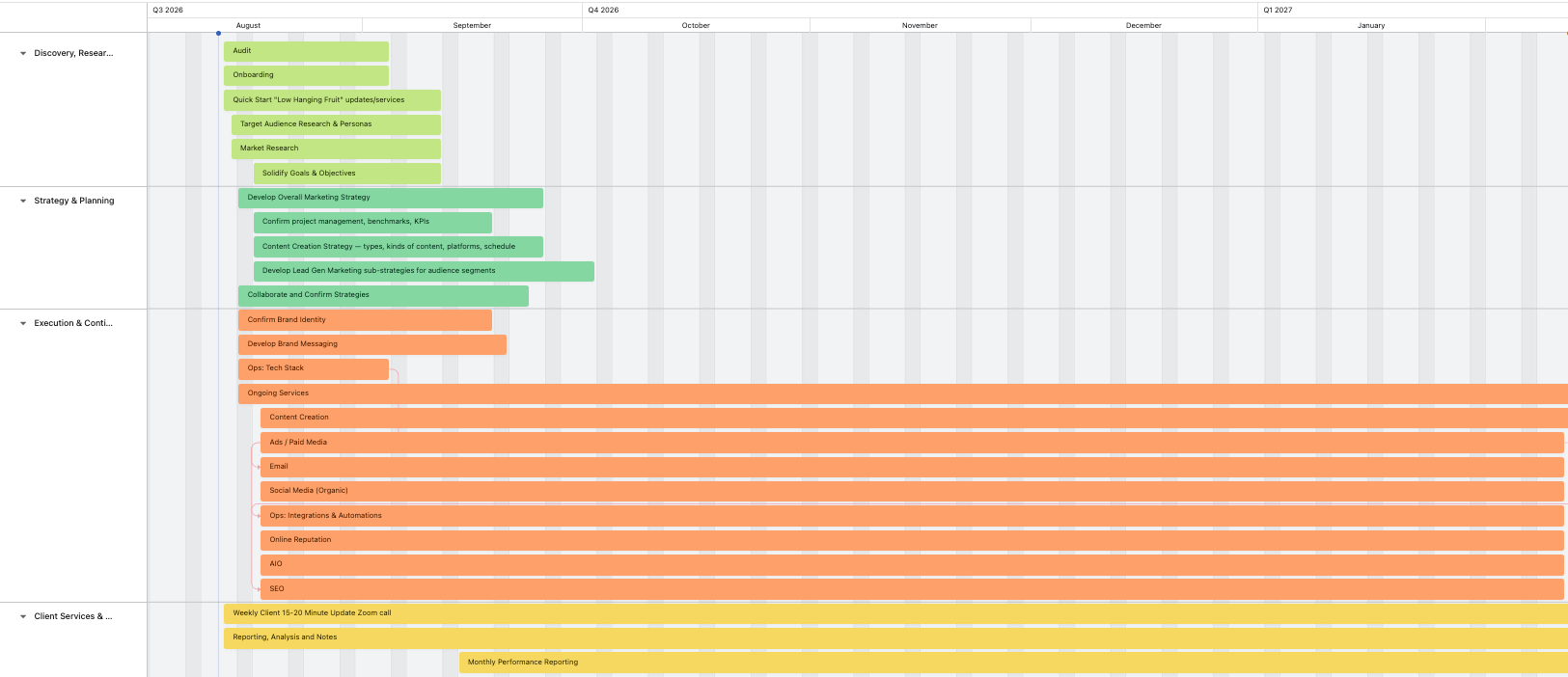
This is not a phased plan where execution waits on research. Short term and long term run at the same time. Research starts on day one and so does execution — the deep work compounds in the background while the fast-moving channels start producing appointments within the first two weeks.
Week 1 — everything starts. Onboarding and access handoff, audit of tracking and intake and existing accounts, target audience research, market and competitor research, and quick-start low-hanging-fruit fixes all begin immediately. Execution begins two days in: Local Service Ads and Google and Bing search go live first because they capture demand that already exists, and cold email infrastructure and domain warm-up start immediately since that clock runs three to four weeks regardless.
Weeks 2–8 — build while running. Landing pages and conversion infrastructure, brand identity and messaging, LinkedIn campaigns, rep enablement, and the retargeting layer come online in sequence, each one launching the moment it is ready rather than waiting for a phase gate. Meanwhile the overall marketing strategy, lead gen sub-strategies by segment, KPI framework, and content strategy are developed off live data rather than assumptions — which is the point of running both at once.
Around week 8 — collaborate and confirm. Full strategy presented for ImageNet co-sign, informed by six to eight weeks of real performance data instead of a research deck alone.
Month 3 forward — optimize and compound. Ninety-day baseline metrics review determines where budget shifts. Cut what is not producing, scale what is, add owned-base referral and attach campaigns, and move upmarket toward multi-machine and multi-service accounts that raise contract value.
Communication runs the entire six months, every week. A weekly fifteen-to-twenty minute update call from week one, ongoing reporting and analysis notes, and monthly performance reporting against the Four Holy Metrics. No black boxes and no month where you are wondering what is happening.
The few real dependencies: tracking and intake must be live before meaningful media spend, and cold email sends wait on domain warm-up. Everything else runs in parallel. This plan flexes to ImageNet's budget and capacity — the timeline stretches before the scope shrinks.
Client homework
- Revenue goals — this year, three year, five year — so the appointment math can be reverse engineered.
- Close rate and average deal size from recent closed-won business, segmented if available.
- Thirty minutes with one or two reps: which doors open, which objections repeat, which verticals actually buy. Field insight beats a research report every time.
- A fuller picture of the offline efforts already running, so we complement rather than duplicate.
- Access to the website, any existing ad accounts, CRM or lead tracking, and the Google Business Profile.
- One person named as lead responder, so inbound leads get answered in minutes rather than days.
- Attendance on the standing weekly call in the first stretch — that is where the strategy actually gets built.
Commercial structure
- Flat fee, never a percentage of ad spend. We have no incentive to inflate a budget. Media spend is ImageNet's and is paid directly to the platforms.
- 60 Day Exit. A client who stays should stay by choice.
- Everything gets co-signed. Strategy is presented, ImageNet approves or sends it back, then we execute. Nothing launches by surprise.
- Standing weekly call with you and the president to start — short, and optional if the week is slammed — tapering to every other week once the rhythm is set. Video updates when a call cannot happen.
- No tech chasm. Ask anything. If we do not have the answer on the spot, we look it up and come back with it.
- ROI is reported including our management fee — which almost no agency does. You see marketing spend leave the door; the honest number counts all of it.
Research Notes
TAM SAM SOM
TAM — total addressable market. All business establishments across the eight counties ImageNet sells into. Source: Florida Office of Economic and Demographic Research county area profiles, establishments 2024.
| County | Establishments (2024) | Population (2025) |
|---|---|---|
| Hillsborough | 58,452 | 1,575,637 |
| Pinellas | 41,521 | 966,933 |
| Lee | 28,954 | 839,223 |
| Sarasota | 21,209 | 487,640 |
| Collier | 18,444 | 413,314 |
| Polk | 17,281 | 846,896 |
| Pasco | 15,145 | 648,369 |
| Manatee | 14,624 | 466,845 |
| TAM total | ≈ 215,600 | ≈ 6.24M |
SAM — serviceable addressable market. Filtering to ImageNet's target verticals (construction and mechanical, manufacturing, financial and real estate, professional and business services, other services including religious and nonprofit) leaves roughly 125,600 establishments — between 53% and 64% of all establishments county by county. Applying the five-to-one-hundred employee filter (nationally about 33% of establishments fall in that band) gives roughly 41,400, and discounting about 15% for home-based, non-fit, or deeply locked accounts lands at ≈ 35,000 serviceable accounts.
SOM — serviceable obtainable market. With five-year contract cycles, roughly 20% of that SAM is in play in any given year — about 7,000 accounts annually. Managed services research suggests a narrower slice, near 2% of a target market, is actively shopping at any moment. Against five or six reps, a focused appointment engine can realistically support 250 to 500 qualified appointments a year; at close rates of 20% to 35%, that produces roughly 40 to 75 net new accounts in year one — approximately $600K to $1.1M in five-year contract value at a $15K midpoint — and roughly 150 to 250 accounts cumulatively by year three, or $2.3M to $3.75M in contract value. Larger multi-machine and multi-service wins move these figures materially.
Hard-sourced: all county establishment and population figures (Florida EDR, 2024–2025); contract values and rep counts (ImageNet, discovery call). Estimated: the employee-size filter, vertical share, annual turnover rate, appointment volume, and close rates. Every assumption should be replaced with ImageNet's own CRM and historical win-rate data before budgets are set.
Audiences
Priority verticals, ranked by density and fit. Law firms lead — high document volume, security and compliance sensitivity, and the highest willingness to pay for reliability, though also the most expensive audience to reach. Real estate and property management follow, with multi-site fleet needs. HVAC and mechanical contractors, manufacturing, engineering and architecture (wide-format plus IT), churches and faith organizations, nonprofits, and private and charter schools round out the list. Professional and business services alone represent the largest single sector block across all eight counties.
Buying-committee messages. The office manager cares about the machine jamming and who picks up the phone. Operations and finance care about total cost, contract terms, and not getting trapped in an auto-renewal. IT — internal or an outside MSP — cares about security, network integration, and whether the vendor will create work for them. Three different messages, one company.
Trigger segments, which matter more than demographics. Businesses inside the ninety-day pre-lease-expiration window; businesses that have moved or expanded office space in the past six months; businesses that have publicly disclosed a security incident or are pursuing a compliance certification; and businesses hiring aggressively, which signals office growth.
Competitive context. The Tampa market is anchored by the largest independent dealer in the country, headquartered locally, PE-backed, and now building its own managed IT arm. National platforms and manufacturer-direct branches also compete. Meanwhile, most local dealer websites are dated and SEO-thin, and the regional MSPs — who market well and lead with cybersecurity — are the real competition for the managed IT conversation. Everyone claims local, trusted, best service, and fast response. Vertical specialization, security-led positioning, owner-led accountability versus PE-owned nationals, and lease transparency are all unclaimed.
Ad spend dynamic budget research
Third-party cost benchmarks (market data, not ImageNet-specific): IT and managed services cost per lead runs near $500; legal services is the most expensive B2B vertical at roughly $650; blended B2B multichannel prospecting sits closer to $190. Cost per qualified meeting in high-ticket B2B services typically ranges $80 to $250, with LinkedIn at the top of that band. Median close rate from a first appointment in managed services is about 35%.
What that implies here. Budget is not allocated evenly. It is allocated by trigger proximity. Pay-per-lead and high-intent search capture buyers already in the window and should be funded first and defended hardest. Push channels — cold email and LinkedIn — carry a lower cost per touch but a longer lag, so they get funded steadily rather than in bursts, because their return shows up one to two quarters out.
The dynamic part. Budget moves monthly toward whichever channel is producing appointments that close, not leads that merely arrive. Any channel exceeding the cost-per-acquisition ceiling implied by ImageNet's contract values gets cut or reworked. Any channel beating it gets more. That ceiling is calculated at the strategy session from ImageNet's actual close rate and average deal size — not guessed at from an industry average.
Benchmark sources include Sopro, Martal, Belkins, Flyweel, Robin Robins, Quocirca (2025 MPS Landscape Study and Print Industry Trends), and IBISWorld. Several are agency publishers with an interest in these numbers; treat as directional and validate against ImageNet's own results once data exists.
6 Month Simple Gantt Chart
Proposal Summary
Comparisons & Your Price
No one wants to feel like a dumbo overpaying an outside firm.
We get it. We abhor 99% of advisors and agencies. Our industry has a lot of snake oil.
If you’re going to try to compare bid costs, you must examine the exact same
QCD+F: Quality, Cost, Deliverability + Flexibility
Average Agency Rate
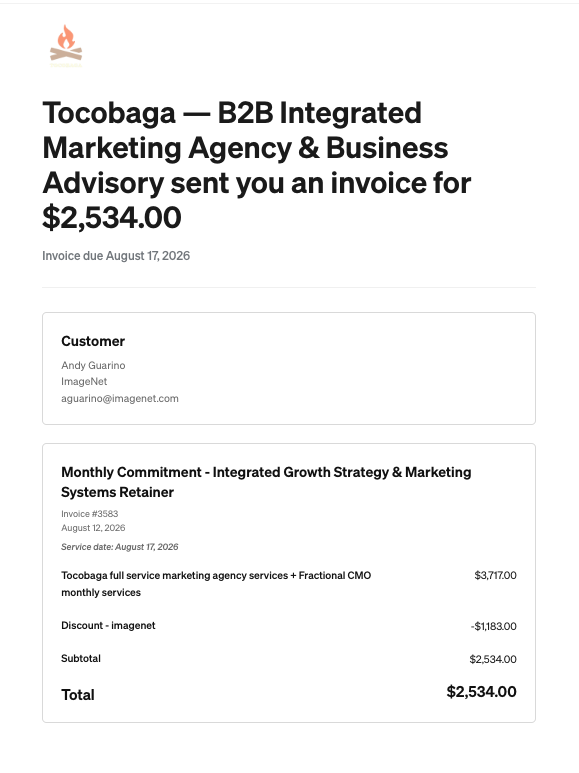
$4,963
Tocobaga’s Normal Rate
$3,717
Your Tocobaga Rate
$2,534
DISCOUNT
SHOT
CLOCK
Quick-Start Next Steps
Administrative & Clerical Tasks
Invoice is deposited - either total for the month or deposit.
Tocobaga begins working
Tocobaga receives access to Tech Stack and any relevant brand collateral
Quick-Start onboarding will not be sequential - aka might be a little out of order than our normal process
Tocobaga will send over Company Services Agreement
Tocobaga will start a Slack workspace for internal communication. If you use another internal communication app, we can integrate Slack with other apps e.g. Slack two-way sync with Teams.
Tocobaga will coordinate a recurring, update meeting cadence - usually once a week initially and then every 2 weeks once we build a rhythm. If clients cannot attend because of schedule conflicts, we will record an update video and send via Slack.
If we’re ready to go right now, the button to the invoice is below or click on the invoice image to the right. Once the invoice is paid, we begin.
Let’s Go ➳
ABOUT
TOCOBAGA
a
B2B, B2C SMB Strategic Advisory
&
Omni-channel, Integrated Marketing Agency
Fractional CMO FAQs
-
A Fractional CMO (Chief Marketing Officer) is a part-time or shared resource hired by a company to provide strategic marketing leadership. This arrangement allows businesses to access high-level marketing expertise without the cost of a full-time executive.
-
A Fractional CMO typically handles various aspects of marketing strategy, planning, and execution. Their responsibilities may include market analysis, brand development, campaign management, and team leadership. They work on a part-time basis, providing strategic guidance to help businesses achieve their marketing goals.
-
1. Cost-Effective: Fractional CMOs offer high-level expertise without the full cost of a permanent executive, making it a cost-effective solution for businesses.
2. Flexibility: Companies can scale their marketing leadership up or down based on their needs, without the commitment of a full-time hire.
3. Diverse Experience: Fractional CMOs often bring diverse industry experience, providing fresh perspectives and insights to the marketing strategy.
4. Strategic Guidance: These professionals offer strategic guidance, helping businesses align marketing efforts with overall business objectives.
5. Access to Networks: Fractional CMOs may bring valuable industry connections and networks, enhancing opportunities for partnerships and collaborations.
6. Objective Perspective: Being external to the organization, Fractional CMOs can provide unbiased and objective viewpoints on marketing strategies.
7. Quick Onboarding: As seasoned professionals, Fractional CMOs can quickly adapt to the business environment, accelerating the onboarding process.
8. Task-Specific Expertise: Companies can engage Fractional CMOs for specific projects or challenges, tapping into their expertise for targeted improvements.
9. Risk Mitigation: Businesses can mitigate the risk associated with hiring a full-time CMO by testing the waters with a fractional arrangement.
10. Efficiency: With a focus on strategic planning, Fractional CMOs can optimize marketing processes for efficiency and effectiveness.
Why would a SMB hire a Fractional CMO?
Small and Medium-sized Businesses (SMBs) might choose to hire a Fractional CMO for several reasons:
1. Cost Efficiency: SMBs often have budget constraints, and a Fractional CMO allows them to access high-level marketing expertise without the cost of a full-time executive.
2. Flexibility: The variable nature of marketing needs in SMBs can be addressed with a part-time resource, adjusting the level of expertise based on the business's current requirements.
3. Strategic Insight: Fractional CMOs bring strategic thinking and experience, helping SMBs develop effective marketing strategies aligned with their business goals.
4. Resource Optimization: SMBs may not need a full-time CMO, making a fractional arrangement a practical way to optimize resources and focus on key priorities.
5. Quick Impact: Fractional CMOs can swiftly assess the marketing landscape, identify opportunities, and implement strategies to generate quick and impactful results.
6. Access to Networks: SMBs can leverage the networks and industry connections of Fractional CMOs, opening doors to potential partnerships and collaborations.
7. Task-Specific Projects: SMBs can engage a Fractional CMO for specific projects or campaigns, tailoring the arrangement to address immediate marketing needs.
8. Objective Perspective: An external CMO can provide an unbiased and objective viewpoint, offering insights that might be challenging to achieve with an in-house team.
9. Risk Mitigation: Hiring a full-time executive involves risks, but a fractional arrangement allows SMBs to test the waters and evaluate the impact of senior marketing leadership.
10. Learning Opportunity: SMBs can benefit from the knowledge transfer that occurs when working with an experienced Fractional CMO, helping build internal marketing capabilities over time.
-
short answer: engagement, commitment, and scope of responsibility
more detailed answer:
1. Time Commitment:
- Fractional CMO: Works on a part-time or project-specific basis, dedicating a limited number of hours per week or month to the organization.
- Full-time CMO: Is a permanent, full-time employee committed to the organization on a daily basis.
2. Cost Structure:
- Fractional CMO: Typically charges on an hourly or project basis, providing a more cost-effective solution for businesses with budget constraints.
- Full-time CMO: Involves a fixed annual salary, potentially with additional benefits, which may be a higher financial commitment for the organization.
3. Scope of Responsibilities:
- Fractional CMO: Focuses on specific strategic initiatives, projects, or areas of expertise as agreed upon with the organization.
- Full-time CMO: Assumes a broader range of responsibilities, overseeing the entire marketing department and contributing to overall business strategy.
4. Flexibility:
- Fractional CMO: Offers greater flexibility, allowing organizations to scale up or down based on their evolving marketing needs.
- Full-time CMO: Represents a more fixed and consistent presence within the organization, which may be less adaptable to changes in workload.
5. Depth of Involvement:
- Fractional CMO: Often works at a more hands-on level, directly involved in strategy development and execution.
- Full-time CMO: Balances strategic leadership with managerial responsibilities, overseeing day-to-day operations and team management.
6. Long-Term Commitment:
- Fractional CMO: May be engaged for specific projects, a defined period, or on an ongoing but part-time basis, providing a more flexible arrangement.
- Full-time CMO: Implies a longer-term commitment to the organization, with a focus on sustained leadership and relationship building.
-
short-answer: adaptability, agility, resources, communication, wisdom (experience x knowledge)
long answer:
1. Diverse Perspectives: A Fractional CMO with varied industry experience can offer diverse perspectives and insights, bringing a fresh and innovative approach to marketing strategies.
2. Cross-Industry Best Practices: They can bring best practices from different industries, adapting successful strategies and tactics to the specific needs of the organization.
3. Benchmarking Opportunities: With exposure to various industries, a Fractional CMO can provide valuable benchmarking data, helping the organization understand how its marketing performance compares to similar businesses in different sectors.
4. Adaptability: The ability to adapt strategies from one industry to another can be a key advantage. The Fractional CMO can leverage successful techniques across different markets, promoting adaptability and agility.
5. Network Access: Their extensive network across industries can open doors to potential partnerships, collaborations, and industry-specific opportunities that may not be readily apparent within a single-sector focus.
6. Innovation and Creativity: Exposure to diverse industries fosters innovation and creativity. A Fractional CMO can bring a rich mix of ideas, drawing on experiences beyond the confines of a single sector.
7. Risk Mitigation: They can provide insights into potential risks and challenges by drawing on experiences from various sectors, helping the organization proactively address issues before they become significant problems.
8. Market Trends Awareness: A Fractional CMO engaged with multiple clients in different industries stays attuned to a wide range of market trends. This knowledge can be invaluable in staying ahead of industry changes and emerging opportunities.
9. Customization for Unique Markets: Leveraging experience in various industries, the Fractional CMO can tailor marketing strategies to suit the unique characteristics and challenges of the organization's specific market.
10. Continuous Learning: A Fractional CMO involved in diverse industries is likely to be a continuous learner, staying updated on the latest trends, technologies, and strategies across various sectors, which can benefit the organization.
-
1. Fractional CMO:
- A Fractional CMO typically refers to a part-time or shared Chief Marketing Officer who provides strategic marketing leadership to organizations on a flexible basis.
- They might work with multiple clients simultaneously, dedicating a certain number of hours per week or month to each client.
2. Interim Fractional CMO:
- An "Interim Fractional CMO" could imply a temporary or transitional role where the Fractional CMO is specifically engaged to fill a gap or address a short-term need.
- The "Interim" aspect suggests a focus on providing leadership during a transitional period, such as when a company is between full-time CMOs or undergoing significant changes in its marketing strategy.
SERVICES
-
OVERALL STRATEGY
CAMPAIGN STRATEGIES
TACITICAL STRATEGIES
-
SMART Goals, Benchmarks + KPI Planning
-
- Audiences
- Targets
- Find out 4 Holy Metrics:
- Cost Per Lead
- Cost Per Acquisition
- Average Revenue of a customer within 1st year
- Lifetime Value
Quick Start Services
Marketing Execution Services
-
Monitoring & Maitenance
Analytics Tracking
SEO (technical)
Live Chat optimization
Build out
* Landing pages by service
* Landing pages by service and city/region
Content
FAQs
Blog posts
-
- PPC
- Google Search Ads
- Bing Search Ads
- Local Services Ads
- AdRoll - cross platform retargeting/remarketing
- Later - platform-industry specific ads w/ Angi, Yelp, etc.
- Social Ads
- AdRoll retargeting ads on FB and IG
- Pinterest might be a great avenue
- Programmatic
- We can get precise targeting
-
- Technical SEO
- At least 1 blog post per month
-
- Automation emails for servicing
- Marketing email campaigns
- New lead automated journeys
-
- Review Capturing
- Review Monitoring
- Directory Listings optimization
-
Traditional Advertising - radio, tv, newspaper, magazine, etc.
Community - sponsorships, focused local corporate responsibility
-
BRANDING:
Brand Development
Brand Identities
Brand Messaging
DESIGN: Any design deliverables needed
Graphic Design, Website Design, UI (User Interface), UX (User Experience), Print Design, Online Ad Design, Video Editing, Image Editing, Custom Illustrations, Newspaper Ads and Design, Magazine Ads and Design, Brick & Mortar Exterior Signage, etc.
Support Services
-
create a Google Data Studio or similar to aggregate analytics into
1) Snapshot
2) by campaign/tactic
-
Setup every task and project in your PM app, Asana?
-
- Starting line: I would want to come in office to War Room around y'all's schedules and work from the office a few days in the beginning. There's always smaller things to absorb just being around that is lost in digital communication
- Slack (or whatever your team uses) for direct communication. We prioritize client communication above email, calls and texts. We keep all conversations in Slack/Teams to have transparency and a searchable knowledge base.
- Update meetings: Weekly until we find a rhythm and go biweekly. I keep them 30 minutes and apply the EOS system to keep it efficient.
-
- Will need to learn your automation processes to streamline any redundant tasks
Possible add-ons services and costs
Online Ad/PPC ad spend without markup
Video Content Production
Purchasing Email Lists via Data Broker
Programmatic Direct Messaging
Approach
Strategy-first approach: work big to small. Macro to Micro. The biggest gaffe in the outsourced marketing services sector is focusing on tactics to begin. Our approach is the following 6 phases:
1. Define Objectives, S.M.A.R.T. goals and Current Analysis & Resource Audit (a current strategy review, branding assessment, resource audit and marketing performance report).
2. Thorough research.
3. Develop a leveraging integrated, omnichannel strategy in lock step communication and approval with the client.
4. Project management execution with respect to achieving KPIs, budgets and resources
5. Analyze quantitative and qualitative reporting.
6. Continuously improve

Strategic plans without execution = a fun idea.
Discipline is the ultimate freedom.
Over-communicate until you have concise shorthand.
Time is a commodity.
Think 3 steps ahead. Contingency plan IFTTT scenarios.
Be agile & adaptable.
The obstacle is the way.
Work short-term and long term at the same time.
Analyze the past while proactively, continuously improve your present and future.
Execute omnichannel, integrated marketing campaigns, online and off.
Work macro and micro.
Generalize and specialize.
Strategic and tactical.
A/B test.
ROI should be the client's main focus and many drill down minutiae. ROI (Return On Investment) is the only thing that matters to our clients (and us). It is the cover image on every one of our proposal decks. It is our mantra; our North Star philosophy. We must provide multiple X ROI for our clients or we cease to exist.