

STT proposal

THE
ONLY
THING
THAT
MATTERS
TO
US
&
OUR
CLIENTS
IS
ROI
Supplemental Video Notes
SMBs Strategically Advised
Successful Integrated Marketing Campaigns
Average Client Return On Investment
Websites Produced
(Developed & Designed)
High Performing Emails Deployed
CASE STUDY
Our Commercial Real Estate Client Saw 2020 As An Eventual Blessing - First Disguised As A Curse
The Covid ERA destroyed commercial real estate firms.
With every bad, there's a good. We used this time to re-strategize.
-
We entered The Lockdown with our newly signed client, a Florida-based commercial real estate company, NAME REDACTED, facing a dual challenge of low lead generation and limited brand awareness as it underwent a succession transition from a legacy owner to a new, young CEO. The company needed to revitalize its image and attract potential clients to increase business. Tocobaga initiated a rebranding campaign, focusing on a modern and dynamic image while respecting the company's legacy. We employed a mix of digital and traditional strategies, including a revamped website, selective PR strategies, networking event creations and participation in community efforts utilizing vacant properties to boost brand visibility.
-
We capitalized on the new allotment of time. Planned the next 5 years with SMART goals, benchmarks and KPIs. The company's website underwent a modern redesign to enhance user experience, incorporating a sleek design and showcasing successful case studies. Multiple channels were utilized to highlight the CEO's vision while paying respect to the previous owner's cowboy persona, researched industry insights, and the revamped the client's unique selling propositions. Participation in relevant industry events allowed our client to connect with potential clients and partners.
-
The strategic approach led to a significant uptick in lead generation and brand awareness, resulting in a remarkable 4.1x return on investment (ROI) in the post-Covid Era. The updated website attracted more visitors, and the CEO's active presence on social media contributed to a positive perception of the company. Tocobaga successfully positioned our client as a forward-thinking industry player, gaining trust and interest from potential clients. The successful case study underscores the importance of strategic rebranding and a multi-channel approach to lead generation. Balancing modernity with respect for legacy allowed our client to capture the attention of its target audience, ultimately leading to a substantial ROI and a strengthened market position.
CASE STUDY
Home Services Is Where The Heart Is
People get in routines because that is always how they have been doing it.
"People don't change" isn't our favorite phrase because...well...change is inevitable.
We had to use the big dog hot phrase, Change Management, to achieve our wins in Lead Gen, Sales Ops and Automations.
-
A 40 year old mom-and-pop home services company, NAME REDACTED, faced the challenge of expanding its client base and increasing revenue. Their biggest challenge was the larger, corporate level competition squeezing their market share. To achieve this, NAME REDACTED needed a comprehensive lead generation strategy that would leverage multiple channels and integrate seamlessly to maximize results.
-
Tocobaga implemented a multichannel approach, combining digital and traditional marketing channels. We utilized targeted online advertising, optimized their website for conversions, ran email campaigns, and engaged in local community outreach. The goal was to create a cohesive marketing ecosystem that guided potential clients through the customer journey. Track everything. We also had to clean up their entire CRM of over 40,000 contacts and develop an API to integrate with their field operating software. The company invested in targeted online advertising campaigns to reach a broader audience. Simultaneously, we revamped their website, ensuring it was user-friendly and featured compelling content. Email campaigns were personalized and segmented to nurture leads effectively.
-
The integrated approach proved highly successful, resulting in an outstanding 38.7x return on investment (ROI) in 6 months. The online advertising increased visibility, the optimized website improved conversion rates, and the personalized email campaigns fostered strong customer relationships. The community outreach efforts not only contributed to brand awareness but also generated local leads. We are proud of this well-executed, multichannel lead generation strategy. The seamless integration of online and offline efforts, combined with a focus on user experience and community engagement, led to an impressive ROI. This success emphasizes the importance of a holistic approach in achieving significant outcomes in the competitive home services industry.
CASE STUDY
Challenge Accepted
We typically don't do event marketing.
We saw this as a fun challenge to up our game.
-
In 2016, new, local altruistic organization wanted to partner with a national charity for a mixed used festival event. We faced the challenge of low attendance, little-to-no brand awareness outside of the organization's personal reach and limited funds for their upcoming fundraising event. They needed to boost lead generation to ensure a successful turnout and maximize donations.
-
We implemented a multi-channel marketing strategy, leveraging social media, email campaigns, and partnerships with local businesses. They also optimized their website for user engagement and introduced a referral program to encourage participants to invite others. We utilized the charity's compelling storytelling in their social media posts and emails, highlighting the impact of their cause. They engaged with influencers and community leaders to amplify their message. Additionally, they collaborated with local businesses to sponsor and promote the event.
-
The lead generation efforts exceeded expectations, resulting in an 8.4x return on investment (ROI) and sold out the event with 5,000 attendees. The optimized website attracted more visitors, and the referral program significantly expanded the reach. The event saw a substantial increase in attendance, leading to a successful fundraising outcome that surpassed the charity's initial goals. The success of the lead generation campaign emphasized the importance of a comprehensive, multi-channel approach. Engaging storytelling, influencer partnerships, and community involvement proved to be powerful tools in achieving remarkable ROI for the charity event. We created the marketing machine. This festival has now spawned off 5 additional metropolitan cities using our framework as their blueprint.
“Leave the campsite better than you found it, and the world will be a better place because of it”
Objectives
- Build STT’s B2B appointment machine from zero to repeatable.
- Convert Mike’s thirty-year Tampa Bay network into first-90-day revenue.
- Stand up a compliant, client-owned prospect database and personalized outbound engine.
- Make LinkedIn — not Facebook — STT’s primary B2B stage.
- Turn the daily two-minute technology brief into a compounding authority asset.
- Capture high-intent demand in Google search, Bing, and AI search results.
- Fix the foundation: site performance, Google Business Profile, tracking, and CRM.
- Answer “how does he get paid?” in the messaging before the prospect has to ask it.
- Measure cost per lead, cost per new client, first-year revenue, and residual lifetime value.
STT overview and value-add proposition
Strategic Technology Team is a technology advisory practice founded by Michael Coughlin — twenty years in telecom and enterprise network engineering, ten years running MCH Networking out of Ybor City with hundreds of clients, and the original network builds behind two of Tampa Bay’s most recognizable employers. Mike sold MCH, built and exited a second company, added AI certification through MIT, and returned with a distributor agreement that puts 500+ providers, their engineers, and their wholesale pricing behind him.
The value-add is structural, not promotional. A business owner who needs connectivity, fiber, VoIP, cloud, SD-WAN, or anything-as-a-service has two bad options: take the first vendor who calls, or hire staff to run a real evaluation. STT is the third option. Mike identifies the requirement, shops it across the full provider set, produces a side-by-side the owner can read in five minutes, project-manages the implementation on a standing weekly call, and stays on as the escalation path when the gremlins show up — because they always do.
The commercial mechanic is the hook and the objection at the same time. The client pays STT nothing; the selected provider pays a percentage of monthly billing. That is a genuinely superior deal for the buyer, and it is also the first thing a skeptical buyer will squint at. The marketing has to say it out loud, early, and confidently — “I get paid by whoever you pick, which is exactly why I don’t care which one you pick” — rather than letting the prospect discover it and wonder.
Primary target audiences
Ring 1 — The warm network (highest close rate, lowest cost, first revenue). Thirty years of Tampa Bay relationships: former MCH clients, former colleagues, the Ybor and Brandon networks, and the operators who already know Mike’s name. These people do not need to be convinced of anything except that he is back and this is what he does now.
Ring 2 — The lookalikes (the volume engine). Tampa Bay commercial businesses, roughly 25 to 500 employees, with enough locations, headcount, or complexity that connectivity and communications are a real line item. Priority verticals drawn directly from Mike’s own track record:
- Staffing and recruiting firms
- Healthcare practices, payers, and multi-site clinics
- Professional services — law, accounting, engineering, architecture
- Construction, contracting, and field-service operations
- Manufacturing and distribution
- Multi-site operators, franchise ownership groups, and property management
- Nonprofits, private schools, and churches with multiple campuses
Buying titles: Owner, President, CFO, COO, Director of IT, IT Manager, Office Manager. In the sub-100-employee band the owner is the IT decision, which is the sweet spot.
Ring 3 — In-market demand (the pull channel). Anyone actively searching right now for business internet, fiber quotes, VoIP replacement, SD-WAN, or a contract renewal they are unhappy with. Lower volume, dramatically higher intent, and the reason search belongs in the mix from month two.
Trigger events worth building lists around: office relocations, new lease signings, acquisitions, rapid headcount growth, a new IT or ops hire, a bad outage in the news, and contract renewal windows.
Goals and KPIs
Mike drew the staircase on the table at lunch, and it is the single most useful thing in this proposal. Each step adds another $5,000/month of newly contracted client billing, stacked on top of everything already signed: $5K → $10K → $15K → $20K → $25K → $30K → $35K → $40K per month. His word for the whole picture was scale.
Step one, as he wrote it out:
| Input | Figure |
|---|---|
| First step of new contracted billing | $5,000/mo |
| Contract term | 24 months, with re-up |
| Total client contract value of step one | $120,000 |
| STT residual on that step | $600/mo |
| STT’s take over the 24-month term | $14,400 |
What the full staircase is worth: $40,000/month of billing under management is roughly $960,000 of total client contract value, paying STT $4,800/month — $57,600 a year, roughly $115,200 across the term. STT is an annuity business, not a transaction business. Every client stacks on top of the last one and the base never resets — which means the cost to acquire a client is a one-time expense against twenty-four months of income, and the honest window to judge performance is six months, not six weeks.
At working assumptions (average client at $2,000/month billing, one close per four qualified appointments), 8–12 qualified appointments per month is the machine that climbs the staircase one step at a time. That is the target the entire six months is engineered to hit.
The Four Holy Marketing Metrics — what we actually report on, with what the industry benchmarks say:
1. Cost Per Lead
What it costs to produce one qualified inquiry. Industry benchmarks for B2B technology services: Google and Microsoft search runs roughly $67 per lead across all industries and about $104 for business services; LinkedIn Lead Gen Forms typically land between $75 and $110; targeted cold email runs around $225 per lead; and a fully sales-accepted IT-services lead from an outsourced appointment firm can run $1,600 and up — which is exactly why we build the machine in-house and STT owns it.
STT target: a blended $75–$150 per qualified lead across search and LinkedIn, recalibrated at day 90 against actuals. If blended CPL runs past ~$200 with no pipeline movement, budget shifts from paid social into search and referral.
2. Cost Per New Customer
What it costs to produce one signed client, all-in. Benchmarks in the neighborhood: best-in-class managed service providers report spending $12,000 to $27,500 in combined sales and marketing to land one new client. STT does not carry a sales team’s payroll, so its number should be a fraction of that.
STT target: a customer acquisition cost in the low thousands — held to no more than roughly a third of a client’s lifetime residual value, which keeps the whole model at or better than the industry-standard 3:1 ratio.
3. Average Revenue Per New Customer (Year One)
What one new client pays STT in the first twelve months. Channel context: technology advisor residuals standardly run 15–20% of a client’s monthly recurring charge; STT’s 12–14% is the conservative end of the channel, and commission is paid on base billing only. A typical new client at $1,500–$2,200 per month in billing yields roughly $2,300–$3,400 in first-year residual — more when the deal bundles multiple services.
This is the metric that keeps everyone honest about deal size: two $5,000/month clients out-earn ten $500/month clients at identical effort per close.
4. Lifetime Value
The full-term residual, including re-ups — the number the whole business is built on. Channel benchmarks: average client tenure in managed technology services runs three to five years with roughly 90% annual retention for healthy providers. A client paying a ~$250/month residual retained four years is roughly $12,000 of lifetime residual — from one close.
The healthy floor for lifetime value against acquisition cost is 3:1. Because STT’s revenue is residual and compounding, every point of retention is worth more than a point of new sales — which is why the machine includes reputation, referral, and client-communication assets, not just lead generation.
Leading indicators reported monthly: qualified appointments booked, appointments held, source of each appointment, LinkedIn connection-to-conversation rate, outbound reply rate, search impression share, brief subscriber growth, and site conversion rate.
Cocktail napkin strategy
Three rings, all starting at kickoff, each maturing at a different speed.
Ring 1 — Convert the warm network. Weeks 1–8. Near-zero media cost. Mine Mike’s thirty years into a structured list, then run a real re-introduction: a proper LinkedIn presence, a launch announcement that reads like a person and not a press release, direct personalized outreach in Mike’s voice, and a simple referral ask for the ones who cannot use STT themselves. This ring pays for the rest of the program.
Ring 2 — Engineer the outbound machine. Weeks 3–24. The volume engine. Build a compliant prospect database against the Ring 2 profile using licensed data tools that STT owns outright. Warm a dedicated sending domain so the main domain is never at risk. Run personalized multi-touch sequences across email and LinkedIn — Sales Navigator driven, written to sound like Mike, not like a sequence. Volume ramps only as deliverability and reply quality hold.
Ring 3 — Turn on the pull channels. Weeks 6–24. Compounding. Be present when someone is already looking: Google Search for high-intent commercial terms, Bing for the Microsoft-default browsers, Google Business Profile for local trust, retargeting for everyone who touched the site or a brief, SEO and AIO so STT surfaces in AI-generated answers, and a review engine that catches happy clients at the peak moment — right after a project lands clean.
The content spine that runs through all three: the daily two-minute technology brief. Mike already reads this material with his morning coffee. Formalizing it into a daily asset — one point per image, five images, not one dense graphic — gives Ring 1 a reason to stay in touch, Ring 2 a warm-up asset that lands before the outreach does, and Ring 3 the search and AI-visibility surface area that no ad budget can buy.
The strategic correction: the brief currently lives on Facebook. STT’s buyers make technology decisions on LinkedIn. LinkedIn becomes the primary stage, YouTube Shorts and an owned email list catch the repurpose, and Facebook stays as the local-community and personal-network channel it is actually good at.
Tocobaga’s role: strategy, channels, and execution
Tocobaga runs the marketing funnel. Mike runs the sales funnel. That line does not blur.
Tocobaga’s job is to get the phone ringing, the forms filling, and qualified appointments landing on Mike’s calendar. Tocobaga does not cold call and does not staff a call center — if sales enablement is ever needed, Tocobaga will help vet and manage an outside partner rather than pretending to be one.
- Strategy first, executed collaboratively. Research on the territory, the verticals, and the buyers, then a full strategy with sub-strategies that Mike co-signs or edits before anything gets built.
- Short-term and long-term simultaneously. Ring 1 revenue while Ring 3 compounds. Nothing waits in a queue.
- QCD+F. Quality, Cost, Delivery, plus Flexibility. Everyone wants fast, cheap, and excellent. Good clients get two of three. The best ones get all three.
- Depth chart, not headcount. Specialist subcontractors matched to the specific need, long-standing relationships, no bloated retainer paying for people who are not touching the account.
- Total transparency on spend. Ad budgets and tool costs are paid by STT, directly, at cost. No markup, no percentage, no vig.
- Communication is the product too. Weekly 15–20 minute update call every week of the engagement. If Mike cannot make it, he gets a recorded video update instead. Every question gets an answer — and if Tocobaga does not have one, it gets researched and answered.
Deliverables
Foundation — Month 1
- Website performance audit and branding audit of strategictechnologyteam.com
- Conversion-focused fixes: messaging, calls to action, forms, speed, mobile
- Google Business Profile setup and verification, including a compliant business address
- Analytics, conversion tracking, call tracking, and pixel installation
- CRM selection and setup, with lead routing and follow-up automation
- Positioning and messaging platform, including the “how I get paid” answer
- Brand asset cleanup: logo usage, provider logo wall, one-pager, email signature
Ring 1 — Network activation
- Structured warm list built from Mike’s thirty years
- LinkedIn personal profile rebuild and company page build
- Launch and re-introduction sequence written in Mike’s voice
- Referral ask framework and a simple incentive structure
- Case study development from the MCH era, with permission
Ring 2 — Outbound engine
- Compliant prospect database, owned by STT, built to the Ring 2 profile
- Dedicated sending domain, warmed properly, with deliverability monitoring
- Personalized multi-touch email sequences by vertical
- LinkedIn Sales Navigator setup, saved searches, and connection-to-conversation sequences
- Trigger-event monitoring lists
Ring 3 — Pull channels
- Google Search campaigns on high-intent commercial terms
- Bing Search campaigns
- Google Local Services Ads evaluation and setup if eligible
- Retargeting across search, social, and display
- SEO: technical, on-page, and local
- AIO: structured content built to be cited in AI-generated answers
- Online reputation engine — review generation at the post-project peak
Content — daily brief system
- Format redesign: one point per image, five-image carousel
- Production template and repeatable workflow Mike can run in under fifteen minutes
- Repurposing pipeline: LinkedIn primary, Shorts, email newsletter, blog
- Owned email list build and newsletter infrastructure
Ops and reporting
- Integrations and automations across site, CRM, calendar, and email
- Tech stack recommendations and implementation
- Weekly 15–20 minute update call
- Monthly performance report against the Four Holy Metrics
- Asana project board so Mike can see every task, every week, at any time
Six-month roadmap
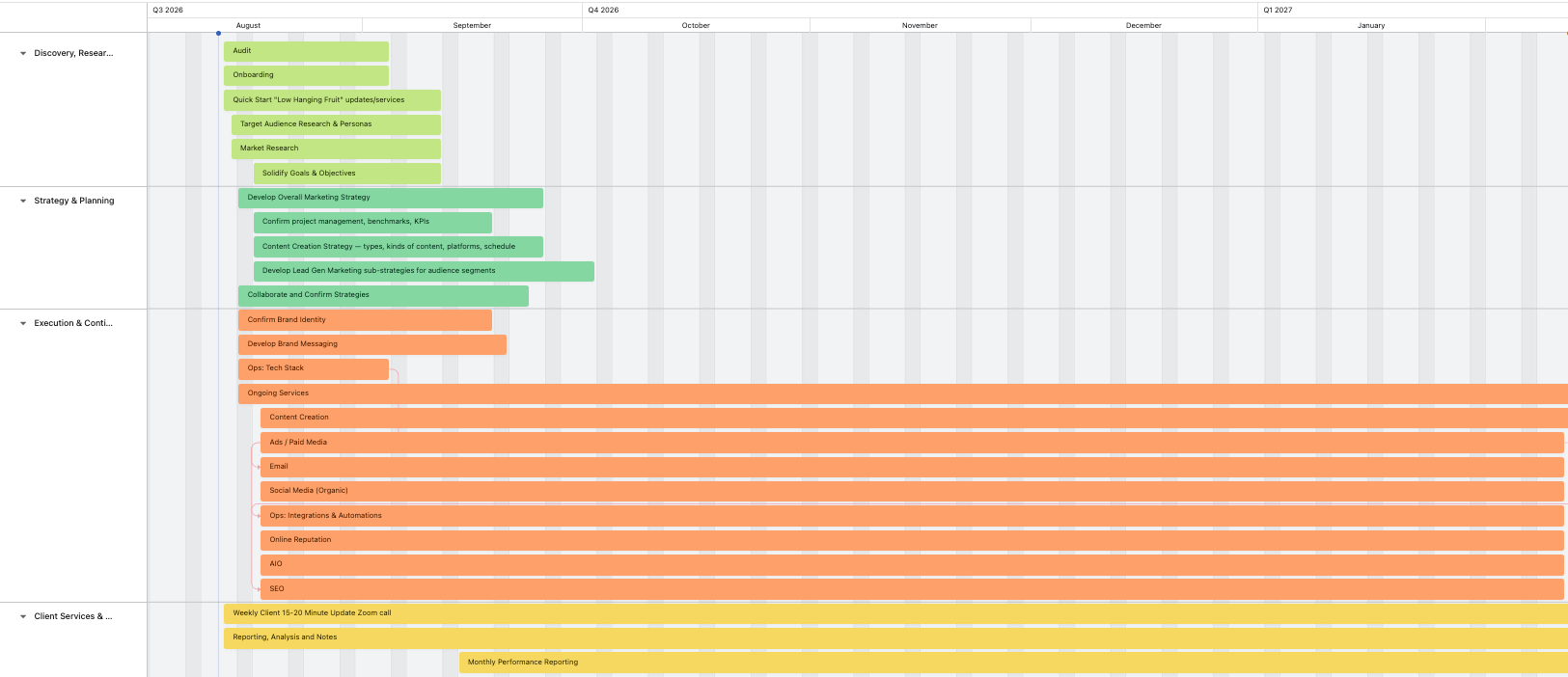
1. Discovery, Research & Onboarding (Weeks 1–4)
Quick-start low-hanging-fruit fixes. Full audit. Target audience research and personas. Solidify goals and objectives against the staircase. Onboarding and access. Market research: territory, verticals, competitive set.
2. Strategy & Planning (Weeks 2–6)
Content creation strategy — formats, cadence, platforms. Collaborate and confirm strategies. Confirm project management, benchmarks, and KPIs. Develop lead-gen sub-strategies by audience segment. Develop the overall marketing strategy.
3. Execution & Continuous Improvement (Week 3 through Month 6, running continuously)
Confirm brand identity. Develop brand messaging. Then all tactic workstreams run in parallel from near-kickoff: Content Creation, Ads / Paid Media, Email, Social Media (Organic), SEO, AIO, Online Reputation, Ops: Integrations & Automations, Ops: Tech Stack.
4. Client Services & Communication (Every week, all six months)
Weekly 15–20 minute client update call. Reporting, analysis, and notes. Monthly performance reporting.
Client homework
Short list, but the engagement moves at the speed of these.
- The warm list. 100+ names from thirty years — former MCH clients, colleagues, friends, anyone who would take the call. Rough is fine; Tocobaga will structure it.
- Access. Website and hosting, domain and DNS, Google Business Profile, Facebook, LinkedIn, and the distributor portal.
- The real numbers. Confirmed commission percentage, standard contract term, average expected deal size, and a realistic appointment-to-close rate.
- Business address decision for the Google Business Profile.
- Provider approval list. Which suppliers can be named and logo’d in marketing, and any co-marketing dollars available through the distributor.
- Proof. Two or three reference clients from the MCH era willing to be quoted, and permission to name the enterprise network builds.
- Calendar capacity. How many discovery calls Mike can personally hold per week, so lead volume is engineered to what he can actually absorb.
Commercial structure
- Flat monthly fee. No percentage of ad spend. No percentage of revenue. No markup on data or software.
- STT owns everything. Every ad account, every domain, every data set, every tool license is in Mike’s name. If we ever part ways, he keeps all of it.
- 60 Day Exit clause. No six- or twelve-month lock-in. It keeps Tocobaga hungry and it means Mike is never trapped by something outside anyone’s performance.
- Media and tool spend paid directly by STT, at cost. Fully transparent, fully visible.
- Starts at base, scales with scope. The engagement begins at Tocobaga’s base monthly. If the machine works and volume demands more, the fee gets revisited together — not before.
- Weekly call included. Not an add-on, not billed hourly.
Research Notes
TAM SAM SOM
The Tampa-St. Petersburg-Clearwater MSA is the 17th largest metropolitan area in the United States — nearly 3.2 million residents, a GDP exceeding $243 billion, and a civilian labor force of over 1.69 million. Technology jobs in the Tampa area grew 30% between 2018 and 2023, outpacing many traditional national tech hubs. The regional economy is anchored by healthcare and life sciences, financial services, aerospace and defense, retail, and advanced manufacturing — which minimizes systemic risk: when one sector cools, the compliance-driven sectors keep buying.
TAM — Total Addressable Market. The MSA holds roughly 204,971 total businesses including sole proprietors; the true addressable base for B2B technology services is approximately 122,700 employer establishments. Segmented by company size and standard annualized IT spend:
| Company size segment | Establishments | Avg annual IT spend | Segment TAM |
|---|---|---|---|
| 1–4 employees | 67,485 | $3,600 | $242.9M |
| 5–9 employees | 22,086 | $7,200 | $159.0M |
| 10–19 employees | 14,724 | $18,000 | $265.0M |
| 20–49 employees | 11,043 | $45,000 | $496.9M |
| 50–99 employees | 4,294 | $100,000 | $429.4M |
| 100–249 employees | 2,209 | $220,000 | $486.0M |
| 250–499 employees | 614 | $480,000 | $294.7M |
| 500+ employees | 245 | $1,000,000 | $245.0M |
| Total bottom-up TAM | 122,700 | $2.62B |
The aggregate TAM for managed IT and technology consulting in Tampa Bay sits at approximately $2.62 billion annually. The most fertile ground is the 20–249 employee range — over $1.4 billion of it — organizations large enough to feel real pain from downtime and cyber threats, but too small to staff a 24/7 internal security operation or dedicated network engineering team. Exactly STT's lane.
SAM — Serviceable Available Market. Narrowing to the verticals that align with STT's service portfolio — cybersecurity, NaaS, SaaS, VoIP, WAN connectivity, Starlink, mobility, and cloud:
| Industry vertical | Establishments | Avg spend/yr | Subtotal (SAM) |
|---|---|---|---|
| Healthcare & Life Sciences (NAICS 62) | 18,619 | $36,000 | $670.3M |
| Financial Services & Insurance (NAICS 52) | 6,500 | $36,000 | $234.0M |
| Manufacturing & Industrial (NAICS 31–33) | 2,800 | $24,000 | $67.2M |
| Retail & E-commerce (NAICS 44–45) | 20,235 | $18,000 | $364.2M |
| Aerospace & Defense | 450 | $48,000 | $21.6M |
| Core SMBs | 18,400 | $24,000 | $441.6M |
| Total SAM | 66,504 | $1.80B |
The compliance-heavy verticals — healthcare (HIPAA), finance (GLBA, SEC, FINRA), and defense (CMMC 2.0, NIST 800-171, anchored by MacDill AFB, USCENTCOM, and USSOCOM) — carry the highest revenue per client, because advanced security and resilient network architecture are not optional there. Retail brings raw volume through PCI-DSS and POS connectivity needs. Manufacturing's move to Industry 4.0 and Florida's hurricane exposure both push demand for resilient connectivity — including Starlink failover — that commodity providers relying on terrestrial ISPs cannot match.
SOM — Serviceable Obtainable Market. Tampa Bay holds an estimated 250–400 managed IT and technology support firms in a highly fragmented market, and research indicates only about 2% of the target market is actively looking to switch providers at any given time — roughly 1,330 of the 66,504 SAM establishments in an active buying cycle in a given year. A pragmatic capture-rate model over a multi-year trajectory:
- Conservative SOM (1% of SAM): $17.98 million annualized
- Moderate SOM (2% of SAM): $35.97 million annualized
- Aggressive SOM (3% of SAM): $53.96 million annualized
With roughly 38,371 serviceable commercial buildings and an estimated 300 IT providers, there are over 120 commercial buildings per provider — ample room for expansion without saturating the competitive pool. The constraint is never the market; it is targeted reach into the small slice actively buying, which is exactly what the appointment machine is built for.
The Industry's 4 Holy Marketing Metrics
National benchmarks for B2B technology consulting and managed services — the yardsticks the engagement will be measured against, adjusted for STT's advisor model.
1. Cost Per Lead
The blended average cost per lead for IT and managed services nationally is approximately $454. By channel: organic runs $325–$327 on average, with SEO around $647 and content marketing around $1,254 — slower to mature at four to six months, but producing the highest-intent leads. Paid runs $458–$840, with PPC averaging $802 and LinkedIn ads around $982 per lead. Well-executed cold outbound with clean data lands between $150 and $350. Trade shows and events exceed $1,390 per lead but convert at higher rates and larger contract values.
The takeaway for STT: the three-ring approach — warm network first, targeted outbound second, high-intent search third — is engineered to run well under these blended national averages, because Ring 1 costs nearly nothing and Ring 2 lives at the low end of the outbound range.
2. Cost Per Acquisition
The average blended customer acquisition cost for the IT and managed services sector is approximately $1,710. Organic-sourced clients come in at $583–$942; paid-sourced clients average $1,907; specialized account-based marketing targeting enterprise accounts can reach $4,664. Cybersecurity-specific acquisition averages $1,970, while generalized business consulting averages $656.
Best-in-class firms willingly spend up to $27,500 all-in to land large compliance-driven accounts — because the recurring revenue math supports it. The lesson carries directly to STT: acquisition cost is a one-time expense against years of residual income, so the ceiling is set by lifetime value, not by first-month comfort.
3. Average Revenue Per New Account (Year One)
The industry has shifted decisively from break-fix hourly billing to monthly recurring revenue. National benchmarks put average MRR for a new managed services client at $1,850–$2,200 per month — $22,200–$26,400 in recurring revenue annualized — with upfront project work typically adding 15–20% on top, bringing total first-year revenue to $25,500–$31,500 per client.
Compliance verticals command premiums: standard environments run $105–$180 per user per month, while regulated CMMC or HIPAA environments command $160–$255. A 50-user defense contractor at $200 per user is $10,000 in MRR — $120,000 in year-one recurring revenue from a single close. Deal size selection matters more than deal count.
4. Lifetime Value
Client stickiness in this industry is exceptionally high — ripping out infrastructure is disruptive, so average retention runs 5–7 years with top-tier annual churn of just 8.5–11%. At roughly $24,000 average annual recurring revenue, a standard six-year retention span yields a baseline lifetime value of $144,000, frequently rising to $150,000–$180,000 with hardware refreshes and security upsells — and into the millions for enterprise accounts.
The industry-standard healthy ratio is 3:1 or 4:1 lifetime value to acquisition cost. At a blended $1,710 acquisition cost against a $144,000 lifetime value, efficient firms exceed 80:1 — which is why the winners in this space spend aggressively on marketing and treat market share as the scarce resource, not budget. The same residual, compounding logic governs STT's advisor model: retention is worth more than acquisition, and the 60-day window to judge anything is six months, not six weeks.
Strategic market dynamics
IT has converged with risk liability. Floridians lost $874.72 million to cybercriminals in 2022 — third-worst state in the country — and high-profile regional incidents like the 2021 Oldsmar water treatment plant attack and the 2024 Florida Department of Health attack have moved technology purchasing from the IT director's desk to the CEO's. Consultants are no longer pitching specs; they are selling risk mitigation to boards. Framing services around compliance, zero-trust architecture, and continuous monitoring shortens sales cycles and raises conversion in a market dominated by regulated finance and healthcare buyers.
Connectivity resilience is a Florida-specific wedge. Hurricane exposure makes business continuity non-negotiable: remote backups, WAN failover, decentralized cloud, and Low Earth Orbit satellite failover neutralize the geographic risk that terrestrial-only providers cannot. This is a differentiated value proposition STT can own in the region.
The economics have killed break-fix. With leads averaging $454 and acquisition running $1,710 and up, intermittent hourly billing is mathematically unsustainable — which is why the industry mandates recurring agreements, and why the market has already been trained to accept technology as a continuous operating expense. STT's advisor model arrives with that education already done: the client pays nothing, the provider pays the residual, and the recurring structure is built into the contract from day one.
6 Month Simple Gantt Chart
Proposal Summary
Comparisons & Your Price
No one wants to feel like a dumbo overpaying an outside firm.
We get it. We abhor 99% of advisors and agencies. Our industry has a lot of snake oil.
If you’re going to try to compare bid costs, you must examine the exact same
QCD+F: Quality, Cost, Deliverability + Flexibility
Average Agency Rate
$4,963
Tocobaga’s Normal Rate
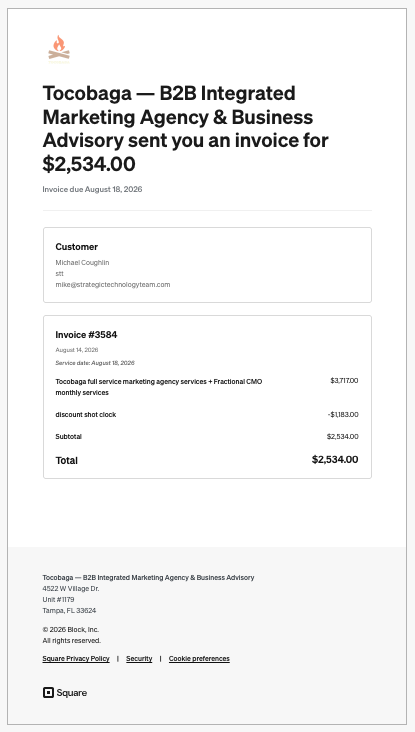
$3,717
Your Tocobaga Rate
$2,534
DISCOUNT
SHOT
CLOCK
Quick-Start Next Steps
Administrative & Clerical Tasks
Invoice is deposited - either total for the month or deposit.
Tocobaga begins working
Tocobaga receives access to Tech Stack and any relevant brand collateral
Quick-Start onboarding will not be sequential - aka might be a little out of order than our normal process
Tocobaga will send over Company Services Agreement
Tocobaga will start a Slack workspace for internal communication. If you use another internal communication app, we can integrate Slack with other apps e.g. Slack two-way sync with Teams.
Tocobaga will coordinate a recurring, update meeting cadence - usually once a week initially and then every 2 weeks once we build a rhythm. If clients cannot attend because of schedule conflicts, we will record an update video and send via Slack.
If we’re ready to go right now, the button to the invoice is below or click on the invoice image to the right. Once the invoice is paid, we begin.
Let’s Go ➳
ABOUT
TOCOBAGA
a
B2B, B2C SMB Strategic Advisory
&
Omni-channel, Integrated Marketing Agency
Fractional CMO FAQs
-
A Fractional CMO (Chief Marketing Officer) is a part-time or shared resource hired by a company to provide strategic marketing leadership. This arrangement allows businesses to access high-level marketing expertise without the cost of a full-time executive.
-
A Fractional CMO typically handles various aspects of marketing strategy, planning, and execution. Their responsibilities may include market analysis, brand development, campaign management, and team leadership. They work on a part-time basis, providing strategic guidance to help businesses achieve their marketing goals.
-
1. Cost-Effective: Fractional CMOs offer high-level expertise without the full cost of a permanent executive, making it a cost-effective solution for businesses.
2. Flexibility: Companies can scale their marketing leadership up or down based on their needs, without the commitment of a full-time hire.
3. Diverse Experience: Fractional CMOs often bring diverse industry experience, providing fresh perspectives and insights to the marketing strategy.
4. Strategic Guidance: These professionals offer strategic guidance, helping businesses align marketing efforts with overall business objectives.
5. Access to Networks: Fractional CMOs may bring valuable industry connections and networks, enhancing opportunities for partnerships and collaborations.
6. Objective Perspective: Being external to the organization, Fractional CMOs can provide unbiased and objective viewpoints on marketing strategies.
7. Quick Onboarding: As seasoned professionals, Fractional CMOs can quickly adapt to the business environment, accelerating the onboarding process.
8. Task-Specific Expertise: Companies can engage Fractional CMOs for specific projects or challenges, tapping into their expertise for targeted improvements.
9. Risk Mitigation: Businesses can mitigate the risk associated with hiring a full-time CMO by testing the waters with a fractional arrangement.
10. Efficiency: With a focus on strategic planning, Fractional CMOs can optimize marketing processes for efficiency and effectiveness.
Why would a SMB hire a Fractional CMO?
Small and Medium-sized Businesses (SMBs) might choose to hire a Fractional CMO for several reasons:
1. Cost Efficiency: SMBs often have budget constraints, and a Fractional CMO allows them to access high-level marketing expertise without the cost of a full-time executive.
2. Flexibility: The variable nature of marketing needs in SMBs can be addressed with a part-time resource, adjusting the level of expertise based on the business's current requirements.
3. Strategic Insight: Fractional CMOs bring strategic thinking and experience, helping SMBs develop effective marketing strategies aligned with their business goals.
4. Resource Optimization: SMBs may not need a full-time CMO, making a fractional arrangement a practical way to optimize resources and focus on key priorities.
5. Quick Impact: Fractional CMOs can swiftly assess the marketing landscape, identify opportunities, and implement strategies to generate quick and impactful results.
6. Access to Networks: SMBs can leverage the networks and industry connections of Fractional CMOs, opening doors to potential partnerships and collaborations.
7. Task-Specific Projects: SMBs can engage a Fractional CMO for specific projects or campaigns, tailoring the arrangement to address immediate marketing needs.
8. Objective Perspective: An external CMO can provide an unbiased and objective viewpoint, offering insights that might be challenging to achieve with an in-house team.
9. Risk Mitigation: Hiring a full-time executive involves risks, but a fractional arrangement allows SMBs to test the waters and evaluate the impact of senior marketing leadership.
10. Learning Opportunity: SMBs can benefit from the knowledge transfer that occurs when working with an experienced Fractional CMO, helping build internal marketing capabilities over time.
-
short answer: engagement, commitment, and scope of responsibility
more detailed answer:
1. Time Commitment:
- Fractional CMO: Works on a part-time or project-specific basis, dedicating a limited number of hours per week or month to the organization.
- Full-time CMO: Is a permanent, full-time employee committed to the organization on a daily basis.
2. Cost Structure:
- Fractional CMO: Typically charges on an hourly or project basis, providing a more cost-effective solution for businesses with budget constraints.
- Full-time CMO: Involves a fixed annual salary, potentially with additional benefits, which may be a higher financial commitment for the organization.
3. Scope of Responsibilities:
- Fractional CMO: Focuses on specific strategic initiatives, projects, or areas of expertise as agreed upon with the organization.
- Full-time CMO: Assumes a broader range of responsibilities, overseeing the entire marketing department and contributing to overall business strategy.
4. Flexibility:
- Fractional CMO: Offers greater flexibility, allowing organizations to scale up or down based on their evolving marketing needs.
- Full-time CMO: Represents a more fixed and consistent presence within the organization, which may be less adaptable to changes in workload.
5. Depth of Involvement:
- Fractional CMO: Often works at a more hands-on level, directly involved in strategy development and execution.
- Full-time CMO: Balances strategic leadership with managerial responsibilities, overseeing day-to-day operations and team management.
6. Long-Term Commitment:
- Fractional CMO: May be engaged for specific projects, a defined period, or on an ongoing but part-time basis, providing a more flexible arrangement.
- Full-time CMO: Implies a longer-term commitment to the organization, with a focus on sustained leadership and relationship building.
-
short-answer: adaptability, agility, resources, communication, wisdom (experience x knowledge)
long answer:
1. Diverse Perspectives: A Fractional CMO with varied industry experience can offer diverse perspectives and insights, bringing a fresh and innovative approach to marketing strategies.
2. Cross-Industry Best Practices: They can bring best practices from different industries, adapting successful strategies and tactics to the specific needs of the organization.
3. Benchmarking Opportunities: With exposure to various industries, a Fractional CMO can provide valuable benchmarking data, helping the organization understand how its marketing performance compares to similar businesses in different sectors.
4. Adaptability: The ability to adapt strategies from one industry to another can be a key advantage. The Fractional CMO can leverage successful techniques across different markets, promoting adaptability and agility.
5. Network Access: Their extensive network across industries can open doors to potential partnerships, collaborations, and industry-specific opportunities that may not be readily apparent within a single-sector focus.
6. Innovation and Creativity: Exposure to diverse industries fosters innovation and creativity. A Fractional CMO can bring a rich mix of ideas, drawing on experiences beyond the confines of a single sector.
7. Risk Mitigation: They can provide insights into potential risks and challenges by drawing on experiences from various sectors, helping the organization proactively address issues before they become significant problems.
8. Market Trends Awareness: A Fractional CMO engaged with multiple clients in different industries stays attuned to a wide range of market trends. This knowledge can be invaluable in staying ahead of industry changes and emerging opportunities.
9. Customization for Unique Markets: Leveraging experience in various industries, the Fractional CMO can tailor marketing strategies to suit the unique characteristics and challenges of the organization's specific market.
10. Continuous Learning: A Fractional CMO involved in diverse industries is likely to be a continuous learner, staying updated on the latest trends, technologies, and strategies across various sectors, which can benefit the organization.
-
1. Fractional CMO:
- A Fractional CMO typically refers to a part-time or shared Chief Marketing Officer who provides strategic marketing leadership to organizations on a flexible basis.
- They might work with multiple clients simultaneously, dedicating a certain number of hours per week or month to each client.
2. Interim Fractional CMO:
- An "Interim Fractional CMO" could imply a temporary or transitional role where the Fractional CMO is specifically engaged to fill a gap or address a short-term need.
- The "Interim" aspect suggests a focus on providing leadership during a transitional period, such as when a company is between full-time CMOs or undergoing significant changes in its marketing strategy.
SERVICES
-
OVERALL STRATEGY
CAMPAIGN STRATEGIES
TACITICAL STRATEGIES
-
SMART Goals, Benchmarks + KPI Planning
-
- Audiences
- Targets
- Find out 4 Holy Metrics:
- Cost Per Lead
- Cost Per Acquisition
- Average Revenue of a customer within 1st year
- Lifetime Value
Quick Start Services
Marketing Execution Services
-
Monitoring & Maitenance
Analytics Tracking
SEO (technical)
Live Chat optimization
Build out
* Landing pages by service
* Landing pages by service and city/region
Content
FAQs
Blog posts
-
- PPC
- Google Search Ads
- Bing Search Ads
- Local Services Ads
- AdRoll - cross platform retargeting/remarketing
- Later - platform-industry specific ads w/ Angi, Yelp, etc.
- Social Ads
- AdRoll retargeting ads on FB and IG
- Pinterest might be a great avenue
- Programmatic
- We can get precise targeting
-
- Technical SEO
- At least 1 blog post per month
-
- Automation emails for servicing
- Marketing email campaigns
- New lead automated journeys
-
- Review Capturing
- Review Monitoring
- Directory Listings optimization
-
Traditional Advertising - radio, tv, newspaper, magazine, etc.
Community - sponsorships, focused local corporate responsibility
-
BRANDING:
Brand Development
Brand Identities
Brand Messaging
DESIGN: Any design deliverables needed
Graphic Design, Website Design, UI (User Interface), UX (User Experience), Print Design, Online Ad Design, Video Editing, Image Editing, Custom Illustrations, Newspaper Ads and Design, Magazine Ads and Design, Brick & Mortar Exterior Signage, etc.
Support Services
-
create a Google Data Studio or similar to aggregate analytics into
1) Snapshot
2) by campaign/tactic
-
Setup every task and project in your PM app, Asana?
-
- Starting line: I would want to come in office to War Room around y'all's schedules and work from the office a few days in the beginning. There's always smaller things to absorb just being around that is lost in digital communication
- Slack (or whatever your team uses) for direct communication. We prioritize client communication above email, calls and texts. We keep all conversations in Slack/Teams to have transparency and a searchable knowledge base.
- Update meetings: Weekly until we find a rhythm and go biweekly. I keep them 30 minutes and apply the EOS system to keep it efficient.
-
- Will need to learn your automation processes to streamline any redundant tasks
Possible add-ons services and costs
Online Ad/PPC ad spend without markup
Video Content Production
Purchasing Email Lists via Data Broker
Programmatic Direct Messaging
Approach
Strategy-first approach: work big to small. Macro to Micro. The biggest gaffe in the outsourced marketing services sector is focusing on tactics to begin. Our approach is the following 6 phases:
1. Define Objectives, S.M.A.R.T. goals and Current Analysis & Resource Audit (a current strategy review, branding assessment, resource audit and marketing performance report).
2. Thorough research.
3. Develop a leveraging integrated, omnichannel strategy in lock step communication and approval with the client.
4. Project management execution with respect to achieving KPIs, budgets and resources
5. Analyze quantitative and qualitative reporting.
6. Continuously improve

Strategic plans without execution = a fun idea.
Discipline is the ultimate freedom.
Over-communicate until you have concise shorthand.
Time is a commodity.
Think 3 steps ahead. Contingency plan IFTTT scenarios.
Be agile & adaptable.
The obstacle is the way.
Work short-term and long term at the same time.
Analyze the past while proactively, continuously improve your present and future.
Execute omnichannel, integrated marketing campaigns, online and off.
Work macro and micro.
Generalize and specialize.
Strategic and tactical.
A/B test.
ROI should be the client's main focus and many drill down minutiae. ROI (Return On Investment) is the only thing that matters to our clients (and us). It is the cover image on every one of our proposal decks. It is our mantra; our North Star philosophy. We must provide multiple X ROI for our clients or we cease to exist.