

You’re Playing Drug Wars on a Supercomputer: The TI-83 Theory of Why Your Business Is Using Claude at 1% of Capacity
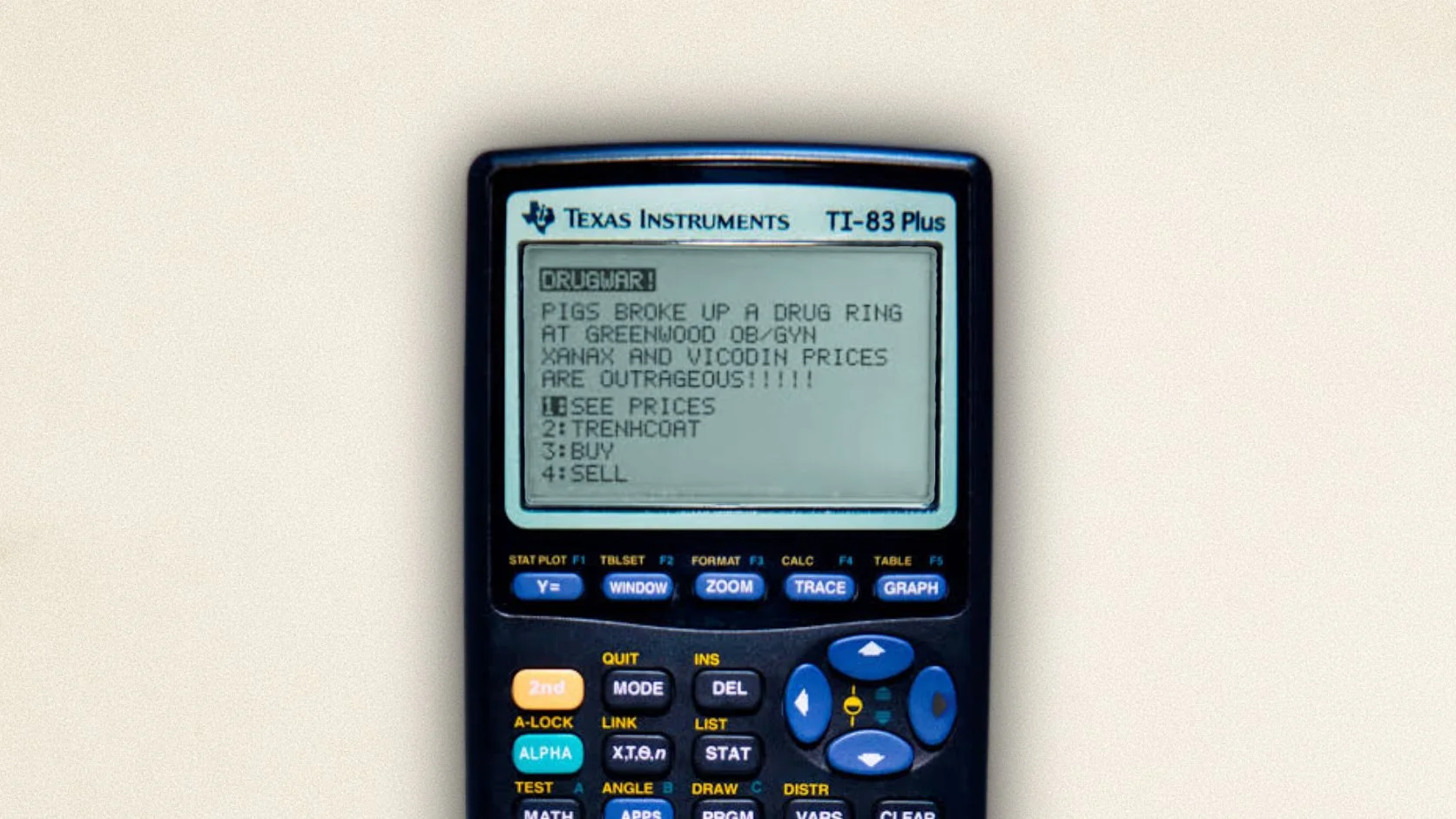
Drug Wars got you through math class boredom.

Law Smith
Founder & President, Tocobaga
Law Smith is the Founder and President of Tocobaga, a Tampa-based ROI-focused marketing agency and SMB advisory. He has strategically advised 1,000+ small and medium businesses, executed 600+ integrated marketing campaigns, and written 30+ business plans. Tocobaga is a Google Partner and Squarespace Gold Partner headquartered in Ybor City.
It’s 2001. Geometry class. Fluorescent lights, the smell of pencil shavings and adolescent despair.
I finish the test early. I always finished geometry early. Geometry was my shit, proofs, angles, the clean Euclidean logic of the thing. It was the one class where my brain and the curriculum shook hands and agreed to get along. This was a couple years before I’d go play ball at the Division-I level, back when my whole identity was "athlete in waiting who is also weirdly good at math and an absolute menace at everything in between." In 2001, that combination came with exactly one marketable skill: finishing a test fast enough to commit minor crimes in the margins.
So I flip the test over. You know the move. And I look at that strip of graph paper running down the side, just begging to be defaced.
And I can’t touch it. Because earlier that same semester I’d gotten in trouble, in this exact class, for drawing a cartoon of a classmate. In my defense, I had witnessed the man’s entire undercarriage hanging out the leg of his shorts before a Thursday no-pads practice, and when you see a thing like that at sixteen, you don’t really get a vote. You draw the cartoon. The Lord compels you. I regret the timing. I do not regret the craftsmanship. Either way, I’m on a list now, and the graph paper stays pristine.
Which leaves the only organ I’m cleared to use, my brain, free to wander. And mine wanders like a golden retriever loose in a Costco. Twenty-some minutes left on the clock, racing thoughts, except they’re racing at a very leisurely pace, and they go about like this:
Why doesn’t Nelly wear that Band-Aid on his cheek anymore? And the reverse jersey?
What, exactly, won’t Meatloaf do for love?
These felt like pressing matters of state. For the record, and the teenage mind does not fact-check, it free-associates, Nelly absolutely still wore the Band-Aid in 2001. He kept it on for years as a tribute to his St. Lunatics guy City Spud, who was locked up, and didn’t retire it until Spud got out in ’08, nine years into a ten-year bid.1 And the thing Meatloaf won’t do? He tells you. Every chorus. It’s the line right before "but I won’t do that." The answer was sitting inside the question the entire time, hold that thought, because that’s the whole post.2
Eventually my hand betrays the watchlist and starts drawing The S. You know The S. Two rows of three little lines, connect the diagonals, cap the ends, and suddenly there’s this pointy, three-dimensional, faintly menacing letter parked on your desk. It looks like an infinity symbol somebody stood upright and sharpened. Nobody taught you to draw it. There was no unit on it. It just arrived, fully formed, passed kid-to-kid like a head cold, on every desk on every continent. A guy spent five years making a documentary trying to find where it came from and basically concluded: nowhere, and everywhere. The oldest version anyone’s found sits in an 1890 drafting textbook by a man who taught geometry at Princeton, a deeply funny possible birthplace for a doodle most associated with the back of a Trapper Keeper, and also not really an origin at all. No inventor. No patent. Just a perfect little piece of code the whole species somehow knows how to run.3
Anyway. I’d just gotten Drug Wars on my calculator. And that is an elite way to kill the last twenty minutes before the bell.
If you went to an American high school after about 1996, you know exactly what was in my hand: a beige Texas Instruments graphing calculator, and loaded onto it, traded over a link cable in the hallway like contraband, which it technically was, a port of Drug Wars.
The history is better than it has any right to be. The original got written in 1984 by a high schooler named John E. Dell, on a TRS-80, for his sophomore computer class. He’d played some buy-low-sell-high game at a buddy’s house, couldn’t remember which one, and rebuilt it from memory with the inventory swapped out for ludes, speed, acid, heroin, and cocaine. His teacher gave him an A, and drew a frowny face on the paper, because he did not care for the subject matter. Dell remembers it to this day. Then he uploaded it to a bulletin board and went off to the Naval Academy.4
In 1993 a sophomore named Jonathan Maier rebuilt it again, this time for a TI graphing calculator, using a homemade cable to drag it off his computer. He knew it was a hit the moment he walked past the math room and saw the teacher playing it alone, calculator screen beamed up on the overhead projector. From there it spread the only way anything spread in a pre-internet classroom: one kid jacked his calculator into another kid’s calculator and pushed the file across. Desk to desk. School to school. Eventually one of Maier’s old classmates slapped his own name on it, uploaded it to a file-sharing site, and the thing went national.4
Here’s the part worth tattooing somewhere. The game was fine. Buy in one borough, sell in another, dodge a cop named Officer Hardass, beat the loan shark before thirty days run out. Fine. What made it immortal wasn’t the product, it was the distribution. A free thing that physically traveled through a network of bored teenagers on a four-inch cable. I’ve been doing this twenty years and I’ll give you the lesson the same way the game gave it to us, free: distribution beats product more often than product people will ever admit out loud.
Now look at the machine itself. That TI-83 ran a Zilog Z80 at 6 MHz with 32 KB of RAM. That is a computer. For scale: the original 1977 Apple II, the thing that lit the fuse on the entire personal-computing era, ran around 1 MHz with as little as 4 KB. Different chips, so it’s not a clean drag race, but the point holds. The calculator in a teenager’s JanSport had roughly the raw guts of the machine that started Silicon Valley.56 And that same calculator is still on the SAT and ACT approved-calculator lists in 2026. It costs an estimated fifteen to twenty bucks to build and sells for about a hundred and fifty. Texas Instruments has owned something like 80% of that market since 1990 and shows zero interest in stopping. A decades-long, effectively state-sanctioned monopoly on a slab of nineties silicon.7
And what did an entire generation do with this pocket supercomputer? Long division. Drug Wars. And we typed 5318008 and flipped it over to spell BOOBIES.8
Sit with that one, because here’s the entire point of this post:
These AI apps, Claude, ChatGPT, Gemini, are TI-83s right now. Absurdly, almost rudely more powerful than what anybody actually does with them. Ninety-nine percent of people are spelling BOOBIES upside down on a machine that could be running the differential equations of their whole business, modeling the pricing, rebuilding the funnel, segmenting the entire customer base, stress-testing next year’s plan before they bet the payroll on it. They ask it to fix a typo. It could write the email, build the offer, model the spreadsheet under the offer, and red-team the strategy that produced the offer, all at once, in the time it takes you to find your reading glasses.
There’s a coda to the Drug Wars story I love. Dell now runs a business-software consultancy. Maier is a senior lecturer in engineering at Clemson. The two guys most responsible for a generation ignoring their math teachers grew up to do the exact serious, technical, build-real-things work the calculator was capable of the entire time.4 The tool was always more than the toy. It usually is.
This whole post is about how to stop spelling BOOBIES and start running the calculus.
The Answer, Up Front
If you read one paragraph: you are almost certainly using AI as a fancy autocomplete, and the gap between that and what these tools can actually do is the single biggest unpriced advantage available to a small or mid-sized business right now.
The move is not "use AI more." It’s to change what you use it for, from one-off text chores to standing systems you build once and run forever: a research engine, a financial model, a customer-segmentation machine, a content factory, a thinking partner that argues with you before you commit. The 18 tips below are the upgrades, in rough order of how fast they pay off.
First, Why Claude, and a Reality Check
I run all three of the big models, and I’ll tell you where each wins. For long-form reasoning, document analysis, and "think with me" work, which is most of what SMB strategy actually is, Claude is my daily driver. The longer memory of a single conversation and its willingness to follow a complicated instruction without wandering off make it feel less like a toy and more like a junior analyst who doesn’t sleep and doesn’t bill hourly. ChatGPT still wins on images, voice, and the wider plug-in world. At twenty bucks a month each, plenty of us run both and hand each job to whichever is better.
The reality check, because we don’t sell hype around here: these tools confabulate. They’ll state a wrong number with the exact same confidence as a right one. They don’t know your business unless you tell them. And they are not a strategy, they’re an amplifier. Point an amplifier at a clear signal and you get scale. Point it at noise and you get louder noise. Everything below assumes you bring the signal.
The Tips & Tricks Nobody Told You
1. Stop Prompting. Start Briefing.
Don’t ask in one line. Brief it like a new hire: who you are, who it’s for, the rules, and one example of "good."
Real example: "Write an email about a price increase" gets mush. "You’re my account manager. Write to a client of four years. Warm, no apology. Announce a 12% increase starting in 60 days. Keep it under 180 words." gets something you can actually send.
Do it in 3 steps:
1. Before your request, add a line: "Here’s the situation, " and explain it in plain English.
2. Add a line: "Here are the rules, " (how long, what tone, what to avoid).
3. Paste one example of what good looks like, then ask for your version.
2. Build a "Cheat Sheet" About Your Business and Reuse It
The AI forgets you between chats. Keep one paragraph about your company and paste it at the top every time.
Real example: A Brandon roofing company keeps a note, "Family roofer, 22 years, we win on warranty not price, customers are homeowners 45+." Every chat starts smarter for it.
Do it in 3 steps:
1. Open a Notes file. Write five or six sentences: what you do, who you sell to, your voice, your edge.
2. Save it where you can find it fast.
3. Paste it at the start of any chat that matters, before you ask your question.
3. Make It Interview You
Instead of asking for an answer, make the machine ask you questions first. The stuff in your head is the missing ingredient.
Real example: A consultant types, "Before you draft this proposal, ask me the 10 questions you’d need to write a winning version." The proposal comes out specific instead of generic.
Do it in 3 steps:
1. Type your request.
2. Add: "Before you answer, ask me the 10 questions you need to do this really well."
3. Answer them. Then say, "Now write it."
4. Use It as a Financial Modeler, Not a Calculator
Hand it your numbers and assumptions, have it build best / base / worst case, then have it poke holes in its own math.
Real example: An owner pastes last year’s revenue and costs and asks for three scenarios for next year, plus "which assumption here is most likely wrong?"
Do it in 3 steps:
1. Paste your revenue, main costs, and any assumptions ("we think we’ll grow 10%").
2. Ask: "Build best, base, and worst case for next year."
3. Then ask: "Which of these assumptions is riskiest, and why?"
5. Segment Your Customers
Describe your customer list and have it sort people into groups, name the groups, and suggest a different pitch for each.
Real example: A med-spa describes its clients; the AI splits them into "Botox regulars," "one-time bridal," and "skincare browsers," with a different email angle for each.
Do it in 3 steps:
1. Describe your customers, or paste an anonymized list (no names or account numbers).
2. Ask: "Group these into segments, name each one, and tell me what each wants."
3. Ask: "Give me a one-line pitch for each group."
6. Turn One Thing Into Twelve
One blog post or one podcast becomes a newsletter, five social posts, a video script, and three subject lines. Build the chain once.
Real example: I record one podcast episode; the transcript becomes the week’s newsletter, the LinkedIn posts, and the Reels captions.
Do it in 3 steps:
1. Paste your blog post, transcript, or long email.
2. Ask: "Turn this into a newsletter, 5 LinkedIn posts, and 3 email subject lines."
3. Keep the ones that sound like you; trash the rest.
7. Red-Team Your Own Plan
Before you commit, make it argue the other side as hard as it can. Cheaper than learning the hard way.
Real example: Before signing a new lease, an owner pastes the terms and says, "Argue against me doing this deal."
Do it in 3 steps:
1. Describe your plan or decision.
2. Ask: "Make the strongest possible case AGAINST this."
3. Then ask: "Now what would make my version bulletproof?"
8. Make It Your Research Analyst
Hand it a messy question, a market, a competitor, a new regulation, and ask for a clean summary with the unknowns flagged. Then verify the facts.
Real example: A manufacturer asks for a plain-English summary of a new tariff and what it might mean for steel costs.
Do it in 3 steps:
1. Ask your question and add: "Give me a structured summary."
2. Add: "Flag anything you’re unsure about so I can double-check it."
3. Confirm the key facts yourself before you act.
9. Build SOPs by Talking Out Loud
Record yourself explaining how a task gets done. Paste the transcript. Get a clean step-by-step your team can follow.
Real example: An owner records a ten-minute voice memo on "how we close out a job"; it comes back as a one-page checklist.
Do it in 3 steps:
1. Record a voice memo walking through a task start to finish (your phone can transcribe it).
2. Paste the text and ask: "Turn this into a step-by-step SOP."
3. Ask: "Flag anything I explained unclearly."
10. Rehearse Hard Conversations
Negotiations, firings, investor updates. Have it play the other person so you walk in ready.
Real example: Before a tense client call, I have the AI play the annoyed client and practice my responses out loud.
Do it in 3 steps:
1. Describe the situation and the person you’re dealing with.
2. Say: "You play them. I’ll respond. Push back on me."
3. Run it a few times until it stops rattling you.
11. Write Better Job Posts and Scorecards
Describe the outcome you need and get the job description, the interview questions, and a 90-day scorecard.
Real example: A firm hiring its first office manager gets a posting, ten interview questions, and a checklist for what "good" looks like at 90 days.
Do it in 3 steps:
1. Describe the role and what success looks like one year in.
2. Ask: "Write the job posting, 10 interview questions, and a 90-day scorecard."
3. Edit it to sound like you.
12. Translate Between Departments
Turn your tech-speak into customer benefits, and turn customer complaints into a to-do list for your team.
Real example: "Our HVAC units have variable-speed compressors" becomes "Your house stays evenly comfortable and your power bill drops."
Do it in 3 steps:
1. Paste the jargon (or the pile of complaints).
2. Ask: "Rewrite this for a customer", or "Turn these complaints into fixes for my team."
3. Use the version that sounds like a human.
13. Get a Private Tutor for the Thing You’re Avoiding
That financial concept or ad platform you keep nodding along to in meetings? Have it teach you simply, then quiz you.
Real example: An owner who’s fuzzy on "gross margin vs. net margin" gets it explained using their own numbers.
Do it in 3 steps:
1. Name the thing you don’t fully get.
2. Say: "Explain it like I’m smart but new, with a real example."
3. Say: "Now quiz me with 5 questions."
14. Build a Reusable Assistant for Repeat Jobs (Projects)
For anything you do over and over, set up a "Project" so you stop starting from scratch every time.
Real example: A "Monthly Newsletter" project holds the brand voice and past issues; each month you just drop in the new news and go.
Do it in 3 steps:
1. In Claude, click "Projects," then "Create Project."
2. Upload your cheat sheet, your brand voice, and a couple of good past examples.
3. Do that recurring task inside the project from now on.
15. Clean Up Messy Data
Inconsistent spreadsheets, scattered notes, it’ll organize, tag, and summarize faster than you’ll find the right Excel formula.
Real example: A sloppy customer list with names in five different formats gets standardized in one pass.
Do it in 3 steps:
1. Paste the messy data, or upload the spreadsheet.
2. Ask: "Clean this up and put it in a neat table."
3. Ask for a quick summary of anything weird it found.
16. Audit Your Own Marketing
Paste your homepage, your best ad, your last few emails, and have it find the leaks.
Real example: "Audit my homepage for the objections a customer would have that I haven’t answered yet."
Do it in 3 steps:
1. Paste the copy, or a screenshot of the page.
2. Ask: "Audit this, where do I lose people, and what’s missing?"
3. Fix the top three things it flags.
17. Make It a Weekly Thinking Partner
Once a week, dump where the business stands and ask what you’re missing. This is the one that compounds.
Real example: Friday afternoon, "Here’s the week. What’s the one thing I should do Monday that I’m not seeing?"
Do it in 3 steps:
1. Once a week, write a few sentences on what’s going on in the business.
2. Ask: "What am I missing, and what’s the highest-impact move right now?"
3. Pick one thing and actually do it.
18. Always Check the Work
It’ll say a wrong number as confidently as a right one. The machine drafts; you decide. Every number you publish gets verified.
Real example: Before quoting a stat in a proposal, paste it back and ask, "Is this accurate, and what’s the source?", then confirm it with your own eyes.
Do it in 3 steps:
1. Treat every fact and figure as trust-but-verify.
2. For anything you’ll send or publish, check the source yourself.
3. Keep a human, you, on every final call.
Do even five of those eighteen and the change isn’t "I saved a little time on email." The change is that a four-person company starts operating with the analytical horsepower of a forty-person company. You research faster, model better, segment sharper, publish more, and make fewer dumb decisions because you red-teamed them before they cost you anything. That’s the differential equations. That’s the supercomputer finally getting used as a supercomputer.
The businesses that win the next few years won’t be the ones with the fanciest model. Everybody’s got the same calculator. The winners are the ones who stopped playing Drug Wars on it. Here’s the honest pitch. You can do all eighteen of these yourself. The tools are cheap and the instructions are right up there. But "you can" and "you will" are different verbs, and most owners are too buried in the day-to-day to build the systems, marketing’s usually the last thing on the list, right behind the thing on fire.
That’s the job. Tocobaga is a Tampa-based, ROI-focused lead generation marketing agency and SMB advisory firm, and a big part of what we do now is build these AI-powered systems into a business, the research engine, the content factory, the financial model, the segmentation machine, and then hand you the keys, with a human still in the loop. Flat fee. No percentage of your ad spend. No auto-renew. You own everything we build, and we don’t put our name in your footer. If you’re tired of spelling BOOBIES upside down on a machine that could be running your whole operation, that’s the conversation. Every intro call is on the house.
Is Claude better than ChatGPT for a business?
For long-form reasoning, document analysis, and strategy, I lean Claude. For image generation, voice, and integrations, ChatGPT or Gemini may win. The honest answer: the gap between models matters far less than the gap between how you use them. Get good at briefing and any of the three will smoke a competitor still typing one-line prompts.
Will AI replace my marketing team or my agency?
No. It replaces the grunt work and amplifies the people. Strategy, taste, accountability, and judgment still have to come from somewhere. AI makes a good team faster and a bad team confidently wrong, faster.
Is it safe to put my business data into these tools?
Use the business or enterprise tier, check the data-retention setting, anonymize anything sensitive, and never paste something you would hate to see leaked. For regulated industries like law, healthcare, and finance, get specific guidance before anything client-identifying goes in.
How much does this actually cost?
The tools run about $20-30 a month per seat. The expensive part is the time to build the systems, which is exactly the part you can hand off.
Where do I start if I have only got an hour?
Tip #2 (build your business cheat sheet) and Tip #3 (make it interview you). Those two lift the quality of everything else immediately.
What is the single most common mistake?
Trusting the first answer and skipping the follow-up. The first response is a draft. The second, third, and fourth questions, like 'go deeper,' 'what did you leave out,' and 'make it half as long and twice as sharp,' are where the gold lives.
Sources
- Nelly's Band-Aid, worn as a tribute to St. Lunatics member City Spud (Lavell Webb), retired in 2008 after Spud's release, nine years into a ten-year sentence. Capital XTRA; Speeli.
- Meat Loaf, 'I'd Do Anything for Love (But I Won't Do That),' released August 1993; 'that' is named in the verse before each chorus. Wikipedia; Songfacts.
- Universal / Cool S, childlore with no confirmed origin; a five-year documentary effort (LEMMiNO) traced the oldest documented precursor to the 1890 book Mechanical Graphics by Princeton geometry instructor Frederick Newton Willson. Wikipedia, 'Cool S'; LEMMiNO, 'The Universal S.'
- Drug Wars origin and spread: original 1984 TRS-80 version by John E. Dell; TI graphing-calculator port by Jonathan Maier in 1993 via a homemade cable, spread desk-to-desk and later re-uploaded nationally by a former classmate; Dell now runs a software consultancy and Maier is a senior lecturer at Clemson. Zack Huffman, 'The Wild Spread of Drug Wars, From Your Calculator to Your Phone,' WIRED, June 28, 2021. (Some calculator archives date a released TI-82 build to December 1994; Maier dates his original to 1993.)
- TI-83 series hardware: Zilog Z80 at 6 MHz, 32 KB RAM, released 1996. Wikipedia, 'TI-83 series.'
- Apple II specs: MOS Technology 6502 at ~1.023 MHz, 4 KB RAM (expandable to 48 KB), on sale June 1977. Wikipedia, 'Apple II.'
- TI ~80% share of a $300M+ graphing-calculator market since 1990; ~$150 MSRP against an estimated $15-20 build cost. The Hustle, 'Is the era of the $100+ graphing calculator coming to an end?' (build-cost/margin figures corroborated via The Washington Post, cited in Mic).
- Calculator spelling: 5318008 reads 'BOOBIES' inverted; the gag traces to the 1970s. Wikipedia, 'Calculator spelling.'