

Patrick Bateman's Era of Acquisition Is Getting American Psycho: What Corporate Consolidation Means for Small Business


Law Smith
Founder & President, Tocobaga
Law Smith is the Founder and President of Tocobaga, a Tampa-based ROI-focused marketing agency and SMB advisory. He has strategically advised 1,000+ small and medium businesses, executed 600+ integrated marketing campaigns, and written 30+ business plans across industries ranging from professional services to e-commerce to B2B technology. Tocobaga is a Google Partner and Squarespace Gold Partner headquartered in Ybor City.
Ida Minerva Tarbell was born in 1857 in a log cabin in Hatch Hollow, in the oil country of western Pennsylvania. Her father, Franklin Tarbell, spent years building wooden tanks to store the crude coming out of the ground, then moved into producing and refining oil himself, and the family began to prosper.* Home was Titusville, a boomtown where a man with a tank, a lease and a stubborn streak could build a real business.
Then, early in 1872, Titusville learned about the South Improvement Company. In a secret alliance with John D. Rockefeller, the big railroads agreed to raise their shipping rates while paying "rebates" and "drawbacks" to him.* In plain English, every independent would pay more to ship oil, and part of that money would land with the biggest competitor in the business. Tarbell later described her prosperous town taking "a blow between the eyes."*
The oil region revolted, and by April 1872 the Pennsylvania legislature had repealed the company's charter before a single transaction went through. It barely mattered. In just six weeks, the threat of the alliance let Rockefeller buy 22 of his 26 competitors in Cleveland.* That is about 85 percent of his local rivals in roughly 42 days, close to one every other day. The scheme died. The consolidation lived.
Franklin Tarbell refused to sell. He stayed independent, struggled and eventually had to mortgage the family home to cover his company's debts. His daughter was 14 when the scheme broke, and she later wrote that it planted in her "a hatred of privilege."*
Thirty years later she settled the score with paperwork. Beginning in 1902, McClure's magazine ran her investigation of Standard Oil as a 19-part series, published in 1904 as The History of the Standard Oil Company. Rockefeller called her "that poisonous woman." In 1911, the U.S. Supreme Court ruled that Standard Oil was violating the Sherman Antitrust Act, and the company was broken into "baby Standards" whose descendants include ExxonMobil and Chevron.*
Now cut to a conference table in 1980s Manhattan that exists only on film. In American Psycho, Bret Easton Ellis's 1991 novel and Mary Harron's 2000 movie, Patrick Bateman is a vice president at Pierce & Pierce, whose business cards announce its line of work: mergers and acquisitions. One of the film's best gags happens in a loud nightclub: Bateman describes his work as murders and executions, and the woman he is talking to hears mergers and acquisitions without blinking.
The scene everyone remembers is about stationery. Bateman lays down his new card: bone, with lettering he calls Silian Rail. A colleague counters with eggshell and Romalian type. More cards hit the table, and then comes the line: "Let's see Paul Allen's card." The cards are nearly identical off-white rectangles, and the men holding them are sweating over differences no client would ever notice. The characters even keep mistaking one another for someone else. Everyone is distinct. Nobody is different.
Tocobaga, the Tampa Bay lead generation marketing agency and SMB advisory behind SolvingHow.com, sees that scene play out in real markets from both sides of the table: independent owners competing against consolidated rivals, and PE-backed and venture-backed companies trying to grow without becoming one more bone-colored card. Full disclosure: Tocobaga's own brand color is literally named Bone. The irony has been noted. Tarbell spent years proving that supposedly separate businesses answered to one owner. Bateman's colleagues spent a meeting admiring tiny differences between things that were, for all practical purposes, the same. The era of acquisition has a little of both: more brands than ever, fewer owners behind them and fees that rise in lockstep.
Why are there so many mergers and acquisitions right now?
Because money and a chase for scale point the same direction: global deal value passed $4.8 trillion by mid-December 2025, the second-biggest year on record after 2021, according to Dealogic data reported by Reuters.† Through the first nine months of 2026, worldwide M&A rose another 28 percent to $3.9 trillion, according to LSEG data.‡
The revealing numbers sit underneath the headline. In 2025, deal value rose 41 percent while the number of deals fell 6 percent, to 38,395.† Do the division and the average deal got about 50 percent bigger in a single year, from roughly $83 million to roughly $125 million. A record 70 deals were worth more than $10 billion apiece, and private equity buyouts reached $1.1 trillion, up 51 percent.† For comparison, the 2021 peak topped $6 trillion on Dealogic's count.†
2026 kept that pace for six months and then took a breath. Third-quarter global M&A totaled $993 billion, down 41 percent from the second quarter and the first quarter under $1 trillion since the second quarter of 2025, as borrowing costs bit.‡ The number of deals fell 8 percent, to levels not seen since 2020, even as total value climbed.‡ Spread $3.9 trillion across the 273 days from January through September and dealmakers committed about $14.3 billion a day, weekends included. Goldman Sachs' Carsten Woehrn told Reuters he sees total deal value passing the 2021 peak if the pace continues.‡
Fewer, bigger deals is the signature of an era. When the average check grows 50 percent in one year, buyers are not shopping for corner stores. They are buying competitors, suppliers and the occasional future threat. That is where Patrick Bateman's job title stops being a punch line and becomes a macroeconomic trend.
For private equity firms, the numbers cut two ways. Record buyout volume means more platforms, more add-ons and more competition for the same assets. It also means more scrutiny of the strategy that built those platforms, a subject the 2023 Merger Guidelines address directly.
Are American industries becoming more concentrated?
Yes, by most measures. A study in the Review of Finance by Gustavo Grullon, Yelena Larkin and Roni Michaely found that since the late 1990s more than 75 percent of U.S. industries have become more concentrated, and that firms in the industries with the biggest increases earned higher profit margins and completed more profitable mergers without a clear improvement in operating efficiency.§ Three industries in four. That is not a sector story. That is the weather.
The authors' conclusion is the part worth framing: market power has become an important source of value for American companies.§ Profit used to signal that a company built something customers wanted badly. In a concentrated industry, it can also signal that customers have fewer places to go.
Markups tell the same story in a different unit. Jan De Loecker, Jan Eeckhout and Gabriel Unger, writing in the Quarterly Journal of Economics, estimated that aggregate markups rose from 21 percent above marginal cost in 1980 to 61 percent in 2016.‖ Translate that into a shelf price. A product that cost $100 to make would sell for about $121 in 1980 and about $161 in 2016. The slice above cost grew about 2.9 times. The authors connect that rise to several long-running trends, including a falling share of income going to workers and slower output growth.‖
A markup is not automatically a rip-off. Software, brands and research all cost money up front and recover it through prices above the cost of the next unit. But a markup that nearly triples across the whole economy is not explained by a few clever software companies. It is the kind of shift that shows up when customers have fewer credible alternatives.
One caveat economists argue about deserves a seat at the table: national numbers can hide local reality. A national chain can raise concentration on a spreadsheet in Washington while opening a new store, and adding a new competitor, in a town that had two. That is why the honest answer to "is concentration rising?" is yes, and the honest answer to "is it always bad?" needs its own section.
Is corporate consolidation good or bad for the economy?
It is both, and the evidence says the difference depends on why companies got big: some concentration reflects the most productive firms winning customers, and some mergers deliver real savings, while other consolidation mostly removes rivals and raises prices. Anyone selling a one-word answer is selling something.
The strongest case for bigness comes from David Autor, David Dorn, Lawrence Katz, Christina Patterson and John Van Reenen. Their "superstar firms" research in the Quarterly Journal of Economics argues that globalization and technology have favored the most productive companies in each industry.¶ Those firms win market share, earn high profits and spend a relatively small share of revenue on labor, so industry sales concentrate in fewer hands.¶ In that story, concentration is a scoreboard, not a crime. The best team keeps winning because it is the best team.
Mergers can also cut real costs. When Miller and Coors combined their U.S. brewing operations in a joint venture, Orley Ashenfelter, Daniel Hosken and Matthew Weinberg studied the result with retail scanner data. They found that the predicted increase in concentration raised prices about 2 percent, an effect offset at the average by "a nearly equal and opposite efficiency effect."** Translation: the combined company made beer cheaper to produce and deliver, and on average the savings roughly canceled out the price bump. Shoppers came out about even. That is the merger defense in its most credible form.
Three more arguments deserve a fair hearing:
Rescue. A buyer can keep a failing plant open, a payroll funded and a product on the shelf when the alternative is a padlock on the door.
Succession. Many owners have no child who wants the business and no manager who can finance a buyout. For them, an acquisition is not a threat. It is the retirement plan.
Scale. A company with 2,000 employees can fund research, compliance, cybersecurity and a 24-hour customer line that a 20-person shop cannot.
None of that is propaganda. It is also not the whole ledger. The superstar story explains why a great firm grows. It does not explain why a firm would pay to shelve a rival's product, why wages stall after a hospital merger or why fees rise in unison across an industry. Those findings come next, and they are why the useful question is never "big or small?" It is "can customers and workers still walk away?"
Do mergers raise prices for consumers?
Often, though not always. Markups across the economy have risen sharply since 1980,‖ and in concentrated industries prices and fees tend to move together as rivals match one another instead of undercutting. Airline baggage fees are the cleanest case study in matching.
In fiscal year 2007, before U.S. airlines began charging for first and second checked bags, they reported $457 million in baggage fee revenue, according to the Government Accountability Office.†† In 2008, airlines began charging separately for services that had never carried their own price, and in calendar years 2008 and 2009 they collected nearly $3.9 billion in baggage fees.†† Then the GAO documented a small moment that explains a lot. In January 2010, Delta Air Lines raised its fee to check a first bag at the airport from $20 to $25, and within a month Continental, United and American matched the increase.††
Nobody has to call a meeting for that to happen. Economists call it parallel conduct, and when it happens without an agreement, it is generally legal. It is also the business card scene with a credit card reader: bone, eggshell and a $25 fee in four slightly different fonts.
By 2025, the 25 U.S. scheduled passenger airlines collected $7.4 billion in baggage fees, according to the Bureau of Transportation Statistics. Their combined net profit that year was $6.0 billion.‡‡ Read that twice. Bag fees out-earned the entire industry's profit by $1.4 billion, about 23 percent. The fee line is roughly 16 times what airlines collected for bags in fiscal 2007, and it works out to about $20 million a day. A traveler deciding between four airlines is choosing a schedule and a seat. The bag fee is mostly not up for competition.
Beer shows the subtler version. The U.S. Treasury Department estimated that in 2021 Anheuser-Busch InBev held 42.4 percent of the U.S. beer market by revenue and Molson Coors held 22.4 percent, together about 65 percent.§§ The MillerCoors research found that efficiencies offset the price effect on average.** Both things can be true at once: a merger can save money, and a market can still be dominated by two companies. The shopper sees dozens of labels. Most of the revenue reports to two head offices.
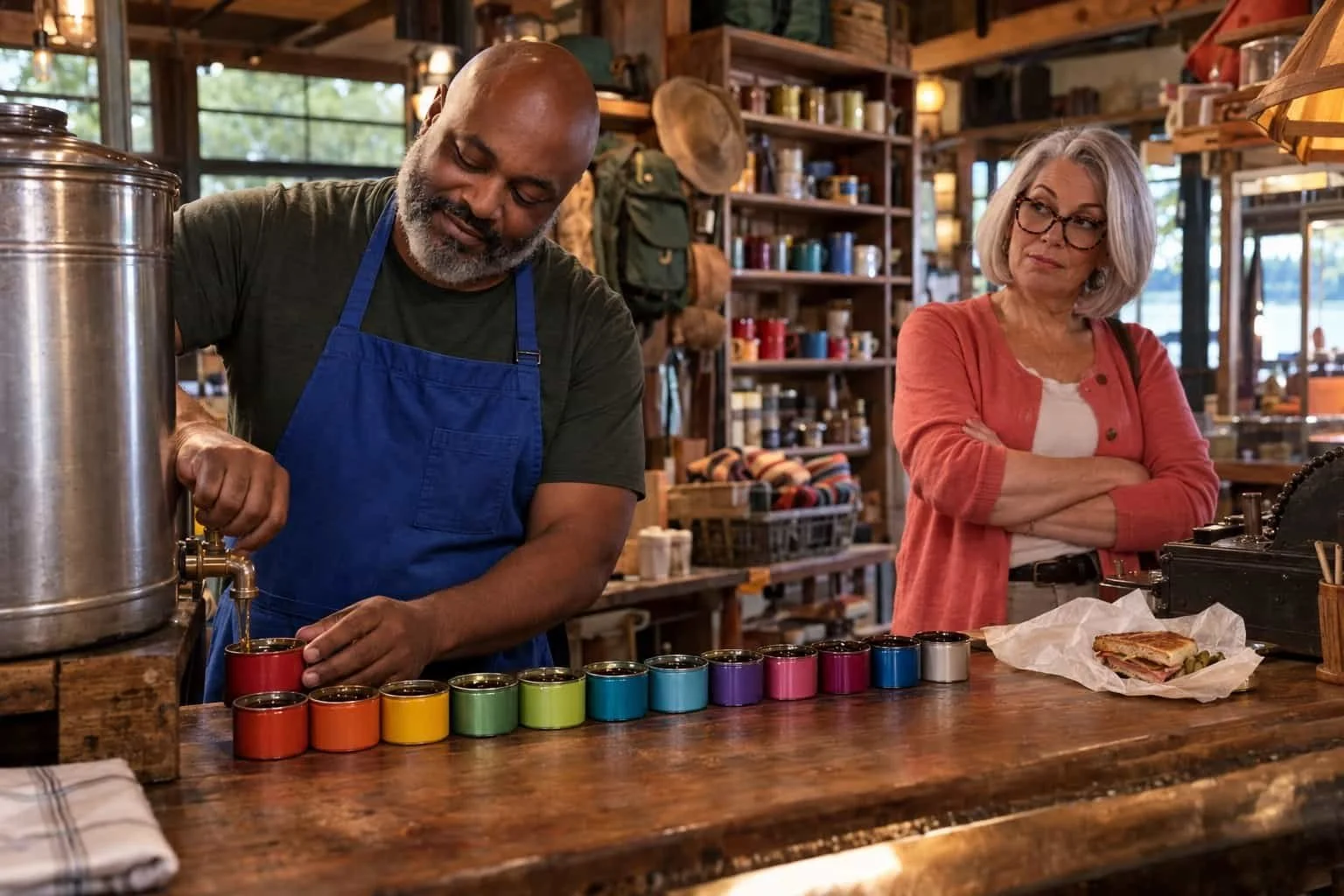
What is the illusion of choice in consumer brands?
The illusion of choice is the gap between how many brands a shopper sees and how many owners actually compete for the sale: independent-looking labels are often owned by a few parent companies, so a shelf full of options can be a short list of balance sheets.
Two famous examples sit in nearly every drugstore. In March 2006, Colgate-Palmolive agreed to pay $100 million in cash for 84 percent of Tom's of Maine, the natural toothpaste company Tom and Kate Chappell founded in 1970, with Tom Chappell staying on to lead it from Kennebunk, Maine.‖‖ That price implied a value of about $119 million for the whole company. Colgate framed the purchase as part of its focus on higher-margin oral and personal care.‖‖
In October 2007, the Clorox Company agreed to buy Burt's Bees for $925 million, for a business with estimated 2007 net sales of about $170 million, sold in nearly 30,000 retail outlets.¶¶ That is roughly 5.4 times a year of sales for a natural lip balm and skin care brand. Clorox's chairman and CEO, Donald Knauss, said the brand's margin structure would be "highly accretive."¶¶
None of that was hidden. Both deals were announced publicly, the founders' stories stayed on the packaging and both brands kept their own look. That is precisely the point. A shopper who reaches past the big-brand toothpaste for the "independent" natural one may simply be choosing between two products from large consumer goods companies. Bone versus eggshell, again.
Beer turns the paradox into a single statistic. At the end of 2020, the United States had 6,406 breweries reporting production, up from a low of 89 in the late 1970s, about 72 times as many.§§ More than 90 percent of them produced fewer than 15,000 barrels a year.§§ Thousands of small brewers and two companies with about two-thirds of revenue: variety exploded at the bottom while concentration held at the top. Choice and competition are not the same thing.
The table below lists verified concentration examples by industry, along with what the evidence actually shows. It is less cinematic than the headlines and more useful.
| Industry | Concentration fact | What the evidence shows |
|---|---|---|
| Economy-wide | More than 75% of U.S. industries more concentrated since the late 1990s | Higher margins and more profitable deals without clear efficiency gains; aggregate markups rose from 21% to 61% above cost, 1980 to 2016 |
| Beer | Two brewers held about 65% of U.S. revenue in 2021, alongside 6,406 breweries in 2020 | MillerCoors study: predicted prices up about 2%, roughly offset by efficiencies on average |
| Airlines | First-bag fees began in 2008; rivals matched Delta's 2010 increase within a month | $7.4 billion in bag fees in 2025 versus $6.0 billion in industry net profit |
| Beef and pork packing | Four firms: 82% of steer and heifer slaughter and 64% of hog slaughter in 2024 | Cattle concentration rose from 77% in 2023; few buyers for ranchers |
| Infant formula | Four companies held about 90% of the U.S. market in 2022 | One Michigan plant supplying up to one-fifth of formula went down, and shelves emptied |
| Hospitals (labor) | Mergers that sharply raised local employer concentration | Annual wage growth 1.1 to 1.7 points slower for skilled and nursing workers |
| Pharmaceuticals | Incumbents buying overlapping drug projects | 5.3% to 7.4% of acquisitions estimated to be killer acquisitions, clustered below review thresholds |
| Online search | Court ruled Google a monopolist in 2024 | Exclusive deals barred and data sharing ordered in 2025; Google appealed in 2026 |
| Online marketplace | FTC, 18 states and Puerto Rico allege an Amazon monopoly | Allegations that Amazon disputes; case pending in federal court |
| Natural personal care | Tom's of Maine (Colgate-Palmolive, 2006) and Burt's Bees (Clorox, 2007) | Independent-looking brands bought by large consumer goods companies |
What is monopsony, and do mergers lower wages?
Monopsony is market power on the buying side: when only a few employers hire a particular kind of worker in a region, they can pay less than a competitive market would. Research by Elena Prager and Matt Schmitt found that after hospital mergers that sharply increased local concentration, wage growth was 1.1 percentage points lower for skilled nonmedical workers and 1.7 points lower for nursing and pharmacy workers.***
Context makes those numbers sting. Average annual U.S. wage growth hovers between 3 and 4 percent, and Prager summarized the effect bluntly: "you're losing about a third of annual wage growth."*** The researchers found no evidence of slower wage growth for low-skilled workers, whose skills transfer easily to other employers, and unions blunted the effect where they were strong.*** A hospital cafeteria worker can cross the street to a restaurant. A cardiac nurse has fewer streets to cross.
Run the math on a round, illustrative number. A nurse earning $80,000 with 3.5 percent annual raises earns about $91,800 four years later. Shave 1.7 points off each raise and she earns about $85,900. That is roughly $5,900 a year less by year four, and about $14,300 in cumulative pay lost over those four years, without a single layoff or a single headline.
Noncompete agreements tighten the same squeeze. Evan Starr, J.J. Prescott and Norman Bishara surveyed a nationally representative sample of 11,505 labor force participants for the Journal of Law and Economics and found that about 18 percent were bound by a noncompete and 38 percent had signed one at some point.††† Only 10 percent negotiated over it, and about a third were handed the agreement after they had already accepted the job.††† In a 50-person company, that is roughly nine people who cannot easily take their skills to a rival.
The federal fix did not survive. The FTC's 2024 rule banning most noncompetes was set aside in Ryan, LLC v. FTC, where a federal district court found the agency had exceeded its statutory authority. In September 2025 the Commission voted 3 to 1 to drop its appeals and accept that ruling, and on February 12, 2026, it formally removed the rule from the Code of Federal Regulations.‡‡‡ Noncompetes are back to being a state-by-state question.
For professional services firms, consulting firms and venture-backed startups, where the inventory walks out the door every evening, that leaves an old question in place. Is the best way to keep talent a contract, or a reason to stay? Monopsony power, whether it comes from a merger or a signature, is a bet that workers have nowhere better to go. Independents win that bet by being somewhere better.
What is a killer acquisition?
A killer acquisition is a purchase made to shut down the target's innovation before it can compete with the buyer's own products. Studying the pharmaceutical industry, Colleen Cunningham, Florian Ederer and Song Ma estimated in the Journal of Political Economy that 5.3 to 7.4 percent of acquisitions in their sample were killer acquisitions, and that these deals disproportionately occurred just below the thresholds that trigger antitrust scrutiny.§§§
The key finding is simple to state. Drug projects that overlapped with the buyer's existing portfolio were less likely to be developed after the acquisition, especially when the buyer faced weak competition or held patents that were far from expiring.§§§ In the study's sample, roughly five to seven of every 100 drug-company acquisitions bought a competing idea in order to keep it from competing. Each is a project that did not fail in a lab. It failed in a boardroom.
The threshold detail matters most for anyone who funds or sells young companies. Federal premerger notification under the Hart-Scott-Rodino Act applies above a dollar threshold, and a deal priced just under it may never get a regulator's look. That is the corporate version of Bateman acquiring Paul Allen's card and filing it in a desk drawer: the rival never reaches the table again.
For venture capital firms and founders, the lesson cuts both ways. An acquisition is a legitimate and often wonderful exit, and most acquisitions are not killers. But a buyer whose own product overlaps with a startup's may value that startup most as something that never ships. Earnouts tied to launches, commitments on continued development and a clear-eyed look at the acquirer's existing portfolio belong in the term sheet conversation, not the post-closing regret conversation.
There is a cultural cost, too. When the most reliable payday is being bought by an incumbent, some companies get built to be acquired rather than to win. That is rational for the founder. It is less healthy for a market that needs a few upstarts to actually go the distance.
Do Google and Amazon act as gatekeepers for small businesses?
A federal court has ruled that Google illegally maintained a monopoly in general search, and the FTC alleges that Amazon illegally maintains monopoly power in online retail, which Amazon denies. For a small business that depends on either platform for customers, the practical effect is a toll road owned by someone else.
The Google case began in October 2020, when the Justice Department sued, joined by 11 state attorneys general. After a nine-week trial, a federal judge in Washington, D.C., issued a 277-page opinion in August 2024 concluding, "Google is a monopolist, and it has acted as one to maintain its monopoly."‖‖‖ On September 2, 2025, the court barred Google from entering or maintaining exclusive contracts for distributing Google Search, Chrome, Google Assistant and the Gemini app, and ordered it to make certain search index and user-interaction data available to rivals.‖‖‖ Google filed its notice of appeal on January 16, 2026, asked the court to pause the data-sharing and syndication remedies while the appeal proceeds, and argued that "people use Google because they want to."¶¶¶ The company said it expected to present its case on appeal later in 2026.¶¶¶
The Amazon case is earlier in its life. In September 2023, the FTC, 18 state attorneys general and Puerto Rico sued Amazon, alleging that it uses "a set of interlocking anticompetitive and unfair strategies" to maintain monopoly power and that its conduct lets it stop rivals and sellers from lowering prices, degrade quality for shoppers, overcharge sellers and stifle innovation.**** Those are allegations, not findings. Amazon has called the suit misguided, argued that sellers have choices and that its fulfillment service is optional, and said it will contest the case.
Here is what both cases mean on a Tuesday morning for an e-commerce brand or a local service business. When one search engine handles most of a market's searches and one marketplace handles a large share of its online shopping, the rules of visibility are written by companies that also sell the ads, and in Amazon's case, also sell their own competing products. A change to an algorithm, a fee schedule or an ad auction can move a small company's revenue more than any direct competitor can.
Platforms deliver real customers, and nobody serious suggests a brand ignore them. The mistake is building the whole house on rented land. Patrick Bateman cared enormously about a card he did not design, printed at a shop he did not own, to impress people who could not tell it apart from the others. A brand whose entire customer list lives inside someone else's platform is holding that card.

Does corporate consolidation make supply chains more fragile?
It can. When production concentrates in a few companies or plants, one failure becomes everyone's shortage, and the 2022 infant formula crisis is the textbook case: four companies controlled about 90 percent of the U.S. market when a single plant went down.††††
The plant was Abbott's facility in Sturgis, Michigan, which reportedly supplied as much as one-fifth of all the infant formula in the country before suspected contamination led to a recall and a shutdown.†††† One building, roughly one can in five. The market's design made it worse. The USDA's WIC program buys about half the formula sold in the United States, and each state contracts with a single manufacturer, which gives that company a near monopoly in that state; Abbott held that position in about two-thirds of states.†††† Efficiency built the system. Redundancy would have saved it.
Meatpacking shows how concentrated a basic industry can get. According to the USDA's Packers and Stockyards Division, the four largest packers accounted for 82 percent of federally inspected steer and heifer slaughter in 2024, up from 77 percent in 2023, and the four largest hog packers handled 64 percent of hog slaughter.‡‡‡‡ Roughly four of every five fed cattle in the country pass through four companies. A rancher with a pen of finished steers has very few buyers to call. That is monopsony again, wearing boots.
For manufacturers and supply chain businesses, the lesson is operational, not political. A single-source input, a single freight lane or a single contract manufacturer is a concentration risk that sits inside a company's own walls. The just-in-time playbook optimized for the average day. Consolidated supply chains punish the worst day, and the worst day always arrives eventually.
The fix is not glamorous. Qualify a second supplier before the first one fails. Know which customer accounts for more than a fifth of revenue. Price the cost of redundancy as insurance rather than waste. The companies that did that before 2022 had a very different spring.
Is it getting harder to start and grow a small business?
The long-run data say yes. Economists Ryan Decker, John Haltiwanger, Ron Jarmin and Javier Miranda found in the Journal of Economic Perspectives that U.S. startup rates and overall business dynamism declined over recent decades, with the decline accelerating after 2000, and that the share of U.S. employment at young firms fell by almost 30 percent over 30 years.§§§§
Business dynamism is the economy's churn: new firms opening, growing, stealing customers and occasionally failing. It is how a better idea replaces a worse one. When fewer young firms start and fewer of them grow, incumbents face less pressure, workers have fewer employers bidding for them and customers have fewer upstarts to switch to. The authors offered partial explanations rather than a single culprit.§§§§ Concentration is a suspect, not a convicted defendant.
Still, the mechanics are easy to see from the ground. A new company has to buy customers through search ads, marketplace placement and social feeds, often bidding in auctions against rivals with consolidated budgets. It may need financing from investors who expect an exit through acquisition. It may need to hire from a labor pool where roughly 18 percent of workers are bound by noncompetes.††† Each hurdle is survivable. Stacked together, they tilt the field toward whoever is already big.
Then there is the exit. For many founders, the fastest path is no longer to become the next incumbent. It is to be bought by the current one. That outcome is fine for the founder and the investors. It is less fine for the market when the buyer's plan is a desk drawer.
What are the 2023 Merger Guidelines, and are they still in effect?
The Merger Guidelines the FTC and the Justice Department released in December 2023 create a presumption of illegality when a merger leaves a market with a Herfindahl-Hirschman Index above 1,800 and raises it by more than 100 points, or gives the merged firm a share above 30 percent with the same 100-point increase.‖‖‖‖ As of 2026, they continue to shape merger review and enforcement priorities at both agencies.¶¶¶¶
The HHI sounds intimidating and is just arithmetic. Square each competitor's market share and add them up. A market of five equal firms, each with 20 percent, scores 2,000. Six equal firms score about 1,667. So the 1,800 line sits between five and six equal-size competitors. Now try national beer revenue as a back-of-the-envelope illustration: Anheuser-Busch InBev's 42.4 percent share squares to about 1,798 by itself, and Molson Coors adds about 502, for roughly 2,300 before counting a single craft brewer.§§ Real antitrust markets are defined more carefully, by product and geography, so treat that as a teaching example rather than a legal finding.
The guidelines also reach beyond single deals. Guideline 8 says that when a merger is part of a series of acquisitions, the agencies may examine the whole series, which speaks directly to private equity roll-ups and serial acquirers.‖‖‖‖ Guideline 10 covers mergers of competing buyers, including employers competing for workers, and Guideline 9 covers multi-sided platforms.‖‖‖‖ For PE firms building platforms through add-ons, the practical takeaway is blunt: ten small deals can now be read as one big one.
Washington's posture shifts with every administration, but the concern about concentration has outlasted several of them. The Google search case was filed in October 2020, won in 2024 and remedied in 2025, a span that covers three presidential terms.‖‖‖ The guidelines written in 2023 remain in use in 2026, even as the current agencies have negotiated settlements in at least 12 merger investigations, compared with four FTC merger consent decrees and none at the Justice Department across fiscal years 2023 and 2024.¶¶¶¶ In February 2026, a federal court in Texas vacated the expanded premerger notification form, and Abigail Slater, who led the Justice Department's Antitrust Division, stepped down.¶¶¶¶
For lobbying firms and the companies they advise, that is the real forecast. The enforcement style changes. The presumption stays. And a deal regulators have not challenged yet is not the same thing as a deal they approved.
How can small businesses compete with big corporations?
By owning what a consolidated rival cannot buy or rent: the customer relationship, the channels that reach those customers and a difference buyers can see without a magnifying glass. Big companies win on scale. Independents win on ownership and specificity, but only when both are visible.
Here is the checklist Tocobaga uses with independent owners and growth-stage companies facing consolidated competition:
Own the channels and the customer data. The website, the domain, the email list, the CRM, the ad accounts and the Google Business Profile should be registered to the business, not to a vendor. Many owners think they own their website and are actually renting it.
Be visibly different, not a skin. If the logo, the claims and the pricing page could be swapped with the category leader's, the business is a bone-colored card. Pick a promise the big player cannot copy without breaking its own model: a named technician, a local guarantee, a founder who answers the phone.
Build local proof. Reviews that name employees, case studies with real numbers, community sponsorships and local press tell buyers exactly who is behind the business. Consolidated brands struggle to fake that at scale.
Diversify customer acquisition. Use a simple decision rule: when any single platform drives more than half of new customers, build a second channel before the platform changes its rules. Email, referrals, partnerships, organic search and direct relationships are channels no auction can price out.
Watch the auctions. In paid search and marketplace advertising, a consolidated competitor with a national budget can bid up the cost of a click in a local market. Track cost per lead, customer acquisition cost and lifetime value weekly, and move spend toward keywords, audiences and channels where a big budget buys less advantage.
Map single points of failure. Manufacturers and supply chain businesses should dual-source critical inputs and know which supplier, carrier or plant could stop the line.
Diligence platform and concentration risk. PE and VC firms should ask what share of a target's revenue flows through one marketplace, one search engine or one customer, and whether an add-on strategy could be read under Guideline 8 as a single acquisition.
For local service businesses specifically, Tocobaga's earlier piece, Same Name on the Truck, covers what private equity roll-ups mean for the plumber down the street.
Tocobaga's house rules exist because of this exact problem. Flat-fee pricing, never a percentage of ad spend, so the agency never profits when an auction gets more expensive. Contracts that never auto-renew. And the client owns everything: website, domain, ad accounts, profiles, data and content. For a no-pressure intro call about competing against consolidated rivals, reach Tocobaga at (813) 934-6605 or through SolvingHow.com.
Is the era of acquisition bad for small business? Law's take
My take, labeled as opinion: the era of acquisition is not a villain, but it is a slow leak, and independents who wait for Washington to patch it will run out of air first.
I believe the superstar research. Some companies are big because they are better, and some mergers make products cheaper to deliver.¶,** I have also watched enough markets to know that the evidence on the other side is specific and stacking up: three in four industries more concentrated, the markup over cost nearly tripled, wage growth slowed by about a third for skilled hospital workers, drug projects bought and shelved, and bag fees that out-earn airline profits.§,‖,***,§§§,‡‡ That is not a conspiracy theory. That is a spreadsheet.
What worries me most is not size. It is sameness. When every option on the shelf, in the search results and in the stack of quotes answers to a few owners, customers lose the one weapon a market gives them, which is leaving. Franklin Tarbell had that weapon until the railroads quietly took it away. Today it disappears more politely, one acquisition at a time, often below any threshold a regulator will see.
Policy will swing. The noncompete rule came and went in about two years.‡‡‡ The 2023 guidelines survived a change in administration.¶¶¶¶ Standard Oil took decades and a journalist with a long memory. Small businesses do not have decades. Here is the good news, and I mean it with full optimism: buyers can still tell the difference when the difference is visible. Those 6,406 breweries prove there is room.§§ The job is to be the card nobody can mistake for another.
The oil girl, the bone card and the independents
Ida Tarbell watched consolidation arrive through a secret railroad deal and spent the next three decades making it visible. Her verdict on Standard Oil came down to five words: "They had never played fair."* She did not win by out-shouting Rockefeller. She won by documenting what everyone suspected and nobody could see.
Patrick Bateman sat at a table full of nearly identical cards and saw only the differences that did not matter. Modern markets reward the same mistake at a larger scale: shelves of brands with a few owners, fees that move together and platforms that own both the road and the toll booth.
The independents who win the era of acquisition will do what Tarbell did and what Bateman never could. They will make the real differences visible: who owns the business, who answers the phone, who keeps the customer data and who will still be here after the next deal closes. Everyone else can keep comparing fonts.
What is corporate consolidation?
Corporate consolidation is the process of fewer companies controlling a larger share of an industry, usually through mergers, acquisitions and the growth of dominant firms. It can lower costs through scale, but it can also reduce competition, raise prices and fees, slow wage growth and leave customers with fewer real alternatives. Researchers have found that more than 75 percent of U.S. industries became more concentrated after the late 1990s.
Why are there so many mergers right now?
Large companies are chasing scale and private equity buyers are active. Global deal value passed $4.8 trillion by mid-December 2025, the second-biggest year after 2021, and worldwide M&A rose another 28 percent to $3.9 trillion through September 2026, although third-quarter activity slowed as borrowing costs rose. Deals are also getting bigger: in 2025, total value rose 41 percent while the number of deals fell 6 percent.
Is corporate consolidation bad for the economy?
The evidence is mixed. Some concentration reflects highly productive superstar firms winning customers, and some mergers deliver efficiencies that offset price increases. Other research links consolidation to higher markups, slower wage growth for skilled workers after hospital mergers and acquisitions that shut down rival drug projects. The outcome depends heavily on whether customers and workers can still switch to real alternatives.
What is a killer acquisition?
A killer acquisition happens when a company buys a rival or startup mainly to shut down its product or project before it can compete. A study of the pharmaceutical industry in the Journal of Political Economy estimated that 5.3 to 7.4 percent of acquisitions in its sample were killer acquisitions, and that they clustered just below the thresholds that trigger antitrust review.
What is monopsony in the labor market?
Monopsony is market power held by buyers rather than sellers. In labor markets, it means a small number of employers dominate hiring for certain skills in a region, which lets them hold down pay. Research on hospital mergers found that when local concentration rose sharply, annual wage growth slowed by 1.1 percentage points for skilled nonmedical workers and 1.7 points for nursing and pharmacy workers.
Are the 2023 Merger Guidelines still in effect?
Yes. As of 2026, the December 2023 Merger Guidelines from the FTC and the Justice Department continue to shape merger review. They presume a merger is illegal when it creates a market with an HHI above 1,800 and an increase of more than 100 points, or a market share above 30 percent, and they allow the agencies to examine a series of acquisitions as a whole.
Is the FTC ban on noncompete agreements still in effect?
No. The FTC's 2024 rule banning most noncompetes was set aside by a federal court, the Commission voted in September 2025 to drop its appeals, and on February 12, 2026, it removed the rule from federal regulations. Noncompete enforceability is now largely a matter of state law and individual cases, and research has found that roughly 18 percent of workers are bound by one.
Which big companies bought Tom's of Maine and Burt's Bees?
Colgate-Palmolive agreed in 2006 to buy 84 percent of Tom's of Maine for $100 million, and the Clorox Company agreed in 2007 to buy Burt's Bees for $925 million. Both brands kept their names and natural positioning, which makes them common examples of the illusion of choice: independent-looking brands owned by large consumer products companies.
How can small businesses compete with large corporations?
Small businesses compete best by owning what consolidated rivals cannot rent: their website, domain, ad accounts, customer data and direct relationships. They should be visibly different rather than copying the category leader, build local proof through reviews and case studies, avoid relying on any single platform for more than half of new customers, and track cost per lead and customer acquisition cost closely.
Sources
- *
- King, Gilbert. "The Woman Who Took on the Tycoon." Smithsonian Magazine, July 5, 2012. Tarbell's 1857 birth in Hatch Hollow, her father's tank building and move into oil production and refining, Titusville's "blow between the eyes," the South Improvement Company's rebates and drawbacks, the April 1872 charter repeal, Rockefeller's purchase of 22 of 26 Cleveland competitors in six weeks, the mortgaged family home, her "hatred of privilege," the 19-part McClure's series beginning in 1902 and the 1904 book, Rockefeller's "poisonous woman" remark, her "never played fair" verdict, and the 1911 Supreme Court ruling and breakup into "baby Standards." https://www.smithsonianmag.com/history/the-woman-who-took-on-the-tycoon-651396/
- †
- Sakoui, Anousha, Dawn Kopecki, and Kane Wu. "More mega deals coming as chase for scale fuels near record-breaking year for M&A." Reuters, republished by MarketScreener, December 18, 2025. Global M&A above $4.8 trillion by mid-December 2025 (up 41 percent) per Dealogic, 38,395 deals (down 6 percent), a record 70 deals above $10 billion, $1.1 trillion in buyouts (up 51 percent), and the 2021 record above $6 trillion. https://www.marketscreener.com/news/more-mega-deals-coming-as-chase-for-scale-fuels-near-record-breaking-year-for-m-a-ce7d50dcd981ff20
- ‡
- Sakoui, Anousha, and Echo Wang. "Global M&A deal rush fades in third quarter as rising borrowing costs bite." Reuters, republished by Euronext, October 1, 2026. Worldwide M&A up 28 percent to $3.9 trillion through September 2026, third-quarter value of $993 billion (down 41 percent from the second quarter), an 8 percent drop in deal count, and Goldman Sachs' Carsten Woehrn's view on passing the 2021 peak. https://live.euronext.com/en/financial-news/global-ma-deal-rush-fades-third-quarter-rising-borrowing-costs-bite
- §
- Grullon, Gustavo, Yelena Larkin, and Roni Michaely. "Are US Industries Becoming More Concentrated?" Review of Finance 23, no. 4 (2019): 697 to 743. More than 75 percent of U.S. industries more concentrated since the late 1990s, with higher profit margins and more profitable mergers in the fastest-consolidating industries and market power as a growing source of firm value. https://ideas.repec.org/a/oup/revfin/v23y2019i4p697-743..html
- ‖
- De Loecker, Jan, Jan Eeckhout, and Gabriel Unger. "The Rise of Market Power and the Macroeconomic Implications." Quarterly Journal of Economics 135, no. 2 (May 2020): 561 to 644. Aggregate markups rising from 21 percent above marginal cost in 1980 to 61 percent in 2016, and links to a falling labor share and slower output growth. https://crei.cat/wp-content/uploads/2020/10/the-rise-1.pdf
- ¶
- Autor, David, David Dorn, Lawrence F. Katz, Christina Patterson, and John Van Reenen. "The Fall of the Labor Share and the Rise of Superstar Firms." Quarterly Journal of Economics 135, no. 2 (2020): 645 to 709; NBER Working Paper 23396. The superstar firms explanation: globalization and technology favoring the most productive firms, which gain share, earn high profits and pay a small share of revenue to labor. https://www.nber.org/papers/w23396
- **
- Ashenfelter, Orley C., Daniel S. Hosken, and Matthew C. Weinberg. "Efficiencies Brewed: Pricing and Consolidation in the US Beer Industry." RAND Journal of Economics 46, no. 2 (Summer 2015): 328 to 361; NBER Working Paper 19353. The MillerCoors joint venture's predicted price increase of about 2 percent and the "nearly equal and opposite efficiency effect." https://www.nber.org/papers/w19353
- ††
- U.S. Government Accountability Office. "Commercial Aviation: Consumers Could Benefit from Better Information about Airline-Imposed Fees and Refundability of Government-Imposed Taxes and Fees." GAO-10-785, July 14, 2010. The $457 million in fiscal 2007 baggage fees, the 2008 start of separate charges, nearly $3.9 billion in bag fees in 2008 and 2009, and Delta's January 2010 increase matched within a month by Continental, United and American. https://www.gao.gov/assets/gao-10-785.pdf
- ‡‡
- U.S. Bureau of Transportation Statistics. "U.S. Airlines Profited $6.0 Billion in 2025, a Decrease Over 2024." Press release BTS 26-43, May 12, 2026. $7.4 billion in 2025 baggage fees and $6.0 billion in net profit for the 25 scheduled passenger airlines. https://www.bts.gov/newsroom/us-airlines-profited-60-billion-2025-decrease-over-2024
- §§
- U.S. Department of the Treasury. "Competition in the Markets for Beer, Wine, and Spirits." February 2022. AB InBev's 42.4 percent and Molson Coors' 22.4 percent of 2021 U.S. beer revenue (about 65 percent combined), 6,406 breweries at the end of 2020 versus a low of 89 in the late 1970s, and the share producing fewer than 15,000 barrels. https://home.treasury.gov/system/files/136/Competition-Report.pdf
- ‖‖
- "Colgate Buys Tom's Of Maine For $100M." CBS News, March 21, 2006. Colgate-Palmolive's $100 million cash purchase of 84 percent of Tom's of Maine, the Chappells' 1970 founding, Tom Chappell staying on in Kennebunk, and Colgate's higher-margin rationale. https://www.cbsnews.com/news/colgate-buys-toms-of-maine-for-100m/
- ¶¶
- The Clorox Company. Press release announcing agreement to acquire Burt's Bees, October 31, 2007, filed with the U.S. Securities and Exchange Commission. The $925 million price, estimated 2007 net sales of about $170 million, nearly 30,000 retail outlets, and Donald Knauss's "highly accretive" comment. https://www.sec.gov/Archives/edgar/data/21076/000119312507230392/dex993.htm
- ***
- Sweeney, Brigid. "When an Industry Consolidates, What Happens to Wages?" Kellogg Insight, April 4, 2019, based on research by Elena Prager and Matt Schmitt later published as "Employer Consolidation and Wages: Evidence from Hospitals," American Economic Review 111, no. 2 (2021): 397 to 427. Wage growth 1.1 points lower for skilled nonmedical workers and 1.7 points lower for nursing and pharmacy workers, the 3 to 4 percent baseline, Prager's "about a third" quote, no effect for low-skilled workers, and the union offset. https://insight.kellogg.northwestern.edu/article/merger-consolidation-wages-effect
- †††
- Starr, Evan P., J.J. Prescott, and Norman D. Bishara. "Noncompete Agreements in the US Labor Force." Journal of Law and Economics 64, no. 1 (2021). Survey of 11,505 labor force participants: about 18 percent bound by a noncompete, 38 percent had signed one, 10 percent negotiated, and about one-third received it after accepting a job. https://chicagounbound.uchicago.edu/jle/vol64/iss1/3
- ‡‡‡
- Federal Trade Commission. "Revision of the Negative Option Rule, Withdrawal of the CARS Rule, Removal of the Non-Compete Rule To Conform These Rules to Federal Court Decisions." Federal Register 91 (February 12, 2026): 6507. The Ryan, LLC v. FTC ruling that the rule exceeded the FTC's authority, the September 2025 3 to 1 vote to accede to vacatur, and removal of 16 CFR part 910 effective February 12, 2026. https://www.federalregister.gov/documents/2026/02/12/2026-02866/revision-of-the-negative-option-rule-withdrawal-of-the-cars-rule-removal-of-the-non-compete-rule-to
- §§§
- Cunningham, Colleen, Florian Ederer, and Song Ma. "Killer Acquisitions." Journal of Political Economy 129, no. 3 (2021): 649 to 702. Estimate that 5.3 to 7.4 percent of pharmaceutical acquisitions in the sample were killer acquisitions, lower development of overlapping projects, and clustering just below antitrust thresholds. https://www.journals.uchicago.edu/doi/10.1086/712506
- ‖‖‖
- U.S. Department of Justice, Office of Public Affairs. "Department of Justice Wins Significant Remedies Against Google." Press release, September 2, 2025. The October 2020 filing joined by 11 state attorneys general, the nine-week trial, the August 2024 277-page opinion and its "monopolist" quote, the ban on exclusive distribution contracts, and the data-sharing order. https://www.justice.gov/opa/pr/department-justice-wins-significant-remedies-against-google
- ¶¶¶
- Mulholland, Lee-Anne. "Why We're Appealing the DOJ Search Distribution Case." Google, The Keyword, January 16, 2026. Google's notice of appeal, its request to pause the data-sharing and syndication remedies, its "people use Google because they want to" argument, and its plan to present its case later in 2026. https://blog.google/company-news/outreach-and-initiatives/public-policy/why-were-appealing-the-doj-search-distribution-case/
- ****
- Federal Trade Commission. "Amazon.com, Inc. (Amazon eCommerce)." Case proceedings page for FTC et al. v. Amazon.com, Inc., No. 2:23-cv-01495 (W.D. Wash.), accessed October 9, 2026. The September 2023 suit by the FTC, 18 state attorneys general and Puerto Rico, and its allegations of "interlocking anticompetitive and unfair strategies" that stop rivals and sellers from lowering prices, degrade quality, overcharge sellers and stifle innovation. https://www.ftc.gov/legal-library/browse/cases-proceedings/1910129-1910130-amazoncom-inc-amazon-ecommerce
- ††††
- "How the U.S. Got into This Baby Formula Mess." NPR, May 19, 2022. Four companies controlling about 90 percent of the U.S. formula market, the Sturgis, Michigan plant supplying as much as one-fifth of U.S. formula, WIC buying about half, single-manufacturer state contracts, and Abbott's position in about two-thirds of states. https://www.npr.org/2022/05/19/1099748064/baby-infant-formula-shortages
- ‡‡‡‡
- U.S. Department of Agriculture, Agricultural Marketing Service. "Packers and Stockyards Division: Annual Report, Fiscal Years 2023 and 2024." September 2026. Four-firm concentration of 77 percent (2023) and 82 percent (2024) in steer and heifer slaughter and 64 percent in 2024 hog slaughter. https://www.ams.usda.gov/sites/default/files/media/PSD_Combined_2023_2024_Annual_Report.pdf
- §§§§
- Decker, Ryan, John Haltiwanger, Ron Jarmin, and Javier Miranda. "The Role of Entrepreneurship in US Job Creation and Economic Dynamism." Journal of Economic Perspectives 28, no. 3 (2014): 3 to 24. Declining U.S. startup rates and business dynamism, the acceleration after 2000, the almost 30 percent fall in young firms' employment share over 30 years, and the authors' partial explanations. https://www.aeaweb.org/articles?id=10.1257/jep.28.3.3
- ‖‖‖‖
- U.S. Department of Justice and Federal Trade Commission. "Merger Guidelines." December 18, 2023. The structural presumption at an HHI above 1,800 with a change above 100, the 30 percent share presumption, Guideline 8 on series of acquisitions, Guideline 9 on multi-sided platforms, and Guideline 10 on competing buyers including employers. https://www.justice.gov/atr/media/1329301/dl?inline
- ¶¶¶¶
- Justus, Bradley, Lisl Dunlop, Josh Jowdy, and Sandhya Taneja. "USA: Trends and Developments." Chambers and Partners, Merger Control 2026 Global Practice Guide, last updated July 7, 2026. The 2023 guidelines continuing to shape merger review, the focus on serial acquisitions, at least 12 merger settlements under the current administration versus four FTC consents and none at DOJ in fiscal 2023 and 2024, the February 2026 vacatur of the expanded HSR form, and Abigail Slater's February 2026 departure. https://practiceguides.chambers.com/practice-guides/merger-control-2026/usa/trends-and-developments