

The Florida Business Marketing Guide for 2026

Law Smith
Founder & President, Tocobaga
Law Smith is the Founder and President of Tocobaga, a Tampa-based ROI-focused marketing agency and SMB advisory. He has strategically advised 1,000+ small and medium businesses, executed 600+ integrated marketing campaigns, and written 30+ business plans across industries ranging from professional services to e-commerce to B2B technology. Tocobaga is a Google Partner and Squarespace Gold Partner headquartered in Ybor City.
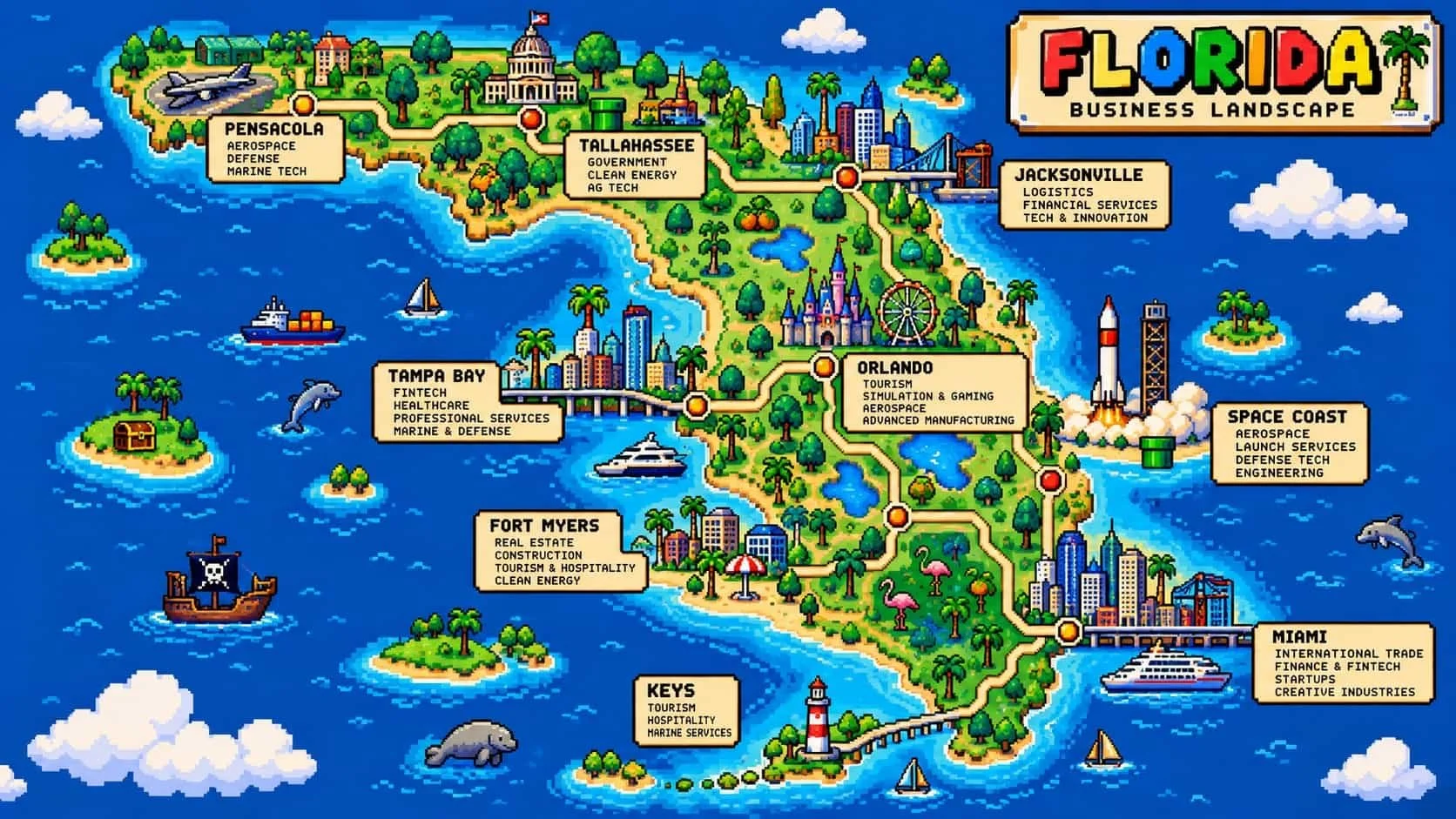
The short version: treat Florida as five-plus distinct markets: Tampa Bay, Orlando, South Florida, Jacksonville, and the Panhandle. Each has its own search behavior, competition, and culture. Build the statewide machine on four disciplines: honest city-by-city local presence (real locations get profiles; service areas get pages, not fake addresses), a calendar that plans for snowbird season and hurricane season instead of being surprised by them annually, bilingual reach where your market genuinely lives in two languages, and compliance fluency in the regulated industries like law, healthcare, contracting, and finance, where Florida's advertising rules have teeth. Then run one measurement spine across all of it, because five markets on five spreadsheets is how statewide budgets disappear.
- How Is Marketing Across Florida Different From One City?
- How Do You Handle Florida Seasonality Without Losing Half the Year?
- Which Florida Industries Face Extra Marketing Rules?
- How Do You Expand City to City Without Faking It?
- Where Tocobaga Fits
- FAQ
One state, five markets, two languages, and a season that flips the customer base. Here is how to market across all of it.
In 1945, the Florida orange had a problem that marketing could not fix: it went bad. Juice spoiled in days, shipping fruit north was costly and lossy, and wartime demand had proven Americans wanted orange juice far more than they wanted the labor of squeezing it. So the state's citrus scientists, working with the USDA, cracked a different problem entirely. They figured out how to concentrate the juice, freeze it, and make it taste like Florida when reconstituted a thousand miles away in February.
Frozen concentrated orange juice turned a perishable regional crop into a national grocery staple, and companies like Minute Maid built empires on the patent.† The product breakthrough came first, but the fortune came from understanding that Florida's real export was not fruit. It was the feeling of Florida, packaged for people who were somewhere colder.
Marketing a business across Florida in 2026 requires the same clear-eyed read of what the state actually is: not one market, but a set of very different metros sharing a flag, a tax structure, and a seasonal tide of customers. Here is how to work with that instead of against it.
How Is Marketing Across Florida Different From One City?
Direct answer: because relevance is local even when your ambition is statewide. A Tampa plumber and a Miami plumber are not competitors; a statewide brand is effectively running parallel campaigns that happen to share a logo. Search behaves city by city: map packs, "near me" queries, and AI answers all resolve locally, so rankings in Orlando do nothing for Jacksonville. Costs differ too: click prices and competitive density in South Florida can run multiples of smaller metros, which means a uniform statewide budget quietly overpays in one market and starves another. The move is a shared brand and measurement system with per-metro pages, profiles, budgets, and, where culture differs, per-metro creative.
How Do You Handle Florida Seasonality Without Losing Half the Year?
- Plan the snowbird calendar in writing: audiences swell roughly October through April in coastal markets. Book the budget shifts in advance instead of reacting in November.
- Sell the off-season honestly: locals-only offers, maintenance-season positioning, and list-building through the summer so the fall push mails to a warm audience.
- Pre-write the hurricane playbook: a pause plan for ads, a communication template for customers, and, for relevant trades, a ready and tasteful response for after the storm. Ambulance-chasing creative after a disaster burns brands; genuine help builds them.
- Measure by season, not just by month: compare January to last January. Judging a Florida business's July against its February is how good campaigns get killed for the crime of being seasonal.
Which Florida Industries Face Extra Marketing Rules?
The big ones: law firms answer to the Florida Bar's advertising rules (Rule 4-7 territory: filing requirements, testimonial limits, no misleading results claims); healthcare navigates HIPAA in testimonials, reviews, and any retargeting touching patient data; contractors must display license numbers in advertising, and unlicensed advertising is its own violation; and financial and insurance products carry state and federal disclosure rules. The practical rule for all of them: compliance is a creative constraint, not a creativity ban. The businesses that learn the rules cold end up out-marketing the ones too scared to say anything, and the ones that ignore the rules eventually fund everyone else's cautionary seminar. Our law firm strategy guide covers the deepest version of this.
How Do You Expand City to City Without Faking It?
- Real offices get real Google Business Profiles. Service-area businesses set service areas honestly. Virtual offices and fake addresses eventually get profiles suspended and trust torched.
- Build one genuinely useful page per city you serve: local proof, local jobs or cases, local answers, not the same paragraph with the city name swapped, which both Google and AI assistants recognize as the wallpaper it is.
- Earn a few local citations and reviews in each new metro before spending on ads there, because credibility first makes every paid dollar cheaper.
- Stage the rollout: prove cost per customer in one new metro before opening the third. Statewide ambitions die of simultaneous expansion more often than competition.
And everywhere, the same 2026 baseline applies: buyers increasingly meet you through answers (zero-click results and AI assistants) before they meet your website, and self-serve research is now the stated preference for most of the journey.* A statewide brand that is the cited answer in five metros is running the FCOJ play: the feeling of local, packaged for scale.
Where Tocobaga Fits
Tocobaga is a Tampa-headquartered, ROI-focused marketing agency and SMB advisory serving businesses across Florida and nationally: 1,000+ SMBs advised, 600+ campaigns, 300+ websites. We build the statewide machine described here: per-metro presence, seasonal planning, bilingual reach where it counts, compliance-fluent creative, and one measurement spine over all of it. Flat fees, no percentage of ad spend, no auto-renew, and you own every asset in every market. Free Marketing ROI Audit at SolvingHow.com or (813) 934-6605.
Still comparing shops? Here is what to look for in a marketing agency before you sign anything.
FAQ
What are the best marketing channels for Florida businesses?
The same intent-first stack as anywhere: Google Business Profiles, local search, Local Services Ads, reviews, and email, deployed per metro rather than statewide, with seasonal budget shifts built into the plan.
Should I pause marketing during hurricane season?
No. Plan it instead. Keep a written pause protocol for active storm periods, communicate usefully with customers, and resume with genuine help rather than opportunism. Businesses that go dark June through November hand the fall to competitors.
Do Florida businesses need bilingual marketing?
In many metros, yes. Large Spanish-speaking populations in South Florida, Orlando, and Tampa Bay make native-quality bilingual profiles, pages, and ads a real share opportunity. Machine-translated tokenism converts nobody; do it properly or wait until you can.
Can I rank in Florida cities where I have no office?
You can rank organically with genuinely useful city pages and earn AI citations with strong answers, but map-pack presence follows real locations and honest service areas. Faking addresses risks suspension, so build service-area pages and local proof instead.
How much should a Florida business budget for statewide marketing?
Budget per metro, not per state: set a cost-per-customer target in each market, fund the proven ones, and stage new metros one at a time. A single statewide number hides the fact that Miami dollars and Ocala dollars buy very different amounts.
Sources
* Gartner, "Gartner Sales Survey Finds 67% of B2B Buyers Prefer a Rep-Free Experience," press release, March 9, 2026; G2, "2025 Buyer Behavior Report," 2025 (AI search reshaping research behavior). https://www.gartner.com/en/newsroom/ · https://research.g2.com/
† Frozen concentrated orange juice: developed mid-1940s by Florida Citrus Commission and USDA researchers (patent filed 1945, issued 1948 to Louis MacDowell, Edwin Moore, and Cedric Atkins); commercialized by Minute Maid from 1946. Florida State Archives and USDA historical accounts.