
You Have Died of Tactics: How to Choose a Marketing Agency That Puts ROI First


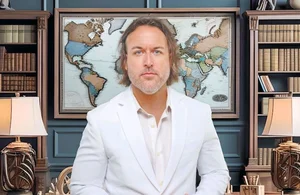
Law Smith
Founder & President, Tocobaga
Law Smith is the Founder and President of Tocobaga, a Tampa-based ROI-focused marketing agency and SMB advisory. He has strategically advised 1,000+ small and medium businesses, executed 600+ integrated marketing campaigns, and written 30+ business plans across industries ranging from professional services to e-commerce to B2B technology. Tocobaga is a Google Partner and Squarespace Gold Partner headquartered in Ybor City.
On December 3, 1971, a 21-year-old student teacher named Don Rawitsch brought a teletype into his eighth-grade history class at Jordan Junior High School in Minneapolis.* A teletype was not a computer. It was a loud printer with a keyboard and a phone line, connected to a computer somewhere else, and it answered at about ten characters per second.†
Rawitsch had been teaching westward expansion with a dice-and-card game laid out on a long butcher-paper map. His roommate Bill Heinemann, who was teaching math across town, took one look at the map and said it would be a perfect application for a computer. Rawitsch told him he needed it in 10 days.*
Heinemann and another roommate, Paul Dillenberger, both about to graduate from Carleton College, wrote the program in BASIC at Bryant Junior High, on a teletype parked in an anteroom to the janitor's closet with space for the machine and exactly one extra chair. Rawitsch could reserve the terminal for only a week, so his students played in groups of four or five, arguing over every decision.*
When the student teaching ended, the program was deleted from the computer. Rawitsch kept a printout of the code.† In 1974 he went to work for the Minnesota Educational Computing Consortium, known as MECC, and by 1975 he had retyped the game onto a network that teachers across the state could reach.*,† The three creators gave the game to MECC without expecting a dime, and they never saw one.*
In 1985, a MECC designer named R. Philip Bouchard rebuilt it for the Apple II with simple graphics, and millions of students met it in a school computer lab.† In 1995, MECC's president, Dale LaFrenz, told an interviewer the game accounted for about a third of the company's $30 million in annual revenue. That is roughly $10 million a year from a program that once survived as a stack of paper. One estimate puts lifetime sales above 65 million copies.*
In 1989, my family bought a brand-new Macintosh. My parents were low-tech, so this was an event. I was five. I had been to an arcade, and I knew how games worked: a game was a machine, and a machine took quarters. So, the way my family tells it, I decided The Oregon Trail was an arcade game and kept feeding quarters into the computer until it broke, within about a month of bringing it home. I do not remember doing it. I have heard it enough times to testify.
Apple's Macintosh SE carried a base price of $2,899 when it launched in 1987.‡ That is 11,596 quarters. I did not get close, but every coin I fed the machine bought the same thing: nothing. The game was already paid for. The slot was never built for money. The machine did what machines do when fed the wrong currency. It quit.
I told that story on October 31, 2022, when Jared Berryman of Hivelead had me on The Life of a Marketer podcast and asked about the oldest technology I remembered using.§ He had also invited me because I moonlight as a stand-up comedian, and I told him the truth: I am probably better at the day job. The day job is Tocobaga, the Tampa Bay lead generation agency and SMB advisory behind SolvingHow.com, where I work as a fractional CMO for companies that sell considered, high-value services, from law firms to PE-backed platforms.
Four years later, the quarters read less like a funny story and more like a diagnosis. Businesses still feed money into the wrong slot. They buy "social media" the way a five-year-old buys a turn at the arcade, and they pay agencies for activity instead of return. The Oregon Trail was never about a coin slot. It was a game about spending a fixed bankroll well before the wagon left Missouri, then living with the consequences. Most of what I told Berryman was about that same discipline. The data has changed since 2022. The trail has not. The table below lines up what I said then, what changed by 2026 and what Tocobaga does about it.
| What Law said in 2022 | What changed by 2026 | What Tocobaga does about it |
|---|---|---|
| Strategy before tactics; owners ask for "social media" without a plan | Gartner 2026: budgets at 7.8% of revenue, 56% of CMOs call them insufficient, 15.3% now goes to AI | Business plan and goals first, then channels, macro to micro |
| ROI is the first vital sign on every report | CMO Survey 2026: 58.8% feel more CEO pressure and 55.5% more CFO pressure to prove value | ROI, or projected ROI with assumptions, on the first line of every report |
| Show adjusted ROI with the agency fee included | Gartner 2025: 39% of CMOs planned to cut agency budgets | Reports 9.7x average client ROI and 7.8x adjusted ROI |
| Most agencies sell better than they deliver | Gartner 2025: 22% of CMOs say generative AI reduced their reliance on agencies | Flat fees, no percentage of ad spend, no auto-renewals, senior people on the work |
| The fractional CMO model | Revelio Labs: fractional mentions rose from 5 to 18 per 1,000 new executive roles, 2018 to 2024; S&P 500 CMO tenure averages 4.1 years | Fractional CMO leadership with a business partner and a specialist roster |
| Law firms as a niche; coach attorneys like a football coach | Clio 2025: more than half of clients would go online for their next lawyer; 24% unlikely to rehire | 30+ law firms since 2015; blunt, prepared, detail-first service |
| PE and VC firms want one partner for everything they acquire | Bain 2026: holding periods near seven years; almost 40% of companies held over five years | One playbook and one reporting standard across the portfolio, by brand and location |
| Say no to poor-fit clients | BLS: food service establishments outlast the average business; Census: e-commerce is 17.1% of retail sales | Says no early and points owners to better-suited resources |
| Add one skill a year, like LeBron James | World Economic Forum: 39% of key job skills expected to change by 2030 | Specialists directed by a senior player-coach |
| The cobbler's children have no shoes | Sweat Equity became the ROI Podcast, now past 500 episodes | Treats its own marketing like a client account |

Why do business owners buy marketing tactics instead of a strategy?
Because tactics are easy to see and strategy is not. A post, an ad or a new website can be pointed at in a meeting, while a strategy is a set of decisions about who to serve, what to say, what to spend and what to measure, made before anyone buys anything. Owners default to what they can point at.
In 2022 I described the most common version of the problem. An owner calls and says, "I need to hire you to do our social media." My reaction then is my reaction now: what does that mean? The request names a channel, not an outcome. It does not say who the customer is, what a customer is worth, what the business is trying to grow or how anyone would know if it worked. "I start with strategy," I told Berryman. "Every time, I go macro to micro."§
Macro to micro means the business plan comes before the marketing plan, and the marketing plan comes before the tactics. Who buys, why, at what margin, through which door and at what lifetime value. Then channels. Then content calendars, ads and posts. In the interview I complained that almost no one writes a business plan, and that is still true of most of the small and midsize companies that call Tocobaga. Tocobaga has written more than 30 business plans for exactly this reason. The plan is not homework. It is the map and the compass.
The Oregon Trail taught this before most of today's owners could drive. In the 1985 Apple II version, a player chose to be a banker, a carpenter or a farmer, which set how much money the family started with, and then spent it at the general store on oxen, food, clothing, ammunition and spare parts before the wagon ever moved. A family that bought nothing but bullets would starve with excellent aim. The store was the strategy. Everything after it was tactics.
The 2026 budget math makes the store more important, not less. Gartner's 2026 CMO Spend Survey of 401 marketing leaders found budgets at 7.8 percent of company revenue, barely up from 7.7 percent, and 56 percent of CMOs said their budget is insufficient to execute their strategy.‖ For a company with $10 million in revenue, 7.8 percent is $780,000 a year, or about $15,000 a week. That sounds like plenty until someone spends six months of it on a channel nobody chose on purpose.
The 2026 version of "hire someone for our social media" is "hire someone for AI." Gartner found CMOs now put 15.3 percent of marketing budgets into AI, while 70 percent say their internal processes are not mature enough to implement and scale it. Gartner's Ewan McIntyre named the risk precisely: "The risk is that CMOs invest in AI tools faster than they build the data foundations."‖ New tactic. Same quarter. Same slot.
How should marketing ROI be measured and reported?
Return on investment should be the first line of every marketing report, ahead of impressions, clicks, followers and rankings: revenue or qualified pipeline produced per dollar of total marketing cost, with a projected ROI early in an engagement and an actual ROI once the data matures.
In the interview I compared it to an emergency room. An ER doctor walking into a room checks vital signs first. Pulse, blood pressure, breathing. Nobody starts with the patient's haircut. "So I just put ROI," I said, describing the top of my monthly client reports. Early in an engagement, before enough deals have closed, the first line is projected ROI and the assumptions behind it. Later it is the real number.§
The pressure to report that way is no longer a preference. It is the job. In the 2026 CMO Survey, run by Duke University's Fuqua School of Business and directed by Christine Moorman, 58.8 percent of marketing leaders said they feel increasing pressure from their CEO to prove marketing's value, 55.5 percent from their CFO and 44.7 percent from their board.¶ Put plainly, in more than half of those companies, the people who sign the checks are asking marketing to show its vitals. The same survey found 86.3 percent of leaders are building stronger performance tracking and 75 percent are working to demonstrate the financial impact of marketing.¶
Most owners already have the instruments. CRMs, call tracking, form data, ad platforms and analytics have existed for years. What they lack is a single place where the number shows up first, and a person accountable for it. I grew up with a version of that problem. My family had a 19-inch color Zenith with a plastic wood-grain panel and no remote, and my dad changed channels with his toe from a couch set perpendicular to the screen. I assumed remotes were for fancy televisions. Zenith itself had shipped a wired remote called Lazy Bones in 1950, the first wireless remote, the Flash-Matic, in 1955, and the ultrasonic Space Command in 1956.** By 1989, the wireless remote was 34 years old. Our house just did not have one.
A business without an ROI line on its report is changing channels with its toe. The technology exists. Nobody handed the owner the remote. That raises the follow-up question every owner should put to an agency: who holds the remote? At Tocobaga, the client owns the website, the domain, the ad accounts, the analytics, the profiles and the data. An agency that keeps the remote in its own pocket is renting the owner a television, and plenty of owners who think they own their website are really renting it.

What is adjusted ROI, and why should an agency count its own fee?
Adjusted ROI is the return recalculated with the agency's own fee added to the cost side, so the number reflects everything the business paid to get the result. Tocobaga reports an average client ROI of 9.7x and an adjusted ROI of 7.8x, with the fee included.
In 2022 I called adjusted ROI the thing almost no one else shows. "Here's something no one else does," I said. "I put the adjusted ROI, which is my fee with all the other expenses."§ The owner or CMO who hired the agency already does this math privately. They see the return, and then they ask what they are paying the agency to produce it. An agency that leaves its fee out of the ROI is not fooling anyone. As I put it then, it is only delaying the inevitable.§
Here is the arithmetic in round, illustrative numbers, using a simple revenue-to-cost multiple rather than any client's real figures. A firm spends $100,000 on media and production and books $970,000 in revenue it can trace to that marketing. That is 9.7x. Now add a $24,000 agency fee to the cost side. The same $970,000 divided by $124,000 is about 7.8x. The campaign did not get worse. The math got honest. The gap between the two numbers is the price of the agency, stated out loud, on the first page.
Honest math also changes how fees should be structured. Many agencies charge a percentage of ad spend. Picture a hypothetical 15 percent fee on $40,000 a month in media: $6,000. If the agency recommends raising spend to $60,000, its fee becomes $9,000, a 50 percent raise for the agency, whether or not a single additional client walks in the door. That is why Tocobaga charges flat fees, never a percentage of ad spend, and why its contracts never auto-renew. An agency confident in its adjusted ROI does not need a contract that renews itself while the owner is on vacation.
Clients are running this math with or without their agencies. Gartner's 2025 CMO Spend Survey found 39 percent of CMOs planned to cut agency budgets, and 22 percent said generative AI had already reduced their reliance on external agencies for creative and strategy work.†† Out of every 100 marketing leaders in that survey, roughly 39 were preparing to pay agencies less. The agencies most likely to survive that cut are the ones whose fee already sits on the scoreboard next to the result.
Are most marketing agencies better at selling than at doing the work?
Many are, in my experience, and the market is behaving as if it agrees: clients are trimming agency budgets, keeping agency workloads flat and replacing some agency work with AI, which is what happens when the pitch outruns the results.
I said it bluntly on Berryman's show: "Most marketing agencies are great at business development. They're terrible at the actual work." Then I confessed my own opposite problem: "I'm bad at bizdev. I'm working on that, though."§ Four years later I still believe the first sentence, and I have made progress on the second. The first sentence is true for structural reasons. Agencies are often built by people who are excellent at winning accounts, then staffed with junior people who do the work while the senior people go win more accounts. The pitch gets the A team. The account gets whoever is left.
The data shows clients redrawing the line between what agencies do and what companies keep. In the 2026 CMO Survey, marketing leaders said external agencies, partners and services perform 33.6 percent of their digital marketing activities today and expect 34.3 percent two years from now.¶ That is flat. Agencies are not losing the work, but they are not winning more of it either. Among companies with less than $10 million in revenue, the share is 28.5 percent today and expected to reach 36.0 percent, a relative increase of about 26 percent, though that subgroup includes only 26 companies and deserves caution.‡‡ Small companies expect to lean on outside help more, which makes choosing the wrong help more expensive.
The Oregon Trail has a fair analogy. At a river crossing, the game offered a choice: ford it, caulk the wagon and float it, or, where one existed, pay for a ferry. The ferry cost money and was usually the safer bet. Nobody resented paying the ferryman. People resented paying the ferryman and then swimming. That is the complaint most owners have about agencies. It is rarely the fee. It is paying for the crossing and still getting soaked.
What does a fractional CMO do?
A fractional CMO is a senior marketing executive who works part-time for several companies at once, owning each company's marketing strategy, budget, reporting and vendor management without the cost of a full-time executive. The model fits companies that need senior judgment more than they need another full-time seat.
Berryman described me that way in 2022, as "a little bit of a fractional CMO" who could also implement the strategy.§ The label has gone mainstream since. Revelio Labs, a workforce data firm, found that the share of new executive positions referencing fractional work rose from 5 per 1,000 in 2018 to 18 per 1,000 in 2024, a 3.6-fold increase. Chief marketing officer appeared in 14.3 percent of fractional leaders' professional headlines, about one in seven, second only to chief financial officer at 18.8 percent.§§
The economics explain the trend. The Bureau of Labor Statistics put the median annual wage for marketing managers at $166,790 in May 2025, about $13,900 a month before benefits, payroll taxes or a bonus.‖‖ Then there is shelf life. Spencer Stuart's 2026 study of S&P 500 companies found the average CMO tenure is 4.1 years, against 5.0 years for the C-suite as a whole, and 31 percent of those companies have no CMO at all.¶¶ That works out to roughly 155 S&P 500 companies without a CMO title. Spencer Stuart argues, fairly, that short tenure reflects broader roles and promotions more than a revolving door. Even so, if the biggest companies change marketing chiefs every four years or so, a $15 million firm should not assume it will hire the right one on the first try.
What a fractional CMO actually does, at least the way Tocobaga runs it, is concrete. Set the strategy and the budget. Build the reporting, with ROI on the first line. Hire and manage the specialists. Sit in the leadership meeting as the person accountable for marketing's number. Tocobaga runs that model with a business partner and a roster of specialist subcontractors rather than a building full of junior staff. In 2022 I called it being a player-coach: most of the time managing specialists, and sometimes getting in there myself.§ A wagon train still needs a trail boss. It does not need one on salary for every mile.
Why do law firms make good clients for a marketing agency?
Law firms sell high-value services, guard their reputations closely and respect measurable results, which makes them strong clients for an agency that can survive a cross-examination. Many agencies avoid them for the same reason: attorneys challenge everything.
My path to law firms was not a business plan. It was a family tree. My father played running back in the NFL and then practiced law for 35 years. An uncle leads a large law firm. A big share of the friends I grew up with became attorneys, by my count about a third, which I did not realize was unusual until recently.§ When I started taking marketing clients, the people I understood best were lawyers, and since 2015 I have partnered with more than 30 law firms.
The data on how clients find and keep lawyers has shifted toward exactly what marketing controls. Clio's 2025 Legal Trends Report, built on a survey of 1,702 legal professionals and 1,000 consumers, found that 70 percent of recent clients had an easy time finding and hiring a lawyer, that most started with a referral, and that more than half would turn to the internet for their next legal problem, with firm websites and online reviews playing strong roles.*** Nearly two-thirds of firms now treat online reviews as a significant focus.***
The uncomfortable number is retention. Clio found 24 percent of clients said they would be unlikely to rehire their most recent lawyer.*** For a firm that opens 400 matters a year, that is roughly 96 clients walking out with no plan to return, and every one of them is a potential review. In a profession built on referrals, one in four is not a rounding error. It is marketing budget leaking out the back door.
The firms that grow are pulling away. Clio found that growing firms doubled revenue on average while increasing clients and matters by about 50 percent and lawyer headcount by 25 percent.*** Revenue up 100 percent on headcount up 25 percent means revenue grew four times as fast as the roster.
How do attorneys want to work with a marketing agency?
Attorneys tend to want a coach, not a cheerleader: direct, prepared, blunt about problems and flawless on details, because many of them believe that how a vendor does anything is how it does everything.
"I treat it more like a football coach," I told Berryman. "They respond to that. That's how they're taught."§ Legal training is built on preparation, critique and someone senior explaining exactly what was wrong with the brief. A marketing partner who shows up with vague optimism sounds, to an attorney, like opposing counsel who did not read the file. I like to build a lead generation model on a whiteboard in front of the attorneys, starting with strategy and working down. Coaches diagram the play before anyone runs it.
The details are not optional. In 2022 I described a meeting every agency that works with lawyers has sat through: a tiny grammatical error on the website, one that may or may not even be an error, and until it is fixed nothing else on the agenda moves.§ Agencies roll their eyes at that. They should not. The attorney is applying a rule: how a vendor does anything is how it does everything. If an agency cannot get a comma right on the firm's own homepage, why would anyone trust it with intake tracking?
There is research behind the temperament. Caliper Profile data presented by consultant Larry Richard and coach Natalie Loeb, drawn from more than 5,000 lawyers, placed lawyers at the 90th percentile of the general public on skepticism, the 89th on autonomy, the 82nd on abstract reasoning and the 71st on urgency, but at the 30th on resilience and the 12th on sociability.††† Translated into agency behavior: bring evidence, because the claim will be doubted. Respect control, because lawyers do not like being managed. Move fast. Lead with facts, not small talk. Deliver hard news directly and without theater, because a low resilience score means criticism lands harder than it looks.
My father went from an NFL backfield to a courtroom, and I suspect the jump was smaller than it sounds. Both jobs reward preparation, punish sloppiness and assume the other side is studying the film. The best way to market a law firm is to treat it like a team that wants to win and expects to be coached like one.
Why do private equity and venture capital firms want one marketing partner across a portfolio?
Because one partner means one playbook, one reporting standard and one working relationship across every company the firm owns, so each new acquisition starts producing results in its first month instead of its sixth.
In 2022 I noticed private equity firms calling more often, and what they wanted was specific. "They want to sign us and then do the work for everything they acquire," I said. The appeal for both sides is that the relationship gets built once, with one person or entity, and nobody has to restart "the psychological part," as I put it, with every new portfolio company.§ Venture capital firms and angel investors want something similar for their startups: a trusted operator they can introduce on day one rather than a fresh agency search every time a company raises a round.
The clock makes the case stronger in 2026. Bain and Company's 2026 private equity outlook found buyout holding periods at exit are hovering around seven years, up from five to six years between 2010 and 2021, and almost 40 percent of companies are now held for more than five years, up from 29 percent in 2019.‡‡‡ Bain counts about 32,000 unsold companies worth $3.8 trillion still sitting in sponsor portfolios, an average of roughly $119 million apiece.‡‡‡ Every one of those companies needs a growth story a future buyer will believe. Marketing that cannot show its ROI by brand and by location does not help write it.
For a sponsor, a single marketing partner across the portfolio does three things. It standardizes measurement, so cost per lead, customer acquisition cost and lifetime value mean the same thing at every company. It transfers lessons, so what works at one platform informs the next acquisition instead of being rediscovered from scratch. And it protects the asset that was actually bought: the local reputation, the reviews and the profiles. The same logic applies to multi-office professional services firms and to logistics companies, where each office or terminal is its own market with its own reputation. Emigrants on the real Oregon Trail traveled in wagon trains for a reason. One guide, one route, many wagons.
Which businesses are a poor fit for a lead generation agency?
Businesses whose economics or operations cannot support the model are poor fits, and for Tocobaga that most often means single-location restaurants and bars, and very small e-commerce shops without inventory discipline. The respectful move is to say so early and point them to resources built for them.
I was blunt about this in 2022. The wording can be kinder now. The point stands. Restaurant groups can be great clients. The single-location restaurant or bar usually is not, and neither is the small online shop whose products are inexpensive and whose systems are held together with tape.§ My reasoning then was about owners, not industries. Most small businesses start, I said, "because they're really good at one thing," and many owners never realize they have holes in their game.§ A brilliant chef is not automatically a marketer, a bookkeeper and an HR department. Neither is a brilliant litigator. The difference is how much room the economics leave to hire help.
First, a myth: restaurants are not doomed. In Bureau of Labor Statistics data, establishments in accommodation and food services that opened in March 2015 had an 88.2 percent rate of surviving one year and a 58.5 percent rate of reaching five years.§§§ For the private sector as a whole, the same cohort's figures were 79.6 percent and 50.2 percent.‖‖‖ The category that includes restaurants and bars outlasted the average business. The fit problem is not survival. It is that a lead generation model built for considered purchases, such as a legal matter, an HVAC system or a freight contract, rarely pencils out on a cheeseburger and a beer.
E-commerce is its own beast. The Census Bureau estimated U.S. retail e-commerce sales at $340.2 billion in the second quarter of 2026, or 17.1 percent of all retail sales, about $3.7 billion a day.¶¶¶ That is a big, crowded aisle. Marketing an online store well means getting inside its operations: inventory, fulfillment and whatever ERP or spreadsheet tracks supply. If an agency pours traffic onto a store that is sloppy about inventory, the store stocks out, and the ads pay to send customers to an empty shelf. If the products are cheap and the volume is low, there is no margin left to pay for acquisition. Tocobaga is picky about e-commerce for that reason, and it works with online sellers whose operations can absorb growth.
When Tocobaga is not the right fit, the team says so and points the business to other resources, whether that is a marketer who specializes in restaurants, a marketplace consultant or the no-cost advising at a local Small Business Development Center. Not being for everyone is not modesty. It is how ROI stays honest. An agency that accepts every client eventually accepts clients it cannot help, and the ROI line is the first casualty.
Can a focus on ROI make marketing worse?
Yes, if ROI is measured only over the short term. In the 2026 CMO Survey, 70.6 percent of marketing leaders said they cope with pressure to prove value by focusing on short-term impact over long-run gains, even though about a third believe their marketing's effects last two years or more.¶
This is the strongest argument against everything above, and it deserves a fair hearing. The same survey asked how long the effects of marketing investments last. The median answer was six months, but 32.1 percent of respondents said two years or more.¶ Brand building, reputation, reviews, content and referral relationships pay off slowly, and a monthly ROI line can make them look like waste. A business that cuts everything without a 90-day return will eventually cut the things that make the next 90 days cheaper.
There is also an attribution problem. A client who first heard a law firm's name on a podcast, read a long article about it six months later, then searched the firm by name and called will often show up in the software as a branded search lead. The podcast gets no credit. The search ad gets all of it. ROI math is only as honest as the attribution underneath it.
My answer is not to abandon ROI. It is to read it the way a doctor reads vitals: first, in context and over time. ROI first does not mean ROI only. Tocobaga reports the short-term number on the first line, labels the time horizon, tracks lifetime value alongside cost per lead and says out loud which investments are expected to pay back over years instead of weeks. The trail punished both mistakes. A party that hoarded cash and skimped on food went hungry. A party that spent everything on the first stretch had nothing left for the mountains. The parties that made it managed for the whole trip.
What career advice still holds up for marketers in 2026?
Early in a career, get in the door, and when hiring, hire on character; in the middle, add one new skill a year; later on, adaptability matters more than anything on the resume. Those three rules from 2022 have only gotten more true.
For people starting out, my 2022 advice was to take whatever job pays the bills, then go be an intern and eat a little crow, because "every marketing agency will take an intern that is hungry." For the people doing the hiring, the advice was to "hire on character, not talent."§ The best data I know on that rule comes from Leadership IQ, whose study of 5,247 hiring managers at 312 organizations found 46 percent of new hires failed within 18 months. Attitude caused 89 percent of those failures and technical skill caused 11 percent, while coachability alone accounted for 26 percent.**** Out of every 100 hires, roughly 46 flame out, and about 41 of those fail for reasons a skills test would never catch. Getting in the door matters more than most young marketers think, too: Spencer Stuart found 62 percent of S&P 500 CMOs were promoted from within, and 73 percent are in their first CMO job.¶¶
For mid-career marketers, I used LeBron James. He came into the league as what I called a single-blade Swiss Army knife and kept adding blades.§ During the 2011 lockout, after the Dallas Mavericks exploited a weakness in his game during the Finals, James traveled to Houston several times to work on low-post play with Hakeem Olajuwon.†††† In my telling, he added the post game, then the jumper, then more of a point guard's job. Marketing has more specialties than ever, so the goal is not to master all of them. It is to add one a year and know enough about the rest to direct the people who do them. I am not a programmer, but I know enough to talk to one.§
For veterans, the rule is adaptability. In 2022 I said that a marketer who feels stuck in a rut is probably not adapting.§ The World Economic Forum's Future of Jobs Report 2025, drawn from more than 1,000 large employers, expects 39 percent of key job skills to change by 2030 and names resilience, flexibility and agility among the skills rising in importance.‡‡‡‡ Spread over five years, that is roughly 8 percent of a skill set turning over every year. LeBron's one-skill-a-year habit is not a luxury anymore. It is the maintenance schedule.
Why are marketing agencies so bad at marketing themselves?
Because client work always feels more urgent than the agency's own, and because self-promotion feels awkward to people who are perfectly comfortable promoting everyone else. The old proverb covers it: the cobbler's children have no shoes.
In 2022 I admitted we were terrible at promoting our own podcast. I said the cobbler's-children excuse works for only so long, and after that it is just laziness. We knew every integrated marketing touchpoint. We ran them for clients every day. Doing it for ourselves was, in my words then, "just icky."§
The podcast was Sweat Equity, which I co-host with Eric Readinger and which we built on the idea of interviewing people smarter than we are. It has since become the ROI Podcast, with more than 500 episodes. I would love to say that number reflects a sudden gift for self-promotion. It mostly reflects showing up, over and over, and treating our own marketing like a client account, with a calendar, clips and a scoreboard.
The cobbler problem matters to buyers, too. When 22 percent of CMOs say generative AI has already reduced their reliance on outside agencies for creative and strategy work, an agency whose own message reads like a template is advertising the reason to replace it.†† The fix is the same prescription Tocobaga writes for clients: strategy first, a consistent publishing rhythm and ROI tracked on the agency's own pipeline. Long-form guides on SolvingHow.com and the podcast are how Tocobaga wears its own shoes.
How should a business choose a marketing agency?
Choose the agency that asks about the business before it pitches tactics, puts ROI on the first line of every report, includes its own fee in that math and lets the client own every account and asset. Everything else is secondary.
A practical checklist, built from the 2022 conversation and four more years of watching owners get this wrong:
Ask what the agency needs to know first. If the first meeting is about posts and ad formats instead of customers, margins and lifetime value, the agency is selling tactics.
Ask to see a sample report. ROI, or projected ROI with stated assumptions, should be the first line, not page nine.
Ask whether that ROI includes the agency's fee. If not, ask for the adjusted number.
Ask how the agency is paid. A flat fee keeps incentives aligned, while a percentage of ad spend pays the agency more when the client spends more, regardless of results.
Ask whether the contract auto-renews. A confident agency does not need it to.
Ask who owns the website, domain, ad accounts, analytics, profiles and data. The answer should be the client, in writing.
Ask who will do the work. Meet the people on the account, not just the people in the pitch.
Ask what kinds of clients the agency turns down. An agency that has never said no has never been honest about fit.
Then apply one decision rule: if an agency cannot describe how it will measure success before it starts, it will not be able to prove success after.
The 2022 version of me would have stopped at item two. The 2026 version knows that items three through six are where most owners lose money, because they look like paperwork and behave like strategy. For a no-pressure intro call about marketing ROI, a fractional CMO engagement or a second opinion on a current agency relationship, reach Tocobaga at (813) 934-6605 or through SolvingHow.com.
Quarters, printouts and the honest slot
Don Rawitsch built a game about spending a fixed budget wisely, and when the class ended, the program was erased. What survived was the printout: the logic, on paper, ready to be typed into the next machine.† Four years later it ran across Minnesota. Fourteen years later it ran in school computer labs across the country.
I spent quarters on the same game, in the wrong slot, on a machine that never asked for money. The game was right there. The strategy was right there. I was paying for the experience through the one opening guaranteed to break it.
Most businesses are not five years old, but plenty are still feeding quarters into the floppy drive: paying for posts instead of a plan, for activity instead of return, for a fee that never appears next to the result. The fix is the printout. Write the logic down first. Put ROI on the first line. Count the fee. Own the remote.
Then buy the oxen, pack the food and hit the trail.
How do I choose a marketing agency?
Start with how the agency begins. A good agency asks about customers, margins and lifetime value before it pitches posts or ads. Then check the reporting: ROI, or projected ROI with stated assumptions, should be the first line of every report, and it should include the agency's own fee. Prefer flat fees over a percentage of ad spend, avoid auto-renewing contracts and confirm in writing that the business owns its website, ad accounts, analytics and data.
What is adjusted ROI in marketing?
Adjusted ROI is return on investment recalculated with the agency's fee added to the cost side, so it shows what the business actually paid for the result. In round illustrative numbers, $970,000 in traceable revenue on $100,000 of media and production is 9.7x, but adding a $24,000 agency fee brings it to about 7.8x. Tocobaga reports both an average client ROI of 9.7x and an adjusted ROI of 7.8x.
How should marketing ROI be reported to a CEO or CFO?
ROI belongs on the first line of the report, ahead of impressions, clicks and followers, the way an emergency room doctor checks vital signs before anything else. Early in an engagement, report projected ROI with the assumptions stated, then switch to actual ROI as deals close. Label the time horizon, track lifetime value and cost per lead, and show an adjusted figure that includes the agency fee.
What does a fractional CMO do?
A fractional CMO is a senior marketing executive who works part-time for several companies, owning strategy, budget, reporting and vendor management for each. The role suits companies that need executive judgment without a full-time salary; the Bureau of Labor Statistics put the median marketing manager wage at $166,790 in May 2025. Revelio Labs found fractional references in new executive roles rose from 5 to 18 per 1,000 between 2018 and 2024.
How long do CMOs usually stay in the job?
Spencer Stuart's 2026 study of S&P 500 companies found an average CMO tenure of 4.1 years, compared with 5.0 years for C-suite roles overall, and 31 percent of those companies had no CMO. Spencer Stuart argues the short tenure reflects broader roles and promotions more than a revolving door, since many departing CMOs move into similar or bigger jobs.
Should a marketing agency charge a percentage of ad spend?
A percentage-of-spend fee ties the agency's pay to how much the client spends, not to what the spending produces. Under a hypothetical 15 percent fee, raising monthly media from $40,000 to $60,000 lifts the agency's fee from $6,000 to $9,000 whether or not results improve. Flat fees, paired with ROI reporting that includes the fee, keep incentives aligned with the client's return.
Why do private equity firms use one marketing agency across portfolio companies?
One partner brings one playbook, one reporting standard and one relationship to every acquisition, so new companies start producing results faster and metrics such as cost per lead and customer acquisition cost mean the same thing across the portfolio. With buyout holding periods near seven years, according to Bain and Company, sponsors need repeatable growth that a future buyer will believe.
Which businesses are a bad fit for a lead generation marketing agency?
Businesses whose economics or operations cannot support lead generation are usually poor fits. For Tocobaga, that often means single-location restaurants and bars, where small tickets rarely justify the model, and small e-commerce shops without inventory discipline, where more traffic can simply cause stockouts. A responsible agency says so early and points the owner to resources built for that kind of business.
Who created The Oregon Trail?
The Oregon Trail was created in 1971 by Don Rawitsch, a 21-year-old student teacher at Jordan Junior High in Minneapolis, with his roommates Bill Heinemann and Paul Dillenberger. Students first played it on December 3, 1971, on a teletype. The Minnesota Educational Computing Consortium distributed it from the mid-1970s, and its 1985 Apple II version made it a fixture of school computer labs.
Sources
- *
- Toppo, Greg. "'Oregon Trail' at 50: How Three Teachers Created the Computer Game That Inspired, and Diverted, Generations of Students." The 74, December 2, 2021. Rawitsch's age and Jordan Junior High assignment, the butcher-paper map game, Heinemann's suggestion and the 10-day deadline, the Bryant Junior High anteroom, the December 3, 1971 debut, the one-week reservation and student groups, the 1974 move to MECC, the creators' unpaid handoff, Dale LaFrenz's 1995 revenue estimate and the 65 million copy estimate. https://www.the74million.org/article/oregon-trail-at-50-how-three-teachers-created-the-computer-game-that-inspired-and-diverted-generations-of-students/
- †
- Reed, Aaron A. "1971: The Oregon Trail." 50 Years of Text Games, January 7, 2021. The teletype's ten-characters-per-second output, the deletion of the program and the surviving printout of its code, the 1975 statewide MECC release and R. Philip Bouchard's 1985 Apple II version. https://if50.substack.com/p/1971-the-oregon-trail
- ‡
- Washington Apple Pi Journal. "Mac II and Mac SE Launch." Accessed October 9, 2026. The Macintosh SE's $2,899 base price at its March 2, 1987 introduction. https://wap.org/journal/topics/mac-ii-mac-se-launch.html
- §
- Berryman, Jared, host. "The Life of a Marketer Podcast." Hivelead. Interview with Law Smith, recorded October 31, 2022. All quotations and positions attributed to Law Smith in 2022, lightly edited for grammar from Tocobaga's transcript of the 25-minute interview; the URL is the show's listing on the host's LinkedIn page, because a public link to this specific episode could not be located. https://www.linkedin.com/posts/jared-berryman-8a85b2b6_the-life-of-a-marketer-podcast-episode-activity-7071882251508068352-mCo2
- ‖
- Gartner. "Gartner 2026 CMO Spend Survey Finds CMOs Allocate 15.3% of Marketing Budgets to AI, But Only 30% Are Ready to Scale AI Capabilities." Press release, May 11, 2026. Budgets at 7.8 percent of revenue versus 7.7 percent, 15.3 percent of budgets allocated to AI, 56 percent reporting insufficient budget, 70 percent citing immature processes, the 401-leader sample and Ewan McIntyre's quote. https://gartner.com/en/newsroom/press-releases/2026-05-11-gartner-2026-cmo-spend-survey-finds-cmos-allocate-15-point-3-percent-of-marketing-budgets-to-ai-but-only-30-percent-are-ready-to-scale-ai-capabilities
- ¶
- Moorman, Christine, director. "The CMO Survey: Topline Report 2026." The CMO Survey, Duke University Fuqua School of Business, March 2026. Pressure to prove value from CEOs (58.8 percent), CFOs (55.5 percent) and boards (44.7 percent); 86.3 percent strengthening performance tracking and 75 percent demonstrating financial impact; 70.6 percent coping by focusing on the short term; the six-month median and 32.1 percent two-years-plus durability answers; agencies performing 33.6 percent of digital marketing activities, 34.3 percent expected. https://cmosurvey.org/wp-content/uploads/2026/03/The_CMO_Survey-Topline_Report-2026.pdf
- **
- Zenith Electronics. "Remote Control Background." Zenith Heritage, accessed October 9, 2026. The wired Lazy Bones remote of 1950, Eugene Polley's wireless Flash-Matic of 1955 and Robert Adler's ultrasonic Space Command of 1956. https://zenith.com/heritage/remote-background/
- ††
- Gartner. "Gartner 2025 CMO Spend Survey Reveals Marketing Budgets Have Flatlined at 7.7% of Overall Company Revenue." Press release, May 12, 2025. 39 percent of CMOs planning to cut agency budgets and 22 percent reporting that generative AI reduced their reliance on external agencies for creative and strategy work. https://www.gartner.com/en/newsroom/press-releases/2025-05-12-gartner-2025-cmo-spend-survey-reveals-marketing-budgets-have-flatlined-at-seven-percent-of-overall-company-revenue
- ‡‡
- Moorman, Christine, director. "The CMO Survey: Firm and Industry Breakout Report 2026." The CMO Survey, Duke University Fuqua School of Business, March 2026. Share of digital marketing activities performed by external agencies at companies with under $10 million in revenue, 28.5 percent now and 36.0 percent expected in two years, from 26 respondents. https://cmosurvey.org/wp-content/uploads/2026/03/The_CMO_Survey-Firm_and_Industry_Breakout_Report-2026.pdf
- §§
- Airoldi, Anna. "Everyone Needs a Side Hustle These Days, Even Executives." Revelio Labs, March 11, 2025. Fractional references rising from 5 to 18 per 1,000 new executive positions between 2018 and 2024, and CMO (14.3 percent) and CFO (18.8 percent) shares of fractional leaders' headlines. https://reveliolabs.com/news/business/everyone-needs-a-side-hustle-these-days-even-executives
- ‖‖
- U.S. Bureau of Labor Statistics. "Advertising, Promotions, and Marketing Managers." Occupational Outlook Handbook, accessed October 9, 2026. Median annual wage of $166,790 for marketing managers in May 2025. https://www.bls.gov/ooh/management/advertising-promotions-and-marketing-managers.htm
- ¶¶
- Spencer Stuart. "CMO Tenure 2026: Snapshot of an Expanding Role for Marketing Leaders." January 2026. Average S&P 500 CMO tenure of 4.1 years versus 5.0 for the C-suite, 31 percent of companies without a CMO, 346 named CMOs as of June 30, 2025, exits into similar or bigger roles, 62 percent promoted from within and 73 percent first-time CMOs. https://spencerstuart.com/research-and-insight/cmo-tenure-2026-snapshot-of-an-expanding-role-for-marketing-leaders
- ***
- Clio. "2025 Legal Trends Report." Clio, 2025. Survey of 1,702 legal professionals and 1,000 consumers; 70 percent of recent clients finding hiring easy; more than half turning to the internet next time; 24 percent unlikely to rehire; nearly two-thirds of firms focused on online reviews; and growing firms' revenue, caseload and headcount changes. https://www.clio.com/resources/legal-trends/read-online/
- †††
- Loeb, Natalie, and Larry Richard. "Unlocking the Lawyer Code to Enhance Leadership at Your Firm." Presentation handout, Chicago, April 22, 2015, hosted by NALP. Caliper Profile scores for lawyers versus the general public, from more than 5,000 lawyers tested: skepticism 90, autonomy 89, abstract reasoning 82, urgency 71, resilience 30, sociability 12. https://www.nalp.org/uploads/15Handouts/UnlockingLawyerCode_Wed130.pdf
- ‡‡‡
- MacArthur, Hugh, Rebecca Burack, Graham Rose, Alexander Schmitz, Kiki Yang, and Sebastien Lamy. "Private Equity Outlook 2026: Gaining Traction." Bain and Company, February 22, 2026. Holding periods near seven years versus five to six in 2010 to 2021, almost 40 percent of companies held more than five years versus 29 percent in 2019, and about 32,000 unsold companies worth $3.8 trillion. https://www.bain.com/insights/outlook-gaining-traction-global-private-equity-report-2026
- §§§
- U.S. Bureau of Labor Statistics, Business Employment Dynamics. "Table 7. Survival of Private Sector Establishments by Opening Year: Accommodation and Food Services." Accessed October 9, 2026. One-year (88.2 percent) and five-year (58.5 percent) survival for establishments opened in March 2015. https://www.bls.gov/bdm/us_age_naics_72_table7.txt
- ‖‖‖
- U.S. Bureau of Labor Statistics, Business Employment Dynamics. "Table 7. Survival of Private Sector Establishments by Opening Year: Total Private." Accessed October 9, 2026. One-year (79.6 percent) and five-year (50.2 percent) survival for all private establishments opened in March 2015. https://www.bls.gov/bdm/us_age_naics_00_table7.txt
- ¶¶¶
- U.S. Census Bureau. "Quarterly Retail E-Commerce Sales, 2nd Quarter 2026." August 18, 2026. Seasonally adjusted e-commerce sales of $340.2 billion, 17.1 percent of total retail sales. https://www.census.gov/retail/ecommerce.html
- ****
- Murphy, Mark. "Why New Hires Fail." Leadership IQ, accessed October 9, 2026. Study of 5,247 hiring managers at 312 organizations: 46 percent of new hires failed within 18 months, 89 percent for attitude and 11 percent for technical skill, with coachability at 26 percent. https://www.leadershipiq.com/blogs/leadershipiq/35354241-why-new-hires-fail-emotional-intelligence-vs-skills
- ††††
- Hill, David. "Olajuwon Is Teaching LeBron the Post." NBC 6 South Florida, August 9, 2011. James's trips to Houston during the 2011 lockout to work on low-post play with Hakeem Olajuwon, and the Finals weakness the work addressed. https://www.nbcmiami.com/news/sports/olajuwon-is-teaching-lebron-the-post/1880818/
- ‡‡‡‡
- Leopold, Till. "Future of Jobs Report 2025: The Jobs of the Future, and the Skills You Need to Get Them." World Economic Forum, January 8, 2025. More than 1,000 employers surveyed, 39 percent of key skills expected to change by 2030, and resilience, flexibility and agility rising in importance. https://www.weforum.org/stories/2025/01/future-of-jobs-report-2025-jobs-of-the-future-and-the-skills-you-need-to-get-them/