

How to Know a Client Needs Work Before They Go Looking
Detection does not scale for a small practice. Position does.

Law Smith
Founder & President, Tocobaga
Law Smith is the Founder and President of Tocobaga, a Tampa-based ROI-focused marketing agency and SMB advisory. He has strategically advised 1,000+ small and medium businesses, executed 600+ integrated marketing campaigns, and written 30+ business plans. Tocobaga is a Google Partner and Squarespace Gold Partner headquartered in Ybor City.
On the night of April 18, 1775, two men rode out of Boston with identical information. Paul Revere took the northern route through Charlestown. William Dawes took the southern route through Roxbury. They covered comparable ground and carried the same warning. By morning, the militia along Revere’s route had turned out in force, and along Dawes’s route almost nobody did.*
The difference was not courage, speed, or the quality of the message. Revere was a member of at least five overlapping organizations in a town of sixteen thousand people. He knew which houses held militia captains, which taverns held the men who would follow them, and which doors were worth the thirty seconds it cost to knock. Dawes rode through towns where he knew nobody, delivered the same news to whoever answered, and the news went nowhere.
Two men, one night, one message, and completely different outcomes determined entirely by who already knew them. That is the whole answer to a question that gets asked constantly in small firm circles and almost never answered honestly.
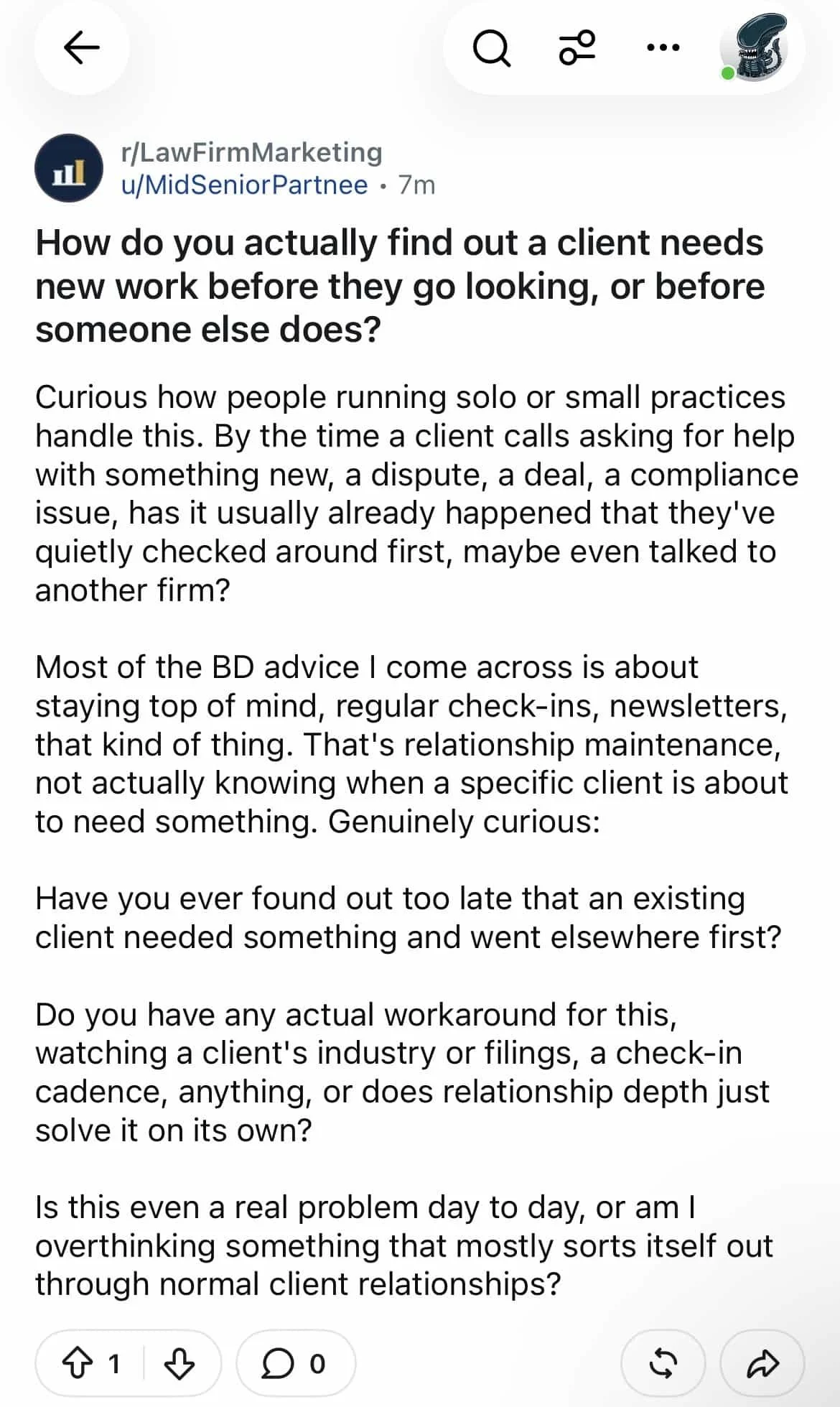
A partner at a small practice recently posted a version of it to a legal marketing forum, and the framing was unusually precise. By the time a client calls about something new, whether a dispute, a transaction, or a compliance problem, has that client usually already checked around quietly, possibly having spoken with another firm first?
The poster went further, and this is the part that makes the question worth answering. Most business development advice, he noted, concerns staying top of mind through check-ins and newsletters, which is relationship maintenance rather than actually knowing when a specific client is about to need something. He wanted to know whether anyone had a genuine workaround: monitoring a client’s industry or filings, some check-in cadence, anything. And he asked, with more self-awareness than most, whether this was a real daily problem or something that mostly resolves itself through ordinary relationships.
The answer has three parts. The premise is partly wrong. The instinct behind it is entirely right. And the solution is not detection.
Detection Does Not Scale, and Chasing It Wastes the Year
The fantasy version of this problem is an early warning system: monitoring filings, tracking industry news, watching for the signals that precede a legal need. Large firms build something like that, staff it, and pay for data subscriptions that cost more than a small practice spends on marketing entirely.
For a solo or a five-lawyer firm, that approach fails on arithmetic rather than on principle. A practice with two hundred active and former clients cannot meaningfully monitor two hundred businesses across a dozen industries. Even where a signal exists, most legal triggers generate no public artifact at all. A partnership dispute produces no filing until it produces a lawsuit. A regulatory letter arrives in an envelope. A diagnosis, a divorce, an acquisition offer, a resignation, a crash: none of these appear anywhere a practitioner could watch, and by the time any of them becomes visible, the client has already called someone.
So the honest answer to whether anyone has a real workaround is that a handful of firms monitor a handful of accounts where the value justifies it, and everyone else is describing an aspiration. The instinct underneath the question, though, is correct and worth taking seriously. Something is being lost. It simply is not being lost at the detection stage.
What Is Actually Being Lost
Research across thousands of business buyers found that roughly 81 percent already hold a preferred vendor at the moment of first contact, and that the preferred vendor wins approximately 80 percent of the time.† Applied to a law practice, that finding reframes the entire problem. The client who quietly checked around had already decided who they preferred before the checking began. The checking was confirmation.
Which means the moment that determined the outcome was not the week the problem arose. It was the eighteen months before, during which the client either did or did not form a default. A firm losing work it never heard about is not losing a detection contest. It is losing a preference contest that concluded before the trigger occurred. That is better news than it sounds, because preference is buildable and triggers are not predictable.
Be The Mayor Strategy
The strategy that solves this has a name that sounds soft and functions as infrastructure. A practitioner should aim to become the mayor of a specific place: a neighborhood, an industry, an association, a professional network, a county. Not the most famous lawyer in the city. The most obvious lawyer in a defined territory.
The mechanics are Revere’s. A person embedded in several overlapping organizations in a bounded community hears things early, not because they are monitoring anything, but because information travels through people and they are standing where it travels. The accountant mentions that a client is buying a building. The banker mentions a partnership going sideways. The insurance agent mentions a claim that is going to become something else. None of that is detection. It is proximity.
It also solves the preference problem at the same time, which is what makes it efficient rather than merely pleasant. The business owner who has seen the same attorney at the chamber breakfast for three years, judged the high school mock trial, and sponsored the youth league is not going to comparison shop when the letter arrives. That attorney is the default, and defaults win roughly four times out of five.
A national competitor with a larger budget cannot purchase a decade of presence in a specific community. This is one of the few advantages a small practice holds that money does not erase, and most firms leave it entirely unclaimed.
It Starts With a Decision, Not a Calendar
The strategy fails when it is attempted without a prior decision, which is how most attempts at it fail. Being the mayor of everywhere is being the mayor of nothing, and a practitioner who joins six organizations without choosing a territory ends up with six obligations and no position.
The decision has three components and they take an afternoon rather than a quarter. First, who the best clients actually are, which most firms can determine from their own closed matters by sorting two years of work by fee collected and examining what the top quintile shares. Second, what the practice stands for in language a non-lawyer would repeat accurately, tested by substituting a competitor name into the firm’s own description and checking whether it still reads correctly. Third, where those clients already gather, which is a list of specific associations, chambers, industry groups, and adjacent professionals rather than a category.
Without those three answers, the civic work becomes a hobby with a networking receipt. With them, every hour spent has a target.
The firms treating this as a real allocation rather than a discretionary one are measurably outgrowing the rest. Research published by the Hinge Research Institute with LexisNexis found high-growth law firms investing 16.5 percent of revenue in marketing against 5 percent for no-growth firms, a threefold gap that holds across the dataset.‡
The Real Constraint Is Hours, and They Have to Be Scheduled
The currency here is not money. A chamber membership costs less than a month of most marketing retainers. The currency is attorney hours, which are the scarcest input in any small practice and the only one that cannot be purchased.
Which means this strategy requires the same calculation any other capacity decision requires. A practitioner billing at a given rate who commits to a weekly association meeting, a monthly board seat, and a quarterly speaking engagement is spending a specific and knowable number of hours per year. That number should be written down and compared honestly against what those hours would otherwise produce.
For most small firms the comparison favors the civic work, because billable capacity is rarely the binding constraint. Matter flow is. An attorney fully booked has a different calculation than one with open capacity, and a practice that does the arithmetic will allocate correctly rather than guiltily.
What does not work is treating these commitments as flexible. An organization attended when convenient produces nothing, because familiarity accumulates through repetition and resets through absence. The commitments belong on the calendar as recurring appointments with the same status as a hearing, or they will be the first thing sacrificed to a busy week, permanently.
Volunteering deserves specific mention because it is the most efficient version of this and the least used. Board service, pro bono clinics, coaching, and organizing produce sustained contact with the same people in a context where the practitioner is demonstrably useful rather than selling. That is a different relationship than a handshake at a mixer, and it compounds faster.
Remind People You Exist
The second half of the answer is cheaper than the first and gets skipped more often. Presence in a room reaches the people in that room. A monthly email reaches everyone the practice has ever met, for essentially nothing. The list is not a marketing asset that requires building. It already exists, distributed across a phone, an email archive, and a client file system: past clients, current clients, referral partners, adjacent professionals, everyone met at every event. Consolidating that into one list is an afternoon of administrative work and it is the highest-return afternoon available to most small practices.
The cadence should be monthly rather than weekly, because a rhythm that survives a busy quarter is worth considerably more than an ambitious one abandoned in March. The mechanism deserves to be stated plainly, because it is not what most people assume. The email does not need to be opened. A recipient who sees a name in an inbox and archives it unread has still been reminded that a specific attorney exists and practices a specific kind of law. Weeks later, when a friend mentions a problem at dinner, that name surfaces. My friend does criminal defense. My friend handles injury cases. You should call her, the first consultation is free. That referral did not come from the email. It came from the fact that the name was recently in front of someone. Open rates measure engagement. This measures existence, and existence is the product.
The Content Problem, Which Is Really a Perfectionism Problem
There is a failure mode here specific to attorneys and it is worth naming directly, because it is the single most common reason the email never gets sent. Attorneys have opinions. Sit with one over a couple of beers and the opinions arrive fully formed, specific, and frequently sharper than anything published in the trade press. The same person asked to write two paragraphs for a monthly email will produce nothing for six months.
Part of that is time. Part is a professional habit of qualifying every statement until nothing remains. And part is genuine concern about advertising rules, which is legitimate and is also, demonstrably, a solved problem, since a great many lawyers publish constantly within the same constraints.
The fix is to lower the bar rather than to find more time. Nobody is asking for every opinion, a treatise, or a position that could be cited against the firm in five years. A monthly email needs to be useful for ninety seconds. A deadline changed. A common mistake observed three times this month. A plain-English explanation of something clients keep asking about. That is enough, and it is enough permanently.
The mechanical version of the fix is to stop writing. An attorney explaining something aloud for ten minutes produces a better draft than the same attorney staring at a blank document for two hours, because speaking is the mode where the expertise already lives. Record it, transcribe it, edit it down, check it for accuracy and compliance, and send it. Twenty of those constitute a content library and each one takes an afternoon.
The compliance concern deserves a real answer rather than dismissal. Results claims require context, testimonials carry specific requirements in most jurisdictions, and specialist language is restricted. Those are constraints on phrasing rather than prohibitions on publishing, and a firm that learns its own rules once ends up out-publishing every competitor too cautious to say anything at all.
Yes, Everyone Has Lost Work This Way
The poster asked whether anyone had discovered too late that an existing client needed something and went elsewhere first. Every practitioner with a few years of history has that story, usually more than one, and usually discovered by accident months later.
The useful response to those episodes is not a monitoring system. It is a question: at the moment that client had the problem, was this firm the obvious default, or merely a firm they had used once? If the answer is the second one, the loss occurred long before the trigger and the fix is not faster detection.
There is also a narrower operational answer worth having, which is that a firm should tell existing clients what else it does. A remarkable number of clients do not know their attorney handles the second thing, because nobody ever said so. A closing letter that names the other practice areas, and a monthly email that occasionally demonstrates them, resolves a meaningful share of the work that goes elsewhere.
The speed answer applies too, for the inquiries that do arrive. Secret shopper research across five hundred firms found only 40 percent answering phone calls and 33 percent responding to emails, with nearly half essentially unreachable by phone.§ A practice that answers is competing against a field where a substantial fraction does not.
What This Looks Like on a Monday
1. Sort two years of closed matters by fee collected and write down what the top quintile has in common. That defines the territory.
2. Name the territory in one sentence and test it by substituting a competitor into the firm’s own description.
3. Choose one organization where those clients actually gather and commit to it as a recurring calendar item for a full year before judging it.
4. List twenty adjacent professionals who sit near the triggers that produce this firm’s work, and establish a contact rhythm, referring out first and visibly.
5. Consolidate every contact into one list and send something useful on the same day each month.
6. Record ten minutes of explanation on the question clients ask most, edit it into a page, and publish it.
7. Track the source of every new matter at intake, so that in twelve months the practice is deciding with data rather than impressions.
None of that requires an agency, which is worth stating by one. Tocobaga works on the parts that come later, once a firm has built the position and wants the search, content, and measurement layers built around it. The order matters more than the vendor.
Revere and Dawes carried the same message the same distance on the same night. One of them had spent twenty years becoming the person whose knock meant something. That was the entire difference, and it was built long before anybody needed the warning.
| Approach | What it costs | What it produces |
|---|---|---|
| Monitoring filings and industry news | Subscriptions and attention a small firm lacks | Signals for a handful of accounts, at best |
| Check-in cadence with past clients | Modest time, easily deferred | Maintenance, not early knowledge |
| Civic and association presence | Scheduled attorney hours, low dollars | Proximity to information and default status |
| Referral partner rhythm | Twenty relationships, quarterly contact | Early word from people near the triggers |
| Monthly email to everyone met | An afternoon to build, an hour a month | Existence in mind when someone asks |
| Answer-first content library | An afternoon per piece | Credibility and search presence that compounds |
How can a small law firm know when a client needs new legal work?
Reliable detection does not scale for a small practice, because most legal triggers produce no public artifact and monitoring hundreds of clients is not feasible. What works instead is occupying a position where information travels: sustained presence in the associations and professional networks where those clients gather, and relationships with the accountants, bankers, and agents who sit near the triggers.
Do clients quietly check around before calling their existing lawyer?
Frequently, and the checking is usually confirmation rather than evaluation. Research across thousands of business buyers found roughly 81 percent already holding a preferred vendor at first contact, with that vendor winning about 80 percent of the time. The outcome is generally decided before the trigger occurs.
Is monitoring a client industry or filings worth the effort?
For a small number of high-value accounts it can be, though most legal triggers never surface publicly before the client has already acted. For a practice with dozens or hundreds of clients, the hours are better spent building the network position that surfaces information through people.
What is the be the mayor strategy?
Becoming the most obvious practitioner in a defined territory rather than the most famous in a city. It requires choosing a bounded community, sustaining presence in several overlapping organizations within it, and doing so long enough that the practitioner becomes the default rather than a candidate.
Does a monthly email newsletter actually generate work for a law firm?
It generates recall, which generates referrals. The mechanism does not depend on the email being opened. A recipient who sees a name and archives the message has still been reminded that a specific attorney practices a specific kind of law, which is what surfaces weeks later when someone describes a problem at dinner.
Why do attorneys struggle to write content when they have strong opinions?
Time, a professional habit of qualifying statements until nothing remains, and genuine concern about advertising rules. The practical fix is lowering the bar to ninety seconds of usefulness and recording an explanation aloud rather than drafting, since speaking is where the expertise already lives.
How much time should a small firm commit to networking and civic presence?
Enough to be counted on, scheduled as recurring calendar appointments rather than attended when convenient, since familiarity accumulates through repetition and resets through absence. The hours should be written down and compared honestly against what they would otherwise produce, a comparison that usually favors the civic work when matter flow rather than billable capacity is the binding constraint.
Sources
- *
- On the differing outcomes of the Revere and Dawes rides of April 18 and 19, 1775, and Revere's membership in multiple overlapping Boston organizations, see David Hackett Fischer, Paul Revere's Ride (Oxford University Press, 1994).
- †
- 6sense. Buyer Experience Report, surveying more than 4,000 business buyers: approximately 81 percent hold a preferred vendor at the moment of first contact, and that vendor wins roughly 80 percent of the time. https://6sense.com/
- ‡
- Hinge Research Institute and LexisNexis. High Growth Study, law firm findings: high-growth firms invest 16.5 percent of revenue in marketing against 5 percent for no-growth firms. https://www.lexisnexis.com/
- §
- Clio. Legal Trends Report, 2024 edition. Secret shopper study across 500 United States firms conducted by an independent research agency: 40 percent answered phone calls, 33 percent responded to emails, and 48 percent were essentially unreachable by phone. https://www.clio.com/resources/legal-trends/
- ‖
- American Bar Association. Model Rules of Professional Conduct 7.1 through 7.3, governing communications concerning a lawyer's services. https://www.americanbar.org/groups/professional_responsibility/publications/model_rules_of_professional_conduct/