

41 Types of SEO in 2026 and How They Earn Their Keep


Law Smith
Founder & President, Tocobaga
Law Smith is the Founder and President of Tocobaga, a Tampa-based ROI-focused marketing agency and SMB advisory. He has strategically advised 1,000+ small and medium businesses, executed 600+ integrated marketing campaigns, and written 30+ business plans across industries ranging from professional services to e-commerce to B2B technology. Tocobaga is a Google Partner and Squarespace Gold Partner headquartered in Ybor City.
More visibility is useful. More profitable business is the assignment.
Nigel Tufnel has an advantage that nobody in the room can explain, including Nigel. His amplifier goes to eleven.
In the 1984 film This Is Spinal Tap, the fictional guitarist proudly demonstrates equipment with a number beyond the usual ten. Asked why an ordinary amplifier could not simply be made louder, he returns to the number on the knob. Eleven settles the matter. The measurement has become the achievement.1
Somewhere, an owner is looking at a marketing report with the same problem. Impressions increased. Rankings improved. Another dashboard acquired another encouraging shade of green. Meanwhile, the number of customers worth having has barely moved.
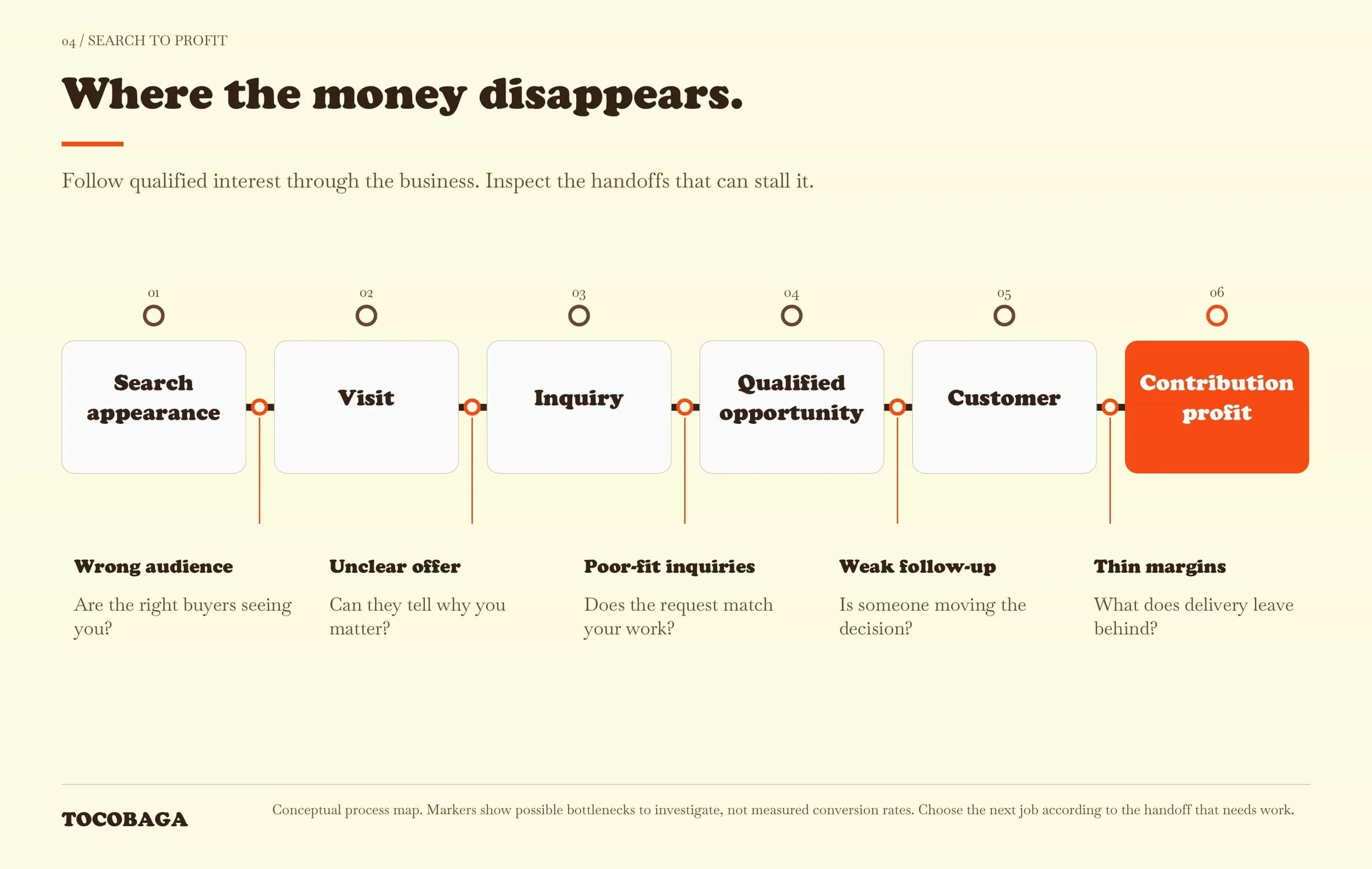
That is the problem this guide is built to solve. Search engine optimization, or SEO, should help a business become discoverable when the right buyer has a relevant problem, then help that interest turn into profitable work. The 41 types below explain the different jobs involved, how to choose among them, and where the money can get lost.
At Tocobaga, the ROI-focused lead generation marketing agency and SMB advisory behind SolvingHow, we treat search as part of a business system. The website, the offer, the inquiry, the follow-up, and the economics belong in the same conversation. A ranking report that stops before that conversation is unfinished.
Quick answer
The types of SEO that matter in 2026 improve technical access, useful content, credibility, visibility across relevant search surfaces, and conversion into profitable business. Choose them around your actual bottleneck. Measure qualified opportunities and incremental contribution profit alongside traffic. AI visibility adds another discovery layer, but it does not replace those fundamentals.
In this guide
What changed in 2026
How to calculate SEO ROI
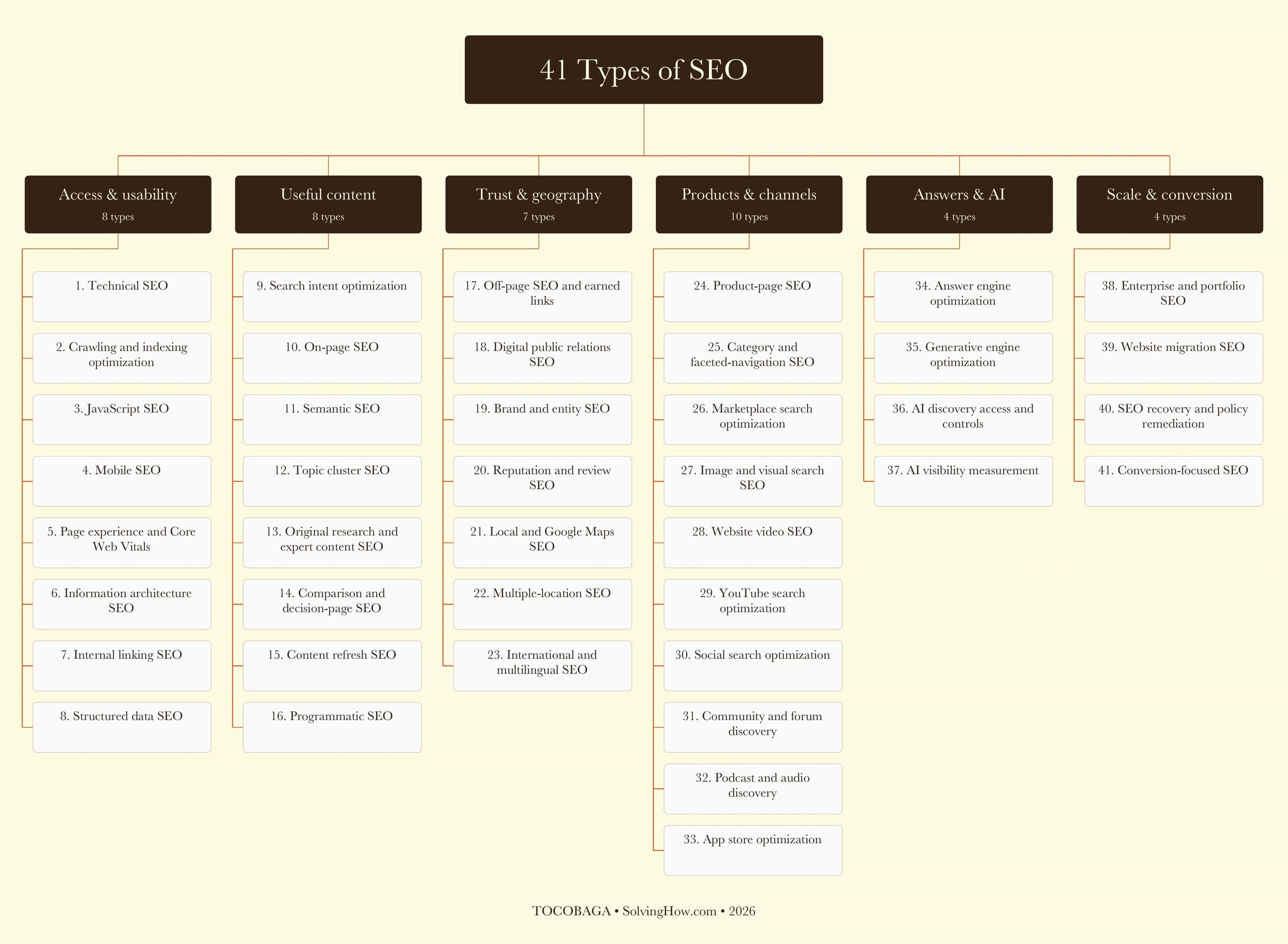
The 41 types of SEO across six groups
What to fund first and a practical 90-day plan
Questions to ask before hiring help
Frequently asked questions and sources
What changed in SEO for 2026?
Search now requires a clearer distinction between being visible, being visited, and being chosen. AI answers can expose a business to buyers while changing whether those buyers need to click through immediately.
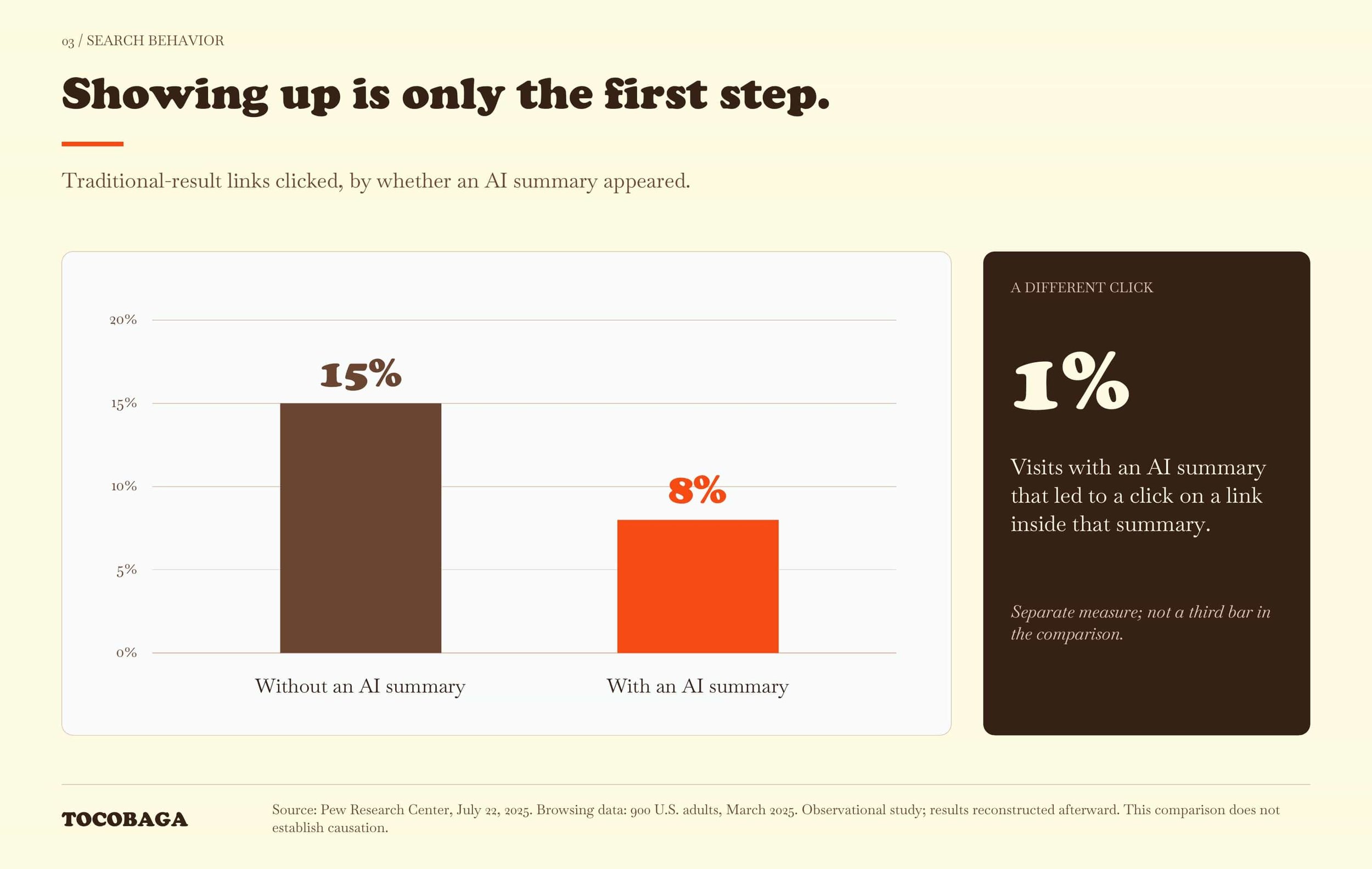
Pew Research Center examined browsing data from 900 U.S. adults in March 2025. People clicked a traditional search result in 8 percent of visits where an AI summary appeared, compared with 15 percent when one did not. Links inside the summaries received clicks in just 1 percent of visits with a summary. Researchers reconstructed the search results afterward, and the study was observational. It does not establish that AI caused an identical traffic decline for every website. It does establish that a search appearance and a website visit are different events.2
For an owner, the practical question becomes sharper. Which pages still earn a visit because the visitor needs something the summary cannot finish? A specification. A credible comparison. A realistic implementation plan. Evidence that this particular business can handle a difficult assignment. Definitions are easy to summarize. A decision with consequences requires more.
There are also concrete changes to the tools. Google's Search Console documentation says its generative AI performance report rolled out worldwide on August 31, 2026. It reports impressions in AI Overviews and AI Mode, with views by page, country, device, and date. Those impressions show exposure. They do not establish a sale.3
Google also documents a Search generative AI inclusion control, rolled out worldwide on the same date. The setting governs whether a site's links and content can appear in covered AI search features. It is separate from model-training controls, and Google says it is not used as a ranking or inclusion signal for other parts of Search.4
These distinctions matter because old advice ages unevenly. A 2025 assertion that AI exposure cannot be separated at all is no longer an adequate description of the reporting available in October 2026. A vendor promising to turn that exposure report directly into an ROI number is skipping several steps.
The useful response is to update the measurement, inspect the actual buyer journey, and retain the work that helps people make decisions. Changing every service name to include “AI” is considerably easier. So is changing the amplifier label.
How do you calculate SEO ROI without flattering yourself?
Calculate SEO ROI from incremental contribution profit after the costs of the SEO program. Revenue, pipeline, and traffic can help explain performance, but each describes something different.
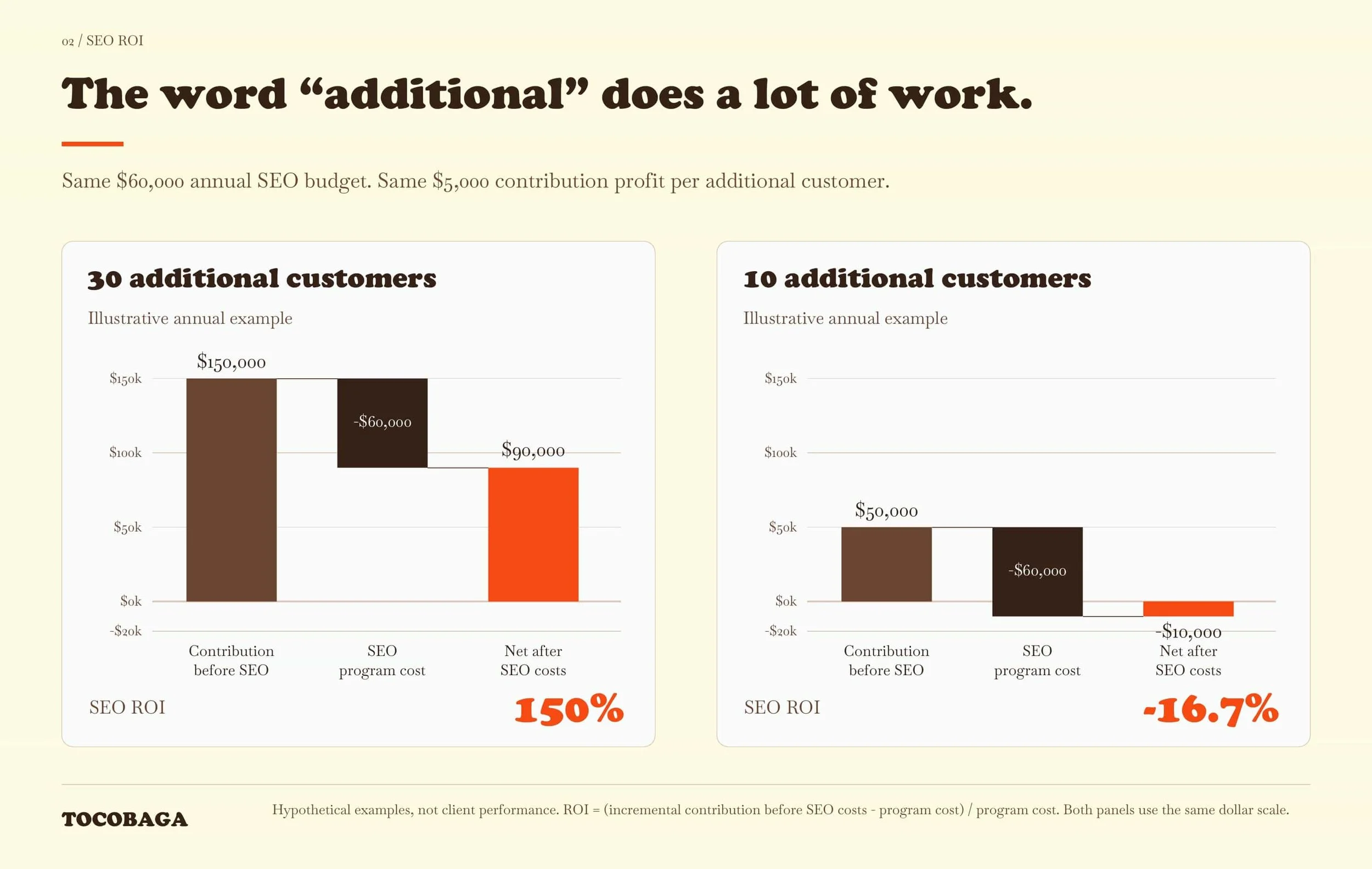
A practical formula is: SEO ROI equals incremental contribution profit before SEO program costs, minus those program costs, divided by those program costs. Multiply by 100 to express the result as a percentage.
Contribution profit means the revenue left after the variable costs of delivering the additional business. Your finance team should define the cost treatment consistently. Include agency fees, internal labor, development, content production, tools, and other program expenses without counting the same expense twice.
Consider a hypothetical annual program costing $60,000. Suppose it produces 30 additional customers with $5,000 in contribution profit each over the agreed measurement period. That is $150,000 before the program cost, $90,000 after it, and a 150 percent return. If only 10 of those customers were additional, the return would be negative 16.7 percent. The difference is not a rounding error. It is the word “additional.”
Attribution assigns credit. Incrementality asks what would have happened without the work. A customer who already intended to buy may search your name before purchasing. Recording that visit is useful. Claiming the entire purchase as newly created SEO demand is ambitious accounting.
This problem has a serious research history. Economists Tom Blake, Chris Nosko, and Steven Tadelis used large field experiments at eBay and found that conventional measurement substantially overstated paid-search returns in that setting. The study concerned advertising, not organic SEO. Its relevant lesson is methodological: observed purchases and purchases caused by marketing are not automatically equal.5
For a smaller business, perfect causal measurement may be impractical. Better measurement is still available. Separate branded from nonbranded demand, while remembering that even a nonbranded search can follow earlier exposure to your business. Compare groups of leads that have had time to buy, rather than this month's leads with this month's closed sales. Record the original landing page, the customer's stated discovery source, qualified opportunity status, and eventual contribution. Where volume permits, use comparable page groups or regions to test changes and watch for other explanations.
Make the uncertainty visible. An estimate with assumptions is more useful than a precise number built on missing information. If the sales cycle lasts nine months, a six-week report should discuss leading indicators and pipeline development. It should not pretend that forecast revenue has arrived in the bank.
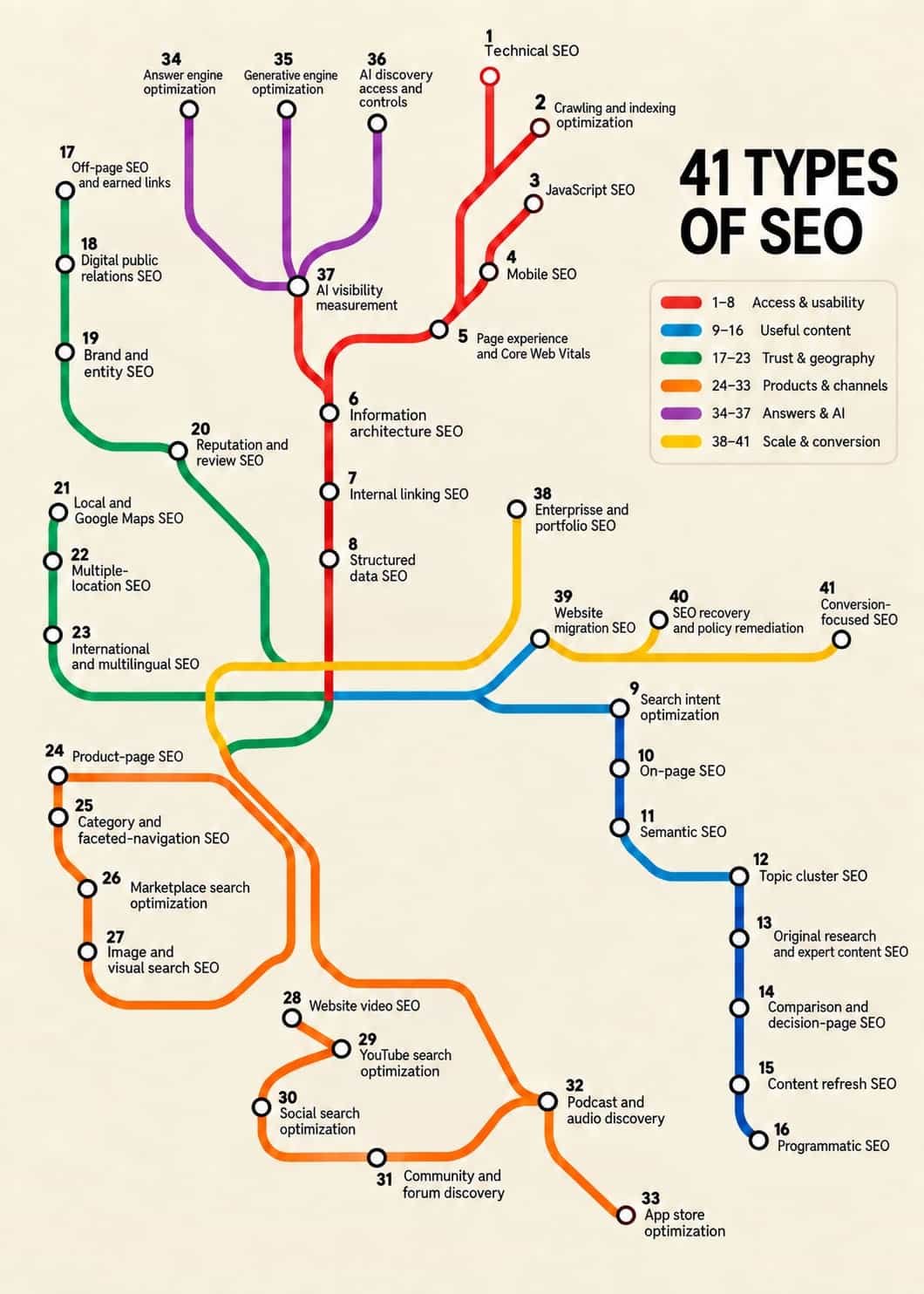
Are there really 41 different types of SEO?
There is no official list of exactly 41 types. SEO labels describe overlapping technical jobs, content approaches, business situations, and discovery channels. This is a practical map for allocating work, not a certification syllabus.
A single product page may need technical, on-page, image, international, and conversion work. Those are five perspectives on one asset. They should not become five unrelated strategies or five opportunities to bill for changing the same heading.
Some categories below, including marketplace and social discovery, extend beyond conventional website SEO. They belong in the discussion because buyers search there. Each should earn its place through evidence of relevant demand.
Which technical types of SEO make the website usable and discoverable?
Technical work deserves priority when valuable pages cannot be found, interpreted, or used reliably. It removes obstacles between a buyer's question and a page that can answer it.
1. Technical SEO
Technical SEO is the maintenance of the website's search infrastructure. It covers issues such as broken pages, incorrect redirects, server failures, and conflicting instructions. Google's minimum technical requirements include allowing access, serving a successful response, and providing indexable content.6
Start with commercially important pages. An inaccessible quote-request page is more urgent than a cosmetic issue on an old announcement. An audit should translate every substantial finding into an affected business function, an owner, and a next step.
Measure the availability and search performance of the pages you repaired, then follow the resulting inquiries. The number of warnings cleared is a production measure. Its commercial value depends on what those warnings were preventing.
2. Crawling and indexing optimization
Crawling is discovery and retrieval. Indexing is the decision to store and make sense of a page for search. A page can be accessible without being indexed, and submitting a sitemap does not guarantee inclusion.7
The practical work is choosing which pages deserve to exist in search, giving them clear paths, and checking what the search engine actually sees. A sprawling collection of near-identical filter URLs can distract from the handful of category pages buyers need.
Judge success by coverage of valuable pages, not by maximizing the raw number indexed. Ten thousand unnecessary pages are not an asset simply because a dashboard has counted them.
3. JavaScript SEO
JavaScript SEO makes sure interactive websites expose their important content and links reliably. Google can render JavaScript, but blocked resources, rendering failures, or content that appears only after certain interactions can create problems.8
For example, a visitor may see a detailed product specification while a crawler receives an incomplete shell. Test the rendered page, especially after platform changes, rather than assuming that what loads on a developer's laptop represents every visitor and crawler.
The commercial measure is whether important content becomes reliably discoverable and usable. Diagnose this work when the site depends on complex applications. Do not purchase it as a fashionable add-on for a straightforward site that already works.
4. Mobile SEO
Mobile SEO makes the small-screen version capable of doing the same serious work as the desktop version. Google uses mobile content for indexing, so hiding important information or structured data on mobile can have consequences beyond appearance.9
A buyer reviewing a supplier between meetings still needs specifications, evidence, and a usable contact path. Tiny comparison tables, intrusive overlays, and forms that reset after an error create unnecessary resistance.
Review conversion quality by device and inspect actual user tasks. If mobile visitors research and desktop visitors purchase, do not assume every mobile session without a sale failed. The question is whether the mobile experience helps the decision move forward.
5. Page experience and Core Web Vitals
Page experience work improves loading, responsiveness, and visual stability. Google's Core Web Vitals assess those experiences through Largest Contentful Paint, Interaction to Next Paint, and Cumulative Layout Shift.10 Good scores do not guarantee high rankings.11
The business reason is easy to understand. A buyer should not have to wait for an oversized background video before reading whether you can solve the problem. Nor should the inquiry button move while someone tries to select it.
Evaluate real-user performance on valuable pages alongside completed actions. Fix painful delays first. Chasing a perfect laboratory score while the offer remains incomprehensible is a very technical way to avoid the real problem.
6. Information architecture SEO
Information architecture organizes the site around how people understand the business. Services, use cases, products, supporting evidence, and next steps should have a comprehensible relationship.
Imagine an operations leader looking for a replacement component. The site should connect the relevant category, compatibility information, technical documents, availability, and a quote path. A menu organized entirely around internal departments makes the customer learn the org chart before buying.
Measure discovery of priority pages and the journeys that follow. Useful architecture also reduces maintenance confusion because the business knows where new information belongs. That operational benefit can matter long before anyone celebrates a ranking change.
7. Internal linking SEO
Internal linking connects relevant pages inside the same website. Search engines use crawlable links to discover pages, and descriptive link text helps readers understand the destination.12
A guide about a costly implementation problem can point to the service that addresses it, an example of the work, and a page explaining the process. Each connection should answer the reader's likely next question.
The measure is movement toward useful information and qualified action. A script that inserts dozens of repetitive links can create clutter without helping either. Useful internal links reduce the effort required to find the next relevant answer.
8. Structured data SEO
Structured data labels information in a machine-readable format. Supported markup can make a page eligible for certain enhanced search displays, but eligibility does not guarantee that a feature will appear. The markup must accurately represent the visible content.13
This is particularly useful where facts have stable fields, such as products, organizations, and videos. It is less useful as an excuse to attach every schema type someone can find to every page.
Measure valid implementation, actual search appearance, and downstream activity. Schema is an identification label on the equipment. It is not a second amplifier hidden inside the box.
Which content types of SEO attract people who might buy?
Content earns its budget when it addresses a real decision with enough specificity to be useful. More articles are justified only when there are more worthwhile questions to answer.
9. Search intent optimization
Search intent work identifies what the person is trying to accomplish. A definition query, a troubleshooting query, and a vendor comparison may contain similar vocabulary while requiring very different pages.
Begin with sales conversations and the current search results. A prospect asking about implementation cost probably needs the factors that change cost, what is included, and when the investment makes sense. Sending that person to a cheerful history of the industry is a failure of listening.
Measure qualified engagement by intent group. Low-volume queries close to a valuable decision can deserve more attention than broad terms that bring a crowd with no reason to hire you.
10. On-page SEO
On-page SEO makes the purpose and substance of an individual page clear. Titles, headings, opening explanations, media, and supporting detail should all serve the same reader need. Google can generate title links from multiple signals, so a supplied title is not an instruction the search engine must obey.14
Write a page that answers the actual question before touring the company's virtues. If buyers need tolerances, delivery conditions, or who will perform the work, say so clearly.
Evaluate relevant impressions, clicks, and qualified actions together. A more specific title may attract fewer clicks and better prospects. That can be progress, provided the numbers confirm it.
11. Semantic SEO
Semantic SEO uses clear language and meaningful relationships to explain a subject. In practical terms, it helps a reader understand what something is, what it does, and how it differs from nearby alternatives.
A page about recurring software billing should distinguish subscriptions, seats, usage, renewals, and implementation fees when those concepts affect the purchase. Repeating one target phrase cannot do that work.
Measure whether the page attracts and satisfies the range of relevant questions it genuinely covers. Do not mistake semantic depth for adding loosely related jargon. If a term does not help the buyer make a better decision, it may not belong on the page.
12. Topic cluster SEO
Topic clusters organize a substantial subject into a central guide and useful supporting pages. The goal is to cover distinct needs and connect them logically, not to hit a quota of satellite articles.
A business selling a complex engagement might need pages on cost, implementation, alternatives, common failures, and evidence. Those pages support each other because the buyer needs the answers together.
Measure the cluster's contribution to qualified opportunities and identify which pages assist the decision. Do not count the same customer as a separate acquisition for every page visited. A buying committee reading five articles still represents one potential engagement.
13. Original research and expert content SEO
Original research gives a page something useful that cannot be obtained merely by rearranging existing search results. It can include a carefully described test, a transparent dataset, a technical explanation, or an expert's documented method.
Google's people-first guidance asks whether content adds original information, reporting, research, or analysis, and whether authorship and experience are clear.15
Start with questions your team can answer from evidence it actually owns. Explain the sample, the period, and the limitations. A chart without a method is decoration with numerical confidence.
Measure citations, relevant referral interest, sales use, and qualified inquiries. Never turn a hypothetical example into a claimed client result to make the story feel more impressive.
14. Comparison and decision-page SEO
Comparison SEO helps buyers choose among credible alternatives. It includes questions about fit, tradeoffs, implementation demands, and situations where your approach is unnecessary.
A strong comparison identifies who benefits from each option. It explains switching costs and what a decision-maker must verify. A page declaring that your product wins every category may be technically indexed, but it reads like a beauty contest judged by the contestant's mother.
Measure qualified conversations and whether prospects arrive better informed. Useful comparisons can reduce wasted sales calls by disqualifying poor fits early. Losing an unsuitable lead can improve the economics of the entire funnel.
15. Content refresh SEO
Content refresh work updates pages whose facts, usefulness, or relationship to current demand have changed. It can mean correcting obsolete instructions, adding missing evidence, or consolidating pages that compete for the same purpose.
Start with pages that still receive relevant impressions and serve a commercially important need. Compare the content with current buyer questions. A new date on an old explanation does not answer a new question.
Measure recovery or improvement by page group, allowing for seasonality and other changes. Keep a change log so the business can distinguish an actual revision from a ceremonial timestamp. This article's 2026 reporting updates are an example of a substantive reason to refresh.
16. Programmatic SEO
Programmatic SEO creates pages from structured information at scale. It can be valuable when each page offers a distinct, accurate answer, such as a compatibility result built from reliable product data.
The danger is confusing the ability to generate pages with a reason for anyone to read them. Google's spam policies address scaled content created primarily to manipulate rankings without adding value, regardless of whether people, automation, or both produce it.16
Pilot a small set. Check data quality, uniqueness of purpose, indexing, and qualified demand before expanding. The relevant measure is profitable coverage of real needs. Ten thousand pages that nobody needed remain ten thousand pages to maintain.
Which authority and market types of SEO build confidence?
Authority work should make the business easier to verify and more credible in the places buyers already trust. Recognition has value when it reflects something real.
17. Off-page SEO and earned links
Off-page SEO includes signals and references beyond the business's own site. Earned links can introduce qualified audiences and connect useful resources across the web. Google's link-spam rules prohibit practices designed to manipulate rankings, including certain paid-link arrangements.17
Publish something worth referencing, participate in legitimate industry work, and make useful relationships. Ask whether a placement would matter if it conveyed no ranking benefit at all.
Measure relevant referral traffic, qualified opportunities, and the quality of the relationship. A pile of unrelated links sold by the hundred is inventory in somebody else's business model. It need not become part of yours.
18. Digital public relations SEO
Digital PR earns attention through news, expertise, or evidence that another publication's audience can use. Its job is to give an independent editor a legitimate reason to care.
A well-supported explanation of a recurring operational failure can be more valuable than announcing that your company remains pleased to announce things. Expert availability, clear data, and a timely contribution make the pitch useful.
Useful coverage introduces a relevant audience, sends interested visitors, or gives prospects independent context about the business. Track those outcomes. A mention without a link can still introduce buyers, but do not assign it an invented ranking value. Public recognition should support the business's credibility, not decorate a report with logos unrelated to its customers.
19. Brand and entity SEO
Brand and entity work makes it clear which organization, people, products, and locations the site represents. Consistent names, accurate profiles, intelligible service descriptions, and real author information help visitors verify who is speaking.
This matters after an acquisition, a rebrand, or years of inconsistent naming. A buyer should not have to investigate whether three similar company names belong to the same supplier.
Can someone who searches your name identify the correct business and find the right person? Review those journeys, correct inaccurate listings, and record recurring confusion at intake. A founder biography helps explain responsibility and expertise. It does not create a magical authority score, and listing credentials nobody holds is not optimization. It is fiction with a headshot.
20. Reputation and review SEO
Reputation work makes credible customer experience discoverable. Accurate profiles, genuine reviews, and useful responses can help someone decide whether contacting a business is sensible.
The commercial importance of reviews has academic support, with limits. Harvard Business School researcher Michael Luca found that a one-star Yelp increase corresponded to a 5 to 9 percent revenue increase for independent restaurants in the Seattle-area setting studied. The effect did not extend to chains. That historical result is evidence that reputation can matter, not a forecast for every business.18
Track review quality, recurring service issues, inquiry confidence, and actual conversion. Use criticism to improve operations. Marketing cannot indefinitely outwrite a customer experience that keeps producing the same complaint.
21. Local and Google Maps SEO
Local SEO connects a business with relevant geographic demand. Google describes local ranking mainly through relevance, distance, and prominence. Complete, accurate business information and appropriate reviews help establish the business's real presence.19
Clarify what you do, where you genuinely operate, and how customers contact you. The objective is not merely a map appearance. It is a useful inquiry from someone you can serve profitably.
Measure answered calls, qualified bookings, direction requests where relevant, and completed business. A call count that includes wrong numbers and unanswered rings is a weak substitute for customers. A pin on a map is an introduction, not a transaction.
22. Multiple-location SEO
Multiple-location SEO manages the accuracy and usefulness of information across real operating locations. Each location should explain its actual services, people, hours, and practical differences.
The work becomes more valuable when branches vary in capacity or specialty. A customer seeking a specific service should arrive at the branch that can provide it. Copying a city name into an otherwise identical page does little to resolve that problem.
Compare qualified demand and conversion by location, including capacity constraints. A branch already turning away good work may need different support from one with unused capacity. Marketing allocation should reflect the business, rather than treating every map marker as an identical investment opportunity.
23. International and multilingual SEO
International SEO helps people reach the right language and regional version of a site. Google's guidance covers separate locale URLs and signals such as hreflang, which identifies language or regional alternatives.20
Translation alone cannot resolve differences in units, delivery terms, product availability, buying conventions, or customer support. A page can be grammatically correct and commercially wrong.
Measure qualified demand, completed orders, and serviceability by market. Start where the business can fulfill the promise. Expanding search visibility into a territory that operations cannot support is not international growth. It is a more geographically diverse collection of disappointed prospects.
Which product and platform types of SEO deserve attention?
Choose platforms according to evidence about where buyers search and evaluate options. Presence everywhere is expensive, and presence without useful participation is easy to ignore.
24. Product-page SEO
Product SEO makes a specific item easy to find, assess, and purchase. The page should answer the questions that determine fit, including specifications, compatibility, availability, price context, and returns where relevant.
Google supports product structured data and Merchant Center information to help communicate product details across eligible experiences. Accuracy across the page and supplied data matters.21
Measure contribution margin from organic product visits, including returns and cancellations. A popular item with heavy discounting may produce less value than a quieter product with strong margin. Optimize toward the economics you actually want, rather than whichever product makes the revenue chart look busiest.
25. Category and faceted-navigation SEO
Category SEO helps buyers compare a useful set of products. Faceted navigation lets them narrow that set by meaningful attributes, such as size, compatibility, material, or use.
Those filters can also generate huge numbers of URL combinations. Google's guidance explains how uncontrolled faceted URLs can consume crawling resources, and how sites can decide which versions need search visibility.22
The business decision comes first: which combinations represent a useful destination with actual demand? Measure discovery and profitable conversion for those pages. Do not expose every filter combination merely because the website can produce one. A warehouse inventory and a customer-facing catalog have different jobs.
26. Marketplace search optimization
Marketplace optimization improves discovery within a marketplace's own search and recommendation environment. It is related to SEO, but its rules, commercial terms, and measurement belong to that platform.
Start with accurate item information, useful images, availability, and the questions buyers need answered. Consult the marketplace's current documentation before relying on a generic checklist of supposed ranking factors.
The financial test is profit after fees, fulfillment, returns, promotions, and support. A channel can generate impressive gross sales while leaving little behind. Include the risk of dependence on a platform you do not control. The practical question is whether access to that audience justifies the cost and restrictions.
27. Image and visual search SEO
Image SEO makes useful visual information discoverable and understandable. Google recommends clear, relevant images, descriptive context, and appropriate alternative text.23
For a technical buyer, an image may answer a question faster than prose: connector shape, installation clearance, surface finish, or what a completed project actually looks like. Original photographs can provide evidence a generic stock image cannot.
Measure relevant image-driven visits and their subsequent behavior. Keep descriptive accessibility text truthful. A photograph of a machine is not improved by stuffing six marketing phrases into its description. The image should help a person recognize something, not merely occupy a rectangular opening in the layout.
28. Website video SEO
Website video SEO helps search engines discover and understand videos hosted or embedded on your pages. Google provides guidance on watch pages, accessible video files, thumbnails, and video information.24
Choose video when seeing the process matters. A demonstration of setup, a walkthrough of a difficult task, or an expert explaining a tradeoff can answer a question that text handles poorly. Provide an accurate transcript when it helps visitors use the information.
Check whether viewers take a useful next step and whether sales conversations reveal that the explanation helped. A two-minute demonstration that resolves a purchasing objection can be more useful than an expensive brand film admired mostly by its producers.
29. YouTube search optimization
YouTube optimization serves people searching and discovering video inside YouTube. The platform describes relevance, engagement, and quality among its search considerations.25
Give each video a clear audience and a useful promise. Titles and thumbnails should accurately represent the content. A demonstration should demonstrate something before the viewer has to sit through a corporate origin story.
Measure qualified audience retention, relevant referrals, and inquiries that mention the video. Search behavior and suggested-video discovery differ, so a broad entertainment audience should not be confused with purchase intent. Winning attention from the wrong viewers can become a costly form of applause.
30. Social search optimization
Social search work makes the business's expertise discoverable within relevant social platforms. Profiles, clear subject language, and useful posts can support that goal. This is adjacent to website SEO, with platform-specific behavior and economics.
Choose a platform because buyers use it to investigate problems, people, or providers. A detailed explanation from a responsible expert may matter more than a large publishing schedule assembled to satisfy a calendar.
Measure qualified conversations and assisted opportunities, using customer-reported discovery where tracking is incomplete. Likes are feedback about a post. They are not a standardized unit of commercial intent, however convenient it would be if accounting accepted them.
31. Community and forum discovery
Community discovery comes from being useful in discussions where relevant people already ask questions. A thoughtful answer can help both the original participant and later readers who discover the thread through search.
Read the community rules, disclose commercial relationships when relevant, and contribute an answer that stands on its own. Someone asking how to solve a problem does not owe you a website visit before receiving any useful information.
Judge the effort by the quality of resulting conversations and referrals. Do not automate fake endorsements or plant questions for your own answer. If the strategy requires pretending to be a satisfied stranger, it is worth asking what would happen if the customer found out.
32. Podcast and audio discovery
Podcast discovery makes an episode's subject clear to listeners and to the platforms that organize audio. Descriptive episode titles, useful summaries, and a companion page can help people decide whether listening is worth their time.
Choose topics with a specific unresolved question. A candid discussion about a failed implementation can teach more than an hour of agreeable generalities. A transcript or edited companion article can give readers a practical way to revisit the explanation.
Measure relevant subscribers, referrals, and conversations influenced. Downloads alone cannot tell you whether the audience matches the business. Recording frequently is a production habit. Reaching the right listeners is the commercial task.
33. App store optimization
App store optimization improves how a real application is presented and discovered in an app store. Apple identifies elements including app metadata and customer behavior in its search guidance.26
The listing should communicate a specific use, show an honest product experience, and set expectations accurately. If an app's value requires a long explanation that the listing never provides, discovery will not fix the resulting disappointment.
Follow installations through activation, retention, and profitable customer relationships. Downloads that never become meaningful use are another amplifier number. This category belongs in your plan only when a native application is a relevant part of the business.
How do AEO and GEO fit into SEO in 2026?
Answer engine optimization and generative engine optimization describe work aimed at answers and AI-mediated discovery. They overlap heavily with established SEO, and their business value must be tested through more than a citation count.
34. Answer engine optimization
Answer engine optimization, or AEO, makes an answer easy for a person to find and understand. A clear question, a direct response, and appropriate detail are useful editorial practices regardless of which interface displays the result.
There is no guaranteed sentence formula that forces selection. Google says special AI files are unnecessary for its search features, and it does not require content to be broken into tiny chunks or rewritten into a special AI style.27
Measure relevant exposure, visits where they occur, and business outcomes. Use concise answers because they help readers. Do not reduce a complicated decision to an inaccurate slogan merely because somebody calls it extractable.
35. Generative engine optimization
Generative engine optimization, or GEO, aims to make a source useful and discoverable in generated answers. Clear evidence, specific explanations, and accurate sourcing are sensible starting points. Universal uplift promises are not.
The foundational GEO paper, whose authors included Princeton researchers, reported visibility improvements of up to 40 percent in its research setup. That measured representation inside generated responses, not a 40 percent increase in leads or profit.28
A 2026 paper by Sunghwan Kim and colleagues, accepted at KDD, evaluated retrieval, reranking, and generation together. It found that existing optimization approaches could harm earlier discovery stages in that environment. The lesson for buyers is to test the full process, rather than assuming one rewrite improves every stage.29
36. AI discovery access and controls
AI discovery work includes checking whether relevant systems can access and use the content the business wants discovered. Search visibility, live retrieval, and training permissions are different questions.
For Google's covered search features, review the current Search Console inclusion setting and the site's technical eligibility. Do not confuse a decision about model training with a complete decision about appearing in search answers.30
For other services, consult their current crawler and publisher documentation individually. Avoid blanket changes based on a screenshot from an unrelated platform. Measure eligible coverage and actual referral or citation evidence. A business should understand which doors it has opened, which it has closed, and why.
37. AI visibility measurement
AI visibility measurement tracks whether, where, and in what context a business appears in generated answers. Google's dedicated report measures impressions; Bing's AI Performance tools report citation-related visibility across supported experiences.31
Keep a stable set of real buyer questions for repeated observation. Record the date, system, question, cited page, and whether the answer represented the business accurately. Results may vary, so a single screenshot is weak evidence of a trend.
Then compare visibility with qualified demand. A citation can introduce a brand without producing an immediately attributable visit. That possibility deserves investigation, not an automatic revenue allocation. Measurement becomes useful when it changes a decision about what to improve next.
Which types of SEO protect and convert the value you build?
Operational SEO protects accumulated visibility and makes incoming demand useful. This work becomes especially important when a business changes platforms, consolidates websites, or struggles to handle the inquiries it already receives.
38. Enterprise and portfolio SEO
Enterprise SEO coordinates search work across large sites, teams, or groups of related businesses. Its defining challenge is often ownership and execution, not a mysterious advanced ranking technique.
Set shared standards for measurement, access, technical releases, and content responsibility. Let local teams retain the knowledge that makes their pages accurate. A central template should help useful information travel, rather than sanding every business down to the same generic paragraph.
Measure results at both the operating-unit and group level. Watch for duplicated work, conflicting pages, and leads routed to the wrong team. The return may come partly from better execution and reduced waste, not just more traffic.
39. Website migration SEO
Migration SEO protects discovery when URLs, platforms, domains, or site structures change. Google's guidance emphasizes mapping old URLs to relevant new destinations, implementing redirects, and monitoring the move.32
Inventory valuable pages before anyone celebrates the new design. Preserve essential content, analytics, ownership access, and conversion paths. Sending every retired page to the homepage is rarely an adequate substitute for a considered mapping.
Measure retained visibility, functioning redirects, and qualified demand after launch. Include a contingency plan and a named person responsible for monitoring. A beautiful relaunch that quietly removes the pages producing inquiries is an expensive way to modernize the lobby while sealing the front door.
40. SEO recovery and policy remediation
Recovery work diagnoses a loss of visibility before prescribing a solution. Technical failures, lost demand, content changes, migration mistakes, ranking changes, and manual actions require different responses.
Start with the timeline and evidence. Google provides separate guidance for investigating traffic drops and understanding manual actions. A decline is not automatically a penalty.33
Some agencies sell shortcuts under labels such as gray-hat or parasite SEO. The label does not reduce the risk. Google's site reputation abuse policy addresses third-party content placed to exploit a host site's established ranking signals; legitimate third-party content is not automatically a violation.34
Measure resolution of the actual cause and recovery of valuable demand. Avoid sweeping deletion or speculative disavowal work unsupported by the diagnosis.
41. Conversion-focused SEO
Conversion-focused SEO connects the searcher's intent with an appropriate next action. Strictly speaking, conversion optimization extends beyond ranking. It belongs here because traffic becomes commercially useful only when the business can do something with it.
Match the action to the decision. A complex engagement may need an initial conversation with enough context to qualify the inquiry. A straightforward product may need accurate availability and a reliable checkout. Both need a functioning process behind the button.
Measure qualified opportunities, completed purchases, response time, and contribution. Review the lost inquiries too. If the form fails or nobody responds, the SEO program may already be delivering an opportunity the operation is throwing away.
Which types of SEO should you fund first?
Fund the work that removes the most consequential constraint on profitable demand. That usually requires an assessment of the website, the buying journey, and the operation receiving the leads.
If valuable pages are inaccessible, begin with technical access. If the site works but explains the offer poorly, improve intent alignment and decision pages. If buyers need proof, develop credible evidence. If inquiries arrive but go nowhere, repair qualification and response before buying a larger audience.
Consider two hypothetical businesses. One sells an expensive engagement, receives modest traffic, and closes well-qualified inquiries at a healthy contribution margin. Another sells a high volume of low-margin items with substantial returns. The first may benefit most from a handful of exceptional decision pages and expert explanations. The second may need product accuracy, category navigation, availability, and contribution-level reporting.
A third business might have recently combined several operating companies. Its immediate opportunity may lie in migrations, consistent identities, sensible routing, and access to accounts the acquired teams previously managed separately. Publishing another general article would not resolve those problems.
The categories are therefore a menu of possible work. Choosing intelligently requires saying no. You do not need an app-store initiative because the list contains app-store optimization. You need one if an app helps the right customer and the economics justify the effort.
Use three questions to rank the backlog: What business problem does this fix? What evidence suggests it is constraining results? What outcome would justify continuing? A proposal that cannot answer those questions has probably organized the work around available services rather than your needs.
What should the first 90 days look like?
The first 90 days should establish reliable measurement, fix the most consequential obstacles, and test a small set of commercially important improvements. They should not be treated as a universal deadline for mature ROI.
During the first month, connect the evidence. Confirm access to search reporting, analytics, the website, and the system that records inquiries and sales. Define a qualified lead. Identify priority offers, contribution assumptions, capacity constraints, and the pages already influencing demand. Test the contact paths personally.
Build a baseline by page group and intent. Separate branded discovery from broader demand where the available data allows it. Record important seasonality, promotions, platform changes, and business events. A baseline without context can make an ordinary seasonal increase look like a breakthrough.
During the second month, make a deliberately limited set of changes. Repair the access problems that affect valuable pages. Improve the pages most closely connected to buying decisions. Add the evidence prospects keep requesting. Assign an owner and completion date to each change so the plan becomes work rather than meeting material.
During the third month, inspect what happened. Did the intended pages become visible? Did relevant visits change? Were the inquiries useful? Did the business respond? Which questions still prevented a decision? Use that information to decide what to expand, revise, or stop.
Longer-term returns depend on the starting point, competition, resources, demand, and sales cycle. Google's SEO Starter Guide explains that some changes can take effect within hours while others may take several months, and generally recommends allowing a few weeks to assess their impact. That concerns search effects, not a fixed timetable for profitability.35
Set earlier checkpoints for work you can verify and later checkpoints for outcomes that need time. If a program produces no meaningful learning, no completed improvements, and no credible explanation for the delay, “SEO takes time” has become a hiding place.
What should an SEO partner explain before you hire them?
An SEO partner should explain the commercial hypothesis, the work required, the evidence they will collect, and the circumstances that would change the plan. Their vocabulary is less important than whether the explanation survives a plain-English question.
Ask how they distinguish a form submission from a qualified opportunity. Ask which costs enter their ROI calculation. Ask how they will handle a long sales cycle, existing brand demand, and customers who encounter several channels before buying.
Ask who owns the website, content, accounts, and data. Ask what happens if the relationship ends. Ask which work depends on your team's participation and how much time that participation requires. An agency cannot interview experts, verify operational claims, or improve follow-up by pretending your organization is absent from the process.
Finally, ask what they would choose not to do. A credible plan has boundaries. An explanation that recommends all 41 categories with equal enthusiasm has failed the allocation test before the first invoice.
At Tocobaga, this is the useful starting point: connect search work to a specific business constraint and a measure the owner can understand. Our SEO, lead generation, and advisory resources address those connected decisions, with related reading collected in the notes.36
If you want a second set of eyes, bring Tocobaga one important offer, the page selling it, and whatever you know about the resulting inquiries. Start with the question of where profitable demand is getting lost. That is enough for a useful first conversation.
Nigel's amplifier has eleven printed on the dial. Your business needs to know whether the room can hear the music, whether the right people bought tickets, and whether the show paid for itself. The number on the knob can wait.
What are the main types of SEO?
Technical, on-page, content, and off-page SEO describe much of the foundational work. Local, international, product, video, marketplace, and AI discovery approaches address particular buying situations or search surfaces. These categories overlap. Choose the combination that helps relevant buyers find, understand, and act on your offer.
Which types of SEO should a business prioritize first?
Start with the problem most likely to prevent profitable demand. Repair inaccessible pages before expanding content. Improve unclear offers before seeking more visitors. Add credible evidence where buyers need reassurance. If inquiries already arrive but fail to become useful conversations, fix qualification and follow-up before increasing traffic.
Is SEO still worth it in 2026 or is AI killing organic traffic?
SEO is worth funding when the work helps your business attract additional profitable demand. AI answers change how some people discover and evaluate businesses, so traffic alone gives an incomplete picture. Assess qualified opportunities, sales, contribution profit, and relevant visibility together. Neither rising impressions nor falling clicks settles the investment question by itself.
How do you calculate SEO ROI?
Subtract SEO program costs from the incremental contribution profit generated before those program costs, then divide by program costs and multiply by 100. Include relevant labor, agency, content, development, and tool expenses without double counting. Separate credit assigned by an attribution model from evidence that the business gained additional sales.
How long does it take to see SEO results?
Timing depends on the starting point, work required, competition, demand, and sales cycle. Indexing, relevant visits, qualified inquiries, and realized profit are different milestones. Use early checkpoints to verify completed improvements and useful learning. Evaluate mature financial outcomes over a period that gives the resulting customers time to buy.
What is the difference between AEO, GEO, and SEO?
SEO broadly helps relevant pages become discoverable in search. Answer engine optimization, or AEO, emphasizes clear, accessible answers. Generative engine optimization, or GEO, emphasizes discovery and representation in generated responses. The work overlaps substantially. Treat AI exposure and citations as evidence to investigate, then connect them to qualified demand wherever measurement permits.
Why can organic traffic rise while qualified leads fall?
More visits can come from people whose needs do not match the offer. Unclear pages, missing evidence, difficult forms, poor qualification, or delayed follow-up can also interrupt the journey. Compare landing pages and search intent with accepted opportunities and sales outcomes. Diagnose where useful interest disappears before assuming the answer is more traffic.
Does every business need all 41 types of SEO?
No. The 41 categories are an organizing framework, not a universal purchasing list. Several may apply to the same page, while others may be irrelevant to your business. Fund work that addresses a demonstrated constraint, has a responsible owner, and can be evaluated against an outcome that matters commercially.
Sources and notes
- Roger Ebert, “This Is Spinal Tap,” RogerEbert.com, January 21, 2001, accessed October 2, 2026, https://www.rogerebert.com/reviews/great-movie-this-is-spinal-tap-1984 .
- Athena Chapekis and Anna Lieb, “Google Users Are Less Likely to Click on Links When an AI Summary Appears in the Results,” Pew Research Center, July 22, 2025, accessed October 2, 2026, https://www.pewresearch.org/short-reads/2025/07/22/google-users-are-less-likely-to-click-on-links-when-an-ai-summary-appears-in-the-results/ .
- Google, “Generative AI Performance Report (Search),” accessed October 2, 2026, https://support.google.com/webmasters/answer/16984139 .
- Google, “Search Generative AI Control,” accessed October 2, 2026, https://support.google.com/webmasters/answer/16908024 .
- Tom Blake, Chris Nosko, and Steven Tadelis, “Consumer Heterogeneity and Paid Search Effectiveness: A Large Scale Field Experiment,” NBER Working Paper 20171, May 2014, accessed October 2, 2026, https://doi.org/10.3386/w20171 .
- Google Search Central, “Google Search Technical Requirements,” last modified December 18, 2025, accessed October 2, 2026, https://developers.google.com/search/docs/essentials/technical .
- Google Search Central, “Learn about Sitemaps,” last modified December 10, 2025, accessed October 2, 2026, https://developers.google.com/search/docs/crawling-indexing/sitemaps/overview .
- Google Search Central, “Understand the JavaScript SEO Basics,” last modified March 4, 2026, accessed October 2, 2026, https://developers.google.com/search/docs/crawling-indexing/javascript/javascript-seo-basics .
- Google Search Central, “Mobile Site and Mobile-First Indexing Best Practices,” last modified December 10, 2025, accessed October 2, 2026, https://developers.google.com/search/docs/crawling-indexing/mobile/mobile-sites-mobile-first-indexing .
- Google Search Central, “Understanding Core Web Vitals and Google Search Results,” last modified December 10, 2025, accessed October 2, 2026, https://developers.google.com/search/docs/appearance/core-web-vitals .
- Google Search Central, “Understanding Page Experience in Google Search Results,” last modified September 22, 2026, accessed October 2, 2026, https://developers.google.com/search/docs/appearance/page-experience .
- Google Search Central, “Link Best Practices for Google,” last modified December 10, 2025, accessed October 2, 2026, https://developers.google.com/search/docs/crawling-indexing/links-crawlable .
- Google Search Central, “General Structured Data Guidelines,” last modified July 10, 2026, accessed October 2, 2026, https://developers.google.com/search/docs/appearance/structured-data/sd-policies .
- Google Search Central, “Influencing Your Title Links in Search Results,” last modified December 10, 2025, accessed October 2, 2026, https://developers.google.com/search/docs/appearance/title-link .
- Google Search Central, “Creating Helpful, Reliable, People-First Content,” last modified October 1, 2026, accessed October 2, 2026, https://developers.google.com/search/docs/fundamentals/creating-helpful-content .
- Google Search Central, “Spam Policies for Google Web Search,” last modified August 28, 2026, accessed October 2, 2026, https://developers.google.com/search/docs/essentials/spam-policies#scaled-content .
- Google Search Central, “Spam Policies, Link Spam,” https://developers.google.com/search/docs/essentials/spam-policies#link-spam .
- Michael Luca, “Reviews, Reputation, and Revenue: The Case of Yelp.com,” Harvard Business School Working Paper 12-016, 2011, revised 2016, accessed October 2, 2026, https://www.hbs.edu/ris/Publication%20Files/12-016_a7e4a5a2-03f9-490d-b093-8f951238dba2.pdf .
- Google, “Tips to Improve Your Local Ranking on Google,” accessed October 2, 2026, https://support.google.com/business/answer/7091 .
- Google Search Central, “Tell Google about Localized Versions of Your Page,” last modified September 21, 2026, accessed October 2, 2026, https://developers.google.com/search/docs/specialty/international/localized-versions .
- Google Search Central, “Share Your Product Data with Google,” last modified December 10, 2025, accessed October 2, 2026, https://developers.google.com/search/docs/specialty/ecommerce/share-your-product-data-with-google .
- Google Crawling Infrastructure, “Managing Crawling of Faceted Navigation URLs,” last modified December 18, 2025, accessed October 2, 2026, https://developers.google.com/crawling/docs/faceted-navigation .
- Google Search Central, “Google Image SEO Best Practices,” last modified March 2, 2026, accessed October 2, 2026, https://developers.google.com/search/docs/appearance/google-images .
- Google Search Central, “Video SEO Best Practices,” last modified December 18, 2025, accessed October 2, 2026, https://developers.google.com/search/docs/appearance/video .
- YouTube, “How YouTube Search Works,” accessed October 2, 2026, https://support.google.com/youtube/answer/16090438 .
- Apple, “App Store Search,” accessed October 2, 2026, https://developer.apple.com/app-store/search/ .
- Google Search Central, “Optimizing Your Website for Generative AI Features on Google Search,” last modified July 10, 2026, accessed October 2, 2026, https://developers.google.com/search/docs/fundamentals/ai-optimization-guide .
- Pranjal Aggarwal, Vishvak Murahari, Tanmay Rajpurohit, Ashwin Kalyan, Karthik Narasimhan, and Ameet Deshpande, “GEO: Generative Engine Optimization,” in Proceedings of the 30th ACM SIGKDD Conference on Knowledge Discovery and Data Mining, 2024, accessed October 2, 2026, https://doi.org/10.1145/3637528.3671900 .
- Sunghwan Kim, Wooseok Jeong, Serin Kim, Sangam Lee, and Dongha Lee, “SAGEO Arena: A Realistic Environment for Evaluating Search-Augmented Generative Engine Optimization,” accepted at KDD 2026, arXiv, revised August 7, 2026, accessed October 2, 2026, https://arxiv.org/abs/2602.12187v2 .
- Google, “Search Generative AI Control,” https://support.google.com/webmasters/answer/16908024 .
- Microsoft Bing, “AI Performance in Bing Webmaster Tools,” accessed October 2, 2026, https://www.bing.com/webmasters/help/ai-performance-9f8e7d6c .
- Google Search Central, “How to Move a Site,” last modified August 20, 2026, accessed October 2, 2026, https://developers.google.com/search/docs/crawling-indexing/site-move-with-url-changes .
- Google Search Central, “Debugging Drops in Google Search Traffic,” last modified December 10, 2025, accessed October 2, 2026, https://developers.google.com/search/docs/monitor-debug/debugging-search-traffic-drops .
- Google Search Central, “Spam Policies, Site Reputation Policy,” https://developers.google.com/search/docs/essentials/spam-policies#site-reputation-abuse .
- Google Search Central, “Search Engine Optimization (SEO) Starter Guide,” last modified December 10, 2025, accessed October 2, 2026, https://developers.google.com/search/docs/fundamentals/seo-starter-guide .
- Tocobaga, related reading, accessed October 2, 2026: “SEO and AI Search Optimization” SEO and AI Search Optimization ; “Your Buyers Now Ask a Chatbot Before They Ask You. G2 Just Measured It.” Your Buyers Now Ask a Chatbot Before They Ask You. G2 Just Measured It. ; “How to Choose an ROI-Driven Lead Generation Agency in Tampa (Without Accidentally Funding a Vibes Department)” How to Choose an ROI-Driven Lead Generation Agency in Tampa (Without Accidentally Funding a Vibes Department) . These links describe Tocobaga resources; they are not independent research evidence.