


Law Smith
Founder & President, Tocobaga
Law Smith is the Founder and President of Tocobaga, a Tampa-based ROI-focused marketing agency and SMB advisory. He has strategically advised 1,000+ small and medium businesses, executed 600+ integrated marketing campaigns, and written 30+ business plans across industries ranging from professional services to e-commerce to B2B technology. Tocobaga is a Google Partner and Squarespace Gold Partner headquartered in Ybor City.
In 1946, a plastics inventor named Earl Tupper put a bowl on American department store shelves for 39 cents, about $5.50 in today's money. He called it the Wonder Bowl. The wonder was the lid. Tupper had patented an airtight seal that had to be "burped" before it would work, and shoppers who had stored leftovers in glass jars and ceramic crocks their whole lives had no idea what to do with it. Plastic itself was still a strange thing to bring into a kitchen. The Wonder Bowl did not sell in department stores, and neither did anything else Tupper made.* The Smithsonian's archivists later summed it up in one dry line: "early attempts at department store sales had been unsuccessful."†
Brownie Mae Humphrey was born in rural Georgia in 1913. She married Robert W. Wise in December 1936, moved to Detroit, had a son named Jerry in 1938 and was divorced by 1942.‡ A single mother needed income, and she found it in other people's living rooms, selling Stanley Home Products at home party demonstrations. When she came across Tupper's new polyethylene containers, she and a handful of other Stanley managers reached the same conclusion: this product belonged at a party, because a buyer had to be shown how to burp the seal.‡
By 1950 she was living in Florida with her mother, Rose, and her son, running her own Tupperware business called Patio Parties and recruiting women to sell for it. Home sellers were already moving product the stores could not. By 1949, one woman had sold more than 56 bowls in a single week.* Earl Tupper noticed. In April 1951 he created Tupperware Home Parties, took the line off store shelves and named Wise vice president, which the Smithsonian calls "an unprecedented position for a woman."§,‖,* Late that year, Tupper bought about 1,000 acres in Kissimmee, Florida, for a headquarters, and the Smithsonian's finding aid on her papers credits the location to her.§,†
Then the numbers arrived. By 1954, Tupperware was selling $25 million a year through a network of about 20,000 dealers, distributors and managers.* Roughly 600 top sellers came to Kissimmee that year for the first Homecoming Jubilee.§ In April 1954, Business Week put Brownie Wise on its cover, the first woman ever to appear there.‖,* Four years later it was over. In January 1958, Tupper and his board forced her out. She had no contract and no stock, and she left with about a year's salary, roughly $30,000.*,‡ Within months, Tupper sold the company to Justin Dart of Rexall Drug for $16 million.§
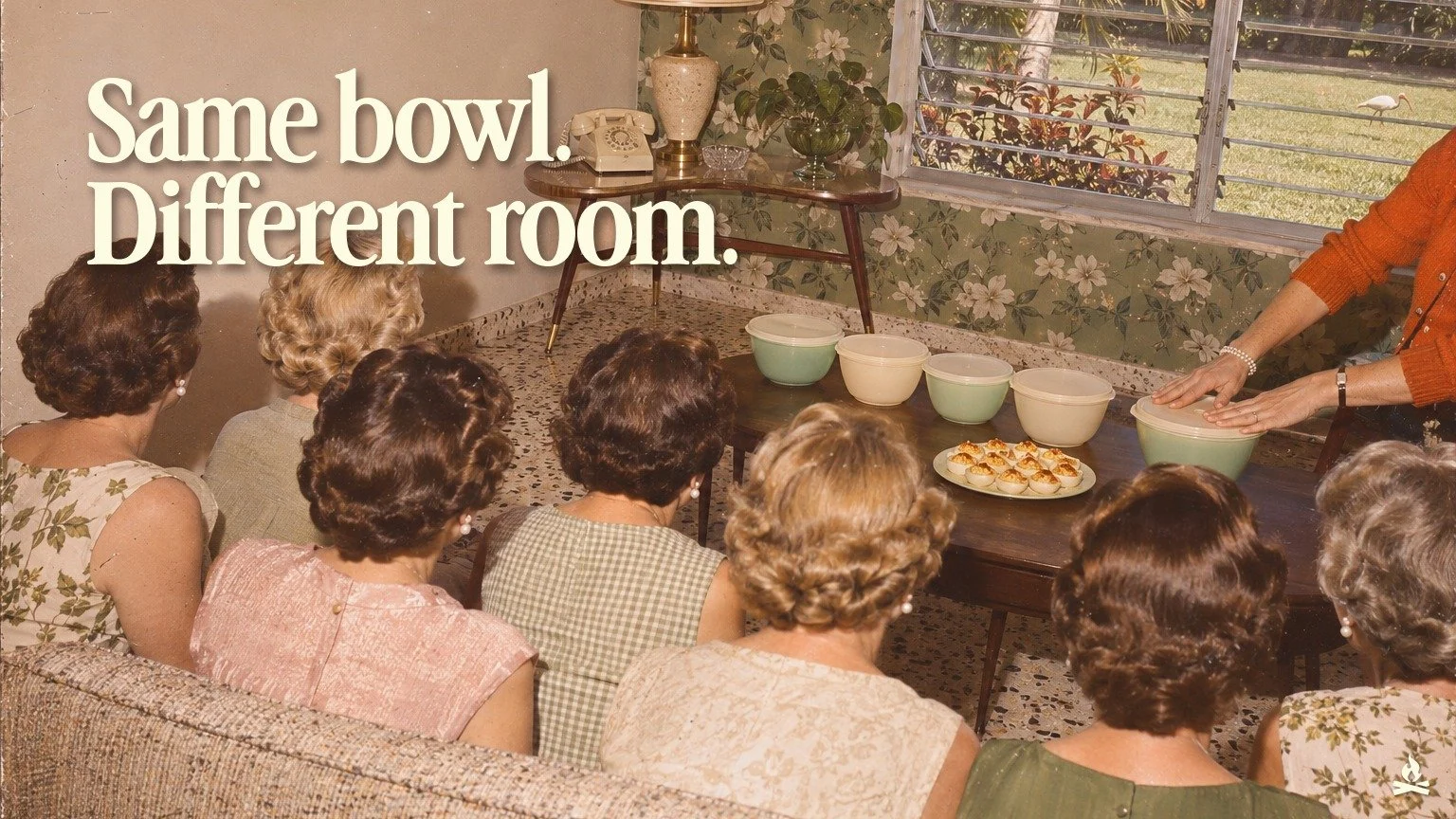
Set Earl Tupper's temper aside for a moment and look at the bowl. Same bowl. Same seal. Same 39 cents. On a department store shelf it was a riddle with nobody standing next to it to explain the trick. In a living room, with a neighbor hosting, a dealer demonstrating and a dozen friends watching the lid burp, it became a $25 million business. The product never changed. The room did.
That is the entire social media question for a small business in 2026. Facebook, Instagram, TikTok, YouTube, LinkedIn and Nextdoor are not one channel wearing six logos. Each one is a different living room, with different people on the couch, a different host and a different reason to be there. A business that sells beautifully in one room can sit on the shelf in another for years, posting faithfully to an audience that will never buy.
Tocobaga hears some version of that problem every week. From an office on East 7th Avenue in Ybor City, Tampa, Law Smith and the Tocobaga team behind SolvingHow.com have advised more than 1,000 small and mid-sized businesses and run more than 600 integrated campaigns, and the question owners type into forums barely changes: which platform, Instagram, TikTok, Facebook, YouTube or LinkedIn, is actually bringing paying customers to a local or small business right now, not just followers? Tocobaga's earlier field guide, Hour 1,491, lays out a posting strategy that ends the content marathon. What follows is the scoreboard: who is actually sitting in each room, which kinds of businesses each room pays, what a booked customer costs there, and how to prove which room the money came from.
What is the best social media platform for small business in 2026?
The best social media platform for small business in 2026 is the one where its buyers already spend time and already buy, so the answer depends on the business type. Facebook still pays best for most local service businesses, Instagram for visual businesses like restaurants and med spas, LinkedIn for B2B firms, and TikTok and YouTube for businesses whose owner will get on camera.
Start with who is in the building. Pew Research Center's 2026 survey of U.S. adults found that 84 percent use YouTube, 70 percent use Facebook, 51 percent use Instagram, 37 percent use TikTok, 33 percent use WhatsApp, 31 percent use LinkedIn, 26 percent use Snapchat, 25 percent use Reddit, and 18 percent each use X and Nextdoor.¶ Frequency matters as much as reach. About half of American adults are on Facebook every day, about half are on YouTube every day, and 24 percent are on TikTok daily.**
Turn those percentages into a town. In a market with 100,000 adults, roughly 84,000 are on YouTube, 70,000 are on Facebook, 51,000 are on Instagram, 37,000 are on TikTok, 31,000 are on LinkedIn and 18,000 are on Nextdoor. Every one of those rooms is big enough to fill a small business's calendar. None of them is a customer list.
Age is where the rooms split apart. Facebook reaches 78 percent of adults 30 to 49 and 71 percent of adults 50 to 64. Instagram reaches 79 percent of adults under 30 but only 41 percent of adults 50 to 64. TikTok reaches 65 percent of adults under 30 and 31 percent of adults 50 to 64. YouTube and Facebook are the only platforms that hold a majority of every age group, and YouTube still reaches 65 percent of adults 65 and older.¶ The homeowner signing a $14,000 roof replacement is far more likely to be 52 than 22, and the platform choice should follow her, not the trend pieces.
Reach tells an owner which rooms could hold a buyer. It says nothing about which room pays. Marketers have opinions on that. In HubSpot's 2026 State of Marketing research, 47.4 percent of business-to-consumer marketers ranked Instagram a top performer for return on investment, and 35 percent said the same of TikTok.†† But marketers rank platforms. Owners have to count customers. The only number that settles the argument is cost per booked customer by platform, and most small businesses cannot produce it, which is exactly why the argument never ends.
| Business type | Primary platform | Secondary platform | Number that proves it |
|---|---|---|---|
| Home services (HVAC, roofing, plumbing) | Facebook groups, Marketplace and Nextdoor | YouTube repair and replacement explainers | Booked jobs by self-reported source |
| Restaurants and cafes | TikTok with the owner or chef on camera | Orders or covers by offer code | |
| Med spas, salons, boutique fitness | Facebook ads for buyers 35 to 64 | Cost per booked first visit and rebook rate | |
| E-commerce brands | TikTok and Instagram, founder-led | YouTube reviews and demos | Revenue by UTM and code, not views |
| Law firms and professional services | YouTube answers to common client questions | LinkedIn for referral sources | Signed clients by intake source |
| B2B SaaS, consultancies, manufacturers | LinkedIn, posted by people, not pages | YouTube product demos | Pipeline and closed revenue per platform |
| Logistics, 3PL and supply chain | YouTube facility walkthroughs | Cost per signed account | |
| PE-backed multi-location platforms | Facebook and Nextdoor by location | LinkedIn for add-on targets and hiring | Cost per booked customer by location |
Is Facebook still worth it for local business?
Facebook is still worth it for most local businesses, because it holds the 30-to-64-year-old homeowners, parents and decision-makers who hire local companies, and they open it every day. Its real power for a local business is not the business page. It is the neighborhood groups and Marketplace, where neighbors recommend companies to each other.
The audience numbers are not close. Seventy percent of U.S. adults use Facebook, including 78 percent of adults 30 to 49.¶ Among adults 30 to 49, 58 percent use it daily.** Meta reported 3.64 billion daily active people across its family of apps in September 2026.‡‡ In the 2025 Sprout Social Index, a survey of more than 4,000 consumers who follow brands on social media, Facebook led every platform for direct purchases, chosen by 39 percent of respondents.§§ Facebook is also where customers talk back. BrightLocal's 2026 consumer survey found Facebook was the second most popular place to write a review, used by 34 percent of consumers in the past year.‖‖
Picture how it actually produces jobs. A woman in a Brandon neighborhood group posts that her air conditioner died in August and asks who to call. Within an hour, 14 neighbors have tagged companies, and one name shows up nine times. That business did not buy those nine tags. It earned them on earlier jobs, and the group delivered them to a buyer with her wallet already open. That is a Brownie Wise home party with the furniture removed: a hostess, a room full of people who trust her, and a product somebody in the room has already watched work.
Marketplace works the same way for a different kind of business. Used equipment dealers, furniture makers, pressure washers and lawn crews post the work and the price where locals are already shopping, and the conversation moves straight into a message thread that ends with an address.
Paid Facebook ads add scale, and the costs are knowable. LocaliQ's 2026 Facebook advertising benchmarks put the average lead campaign at a $27.39 cost per lead with an 8.54 percent conversion rate, and home and home improvement businesses at $42.95 per lead.¶¶ Put that against a PE-backed HVAC platform in its second add-on, spending $5,000 a month on Facebook lead ads in one market. At $42.95, that is about 116 leads. If the call center reaches and books 25 percent of them, that is 29 in-home estimates. If the comfort advisors close 35 percent, that is 10 system replacements, and at $9,000 apiece, $90,000 in revenue on $5,000 in ads. Those are assumptions, not promises. The point is that every link in that chain can be measured, and the chain breaks most often at the second link, when a lead form sits untouched for six hours while the buyer calls the next company.
Is Nextdoor worth it for a local business?
Nextdoor is worth it for home services, contractors, cleaners, pet care and neighborhood restaurants, and close to worthless for B2B firms and online-only brands. Its audience is small, local and tilted toward older, higher-income households, which is exactly why it pays a plumber and does nothing for a software company.
Eighteen percent of U.S. adults use Nextdoor, according to Pew's 2026 data. The mix is what matters. Twenty-one percent of adults 30 to 49 use it, along with 19 percent of adults 50 to 64 and 18 percent of adults 65 and older, but only 10 percent of adults under 30. It reaches 23 percent of college graduates and 23 percent of households earning $100,000 or more, against 9 percent of households earning under $30,000.¶ That profile looks a lot like the people who own a roof, a lawn, a pool pump and a water heater, and who are old enough to have opinions about all four.
The company is growing steadily rather than explosively. Nextdoor reported a record 24.5 million platform weekly active users in the third quarter of 2026, up 14 percent from a year earlier, on revenue of about $79 million, up 14 percent, and it counts more than 110 million verified neighbors.***
Run the math on a pressure washing company in a suburb of 40,000 adults. If 18 percent of them use Nextdoor, that is a 7,200-person room. If one recommendation thread a month turns into three quotes and two jobs at $350 each, that is $8,400 a year from a free business page and a reputation for showing up on time. Nobody will build a company on that number. Plenty of owners would happily take it for an hour of effort a month.
For a local business, Nextdoor is a reputation channel first and an ad channel second. The posts that produce jobs are the recommendation threads, where a neighbor asks who people trust for gutter cleaning and a dozen replies name names. The owner's job is to claim the business page, make it easy for happy customers to recommend it, and reply to threads like a neighbor rather than a billboard. Nextdoor is the closest thing in 2026 to Brownie Wise's original model: a sale that happens because someone the buyer knows vouched for the seller, in a room the seller does not control.
Is Instagram worth it for restaurants, salons and med spas?
Instagram is worth it for any business whose work photographs well and whose buyers are mostly under 50: restaurants, salons, med spas, boutique gyms, florists, custom builders and landscaping companies with dramatic before-and-afters. It is the platform marketers most often rank first for return on investment, and it is the one where the feed itself does the demonstrating.
Instagram reaches 51 percent of U.S. adults, including 79 percent of adults under 30 and 64 percent of adults 30 to 49.¶ In HubSpot's 2026 research, 47.4 percent of B2C marketers ranked it a top performer, the highest of any platform.†† It also works as a search engine for a certain kind of decision. In July 2022, Google's Prabhakar Raghavan said that in Google's own studies, almost 40 percent of young people looking for a place for lunch did not go to Google Maps or Search. They went to TikTok or Instagram.†††
Picture that in Ybor City on a Friday night. A couple deciding among three Cuban restaurants does not read three menus. They scroll three grids. The restaurant whose last nine posts show a pressed sandwich, a line out the door and a bartender mid-pour gets the table. The one whose last post was a holiday hours graphic from December gets skipped, and never learns it was considered.
Instagram is Brownie Wise's demonstration table. The lid had to be burped in front of the buyer before the buyer believed it. A med spa's before-and-after, a stylist's color correction and a builder's framing-to-finish Reel do the same work. The weakness is that Instagram demonstrations are easy to admire and easy to scroll past, so a med spa or salon has to connect every Reel to a booking link with a tracking tag on it. Without that, the grid is a scrapbook.

Is TikTok worth it for a local business?
TikTok is worth it for a local business when the owner, or one natural on-camera employee, will show up in videos every week, and for e-commerce brands that can sell inside the app. Without a recognizable face and a reason to watch, TikTok produces views that never turn into phone calls.
The audience has grown fast. Thirty-seven percent of U.S. adults use TikTok, up from 21 percent in 2021, and it reaches 65 percent of adults under 30, 45 percent of adults 30 to 49, 31 percent of adults 50 to 64 and 11 percent of adults 65 and older.¶,‡‡‡ Sixty-two percent of adult TikTok users say product reviews or recommendations are a reason they use it.‡‡‡ Small businesses have piled in. In an Adobe survey of 200 U.S. small business owners fielded in early 2026, 58 percent had used TikTok for business promotion, they put an average of 16 percent of their marketing budgets into TikTok content, and 38 percent named converting TikTok engagement into sales as their biggest challenge.§§§
Read that last number twice. More than a third of owners on TikTok say the hard part is the only part that matters. Run it through a business with a $60,000 annual marketing budget: 16 percent is $9,600 a year riding on a platform where owners' own top complaint is that views do not become customers.
There is a reason the owners who win on TikTok are usually the ones on camera. Pew found that the most active 25 percent of adult TikTok users produced 98 percent of publicly accessible videos in its 2023 study.‡‡‡ TikTok is a room built around people who post constantly and talk directly into the lens, and a polished, faceless brand account is a stranger at that party. A Shopify brand doing $4 million a year whose founder films the warehouse, the packaging mistakes and the customer emails will usually beat a competitor with ten times the production budget and no face.
Brownie Wise's dealers did not hand out brochures. They burped the lid in front of the room. On TikTok, the owner on camera is the dealer. The faceless brand account is the Wonder Bowl on the department store shelf, technically available and practically invisible.
Do people really use TikTok and Instagram as search engines?
Yes, a large share of consumers now search inside social apps, especially younger adults. In Adobe's early-2026 survey of 807 U.S. consumers, 49 percent said they use TikTok as a search engine, and a senior Google executive said in 2022 that almost 40 percent of young people looking for a lunch spot go to TikTok or Instagram instead of Google Maps or Search.§§§,†††
Social video has also become a news and information source for millions of adults. Twenty percent of all U.S. adults regularly get news on TikTok, up from 3 percent in 2020, and among adults 18 to 29 the figure is 39 percent.‡‡‡,‖‖‖ Consumers in Adobe's survey preferred video tutorials, at 61 percent, and product reviews, at 45 percent, when they searched there.§§§
Social search changes how a post should be built. A video titled "Saturday vibes" is invisible to search. A video in which a Tampa pool builder says "how much does a pool cost in Tampa" out loud, puts the same words on screen and in the caption, and then answers with a real price range is a search result. Captions, on-screen text and spoken words are now metadata. The business name and the city belong in the profile name, not just the handle, and the most common customer questions belong in the first three seconds of the videos that answer them.
The search shift does not stop at social apps. Local buyers are also asking AI tools. BrightLocal's 2026 Local Consumer Review Survey found 45 percent of consumers now use ChatGPT and other AI tools for local recommendations, up from 6 percent a year earlier, and it flagged Instagram, TikTok and YouTube as video platforms gaining traction for local recommendations.‖‖ A social post that answers a real question does double duty: it reaches people searching inside the app, and it becomes raw material for the machines answering questions outside it.
Is YouTube worth it for a small business?
YouTube is worth it for small businesses that sell considered purchases: anything expensive, technical, regulated or nerve-wracking enough that the buyer researches before calling. Roofers, pool builders, HVAC companies, estate planning firms, cosmetic practices, industrial equipment makers and software companies get the most from it, because a good video keeps answering questions for years.
YouTube is the largest room in the building. Eighty-four percent of U.S. adults use it, including 91 percent of adults 30 to 49, 85 percent of adults 50 to 64 and 65 percent of adults 65 and older.¶ About half of U.S. adults use it daily.** It also has a second job no other social platform does as well. When Pew studied real Google searches in 2025, it found that Wikipedia, YouTube and Reddit were the most frequently cited sources in Google's AI summaries, together accounting for 15 percent of the sources listed.¶¶¶ Tocobaga's guide to getting cited by AI engines, Phone a Friend, covers the mechanics. The short version: a YouTube answer is a citation candidate in a way that a 24-hour Instagram Story never will be.
Here is what that looks like for a two-partner estate planning firm in Clearwater. The partners film 12 videos, each answering one question they hear in every consultation: what happens without a will in Florida, whether a living trust avoids probate, what a power of attorney actually allows. Each video runs six to ten minutes, shot in the conference room on a decent phone. If that library produces two signed clients a month at a $3,500 flat fee, it is worth $84,000 a year, and the videos do not need to be re-shot next year. A feed post, by comparison, has a useful life measured in hours.
YouTube rarely produces fast leads. It produces trust that shows up later, which is exactly why owners undercount it. The client who watched four videos over three weeks and then called will say she found the firm on Google unless someone at intake asks a better question. The fix is cheap: ask which videos she watched, and write the answer in the client file.
Is LinkedIn worth it for B2B leads?
LinkedIn is worth it for B2B lead generation, and it is usually the best paid social channel per closed customer even though it is the most expensive per click. It is the only major platform where a buyer can be targeted by job title, company, industry and seniority, and that precision is what B2B firms are paying for.
The audience is narrow and affluent. Pew's 2026 data shows 31 percent of U.S. adults use LinkedIn, but that share rises to 51 percent among college graduates and 45 percent among households earning $100,000 or more, against 13 percent of adults with a high school education or less.¶ In HubSpot's 2026 research, 47 percent of companies reported using LinkedIn, and B2B marketers ranked paid social third for return on investment, at 23.3 percent, behind their websites and SEO at 30.2 percent and email at 23.6 percent.††
The costs are real. Metadata's analysis of 2025 campaigns from 138 B2B advertisers found a median LinkedIn cost per click of $9.39 and a median cost per thousand impressions of $63.19, about four times Facebook's $15.50. The median LinkedIn cost per lead was $202, against $145 on Facebook and $138 on Instagram. But LinkedIn also generated pipeline worth 10.2 times its lead-generation spend, against 7.97 times across the full dataset.**** That is the entire LinkedIn argument in two numbers: leads that cost 39 percent more than Facebook's, and more pipeline for every dollar.
The firms LinkedIn pays are easy to name: private equity firms looking for founders and add-on targets, law firms that sell through referral sources rather than consumers, management consultancies, SaaS companies, manufacturers selling to procurement teams, lobbying firms and logistics companies. The posts that work usually come from a person, not a page: a founder, a managing partner or a plant manager explaining something specific and slightly uncomfortable. A company page that reposts press releases is a brochure rack in a hallway.
In Brownie Wise's terms, LinkedIn is not the living room. It is the conference room, and a pitch that charms a couch full of neighbors dies at a conference table. A home services company that runs its Facebook playbook on LinkedIn finds that out quickly and expensively. A Tampa manufacturer that runs its LinkedIn playbook in a neighborhood Facebook group finds out just as fast.
Should a small business pay for social ads or post organically?
A small business should do both, in a specific order: use organic posts to find the message that makes buyers act, then pay to put that proven message in front of more of the right people. Organic alone rarely reaches enough buyers, and paid alone burns money testing creative that has never worked.
The economics of rented attention keep moving against the renter. In the third quarter of 2026, Meta's ad impressions rose 10 percent from a year earlier and its average price per ad rose 14 percent, on total revenue of $64.60 billion, up 26 percent.‡‡ For a small business, that 14 percent works like a quiet tax. A shop that spent $2,000 a month last year buys about 12 percent fewer of the same ads this year for the same money. Over 12 months, that is roughly $2,950 of last year's reach that simply never shows up.
Paid still wins on reach and speed. HubSpot's 2026 data shows B2C marketers ranked paid social content as their top channel for return on investment, at 28.5 percent, with organic social content and social shopping tools tied behind it at 23.9 percent each.†† Short-form video was the top-performing format, with 48.6 percent of marketers ranking it in their top three for performance.††
The sequence that works for most local businesses is simple. Post organically three times a week for six weeks. Find the one or two posts that triggered calls, messages or bookings, not likes. Put a modest daily budget behind those exact posts, aimed at a 10-to-20-mile radius and the age range that actually buys. Kill anything that does not produce a booked customer inside the test window. Repeat. Hour 1,491 covers the content side of that cadence. The money side comes down to one discipline: never boost a post simply because it was popular.
How do small businesses track sales from social media?
Small businesses track sales from social media by combining five tools: a required question at booking about how the customer found the business, UTM-tagged links, platform-specific offers, a separate call tracking number for each platform, and a CRM source field that carries all of it to the closed sale. No single tool is enough, because each one misses a different kind of customer.
At a Tupperware party, attribution was never a mystery. The sale happened in the room. Everyone knew who hosted, who demonstrated and who bought, and a sales count like 56 bowls in a week was a number somebody wrote down. Social media scattered that room across six apps, a search engine, a group chat and a dinner conversation. Tracking is the work of putting the room back together, and it takes five pieces.
The referral question comes first. Every booking form, intake script and checkout needs a required question about how the customer found the business, with Facebook, Facebook group, Instagram, TikTok, YouTube, LinkedIn, Nextdoor, Google search, Google Maps, an AI assistant, a friend or neighbor, and "other" listed separately. Ask it when the customer books, not when the invoice goes out. Self-reported answers catch what no pixel can see: the group tag, the YouTube video watched three weeks earlier, the neighbor's recommendation over the fence.
UTM links come second. Every link in a bio, a post, a story and an ad gets tagged. Google's own Analytics guidance says to always use utm_source, utm_medium and utm_campaign, and warns that missing parameters show up in reports as "(not set)."†††† A business with untagged Instagram links has chosen to let Instagram's sales show up as nothing in particular.
Unique offers come third. A different code or offer for each platform, such as a Nextdoor neighbor discount and an Instagram first-visit offer, turns redemptions into a clean count that no algorithm can argue with.
Call tracking numbers come fourth. For a plumber, a roofer or a law firm, the phone call is the conversion. A separate forwarding number on each platform's profile and ads tells the owner which room the call came from, and recorded calls show whether the caller was a buyer, a vendor or a robot.
CRM source fields come last, and they tie the rest together. The CRM needs two fields for every customer, the tracked source and the self-reported source, plus the revenue at close. Once a month, someone sorts revenue by source. That report is the whole game, and most small businesses have never run it.
Platform dashboards deserve skepticism. Meta's default attribution setting counts a conversion that happens within seven days of a click or one day of an ad view, and view-through conversions cannot be verified in Google Analytics.‡‡‡‡ A person who scrolled past an ad on Tuesday and searched the business by name on Wednesday can be claimed by Meta. The platform is grading its own homework. Tocobaga's earlier field guide to proving marketing ROI, The Map Is Not the Pump, explains why the business's own records, not the vendor's, have to be the ledger.
What does social media ROI look like for a small business in real numbers?
Social media ROI for a small business is measured in cost per booked customer and the gross profit those customers produce, not in cost per click or follower growth. Two hypothetical tests show how the cheapest leads can lose: a Tampa med spa comparing Instagram with TikTok, and a Tampa 3PL comparing LinkedIn with Facebook.
The med spa test: Instagram vs. TikTok
A med spa in South Tampa runs a 90-day test with $7,500 on each platform, $2,500 a month apiece, promoting the same first-visit offer. For a benchmark, LocaliQ's 2026 data puts the average Facebook lead for beauty and personal care businesses at $50.91.¶¶
On Instagram, leads come in at about $50, so $7,500 buys 150 leads. Forty percent book a consultation, which is 60. Seventy-five percent of those show up, which is 45. Half of those buy a first treatment, which is 22 customers. Cost per booked customer: $7,500 divided by 22, or about $341.
On TikTok, leads are cheaper, about $25, so the same $7,500 buys 300 leads, twice as many. But the leads are younger, farther away and more curious than committed. Fifteen percent book, which is 45. Sixty percent show, which is 27. Forty-five percent buy, which is 12 customers. Cost per booked customer: $7,500 divided by 12, or $625.
Now follow the customers for a year. The Instagram customers skew 35 to 55 and come back for neurotoxin three times a year at $450 a visit, so each is worth about $1,350 in first-year revenue. Twenty-two of them produce $29,700. The TikTok customers skew younger and buy a single facial or treatment more often than a program, so each is worth about $750 in the first year. Twelve of them produce $9,000. At a 60 percent gross margin, Instagram returns $17,820 in gross profit on $7,500 in spend, a profit of $10,320. TikTok returns $5,400 in gross profit on $7,500, a loss of $2,100.
Here is the part that gets owners in trouble. In a test like this one, the TikTok account usually looks like the winner on the platform's own dashboard: more views, more comments, more followers. The dashboard says TikTok. The bank says Instagram. The right move is not to quit TikTok. It is to stop buying leads there, put the lead injector on camera organically, track every booking by source and run the test again next quarter.
The 3PL test: LinkedIn vs. Facebook
A Tampa third-party logistics firm that warehouses and ships for e-commerce brands spends $6,000 on each platform over a quarter. Using Metadata's 2025 medians, LinkedIn leads cost about $202 and Facebook leads about $145.****
On LinkedIn, $6,000 buys about 30 leads. Forty percent are real prospects with the right volume and freight profile, which is 12. A quarter of those sign, which is three accounts. Cost per customer: $2,000.
On Facebook, $6,000 buys about 41 leads. Only 10 percent are real prospects, which is four, mostly because Facebook's audience is everyone and a 3PL's buyer is an operations director. A quarter of those sign, which is one account. Cost per customer: $6,000.
If an average account bills $150,000 a year at a 24 percent gross margin, each one is worth $36,000 in annual gross profit. LinkedIn's three accounts produce $108,000 on $6,000 of spend. Facebook's one account produces $36,000 on the same $6,000. Both made money. LinkedIn made three times as much, from leads that cost 39 percent more.
The cheapest lead lost both tests. That is not an accident. A cheap lead is cheap because the platform found the people most willing to tap a button, and those are rarely the people most willing to sign.
What is the strongest case for chasing followers first?
The strongest case for chasing followers is that an audience compounds: followers become retargeting pools, social proof and a free distribution channel for every future offer, and a big enough following can turn a small brand into a category name. For creator-led and e-commerce brands, the audience can genuinely be the business.
That case deserves a fair hearing. A profile with 40 followers and a last post from 2024 looks closed to a buyer checking it before calling. A large audience lets a brand test offers for free before spending a dollar. Engaged followers feed the lookalike and retargeting audiences that make paid ads cheaper. And for an e-commerce brand selling a $40 product online, one strong video can produce more revenue in a weekend than a year of careful local marketing. Even for local businesses, the account itself is part of the customer experience: in the 2025 Sprout Social Index, 73 percent of consumers said they would buy from a competitor if a brand did not respond on social media.§§
Now the rebuttal. Followers are not owned. The platform rents them back at a rising price, and Meta's average price per ad rose 14 percent in a single year.‡‡ Trend-chasing to grow a following carries its own risk: the same Sprout Social research found that a third of consumers consider brands jumping on viral trends embarrassing.§§ And followers outside the service area are worth exactly nothing to a local business. A Dayton roofer with 40,000 followers, 39,000 of them outside Ohio, has an audience the size of a minor league ballpark and a customer base the size of a cul-de-sac.
Brownie Wise had about 20,000 dealers, distributors and managers by 1954, and not one of them was a follower.* They were a sales force, and every one of them was counted by what they sold. The right answer for most small businesses is to treat followers as a byproduct of content that sells, never as the goal. Count followers the way a restaurant counts people who walk past the window: interesting, occasionally encouraging, and not revenue.

How should a small business pick which social platforms to focus on?
A small business should pick one primary platform and one secondary platform based on where its buyers are, what the product needs in order to be believed, and what the team can sustain, then let 90 days of cost-per-customer data overrule everyone's opinion, including the owner's. Most small businesses that try to be everywhere end up being nowhere in particular.
The steps, in order:
Write down the buyer in one sentence: age range, role, homeowner or not, and what that person types into a search bar before calling.
Match the buyer to the rooms using Pew's age, education and income data, and cross off any platform where fewer than a quarter of the buyer's age group shows up.
Ask the last 30 customers how they found the business and what they checked before calling, and write the answers down word for word.
Add a required referral-source question to every form, booking script and checkout, listing each platform separately plus AI assistants and word of mouth.
Tag every link with UTMs and give each platform its own tracking phone number and its own offer code.
Choose one primary and one secondary platform from the business-type table, and stop posting everywhere else for the length of the test.
Run a 90-day test with a fixed budget and fixed creative per platform, instead of changing everything every week.
Count booked customers and first-year gross profit by source every month in the CRM.
Cut the platform with the worst cost per booked customer, unless the self-reported answers show it is feeding the winner.
Re-run the test every quarter, because platform costs, audiences and algorithms will not hold still.
One rule for the camera belongs on the wall. If nobody in the business will appear on video at least once a week, skip TikTok entirely and put that time into YouTube answers the owner can script and record in a single afternoon a month. One honest hour on camera beats 40 hours of faceless graphics.
The test has a side effect worth naming. Once an owner sees cost per booked customer by platform, the argument about which platform to keep stops being a matter of taste and becomes a matter of arithmetic.
Is it worth hiring help to run social media for a small business?
Hiring help with social media is worth it when the business cannot produce cost per booked customer by platform on its own, or when the owner is the one posting at 11 p.m. after a full day of work. Any help should be measured on booked customers and gross profit, not on the number of posts delivered.
Tocobaga does that work for small and mid-sized businesses, from neighborhood service companies and med spas to PE-backed platforms, law firms, manufacturers and B2B firms. The work starts with measurement: the referral question, the link tags, the call tracking and the CRM fields, so the first report is about revenue by room rather than reach. Tocobaga charges flat fees, never a percentage of ad spend, does not auto-renew contracts, and leaves the client owning every account and asset, from the ad accounts and pages to the pixels and the data. There is no Tocobaga name stamped on client websites. Tocobaga is also not for everyone, and when a business needs something different, the team will say so and point to a better fit. An intro call starts at (813) 534-1261, or by email at hello@solvinghow.com through SolvingHow.com.
Why does the same product sell on one platform and flop on another?
The same product sells on one platform and flops on another because a platform is a room, and rooms differ in who is sitting in them, why they came and who is vouching for the seller. The product is the constant. Fit is the variable that decides whether anyone buys.
Brownie Wise died in Kissimmee in 1992.‡ In 2016, Tupperware gave $200,000 to an Orlando park near its headquarters so it could be renamed Brownie Wise Park.* It took the company 58 years after her firing to put her name back on something. That is a long time to admit who actually figured out how to sell the bowl.
Earl Tupper built a better container and could not move it. Brownie Wise did not invent anything. She understood that the product needed a room with a host, a demonstration and a buyer sitting next to someone she trusted, and she built a sales network of 20,000 people around that idea. Every small business owner in 2026 has a Wonder Bowl: a good service, a fair price, a real reason to buy. The question is which room it is sitting in. Plenty of them are on a department store shelf called a business page, waiting for a stranger to figure out the lid.
Same bowl. Different room. Count what the room pays.
Which social media platform is best for a local service business?
For most local service businesses, Facebook is the strongest starting point. Pew's 2026 data shows it reaches 70 percent of U.S. adults and 78 percent of adults 30 to 49, the age group that hires contractors and buys services. Neighborhood groups, Marketplace and Nextdoor recommendation threads drive many home service jobs. Visual businesses like restaurants and med spas usually do better on Instagram. The final answer should come from cost per booked customer by platform, measured over 90 days.
How can a small business tell whether social media is bringing in paying customers?
A small business can tell by tracking each customer's source from first touch to closed sale. That means a required referral-source question at booking, UTM tags on every link, a separate call tracking number and offer code for each platform, and CRM fields for both the tracked and the self-reported source. Once a month, revenue gets sorted by source. Platform dashboards alone tend to overcount, since Meta's default setting credits conversions within one day of an ad view.
Is LinkedIn advertising worth the cost for B2B companies?
LinkedIn advertising is usually worth it for B2B companies selling high-value contracts, even though it is expensive. Metadata's analysis of 2025 B2B campaigns found a median LinkedIn cost per lead of $202, against $145 on Facebook, but LinkedIn also generated more pipeline per lead-generation dollar than the dataset average. For firms selling to specific job titles, LinkedIn's targeting tends to produce fewer, better leads and a lower cost per signed customer.
Is TikTok worth it for a small business whose customers are over 50?
Usually not as a primary channel. Pew's 2026 data shows TikTok reaches 65 percent of adults under 30 but only 31 percent of adults 50 to 64 and 11 percent of those 65 and older. A business selling mainly to older customers will usually get more from Facebook, YouTube and Nextdoor. TikTok can still help with recruiting younger employees or reaching adult children who influence a parent's purchase, as long as someone in the business is willing to be on camera.
How much does a Facebook lead cost for a small business in 2026?
LocaliQ's 2026 Facebook advertising benchmarks put the average cost per lead for lead campaigns at $27.39, with an average conversion rate of 8.54 percent. Costs vary widely by industry: home and home improvement businesses averaged $42.95 per lead, beauty and personal care $50.91, and dentists $61.56. A lead is not a customer, so the more useful number is cost per booked customer after the business applies its own booking and close rates.
Does Nextdoor work for contractors and home service businesses?
Nextdoor works well for many contractors because its users tilt toward older, higher-income households. Pew's 2026 data shows 18 percent of U.S. adults use it, including 21 percent of adults 30 to 49 but only 10 percent of adults under 30. The jobs usually come from neighbor recommendation threads rather than ads, so the payoff depends on doing good work, claiming the business page and replying to threads like a neighbor instead of an advertiser.
How many social media platforms should a small business be on?
Most small businesses should commit to one primary platform and one secondary platform, chosen by where their buyers are and what the product needs in order to be believed. Spreading a small team across five or six platforms usually produces thin, inconsistent content everywhere and no clean data anywhere. After a 90-day test that measures cost per booked customer, a business can add a third platform if the first two are clearly working.
Do people use YouTube to research local businesses before buying?
Many do, especially before expensive or technical purchases. Pew's 2026 data shows YouTube reaches 84 percent of U.S. adults, including 91 percent of adults 30 to 49, and Pew's 2025 study of Google searches found YouTube among the three most-cited sources in Google's AI summaries. Videos that answer common pre-purchase questions can keep producing customers for years, which makes YouTube a strong fit for roofers, pool builders, law firms and B2B companies.
Sources
- *
- Eschner, Kat. "The Story of Brownie Wise, the Ingenious Marketer Behind the Tupperware Party." Smithsonian Magazine, April 10, 2018. Reports the 1946 Wonder Bowl at 39 cents (about $5.50 today), weak department store sales because plastic was unfamiliar and the seal had to be burped, Wise's Patio Parties and life in Florida with her mother and son, one seller's 56-plus bowls in a week by 1949, her 1951 vice presidency, $25 million in 1954 sales through about 20,000 dealers, distributors and managers, her Business Week cover, her January 1958 firing with about $30,000, and Tupperware's 2016 $200,000 gift to rename an Orlando park for her. https://www.smithsonianmag.com/smithsonian-institution/story-brownie-wise-ingenious-marketer-behind-tupperware-party-180968658/
- †
- Smithsonian Institution, National Museum of American History Archives Center. "Brownie Wise Papers." Finding aid, accessed October 26, 2026. States that early attempts at department store sales had been unsuccessful, that Tupper named Wise vice president in 1951, that locating headquarters in Kissimmee was her idea, and that the board forced her out in January 1958. https://si.edu/object/archives/sova-nmah-ac-0509
- ‡
- PBS American Experience. "Brownie Wise." Tupperware!, accessed October 26, 2026. Gives her 1913 birth in rural Georgia, her December 1936 marriage and move to Detroit, son Jerry born in 1938, her 1942 divorce, her Stanley Home Products home parties, the managers' view that Tupperware needed home demonstrations because buyers had to learn to burp the seal, her 1958 firing with one year's salary and no stock, and her 1992 death in Kissimmee. https://www.pbs.org/wgbh/americanexperience/features/tupperware-wise/
- §
- PBS American Experience. "Tupperware Home Parties." Tupperware!, accessed October 26, 2026. Dates Tupperware Home Parties to April 1951, Tupper's late-1951 purchase of about 1,000 acres in Kissimmee, Florida, the first Homecoming Jubilee in 1954 with about 600 top sellers, Wise's January 1958 firing and the sale to Justin Dart of Rexall Drug for $16 million. https://www.pbs.org/wgbh/americanexperience/features/tupperware-parties/
- ‖
- America Comes Alive. "First Woman on Cover of Business Week." Accessed October 26, 2026. Dates Brownie Wise's Business Week cover to April 1954 and notes that Tupper and Wise removed Tupperware from store shelves in favor of home parties. https://americacomesalive.com/first-woman-on-cover-of-business-week/
- ¶
- Pew Research Center. "Social Media Fact Sheet." Pew Research Center, October 19, 2026. From a survey of U.S. adults conducted January 30 to June 18, 2026: YouTube 84 percent, Facebook 70, Instagram 51, TikTok 37, WhatsApp 33, LinkedIn 31, Snapchat 26, Reddit 25, X 18 and Nextdoor 18, plus the age, education and income breakdowns cited for Facebook, Instagram, TikTok, YouTube, LinkedIn and Nextdoor. https://www.pewresearch.org/internet/fact-sheet/social-media/
- **
- Gottfried, Jeffrey, and Eugenie Park. "Americans' Social Media Use 2025." Pew Research Center, November 20, 2025. Reports that about half of U.S. adults use Facebook daily and about half use YouTube daily, that 24 percent use TikTok daily, and that 58 percent of adults 30 to 49 use Facebook daily. https://www.pewresearch.org/internet/2025/11/20/americans-social-media-use-2025/
- ††
- HubSpot. "The Top Marketing Channels of 2026, According to Marketers [Data]." HubSpot Marketing Blog, updated January 19, 2026. From the State of Marketing 2026 survey of 1,500-plus marketers: 47.4 percent of B2C marketers ranked Instagram a top performer and 35 percent cited high ROI on TikTok; 48.6 percent ranked short-form video in their top three formats; B2C marketers ranked paid social first at 28.5 percent, with organic social and social shopping tools at 23.9 percent; B2B marketers ranked website and SEO at 30.2 percent, email at 23.6 and paid social at 23.3; 47 percent of companies use LinkedIn. https://blog.hubspot.com/marketing/marketing-channels
- ‡‡
- Meta Platforms. "Meta Reports Third Quarter 2026 Results." Meta Investor Relations, October 21, 2026. Family daily active people averaged 3.64 billion in September 2026; revenue was $64.60 billion, up 26 percent; ad impressions rose 10 percent and average price per ad rose 14 percent year over year. https://investor.atmeta.com/investor-news/press-release-details/2026/Meta-Reports-Third-Quarter-2026-Results/
- §§
- Sprout Social. "The Days of Trend-Chasing Are Over: New Research from Sprout Social Reveals a Third of Consumers Think Jumping on Viral Trends Is 'Embarrassing' for Brands." GlobeNewswire, January 7, 2025. The 2025 Sprout Social Index surveyed 4,044 consumers who follow brands on social media: Facebook led direct social purchases at 39 percent, 73 percent would buy from a competitor if a brand does not respond on social, and a third find brand trend-chasing embarrassing. https://www.globenewswire.com/news-release/2025/01/07/3005527/0/en/index.html
- ‖‖
- BrightLocal. "Local Consumer Review Survey 2026." BrightLocal, February 11, 2026. Survey of 1,002 U.S. adults: 45 percent use ChatGPT and other AI tools for local recommendations, up from 6 percent; Facebook was the second most popular site for writing reviews, at 34 percent; Instagram, TikTok and YouTube are gaining traction for local recommendations. https://www.brightlocal.com/research/local-consumer-review-survey/
- ¶¶
- Marino, Susie. "Facebook Advertising Benchmarks for 2026 (+Quick Tips to Improve Results!)." LocaliQ, updated September 23, 2026. Lead campaigns averaged a $27.39 cost per lead and an 8.54 percent conversion rate; home and home improvement averaged $42.95 per lead, beauty and personal care $50.91 and dentists $61.56. https://localiq.com/blog/facebook-advertising-benchmarks/
- ***
- Nextdoor Holdings, Inc. "Nextdoor Reports Third Quarter 2026 Results." Nextdoor Holdings, Inc., Form 8-K Exhibit 99.1, November 5, 2026. Reports third-quarter 2026 platform weekly active users of 24.5 million, up 14 percent, revenue of about $79 million, up 14 percent, and more than 110 million verified neighbors. https://www.sec.gov/Archives/edgar/data/0001846069/000184606926000195/exhibit991-pressreleasexq3.htm
- †††
- Perez, Sarah. "Google Exec Suggests Instagram and TikTok Are Eating into Google's Core Products, Search and Maps." TechCrunch, July 12, 2022. Quotes Google's Prabhakar Raghavan saying that almost 40 percent of young people looking for a place for lunch go to TikTok or Instagram rather than Google Maps or Search, based on internal research. https://techcrunch.com/2022/07/12/google-exec-suggests-instagram-and-tiktok-are-eating-into-googles-core-products-search-and-maps/
- ‡‡‡
- McClain, Colleen, and Kirsten Eddy. "8 Facts About Americans and TikTok." Pew Research Center, March 2, 2026. TikTok use rose from 21 percent of adults in 2021 to 37 percent; 62 percent of adult users cite product reviews or recommendations as a reason to use it; 20 percent of all adults regularly get news there, up from 3 percent of adults in 2020; the most active 25 percent of adult users produced 98 percent of public videos in a 2023 study. https://www.pewresearch.org/short-reads/2026/03/02/8-facts-about-americans-and-tiktok/
- §§§
- Adobe Express. "Using TikTok as a Search Engine: Consumer and Business Perspectives." Adobe, February 17, 2026. Survey of 807 U.S. consumers and 200 small business owners: 49 percent of consumers use TikTok as a search engine and prefer video tutorials (61 percent) and product reviews (45 percent); 58 percent of owners had used TikTok for promotion, allocating an average of 16 percent of marketing budgets to it, and 38 percent called converting engagement into sales their biggest challenge. https://www.adobe.com/express/learn/blog/using-tiktok-as-a-search-engine
- ‖‖‖
- Pew Research Center. "Social Media and News Fact Sheet." Pew Research Center, October 19, 2026. From an August 24 to 30, 2026 survey of 5,166 U.S. adults: 20 percent of adults and 39 percent of adults 18 to 29 regularly get news on TikTok. https://www.pewresearch.org/journalism/fact-sheet/social-media-and-news-fact-sheet/
- ¶¶¶
- Chapekis, Athena, and Anna Lieb. "Google Users Are Less Likely to Click on Links When an AI Summary Appears in the Results." Pew Research Center, July 22, 2025. Found that Wikipedia, YouTube and Reddit were the most frequently cited sources in Google AI summaries, together 15 percent of the sources listed. https://www.pewresearch.org/short-reads/2025/07/22/google-users-are-less-likely-to-click-on-links-when-an-ai-summary-appears-in-the-results/
- ****
- Traverzim, Glaucia. "What LinkedIn Ads Cost in 2025." Metadata, August 25, 2026. Analysis of 2025 campaigns from 138 B2B advertisers: median LinkedIn cost per click $9.39, CPM $63.19 against $15.50 on Facebook, cost per lead $202 against $145 on Facebook and $138 on Instagram, and pipeline of 10.2 times lead-generation spend against 7.97 times for the full dataset. https://metadata.io/resources/blog/what-linkedin-ads-cost
- ††††
- Google. "URL Builders: Collect Campaign Data with Custom URLs." Analytics Help, accessed October 26, 2026. Advises always using utm_source, utm_medium and utm_campaign and warns that missing parameters appear as "(not set)" in reports. https://support.google.com/analytics/answer/10917952?hl=en
- ‡‡‡‡
- Loomer, Jon. "Meta Ads Attribution Setting: A Complete Guide." Jon Loomer Digital, accessed October 26, 2026. Explains that Meta's default attribution setting is 7-day click and 1-day view and that view-through conversions cannot be verified in Google Analytics. https://www.jonloomer.com/meta-ads-attribution-setting-a-complete-guide/